

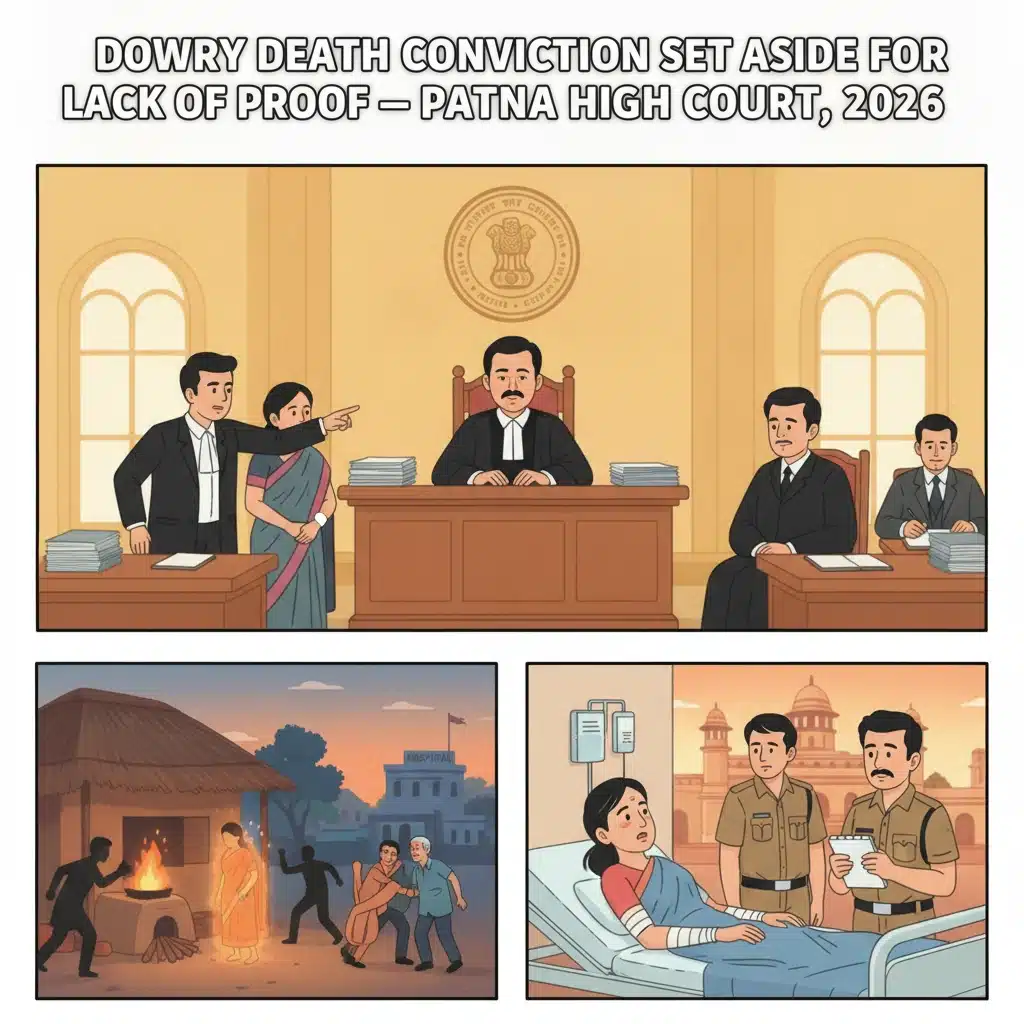
Case Background
The case arose from the death of a young married woman from burns at her matrimonial home in village Imamnagar, under Halsi Police Station, District Lakhisarai.
She had married the appellant about one and a half years before the incident. On 02.11.2017, she suffered burn injuries at night and was first taken to a hospital at Sheikhpura and then referred to Patna Medical College and Hospital (PMCH), Patna, where she died during treatment on 11.11.2017.
On the same day, 11.11.2017, her father gave his fardbayan at PMCH. On its basis, Halsi Police Station Case No. 112 of 2017 was registered on 02.12.2017 under Sections 304-B/34 of the Indian Penal Code (IPC) alleging dowry death.
Police investigated and filed a charge sheet on 31.07.2018 against the appellant and one co-accused under Sections 304-B/506/34 IPC and Section 3/4 of the Dowry Prohibition Act, keeping investigation pending against others. A supplementary charge sheet was later filed on 31.01.2019 against another accused person under the same sections.
Cognizance was taken by the Judicial Magistrate, 1st Class, Lakhisarai, and the cases were committed to the Court of Sessions, giving rise to Sessions Trial No. 23 of 2019 and Sessions Trial No. 60 of 2019, which were later amalgamated.
On 12.03.2019 and 06.05.2019, the Trial Court framed charges against the appellant and co-accused under Sections 304-B read with 149 IPC and 302 read with 149 IPC. The appellant pleaded not guilty and faced trial.
By judgment dated 16.06.2022 and order of sentence dated 18.06.2022, the Additional Sessions Judge-III, Lakhisarai, convicted the appellant under Section 304-B IPC and sentenced him to 10 years’ rigorous imprisonment with fine. Co-accused Rajesh Paswan and Lagni Devi were acquitted on benefit of doubt.
The appellant then filed Criminal Appeal (SJ) No. 2666 of 2022 before the Patna High Court challenging his conviction and sentence.
What the Court Examined and Decided
The Patna High Court, through Hon’ble Mr. Justice Anil Kumar Sinha, examined the entire record: witness statements, medical evidence, investigation steps and the delay in recording the fardbayan.
The defence argued that the Trial Court’s judgment was based on presumption of guilt, not on solid proof. According to the appellant, there were glaring contradictions in prosecution evidence, no reliable proof of demand of dowry, no proof of cruelty “soon before” death, and no clear medical support for the allegation that kerosene was used.
The State argued that the prosecution witnesses supported the case and that the conviction should be maintained.
The High Court first looked closely at the evidence of the informant (PW 2), the deceased’s father. He stated that on 02.11.2017 he was at home when the appellant called and told him to “ask your daughter to mend her behaviour, otherwise he would do it”. About half an hour later, the appellant again called to say that his daughter had been burnt.
PW 2 then contacted a relative living near the appellant’s village and asked him to see his daughter. According to PW 2, this relative saw the deceased rolling on the ground in a burnt condition, after which the appellant took her to Sheikhpura Nursing Home and then to PMCH. PW 2 said he himself went to PMCH after two days and there his daughter allegedly told him that the appellant and several in-laws had poured kerosene and set her on fire. He stated that he gave his fardbayan after her death and identified his signatures on the fardbayan and inquest report.
However, during cross-examination, PW 2 admitted that after getting the news of burning on 02.11.2017, neither he nor any other family member immediately went to the matrimonial house. He also admitted that although he got the information on the date of occurrence, he did not inform the police at that time or on the next day.
The Court noted this conduct as highly unnatural for a father who believes his daughter has been burnt by in-laws, especially when dowry demand and torture are alleged. The Court found it “quite improbable and unbelievable” that despite such serious information, he did not inform the police and only went to see his daughter in PMCH on the third day.
The Court then examined the deposition of PW 1, the deceased’s uncle and brother of PW 2. PW 1 claimed that the deceased used to tell him that her in-laws demanded money and harassed her. He stated that after being informed that she had been burnt and taken to Sheikhpura, he went to Sheikhpura hospital where she allegedly disclosed that her husband (the appellant) and other in-laws burnt her.
PW 1 further said that he, the deceased’s father and one or two women went to the in-laws’ house at night, and later the appellant, informant and others took her from Sheikhpura to PMCH in a Bolero.
The High Court compared this evidence with PW 2’s version and found serious contradictions. PW 2 had clearly stated that neither he nor any family member went to the matrimonial home that night and that he did not go with the deceased to PMCH; according to him, the appellant and his family alone took her to PMCH. These contradictions shook the credibility of both PW 1 and PW 2 on key aspects.
The Court then turned to the independent neighbours.
PW 3, a neighbour of the appellant, deposed that on hearing noise he went to the appellant’s house and saw the appellant’s wife burning. He said the appellant and his father took her to Sheikhpura and then to Patna for better treatment, where she died. Importantly, in cross-examination he stated that when he reached, the appellant and his father were not present in the house and the deceased told them that while cooking on a mud stove with straw, her body caught fire accidentally. He further said relations between the couple were good and there was no dispute.
PW 4, son of PW 3 and also a neighbour, stated that on hearing the commotion he reached the house and saw the deceased burning and screaming, and that the fire had caught while cooking with hay. At the request of the prosecution he was declared hostile, and in cross-examination by the defence he said that at the time of burning the appellant and his family members were not present in the house.
PW 5, the appellant’s brother, initially stated that in the evening he saw the deceased coming out of the house in burnt condition and that her clothes caught fire while cooking with straw. He too was declared hostile by the prosecution.
The High Court noted that PW 3 had not been declared hostile and his version was consistent with his earlier police statement. The Court held that his evidence could not be discarded merely because he was a neighbour of the appellant. His testimony strongly supported the defence version of an accidental kitchen fire.
The medical evidence was then examined. PW 7, the doctor who conducted the post-mortem on the deceased Sulekha Devi, recorded extensive burn injuries over the lower face, neck, chest, abdomen, both upper limbs and part of the thigh. He opined that the burns were ante-mortem, caused by flame, and that death was due to burns and their complications. He preserved hair and body swabs for FSL examination to detect any inflammable substance and handed them to the police.
Crucially, the doctor did not state that kerosene or any specific inflammable liquid had been used. The post-mortem report (Exhibit 5) was proved, but there was no evidence produced about any chemical examination of the preserved samples. Thus, there was no scientific proof that kerosene had been poured on the deceased.
PW 6, the Investigating Officer, stated that he received the fardbayan on 11.11.2017, and registered Halsi P.S. Case No. 112 of 2017 on 02.12.2017. He inspected the place of occurrence, described as the deceased’s brick and asbestos house. In cross-examination, he frankly admitted that he did not find any inflammable substance or smell there, and he did not prepare any sketch map.
He further testified that local witnesses from the vicinity – Dwarika Paswan, Subelal Paswan, Shivnath Mandal and Ramkhelawan Paswan – stated before him that at the time of the incident the deceased was cooking on a straw stove and got burnt during cooking, and that there was no dowry demand from the in-laws’ side. The IO also admitted there was no station diary entry from the date of burning till the deceased’s death, and that no statement of the deceased was recorded at Sheikhpura or PMCH.
The Court stressed that if the deceased had indeed been in a condition to narrate the incident, as claimed by PW 1 and PW 2, it was natural that she would have informed the doctors treating her in Sheikhpura and PMCH over 10–11 days, and that the doctors would have informed the police immediately. The prosecution produced no such medical record or dying declaration. This weakened the prosecution’s claim that she had accused her in-laws.
Considering all this, the Court concluded that the essential ingredients of Section 304-B IPC were not established. In particular, the prosecution failed to prove cruelty or harassment “soon before” death in connection with dowry demand, and failed to show a live and proximate link between such alleged cruelty and the death.
The Court held that the evidence on record was “grossly inadequate” for a criminal conviction and that, at the very least, the appellant was entitled to benefit of doubt. Consequently, the judgment of conviction dated 16.06.2022 and sentence dated 18.06.2022 were set aside. The appellant was acquitted of the charge under Section 304-B IPC and directed to be released forthwith unless required in any other case.
Why This Judgment Matters
This Patna High Court judgment is significant for families involved in dowry death cases and for accused persons alike.
First, it shows that even in serious and sensitive cases like death of a married woman within seven years of marriage, the Court will not uphold a conviction unless the basic legal requirements are strictly proved. Suspicion, delay and contradictory versions are not enough.
Second, the decision underlines that statements made by relatives, if not promptly reported to police or doctors and if contradicted by neutral witnesses, may not be treated as reliable. The Court looked closely at the behaviour of the complainant’s family, the delay of 8–9 days in recording the fardbayan, and the absence of any medical record showing that the deceased blamed her in-laws.
Third, the judgment highlights the importance of independent neighbours and proper investigation. Here, neighbours supported the version of an accidental kitchen fire, and the Investigating Officer confirmed the absence of evidence of kerosene or dowry demand. This helped create reasonable doubt.
For laypersons, the message is that in any suspicious death, especially of a married woman, it is vital to inform the police immediately, insist on proper recording of statements and preserve all possible evidence. For the accused, the case shows that courts will give benefit of doubt where prosecution evidence is weak or inconsistent.
Legal Issues and Answers
-
Issue: Whether the prosecution proved beyond reasonable doubt that the deceased was subjected to cruelty or harassment for dowry soon before her death, so as to sustain the appellant’s conviction under Section 304-B IPC.
Answer: No. The Patna High Court held that the evidence regarding dowry demand, cruelty, and the alleged act of burning was unreliable and contradicted by neighbours and investigation; essential ingredients of Section 304-B IPC were not established, so the appellant was acquitted on benefit of doubt. -
Issue: Whether the deceased’s death could be treated as a homicidal dowry death caused by pouring kerosene and setting her on fire.
Answer: No. The Court found no medical or forensic proof of kerosene use, no inflammable substance at the spot, and credible evidence suggesting accidental burns while cooking; therefore, it was “wholly impossible” to infer a homicidal death with kerosene.
Cases Cited by the Court
- The judgment text, as provided, does not mention or rely on any other specific reported case. No prior judgments are cited.
Case Details
Case Number: Criminal Appeal (SJ) No. 2666 of 2022; arising out of Halsi P.S. Case No. 112 of 2017; Sessions Trial No. 23 of 2019 (amalgamated with Sessions Trial No. 60 of 2019).
Case Title: Mukesh Paswan vs. State of Bihar.
Citation: To be added manually.
Coram: Hon’ble Mr. Justice Anil Kumar Sinha.
Date of High Court Judgment: 12.05.2026 (C.A.V.; CAV date 21.04.2026).
Trial Court Judgment and Sentence: Judgment of conviction dated 16.06.2022 and order of sentence dated 18.06.2022 by Additional Sessions Judge-III, Lakhisarai.
Offences Alleged: Section 304-B IPC initially; charges framed under Sections 304-B/149 and 302/149 IPC; charge sheet also mentioned Section 506/34 IPC and Section 3/4 of the Dowry Prohibition Act.
Final High Court Outcome: Appeal allowed; conviction and sentence under Section 304-B IPC set aside; appellant acquitted on benefit of doubt and directed to be released unless wanted in another case.
Advocates: For the appellant – Ms. Ankita Kumari. For the State – Ms. Anita Kumari Singh.
Nature of Case: Criminal appeal (single judge) against conviction and sentence for dowry death under Section 304-B IPC.
Link to Judgment: To be added manually from the official website of the Patna High Court.
If you found this explanation helpful and wish to stay informed about
how legal developments may affect your rights in Bihar,
you may consider following Samvida Law Associates for more updates.




