

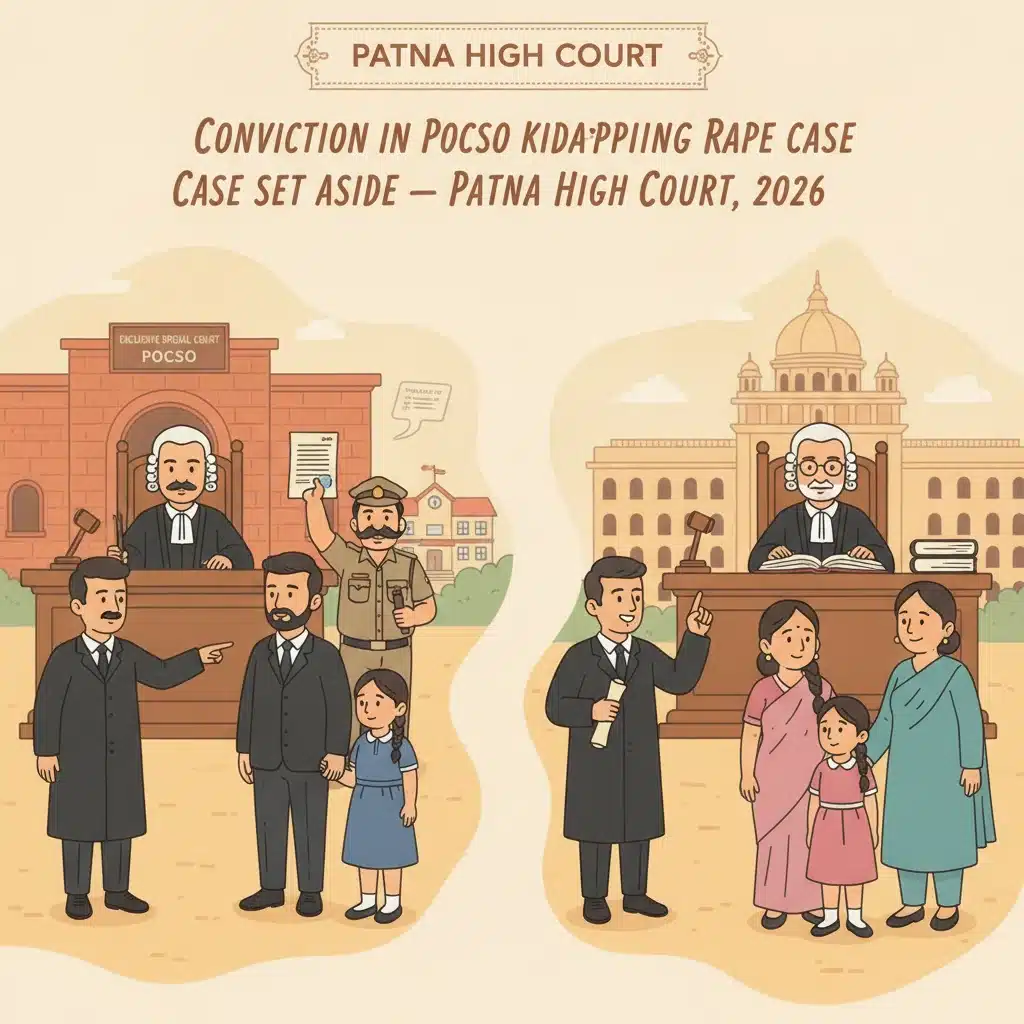
Case Background
The case arose from Sanhaula P.S. Case No. 71 of 2018, Bhagalpur district. The first information was given by the victim’s father (PW-2) through a written application to the Station House Officer, Sanhaula Police Station, on 18.04.2018 at about 9:00 p.m.
He alleged that his minor daughter, around 13 years old, was living with her maternal family at village Dogachhi after the death of his wife. On 17.04.2018, while he was at his native village, he received information that the accused, a co-villager aged about 45 years, had enticed away and kidnapped his daughter with the intention to marry her, with the help of one Purushottam Singh.
According to him, when he rushed to his in-laws’ house at Dogachhi and inquired from his brothers-in-law, they told him that the appellant had taken away his daughter to marry her with the said associate’s assistance. On this basis, Sanhaula P.S. Case No. 71 of 2018 was registered initially under section 366A read with section 34 of the Indian Penal Code.
Later, by order dated 06.08.2018, further sections were added: sections 363, 376 and 327 of the IPC and section 4 of the Protection of Children from Sexual Offences Act, 2012. During investigation, the girl (PW-3) was recovered. Her statements were recorded under sections 161 and 164 of the Code of Criminal Procedure.
After investigation, a chargesheet was filed against the appellant for offences under sections 363, 366A, 376 and 327 read with section 34 of the IPC and section 4 of the POCSO Act. Cognizance was taken, and the Chief Judicial Magistrate, Bhagalpur, committed the case to the Exclusive Special Court (POCSO Act)-cum-Additional District and Sessions Judge, Bhagalpur, for trial.
The appellant was charged under sections 366A, 363/34, 376 and 327 of the IPC and sections 4 and 18 of the POCSO Act. The charges were explained to him in Hindi; he pleaded not guilty and faced trial.
The prosecution examined eight witnesses, including the victim, her father, a maternal uncle, the medical officer, three investigating officers and the school principal who produced her transfer certificate. Certain documents such as the FIR, medical report, statements under section 161 and 164 Cr.P.C., chargesheet and transfer certificate were exhibited.
The trial court mainly relied on the testimony of the victim (PW-3) and convicted the appellant under sections 363 and 376 IPC and section 4 of the POCSO Act, ultimately imposing sentence under section 363 IPC and section 4 POCSO while, in view of section 42 POCSO, not awarding a separate sentence under section 376 IPC. Rigorous imprisonment of three years under section 363 IPC and ten years under section 4 POCSO with fines was imposed, sentences to run concurrently.
Aggrieved, the appellant filed Criminal Appeal (SJ) No. 2433 of 2024 before the Patna High Court. Hon’ble Mr. Justice Shailendra Singh heard the appeal and delivered an oral judgment on 29.06.2026.
What the Court Examined and Decided
Counsel for the appellant argued that the victim was not a “sterling witness” whose testimony alone could sustain conviction for such serious offences. He pointed to material contradictions in her evidence and between her evidence and that of other witnesses. He also questioned the reliability of the FIR, stating that the father (PW-2) was illiterate and had only signed a report drafted by a police official, not knowing its contents. It was further argued that one maternal uncle (PW-4) was wrongly projected as an eye-witness and that important neighbours and relatives were not examined.
The State, through the learned APP, contended that the victim’s evidence was sufficient. It was submitted that she consistently supported the prosecution in her section 164 Cr.P.C. statement and in court and that her version was corroborated by the medical report which noted an abrasion on the outer vaginal orifice.
The High Court first scrutinised the testimony of the informant-father (PW-2). He admitted in cross-examination that he could not read or write, only sign, and that the written report was scribed by a “Bada Babu” (a police official). He did not even know who wrote it and signed only on the direction of this official. The Court found this created doubt about whether the FIR truly reflected his own statement.
There were also inconsistencies about from whom PW-2 first got information. In the FIR he said he was informed by both his brothers-in-law. In his examination-in-chief he said he got information regarding rape from his daughter herself. In cross-examination he said he lodged the FIR on the basis of information from one brother-in-law (PW-4). These changes made his version unreliable as to the source and content of the first information.
The Court then examined the victim’s evidence (PW-3) in detail. She stated that on the date of incident, only she and her maternal grandmother (Nani) were at home; her uncles had gone to a feast. According to her, the appellant along with three associates came, the appellant caught her by the hair, threatened to kill her if she refused to marry him, beat her grandmother, and then took her to a temple near the Geruwa river where he forcibly married her at gunpoint. She then described being taken to Ghogha railway station, then to Ranchi, and being kept in a rented room.
The Court noted that on her own version, the grandmother was a direct eye-witness. However, the grandmother was not examined by the prosecution. No medical record was produced to show that the grandmother, allegedly beaten, had been medically treated. This omission weakened the story about the assault in the house and kidnapping from there.
Her statement also directly contradicted PW-4’s evidence. PW-4, a maternal uncle, claimed that he and his family had gone to sleep after dinner and that the appellant and his associates came armed, beat him, dragged the victim by her hair out of the house, and fired shots on the outskirts of the village. Thus he projected himself as an eye-witness present at the spot. This clashed with PW-3’s version that the uncles were away at a feast at that time and only she and her grandmother were at home.
The High Court treated this as a “serious contradiction” between two core witnesses on the basic question of who was present during the first part of the occurrence. It held that such a contradiction created serious doubt about the overall prosecution story.
The Court also noted investigative lapses. The victim said she had been taken to Ranchi and kept in a rented room for several days. Yet the investigating officer made no effort to trace that place, find the landlord or neighbours, or collect any supporting material. Similarly, though the events in the village allegedly occurred in a locality surrounded by houses of relatives and villagers, none of these neighbours were examined. This failure to collect and produce “best possible” evidence, the Court held, went against the prosecution.
With regard to PW-4, the Court examined his conduct. He said he did not lodge an FIR due to threats from the accused, but later admitted that after the incident and for four years afterwards, the appellant never threatened him. He also said that when the victim came back home on her own, he did not inform the police. The Court found this conduct suspicious and damaging to his credibility. He also claimed to have been beaten with 10–20 blows of a gun butt and treated by a doctor, but no medical record was produced.
A further serious point noted was that the main investigating officer was not examined at all. Because of this, the defence had no chance to cross-examine him on why critical witnesses were not examined, why key places like the Ranchi room or the temple were not properly investigated, and why neighbours were not brought to court. The Court found that this non-examination prejudiced the defence.
Another aspect considered by the Court was the statement of the father (PW-2) during cross-examination that his daughter had been married one year earlier and had a male child aged 5–6 months at that time. The prosecution offered no explanation to counter this statement. The Court referred to this while assessing the overall credibility of the prosecution’s narrative.
Regarding medical evidence, the doctor (PW-5) reported an abrasion on the outer vaginal orifice but categorically admitted that she found no evidence of recent sexual intercourse. The examination took place on 08.05.2018 whereas the alleged incident occurred on 17.04.2018. The Court held that in the absence of clear evidence about what happened in the intervening period, it would be speculative to link the abrasion directly to the alleged sexual assault by the appellant. Therefore the medical report, by itself, could not prove rape beyond reasonable doubt.
The High Court then applied the concept of “sterling witness” as explained by the Supreme Court in Rai Sandeep @ Deepu v. State (NCT of Delhi), (2012) 8 SCC 21. It held that the victim’s testimony, due to inconsistencies and contradictions with other evidence, did not have that high degree of certainty and reliability required to be treated as a sterling witness whose sole word can sustain conviction.
Because of these weaknesses, the Court concluded that the prosecution had failed to establish the basic foundational facts needed to invoke the statutory presumption under section 29 of the POCSO Act. Unless those foundational facts are first proved, the presumption of guilt cannot be raised against the accused. In this case, therefore, the burden could not be shifted to the appellant.
In the end, the Court found that the conviction under section 363 IPC and section 4 POCSO did not inspire confidence. Considering the serious contradictions, lack of reliable supporting evidence, non-examination of key witnesses and investigating officer, and limited value of the medical evidence, it held that the appellant’s guilt had not been proved beyond reasonable doubt.
The Patna High Court therefore set aside the judgment of conviction dated 29.04.2024 and the order of sentence dated 06.05.2024 passed by the Exclusive Special Court (POCSO Act)-cum-7th Additional District and Sessions Judge, Bhagalpur in POCSO Case No. 1720 of 2018 arising out of Sanhaula P.S. Case No. 71 of 2018. The criminal appeal was allowed. As the appellant was in judicial custody, the Court directed that he be released forthwith if not required in any other case. The records were ordered to be sent back to the trial court for necessary compliance.
Why This Judgment Matters
This judgment shows that even in sensitive POCSO cases, where allegations are extremely serious, the Patna High Court insists on strict proof. The Court did not let the gravity of the charge replace the requirement of trustworthy evidence.
For victims and families, it highlights the importance of prompt, consistent statements and supporting witnesses. When key eye-witnesses like a grandmother or neighbours are not examined, courts may find it unsafe to convict.
For police and prosecution, the decision underlines the need for thorough investigation: visiting all relevant places, identifying and examining independent witnesses, and placing all material before the court. Non-examination of the investigating officer can seriously weaken the case.
The judgment also clarifies that the presumption under section 29 of the POCSO Act is not automatic. First, the prosecution must establish a basic, credible story. Only then does the burden shift to the accused. If foundational facts are shaky, as found here, the benefit of doubt will go to the accused.
Legal Issues and Answers
- Issue: Whether the prosecution proved beyond reasonable doubt that the appellant kidnapped and sexually assaulted the minor girl so as to sustain conviction under section 363 IPC and section 4 of the POCSO Act.
Answer: No. The Patna High Court found material contradictions in witness testimonies, non-examination of key witnesses and investigating officer, and inadequate corroboration from medical and other evidence. Hence, conviction was set aside. - Issue: Whether the statutory presumption under section 29 of the POCSO Act could be invoked against the appellant on the facts of this case.
Answer: No. The Court held that the prosecution failed to establish foundational facts due to unreliable and inconsistent evidence. Therefore the presumption under section 29 could not be used, and the burden could not be shifted to the appellant. - Issue: Whether the victim’s evidence in this case could be treated as that of a “sterling witness” sufficient, by itself, to justify conviction.
Answer: No. Relying on the standard laid down in Rai Sandeep @ Deepu v. State (NCT of Delhi), the Court held that her testimony lacked the required consistency and certainty and was contradicted by other evidence.
Cases Cited by the Court
- Rai Sandeep @ Deepu v. State (NCT of Delhi), (2012) 8 SCC 21 – cited on the concept of a “sterling witness”.
Case Details
Case Number: Criminal Appeal (SJ) No. 2433 of 2024; arising out of Sanhaula P.S. Case No. 71 of 2018; POCSO Case No. 1720 of 2018.
Case Title: Pappu Singh v. The State of Bihar & Anr.
Court: High Court of Judicature at Patna.
Coram: Hon’ble Mr. Justice Shailendra Singh.
Date of High Court Judgment: 29.06.2026.
Impugned Judgment and Order: Judgment of conviction dated 29.04.2024 and order of sentence dated 06.05.2024 passed by the Exclusive Special Court (POCSO Act)-cum-7th Additional District & Sessions Judge, Bhagalpur.
Advocates: For the appellant – Mr. Ajay Kumar Thakur, Advocate; Mr. Ranjan Kumar Jha, Advocate; Mr. Rana Pratap Singh, Advocate. For the State – Ms. Anita Kumari Singh, APP.
Statutory Provisions Involved: Sections 363, 366A, 376, 327, 34 of the Indian Penal Code; Sections 4, 18, 29 and 42 of the Protection of Children from Sexual Offences Act, 2012; Sections 161, 164 and 313 of the Code of Criminal Procedure.
Nature of the Case: Criminal appeal (single judge) against conviction and sentence by Special Court under the POCSO Act.
Link to Judgment: https://patnahighcourt.gov.in/viewjudgment/MjQjMjQzMyMyMDI0IzEjTg==-nz7CoTY7TGE=
If you found this explanation helpful and wish to stay informed about
how legal developments may affect your rights in Bihar,
you may consider following Samvida Law Associates for more updates.




