

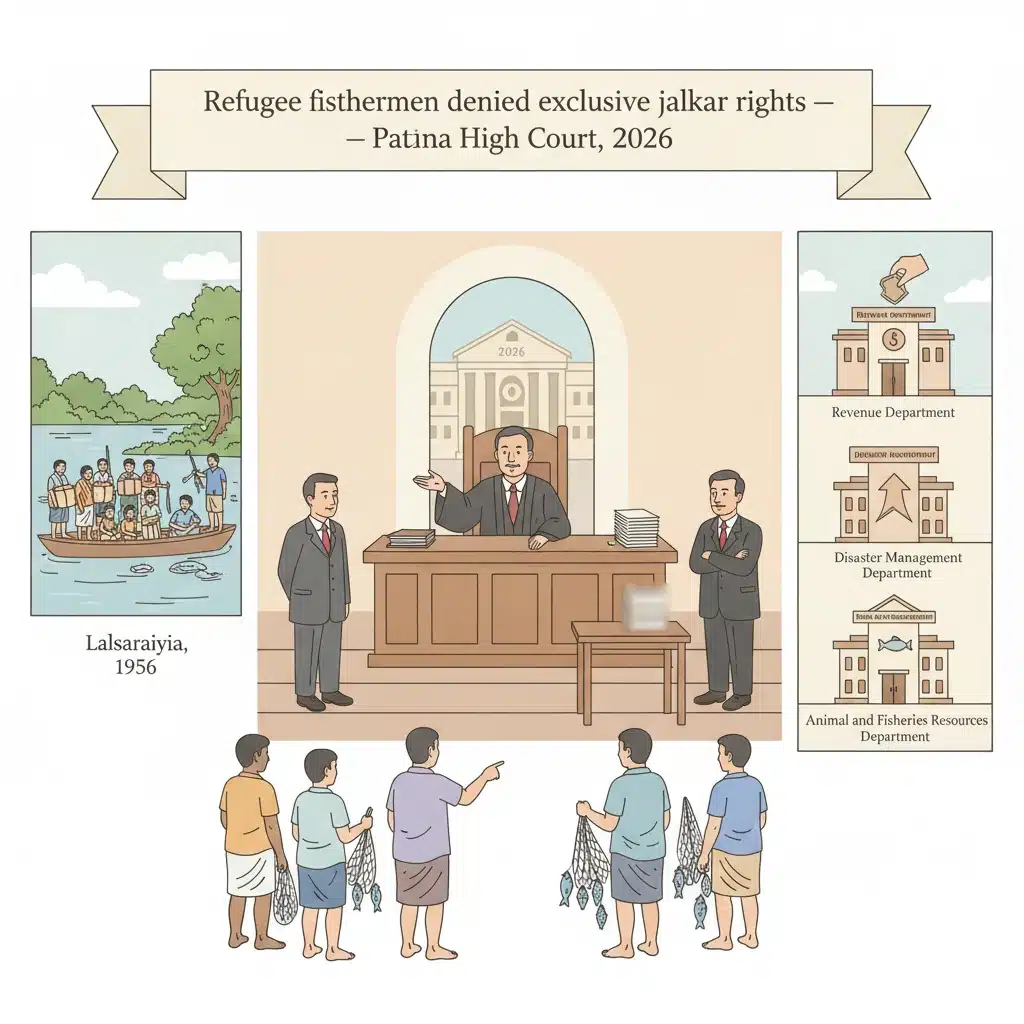
Case Background
This case arises from a long-running dispute over fishing rights in Karmawa Man Jalkar at Lal Saraiya, in Majhaulia Block, West Champaran.
According to the petitioner, his cooperative society is a self-supporting cooperative. The forefathers of its present members were fishermen who migrated from East Pakistan. In 1956, the Ministry of Rehabilitation, Government of India, settled 15 refugee fishermen families at Lalsaraiya Majhauliya Block, Bettiah, West Champaran.
These families were allotted a total of 348.55 acres of Karmawa Man Jalkar for their livelihood. Initially, this settlement was without any payment of rent. Later, the Revenue Department of the Government of Bihar realised that no revenue was coming from this jalkar.
In 1985, and again in 1997, the State decided that the jalkar should be settled on the basis of a fixed reserved jama (rent). The fishermen families collectively paid the reserved jama till the year 2000.
In 2001, the State Government reiterated its intention to settle the jalkar in favour of the 15 refugee fishermen families on a preferential basis. It again fixed reserved jama and directed formation of a cooperative society for them. This government order was challenged in CWJC No. 5608 of 2001.
That earlier writ was disposed of on 22.01.2002. The High Court then only observed that authorities should act reasonably and fairly in fixing the reserved jama so that the refugee fishermen families were not put to undue hardship.
In compliance with the State Government’s directions, the Lal Saraiya Fishermen Refugees Co-operative Society was constituted. Its operation was confined within the limits of Lal Saraiya Man in the Lal Saraiya Refugee Colony, and it could not fish outside that area.
In 2007, the State transferred the jalkar from the Animal and Fisheries Resources Department to the Disaster Management Department. The District Fisheries Officer-cum-Joint Executive Officer, Bettiah, fixed reserved jama at Rs. 42,000/- for 2007–2008. A parwana (settlement order) was issued to the petitioner on 29.03.2008 upon payment of that jama.
Thereafter, the Disaster Management Department increased the reserved jama from Rs. 42,000/- to Rs. 93,960/- for the next five years by Letter No. 143 dated 06.03.2009.
The petitioner’s society claims it repeatedly objected to this steep hike before the Disaster Management Department and the Fisheries Department, but got no relief. It then filed CWJC No. 22265 of 2018 challenging the order dated 06.03.2009.
On 13.01.2021, that writ was disposed of with a direction to the Disaster Management Department to hear the petitioner’s counsel personally and pass an order within 45 days.
In 2022, the jalkar was again transferred back to the Animal and Fisheries Resources Department by Notification No. 1297 dated 29.03.2022. From then onwards, that Department became responsible for settlement of the jalkar.
The petitioner’s society, comprising 116 members fully dependent on fishing income, submitted representations for settlement of the same jalkar in its favour. One representation dated 06.04.2022 was placed on record.
The petitioner alleges that some non-refugee fishermen tried to usurp the settlement rights over the jalkar. According to him, these fishermen illegally asserted dominance and even resorted to physical confrontation when they forcibly undertook fishing in the disputed water body.
Instead of settling the jalkar with the petitioner’s society, the Department issued Letter No. 17959 dated 27.08.2022 to the Secretary, Prakhand Matsyajivi Sahyog Samiti Limited, regarding settlement of this very jalkar. This triggered the present writ petition.
What the Court Examined and Decided
The petitioner asked the Patna High Court to direct the Animal and Fisheries Resources Department to settle Karmawa Man Jalkar at Lal Saraiya in favour of his cooperative society.
He relied mainly on three sets of facts: the 1956 refugee settlement; two later executive communications of 1995 and 2001 giving them preference; and earlier settlements and payments of reserved jama, including the 2007–2008 settlement.
The petitioner argued that his forefathers were refugees from East Pakistan, settled by the Government of India, and that the jalkar was the only livelihood of these families for more than 50 years. He claimed the State had historically recognised their preferential claim, and that the society was ready to pay all past dues as per the Bihar Fish Jalkar Water Management Act, 2006.
He further complained that, despite the High Court’s earlier direction to act fairly, the authorities had transferred the jalkar to another body, thereby frustrating his legitimate expectation of continued settlement.
On the other side, the State, through the District Fisheries Officer, Bettiah, gave a different picture. It stated that a competent committee headed by the Deputy Director, Fisheries, fixed the reserved jama on 02.09.2022 for the settlement of Karmawa Man Jalkar at Lal Saraiya.
The State’s stand was that, under the Bihar Jalkar Management Act, 2006, as amended in 2007, 2010 and 2018, the jalkar had been settled with the Fisheries Cooperative Society in 2010. It was noted that the petitioner’s cooperative had not been merged with the Fisheries Society between 1955 and 2010.
Since, under the scheme, there can be only one fishermen cooperative society per block, the State argued that the petitioner’s society had no right to demand jalkar settlement in its own name. Its members, the State claimed, had been fishing without legal right or title.
During the writ proceedings, an interlocutory application (I.A. No. 2 of 2022) was filed by two interveners, who described themselves as Secretary-cum-Treasurer and Chairman of Majhaulia Prakhand Matsyajivi Sahyog Samiti Limited. They were added as respondent nos. 8 and 9.
These interveners argued that the petitioner’s society, Lal Saraiya Fishermen Refugees Co-operative Society, no longer existed from 2010 onwards. They relied on Section 11-B of the Bihar Cooperative Societies Act, 1933 (inserted by Act 22 of 2010).
Section 11-B provides that all jalkar societies at block level shall stand merged into one cooperative society, for which the Registrar, Cooperative Societies, will issue registration. Existing self-supporting societies under the Bihar Self-Supporting Cooperative Societies Act, 1996 would automatically become members of this reorganised block-level society.
Based on this, the interveners stated that only one fishermen cooperative—Majhauliya Prakhand Matsyajivi Sahyog Samiti Limited—has existed in that block since 2010. They also stated that the District Fisheries Officer-cum-Chief Executive Officer had informed the Joint Director of Fisheries, Patna, about illegal occupation of the jalkar by others.
According to them, Karmawa Man Jalkar at Lal Saraiya, Majhaulia, had already been allotted to their society for the period 2022–23 to 2026–27.
After hearing both sides, the Patna High Court focused on a central legal question: did the petitioner have any enforceable legal right which the Court could protect through a writ of mandamus?
The Court reiterated that a writ of mandamus can be issued only if two conditions are met: the petitioner must show a subsisting legal right, and the respondent must have a corresponding statutory or public duty. Without this, the High Court cannot compel the State to act in a particular way.
To support this, the Court cited the Supreme Court decision in Union of India & Anr. v. S.B. Vohra & Ors., (2004) 2 SCC 150, where it was held that mandamus lies only when a legal right and a corresponding legal duty are clearly established.
In this case, the Court found that the petitioner had not pointed out any statutory provision giving him a legal right to insist on settlement of the jalkar in his favour. His claim was based mainly on past settlements and executive communications.
The Court held that the 1956 settlement and the later government letters of 1995 and 2001 were only executive decisions. They did not create a perpetual, never-ending right to settlement of the jalkar, especially when there are governing statutory provisions like the Bihar Jalkar Management Act, 2006 and the Bihar Cooperative Societies Act, 1933.
The Court also noted that the settlement given to the petitioner in 2007–2008 was for a fixed period, dependent on payment of reserve jama. Once that period expired, the settlement ended by efflux of time. It did not create any automatic right for renewal or fresh settlement in favour of the petitioner.
On this point, the Court relied on the Supreme Court judgment in State of U.P. & Ors. v. Lalji Tandon (Dead) through LRs, (2004) 1 SCC 1, which holds that renewal of a lease or licence is a fresh grant. There is no vested right to renewal unless the law itself clearly provides for it.
The Court then examined the argument that, because the petitioner is a refugee and had enjoyed past preference, he should continue to get special treatment. It rejected this, emphasising that the jalkar is government property and its settlement must comply with Article 14 of the Constitution.
For this proposition, the Court referred to Akhil Bhartiya Upbhokta Congress v. State of Madhya Pradesh & Ors., (2011) 5 SCC 29. That decision warns that State property cannot be distributed arbitrarily or as largesse at the “sweet will and whims” of officials. Any such distribution must be under a clear, transparent, non-discriminatory policy.
The Patna High Court reproduced paragraph 65 of that judgment, stressing that allotments like land, quotas, permits or licences must be made fairly, without favouritism or nepotism, and according to a publicly known policy.
Given that Karmawa Man Jalkar is undisputedly a government property, its settlement must follow the statutory rules and constitutional requirements of fairness and equality. The Court said it cannot direct allotment of the jalkar to any particular person or society contrary to law.
The petitioner had also relied on executive instructions and earlier High Court orders that asked authorities to act fairly or to consider his representations. The Court clarified that such directions do not themselves create a substantive right to settlement.
To reinforce this, the Court cited Sant Ram Sharma v. State of Rajasthan & Ors., AIR 1967 SC 1910, which holds that executive instructions cannot override statutory rules and generally do not create enforceable rights.
Lastly, the Court noted that during the pendency of this writ, the Department had already written to the Secretary of the block-level fishermen cooperative (respondent no. 8) regarding settlement of the disputed jalkar. The law meanwhile provides for a single cooperative society at the block level.
On this entire material, the Court concluded that the petitioner’s society had failed to show any legal or statutory right to demand settlement of Karmawa Man Jalkar in its own favour. Without such a right, the High Court could not interfere.
Accordingly, the writ application was dismissed, with a clear finding that there was no merit in the petition and no ground to exercise powers under Article 226 of the Constitution.
Why This Judgment Matters
This judgment is important for fishermen communities and cooperative societies in Bihar who depend on government jalkars for livelihood.
The Patna High Court has made it clear that even long-standing use of a jalkar, refugee status, or old government favours do not by themselves give a permanent right to settlement.
Once a time-bound settlement expires, there is no automatic right to renewal unless a statute specifically grants it. Settlement of jalkars must follow current laws and policies, including provisions that allow only one block-level fishermen cooperative.
The judgment also sends a message that courts will not force the State to allot public resources to any particular group merely on grounds of sympathy or past practice. Decisions must comply with statutes and Article 14 of the Constitution.
Legal Issues and Answers
- Issue: Does a refugee fishermen cooperative have a legal right to insist that a government jalkar be settled with it on a preferential basis, based on past settlements and executive communications?
Answer: No. The Court held that past settlements and executive letters do not create a perpetual or enforceable legal right to demand settlement, particularly when statutory provisions now govern the field. - Issue: Can the High Court issue a writ of mandamus directing the State to settle a specific jalkar with the petitioner society?
Answer: No. Since the petitioner failed to show any subsisting legal or statutory right and the State had no corresponding legal duty towards him, no mandamus could be issued. - Issue: Does earlier use of a jalkar or a previous time-bound settlement create a vested right to renewal or fresh settlement?
Answer: No. Relying on Supreme Court precedent, the Court held that renewal is a fresh grant, and there is no vested right to renewal unless the statute provides for it.
Cases Cited by the Court
- Union of India & Anr. v. S.B. Vohra & Ors., (2004) 2 SCC 150 – on the requirement of a subsisting legal right and corresponding legal duty for mandamus.
- State of U.P. & Ors. v. Lalji Tandon (Dead) through LRs, (2004) 1 SCC 1 – on renewal being a fresh grant and absence of vested right to renewal.
- Akhil Bhartiya Upbhokta Congress v. State of Madhya Pradesh & Ors., (2011) 5 SCC 29 – on non-arbitrary distribution of State largesse and the need for transparent policy.
- Sant Ram Sharma v. State of Rajasthan & Ors., AIR 1967 SC 1910 – on executive instructions not overriding statutory rules and ordinarily not creating enforceable rights.
Case Details
Case Number: Civil Writ Jurisdiction Case No. 11809 of 2022
Case Title: Ramesh Kumar Malo v. The State of Bihar & Ors.
Coram: Hon’ble Mr. Justice Sourendra Pandey
Citation: 2026 (4) PLJR 474
Date of Judgment: 03-07-2026
Court: High Court of Judicature at Patna
Advocates:
- For the petitioner: Mr. Ankit Katriar, Advocate
- For respondent nos. 8 & 9: Mr. Mukesh Kumar, Advocate; Mr. Krishna Chandra Ojha, Advocate
- For the State: Mr. Sajid Salim Khan, SC-25
Nature of the case: Writ petition under Article 226 of the Constitution seeking mandamus for settlement of a government jalkar in favour of a refugee fishermen cooperative society.
Link to full judgment: https://patnahighcourt.gov.in/viewjudgment/MTUjMTE4MDkjMjAyMiMxI04=-MIWSu5ZrDzc=
If you found this explanation helpful and wish to stay informed about
how legal developments may affect your rights in Bihar,
you may consider following Samvida Law Associates for more updates.




