

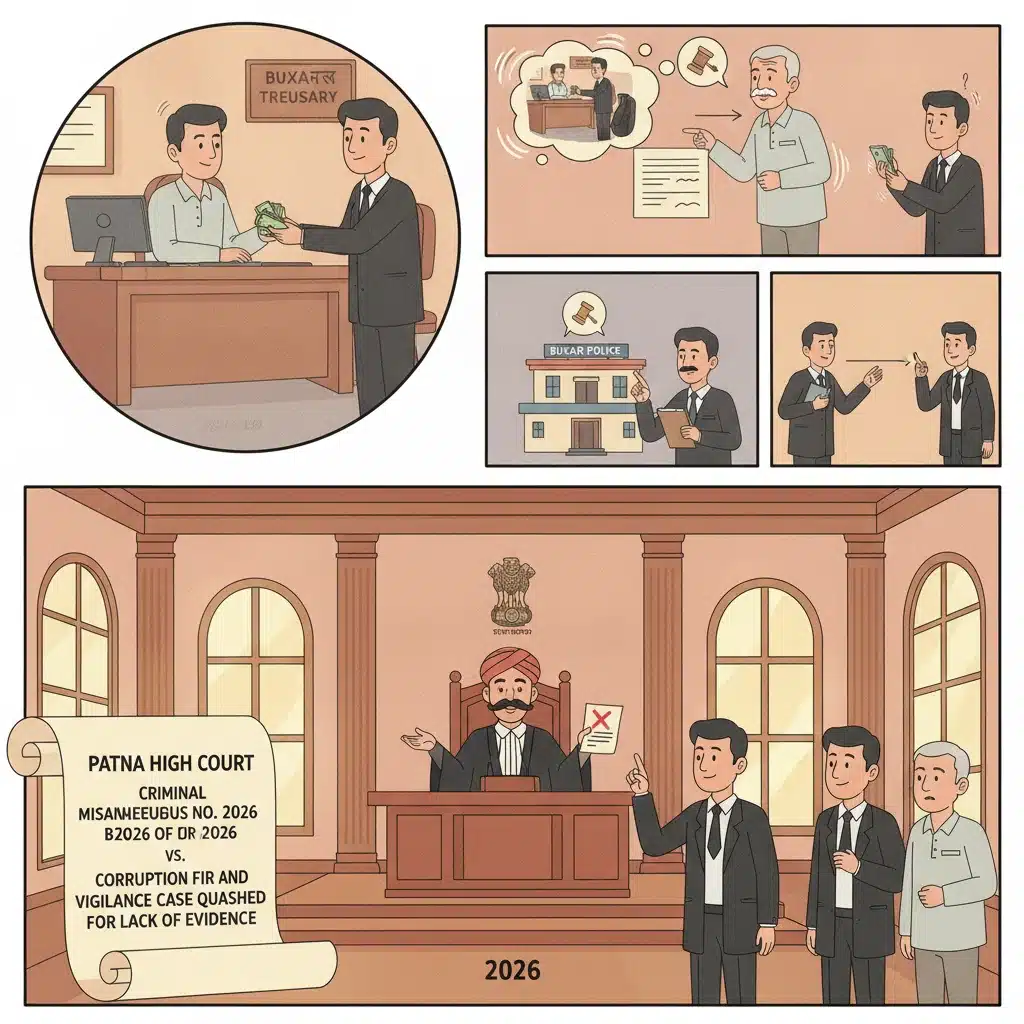
The Court found that no witness supported the allegation of bribe and the investigation had dragged on for nearly six years without progress.
It quashed the FIR and the entire vigilance case, calling further proceedings an abuse of process.
The criminal case against the petitioner now comes to an end.
Case Background
The petitioner, Ratneshwar Kumar, was working as a Data Entry Operator (Grade-A) at the Buxar Treasury. He has since been dismissed from service.
On 22.07.2020, a pensioner, Saryu Ojha, went to the Treasury and received his pension on the same day. This visit and the events around it are at the centre of the case.
Importantly, no complaint was made on or near 22.07.2020. No FIR was lodged on that date alleging demand or taking of any bribe.
More than a month later, on 28.08.2020, a video surfaced on social media. It appeared to show the petitioner receiving money from pensioner Saryu Ojha inside the Treasury.
The District Magistrate, Buxar, noticed this viral video. He directed the Additional Collector, Buxar, to conduct an inquiry into the incident.
After inquiry, the Additional Collector gave an adverse finding against the petitioner through letter No. 10-3228 dated 04.09.2020. He recommended that a criminal case be registered.
On this basis, the Senior Treasury Officer, Ajmal Ali Ansari, sent a written complaint (letter No. 180438 dated 05.09.2020) to the Station House Officer, Town Police Station, Buxar.
Acting on that complaint, Buxar (Town) PS Case No. 389 of 2020 was registered on 05.09.2020 under Sections 7, 8 and 9 of the Prevention of Corruption Act, 1988. The investigation was entrusted to CI Mukesh Kumar Shree.
A Special Case, numbered 22 of 2020, was initiated before the Special Judge, Vigilance, Patna on the basis of this FIR. Over time, however, the investigation did not move forward towards chargesheet or trial.
The petitioner approached the Patna High Court through Criminal Miscellaneous No. 53270 of 2023 seeking quashing of the FIR and all criminal proceedings arising from it. The matter was heard by Hon’ble Mr. Justice Ansul, who delivered a CAV judgment on 24.06.2026.
What the Court Examined and Decided
The Court first looked closely at the FIR itself, which was on record as Annexure-1. It noted several key gaps in the basic allegations.
The FIR did not mention any specific demand by the petitioner for a bribe. It did not identify any particular occasion of acceptance of illegal money.
No exact amount was described in the FIR as a bribe. No specific time or place where illegal gratification was allegedly exchanged was mentioned. The only clear date in the FIR was 28.08.2020, which was actually the date on which the video went viral, not the date of pension payment.
The complainant in the FIR was the Senior Treasury Officer, Ajmal Ali Ansari. He was the superior officer of the petitioner but he was not present at the alleged place of occurrence where the transaction between the petitioner and the pensioner supposedly took place.
The alleged offences were under Sections 7, 8, and 9 of the Prevention of Corruption Act, 1988. The Court explained that these provisions require, at the very starting point, clear proof that a public servant accepted or obtained an “undue advantage” (illegal benefit) from an identifiable person.
Here, the only alleged source of any money was the pensioner, Saryu Ojha. Therefore, what he told the police during investigation became crucial.
The investigating agency recorded the statement of Saryu Ojha. The Court examined this statement. Saryu Ojha, the very person said to have paid the alleged bribe, stated that he had no recollection of having paid any illegal gratification to the petitioner.
According to the Court, without his testimony saying that a bribe was paid, the basic ingredient of the offences under the Prevention of Corruption Act simply did not arise. The Court remarked that the case against the petitioner “begins and ends with Saryu Ojha” and his statement did not support the prosecution.
The Court then turned to the role of the viral video and the statement of the person who recorded and shared it, Ujjawal Ojha, the grandson of the pensioner.
Ujjawal Ojha gave a written statement to the Police Inspector, Town Anchal, Buxar. As per the record considered by the Court, he stated that his grandfather had given a total amount of Rs. 8,000/-. Out of this, Rs. 500/- was given to the petitioner towards petrol and vehicle hire charges.
He clearly stated that no illegal gratification was paid to the petitioner. He further clarified that the video had been made due to a misunderstanding.
The police also recorded the statements of Shrikant Ojha and Ramakant Ojha, both sons of Saryu Ojha. They too stated that their father had not paid any illegal gratification. According to them, whatever money changed hands was only for transport expenses.
On this basis, the Court concluded that there was not a single person with direct knowledge of the events of 22.07.2020 who supported the allegation that any bribe had been paid. The entire prosecution rested on the video, and the person who made that video had retracted any suggestion of bribery.
The Court then referred to the guiding Supreme Court judgment in State of Haryana v. Bhajan Lal, 1992 Supp. (1) SCC 335. Bhajan Lal had laid down categories of cases where the High Court can use its inherent powers under Section 482 CrPC to quash criminal proceedings.
Two such categories applied here: first, where the uncontroverted allegations in the FIR and the evidence collected do not disclose any offence or make out a case against the accused; and second, where continuing the proceedings would amount to abuse of the process of the court.
The Court also cited Manoj Kumar Sharma v. State of Chhattisgarh, (2016) 9 SCC 1. There, the Supreme Court noted that when allegations in the FIR are inherently improbable and the supporting evidence does not show any offence, the case can be quashed. The Patna High Court found the same situation in the present matter.
After dealing with the lack of substantive evidence, the Court moved to an independent but equally serious concern: the delay in investigation.
The FIR had been registered on 05.09.2020. The Court’s decision came on 24.06.2026, and the Court noted that as of 23.06.2026, nearly five years and ten months had gone by.
Despite this long period, the pen drive containing the viral video, which was the sole material evidence, had not been sent for Forensic Science Laboratory examination.
No chargesheet had been filed. No charge had been framed by the Special Judge, Vigilance, Patna in Special Case No. 22 of 2020. An earlier order dated 12.05.2023 of the Special Judge, produced as Annexure-2, showed that even after almost three years from the FIR, the final form of the investigation had not been submitted.
When the matter was taken up earlier by the High Court, the SDPO appeared and said that the pen drive had been acquired. But he offered no explanation for the long, inactive investigation of five years and ten months.
The Court emphasised that the constitutional right to a speedy trial in criminal matters is not limited to the court trial alone. It also fully covers the period of police investigation.
For this principle, the Court relied on the Full Bench judgment of the Patna High Court in Madheshwardhari Singh v. State of Bihar, AIR 1986 Patna 324. There, it was directly held that the right to a speedy public trial applies not only to court proceedings but also to the preceding police investigation.
The Full Bench further held that an “outer time limit” of seven years, in the absence of fault of the accused or special reasons, marks a point beyond which delay in investigation and trial violates Article 21 of the Constitution. After such a delay, prejudice to the accused is presumed and the burden shifts heavily to the State.
The present case involved delay less than seven years, but still nearly six years with virtually no progress. The Court noted that even shorter delays can amount to prejudice depending on the circumstances. Here, there was prolonged inaction with no justification, while the petitioner remained present and did not cause any delay.
To support the broader constitutional principle, the Court cited several Supreme Court decisions starting from Maneka Gandhi v. Union of India, (1978) 1 SCC 248, which held that any procedure under Article 21 must be “reasonable, fair and just.”
Building on this, Hussainara Khatoon v. Home Secretary, State of Bihar, (1980) 1 SCC 81 held that a procedure which does not ensure a reasonably quick trial is not fair or just and violates Article 21. It also held that the State cannot excuse delay by pleading lack of financial resources.
The Constitution Bench judgment in Abdul Rehman Antulay v. R.S. Nayak, (1992) 1 SCC 225, crystallised the law: the right to speedy trial flows from Article 21 and covers all stages, including investigation. Generally, if this right is violated, charges should be quashed.
Applying these principles specifically to corruption cases from Bihar, the Court referred to:
(i) Mahendra Lal Das v. State of Bihar, (2002) 1 SCC 149, which said that corruption cases must be dealt with swiftly and that investigation cannot be prolonged indefinitely.
(ii) Ramanand Chaudhary v. State of Bihar, (2002) 1 SCC 153, where prosecution was quashed after long delays turned it into a travesty of justice.
(iii) Vakil Prasad Singh v. State of Bihar, (2009) 3 SCC 355, where the Supreme Court repeated that violation of the right to speedy trial can justify quashing.
(iv) The recent decision in Robert Lalchungnunga Chongthu v. State of Bihar, 2025 INSC 1339, decided on 20.11.2025, which clearly held that investigation itself falls within the right to speedy trial and violation of this right can strike at the root of the investigation, leading to its quashing.
The Court also acknowledged the caution expressed in Superintendent of Police, Karnataka Lokayukta v. B. Srinivas, (2008) 8 SCC 580, that mere delay in investigation is not, by itself, a universal ground for quashing and each case must be decided on its facts.
However, in this case, the Court emphasised that its decision rested not only on delay but “with equal force” on the merits. The evidence collected did not make out any offence under Sections 7, 8 and 9 of the Prevention of Corruption Act against the petitioner.
The Court held that the delay was entirely attributable to the investigating agency. The petitioner had not absconded or caused delay. No extraordinary or exceptional reason was shown by the State to explain the long inaction. The burden placed on the State by the Full Bench in Madheshwardhari Singh was not discharged.
In the final result, the petition was allowed. The Patna High Court quashed the FIR in Buxar (Town) PS Case No. 389 of 2020 dated 05.09.2020 under Sections 7, 8 and 9 of the Prevention of Corruption Act, 1988, and all proceedings of Special Case No. 22 of 2020 pending before the Special Judge, Vigilance, Patna. The petition was disposed of accordingly.
Why This Judgment Matters
This judgment is important for public servants, pensioners, and ordinary citizens who may get caught in corruption cases based only on videos or social media posts.
The Patna High Court has made it clear that a corruption case cannot stand if the main witnesses themselves deny paying any bribe and say that money was exchanged only for legitimate reasons like transport expenses.
It also shows that the police cannot keep a person under the shadow of a corruption case for years without sending key evidence for forensic testing, without filing chargesheet, and without moving the case towards trial.
The Court has reinforced that the right to a speedy trial under Article 21 covers not just the court stage but also the police investigation. Long, unexplained delay by the investigating agency can make the entire prosecution an abuse of process.
For accused persons facing similar long-pending cases, this judgment signals that they can approach the High Court if there is no real evidence and the investigation has been kept pending for years without valid reason.
Legal Issues and Answers
- Issue: Whether the FIR and vigilance case for alleged corruption against the petitioner disclosed any offence under Sections 7, 8 and 9 of the Prevention of Corruption Act, 1988.
Answer: No. The FIR lacked specific details of demand or acceptance of bribe, and every material witness, including the alleged payer and the maker of the video, denied any illegal gratification, so no offence was made out. - Issue: Whether nearly six years of inactive investigation without chargesheet or forensic examination violated the petitioner’s right to speedy trial and justified quashing the case.
Answer: Yes. The prolonged and unexplained delay attributable solely to the investigating agency infringed the right to speedy trial under Article 21 and, together with lack of evidence, warranted quashing of the FIR and proceedings.
Cases Cited by the Court
- State of Haryana v. Bhajan Lal, 1992 Supp. (1) SCC 335
- Manoj Kumar Sharma v. State of Chhattisgarh, (2016) 9 SCC 1
- Madheshwardhari Singh v. State of Bihar, AIR 1986 Patna 324 (Full Bench, Patna High Court)
- Maneka Gandhi v. Union of India, (1978) 1 SCC 248
- Hussainara Khatoon v. Home Secretary, State of Bihar, (1980) 1 SCC 81
- Abdul Rehman Antulay v. R.S. Nayak, (1992) 1 SCC 225
- Mahendra Lal Das v. State of Bihar, (2002) 1 SCC 149
- Ramanand Chaudhary v. State of Bihar, (2002) 1 SCC 153
- Vakil Prasad Singh v. State of Bihar, (2009) 3 SCC 355
- Robert Lalchungnunga Chongthu v. State of Bihar, 2025 INSC 1339 (decided on 20.11.2025)
- Superintendent of Police, Karnataka Lokayukta v. B. Srinivas, (2008) 8 SCC 580
Case Details
Case Number: Criminal Miscellaneous No. 53270 of 2023; arising out of Buxar (Town) PS Case No. 389 of 2020; Special Case No. 22 of 2020 (Vigilance)
Case Title: Ratneshwar Kumar v. The State of Bihar & Ors.
Coram: Hon’ble Mr. Justice Ansul
Citation: 2026 (4) PLJR 618
Advocates: Mr. Abhash Ad., Advocate for the petitioner; Mr. Jai Narain Thakur, SPP (Vigilance) for the State
Nature of the Case: Petition under Section 482 CrPC (criminal miscellaneous) seeking quashing of FIR and related vigilance proceedings under the Prevention of Corruption Act
Date of Judgment: 24.06.2026 (CAV; CAV date 23.06.2026)
Link to Judgment: https://patnahighcourt.gov.in/viewjudgment/NiM1MzI3MCMyMDIzIzEjTg==-pjARgeUFrkw=
If you found this explanation helpful and wish to stay informed about how legal developments may affect your rights in Bihar, you may consider following Samvida Law Associates for more updates.




