

Case Background
The appellant is an employee of the Border Security Force (BSF). He joined service on 28.08.1994.
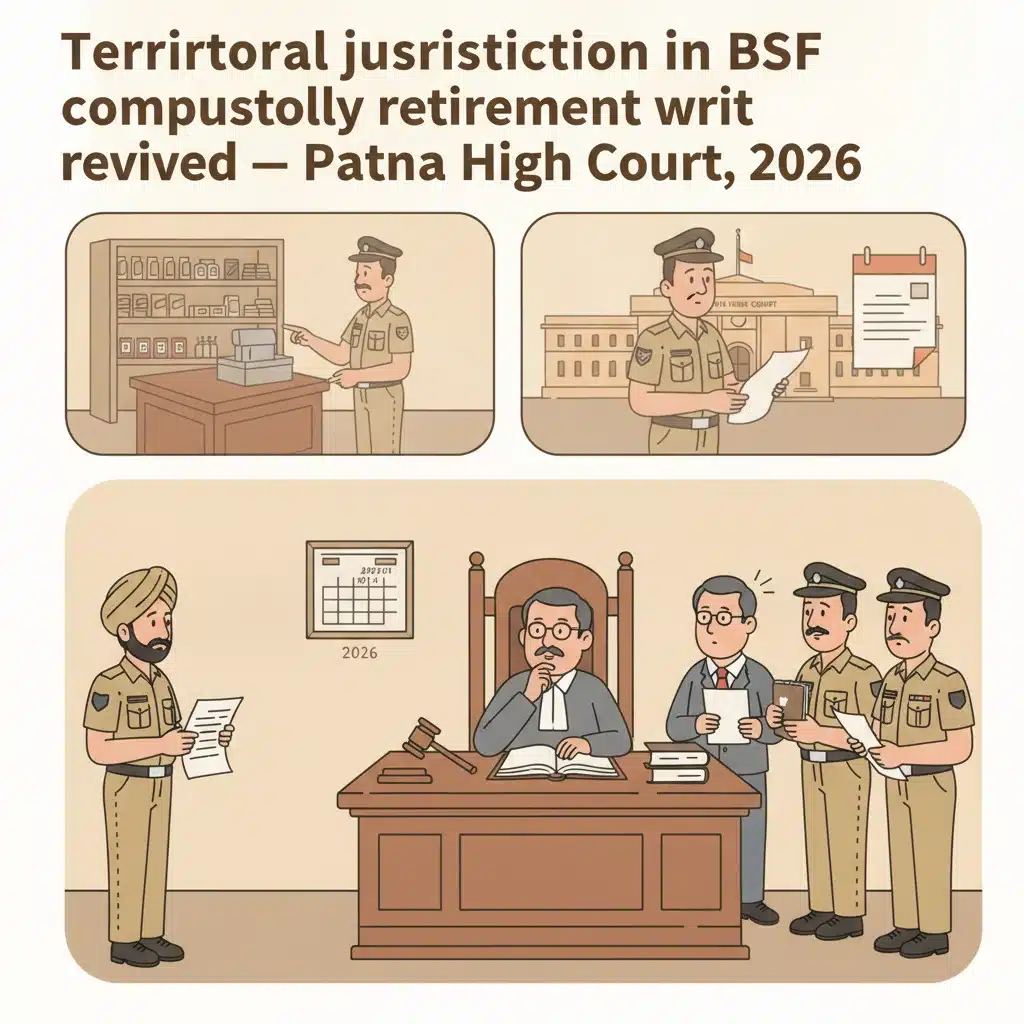
According to him, trouble began while he was posted in 53 Battalion, BSF. He claimed he pointed out irregularities in the unit canteen. He alleged that, in retaliation, the Commandant (arrayed as respondent no. 6) imposed a seven-day penalty on him.
The appellant challenged that penalty before a higher authority, the D.G. Command, Frontier Headquarters, BSF (respondent no. 3). By order dated 25.08.2012, this higher authority set aside the penalty.
After this, the appellant claimed that respondent no. 6 continued to harass him. He submitted a representation dated 24.10.2019 complaining of such harassment.
Soon thereafter, he received a final show-cause notice dated 13.11.2019 from respondent no. 6, proposing his retirement under the BSF Rules, 1969. The appellant wrote multiple communications to different BSF authorities, alleging that the actions against him were illegal and arbitrary.
With no relief from departmental authorities, the appellant approached the Delhi High Court by filing Writ Petition (Civil) No. 455 of 2021 on 11.01.2021. On 19.01.2021, the Delhi High Court disposed of that writ petition directing the respondents to give him a copy of the Inquiry Officer’s report and to process his medical bills within two weeks.
Despite that direction, the appellant alleged that the authorities did not comply. Instead, another show-cause notice dated 11.06.2021 was issued proposing his retirement on the ground of unsuitability and alleging poor performance.
The appellant replied to this show-cause notice. However, on 10.07.2021, the Commandant, 53 Battalion BSF at COB, Phulpar, District Kanker (Chhattisgarh) issued Memo No. 8302-13, compulsorily retiring him from service with effect from 31.07.2021. This was done under Rule 26 of the Border Security Force Rules, 1969 read with Rule 40 of the Central Civil Services (Pension) Rules, 1972.
The appellant filed an appeal before the Director General, BSF on 27.07.2021. By order dated 31.01.2022, this appeal was rejected. The appellant says he was thereby “forcefully” retired from 31.07.2021.
He then filed Civil Writ Jurisdiction Case No. 9289 of 2022 before the Patna High Court challenging the compulsory retirement order dated 10.07.2021 and the appellate order dated 31.01.2022, and seeking reinstatement with full pensionary benefits.
The learned Single Judge of the Patna High Court disposed of this writ petition by order dated 31.01.2026. The Single Judge held that the cause of action related to the petitioner had arisen in the State of Chhattisgarh and, therefore, the Patna High Court lacked territorial jurisdiction. Liberty was given to the petitioner to approach the competent court in Chhattisgarh within 90 days.
Aggrieved, the appellant filed the present Letters Patent Appeal (LPA No. 155 of 2026), not to argue the merits of his compulsory retirement, but to challenge the finding that the Patna High Court had no jurisdiction.
What the Court Examined and Decided
The Division Bench, consisting of Hon’ble the Chief Justice and Hon’ble Justice Smt. Soni Shrivastava, focused on a narrow but crucial question: did the Patna High Court have territorial jurisdiction to hear the appellant’s writ petition?
The appellant’s counsel made it clear that the appeal did not question the merits of the compulsory retirement. The grievance was only against the Single Judge’s conclusion that the entire cause of action arose in Chhattisgarh.
To support his case, the appellant’s counsel relied heavily on earlier judgments, especially:
1. A judgment of the Patna High Court in L.P.A. No. 384 of 2002, Rameshwar Prasad vs. The Union of India and others, reported in 2003 (2) PLJR 151.
2. The Supreme Court decision in Civil Appeal No. 3630 of 2020, Shanti Devi @ Shanti Mishra vs. Union of India and others.
In Rameshwar Prasad, the Patna High Court had held that an order of dismissal becomes effective only when it is communicated or made known to the person concerned. In that case, although the dismissal was ordered in Srinagar and New Delhi, it was sent by post and served at the employee’s village in Bihar. The Court held that, as the order became known to him in Bihar, part of the cause of action arose in Bihar and the Patna High Court had jurisdiction.
In Shanti Devi, the Supreme Court was dealing with a similar jurisdiction issue in a case arising from the Patna High Court. The Supreme Court held that both the Single Judge and the Division Bench of the Patna High Court had erred in dismissing the writ petition for lack of territorial jurisdiction. It noted that they had failed to consider an earlier Patna High Court judgment in Saryu Singh vs. Union of India and others, reported in 2015 (2) PLJR 256. The Supreme Court revived the writ petition before the Patna High Court.
The appellant’s counsel argued that these decisions showed that when an order is communicated to a person at his home in Bihar, or when representations and replies are exchanged with him at his Bihar address, part of the cause of action can be said to arise in Bihar. Therefore, the Patna High Court could hear his case.
The Division Bench then turned to the text of Article 226(2) of the Constitution of India. This provision allows a High Court to issue writs if the cause of action arises, wholly or in part, within its territorial jurisdiction, even if the government or authority against whom the writ is sought is located elsewhere.
The Bench explained that Article 226(2) was inserted by the Constitution (Fifteenth Amendment) in 1963 and later renumbered by the 42nd Amendment in 1976. The purpose was to allow High Courts to entertain writs where even a part of the cause of action fell within their territory, regardless of where the authority is seated.
The Court referred to the Supreme Court judgment in Kusum Ingots and Alloys Ltd. vs. Union of India and another, (2004) 6 SCC 254. In that case, the Supreme Court held that though Section 20(c) of the Code of Civil Procedure does not directly apply to writ petitions, the language of Section 20(c) CPC and Article 226(2) is similar. Therefore, principles developed under Section 20(c) on “cause of action” apply to writ cases as well. Even a small fraction of the cause of action is enough to confer jurisdiction.
The Bench then cited Kunjan Nair Sivaraman Nair vs. Narayanan Nair and others, (2004) 3 SCC 277. The Supreme Court there explained “cause of action” using Halsbury’s Laws of England: it means every fact necessary for the plaintiff to prove, if contested, to obtain a judgment. It is not just each piece of evidence but the essential facts that give rise to a legal claim.
The Patna High Court further relied on another Supreme Court decision, Nawal Kishore Sharma vs. Union of India and others, (2014) 9 SCC 329. In that case, a seaman’s registration was cancelled and the cancellation order was sent to his address in Gaya, Bihar. All his representations and the employer’s replies were exchanged at that address. The Supreme Court held that part of the cause of action arose in Bihar and the writ should not have been dismissed for lack of territorial jurisdiction.
After setting out this legal position, the Division Bench examined the facts of the present case closely.
It noted that Annexure-10 in the writ petition was a representation dated 13.09.2021 sent by the appellant from his native place in Bihar to the Director General, BSF in New Delhi. In reply, the Director General, BSF sent a communication (marked as Annexure-R-7) to the appellant at his address in Saharsa, Bihar.
Further, the Court observed that the Assistant Commandant, BSF had also written a letter to the appellant dated 08.06.2022 (Annexure-R-8). In this letter, the authority refused to reinstate him, stating that his representation lacked merit. This letter too was addressed to him at his Bihar address.
Taking these facts together, the Bench held that part of the cause of action clearly arose in Bihar. The communications rejecting his plea for reinstatement were sent to him at his Bihar address. His representation, which formed part of his grievance, also originated from Bihar.
Applying the principles from Rameshwar Prasad and Nawal Kishore Sharma, the Court concluded that the Single Judge had erred in holding that no part of the cause of action arose within Bihar. The dismissal of the writ petition on the ground of lack of territorial jurisdiction was, therefore, unsustainable.
The Division Bench explicitly recorded that the appellant’s counsel had not asked the Bench to decide anything on the merits of the compulsory retirement. The only issue before the Bench was jurisdiction.
Finally, the Court allowed the Letters Patent Appeal to this limited extent. It set aside the order dated 31.01.2026 passed by the Single Judge in C.W.J.C. No. 9289 of 2022. It revived the writ petition and directed that it be heard on merits by an appropriate Single Judge of the Patna High Court.
With this, the Letters Patent Appeal was disposed of. Any pending interlocutory applications were also disposed of.
Why This Judgment Matters
This judgment is important for government employees, paramilitary personnel, and other workers who return to their home State after facing dismissal or compulsory retirement elsewhere.
The Patna High Court has clarified that if key steps in the dispute happen at a person’s home address in Bihar—such as sending representations, receiving rejection letters, or receiving orders—then part of the “cause of action” may arise in Bihar. This can allow the person to file a writ petition before the Patna High Court instead of going only to the court where they were posted.
For many people, especially those serving in forces like the BSF, postings are often in distant States. Travelling back to those States to fight a case can be difficult and costly. This judgment reinforces earlier rulings that the law does not force them to do so in every case. Where some crucial events occur in Bihar, the Patna High Court can step in.
However, the judgment also makes clear that this decision is only about where the case will be heard, not about whether the compulsory retirement is right or wrong. Those questions will be decided later by the Single Judge when the writ petition is heard on merits.
Legal Issues and Answers
- Issue: Does the Patna High Court have territorial jurisdiction to hear a writ petition by a BSF employee challenging his compulsory retirement when the retirement order was passed in another State but related representations and replies were sent from and to his address in Bihar?
Answer: Yes. The Court held that, because the appellant sent representations from Bihar and received replies and rejection letters at his Bihar address, part of the cause of action arose in Bihar under Article 226(2) of the Constitution. Therefore, the Patna High Court has territorial jurisdiction, and the writ petition must be heard on merits.
Cases Cited by the Court
- Kusum Ingots and Alloys Ltd. vs. Union of India and another, (2004) 6 SCC 254.
- Kunjan Nair Sivaraman Nair vs. Narayanan Nair and others, (2004) 3 SCC 277.
- Nawal Kishore Sharma vs. Union of India and others, (2014) 9 SCC 329.
- Rameshwar Prasad vs. The Union of India and others, 2003 (2) PLJR 151.
- Shanti Devi @ Shanti Mishra vs. Union of India and others, Civil Appeal No. 3630 of 2020.
- Saryu Singh vs. The Union of India and others, 2015 (2) PLJR 256.
Case Details
Case Number: Letters Patent Appeal No. 155 of 2026 in Civil Writ Jurisdiction Case No. 9289 of 2022
Case Title: Sanjay Kumar Singh vs. Union of India and others
Citation: 2026 (4) PLJR 538
Court: High Court of Judicature at Patna
Coram: Hon’ble the Chief Justice Meenakshi Madan Rai and Hon’ble Justice Smt. Soni Shrivastava
Date of Judgment: 03.07.2026
Advocates:
- For the appellant: Mr. Pravin Kumar, Advocate
- For the respondents: Mr. Awadesh Kumar Pandey, Senior Central Government Counsel; Mr. Arvind Kumar, Central Government Counsel; Mr. Lokesh, Advocate
Nature of the Case: Letters Patent Appeal challenging a Single Judge’s order dismissing a writ petition for lack of territorial jurisdiction in a compulsory retirement dispute.
Link to Judgment: https://patnahighcourt.gov.in/viewjudgment/MyMxNTUjMjAyNiMxI04=-yDvLoHCIi3Q=
If you found this explanation helpful and wish to stay informed about how legal developments may affect your rights in Bihar, you may consider following Samvida Law Associates for more updates.




