

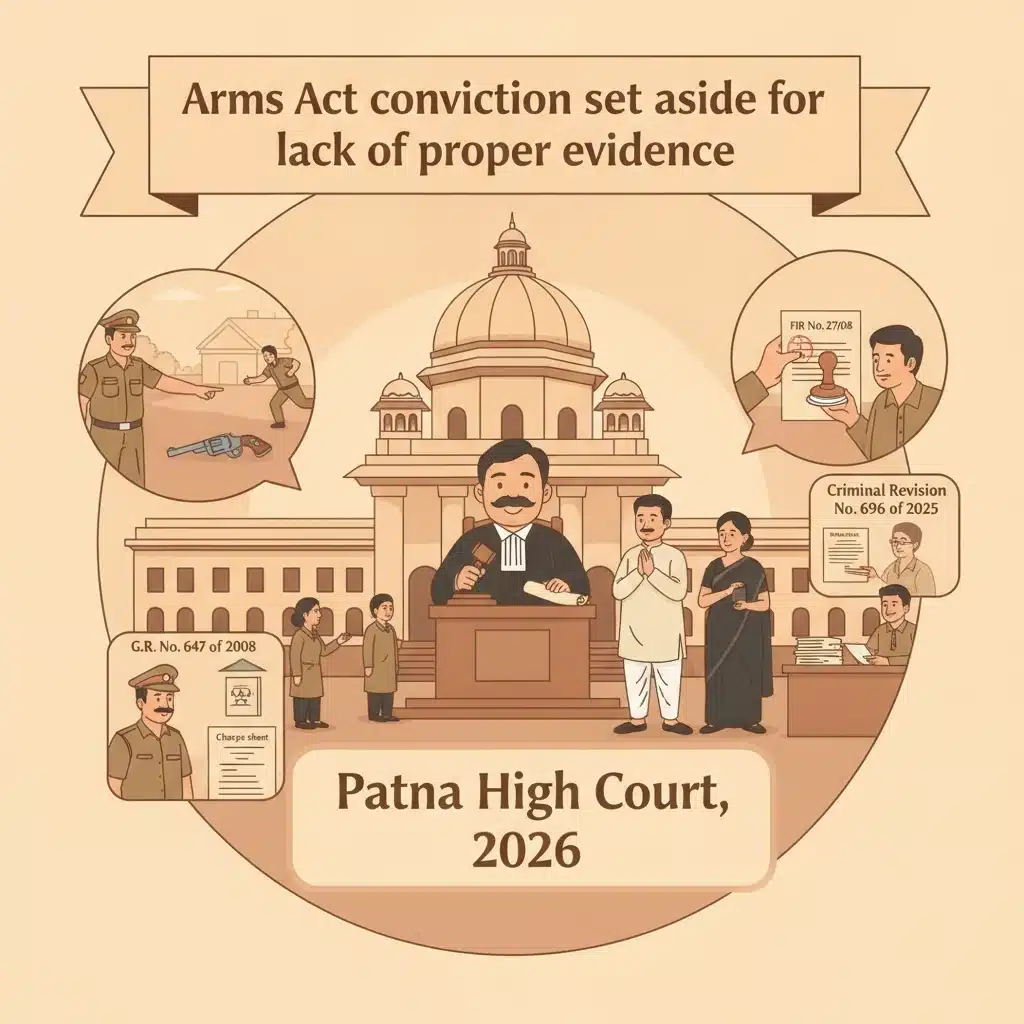
Case Background
The case started with Jankinagar P.S. Case No. 27 of 2008, registered on 20.03.2008 under Sections 25(1-b)a and 26(i) of the Arms Act. The FIR was based on the self-statement of Sub Inspector Md. Janifuddin, then SHO of Jankinagar police station.
According to the FIR, the SHO of Murliganj police station came to Jankinagar police station seeking help to arrest one Raj Kumar Yadav in connection with Murliganj P.S. Case No. 33 of 2008 dated 15.03.2008, registered under Sections 353, 333, 307, 302/34 of the Indian Penal Code and Section 27 of the Arms Act. The Jankinagar SHO claimed to have received information that this accused was sleeping in the house of the present petitioner at village Sahuria.
Police parties surrounded the petitioner’s house in the early morning. As per the FIR, when the petitioner saw the police, he started running and something fell from his waist, which was later claimed to be a country-made revolver of six rounds. The petitioner and 2–3 unknown persons allegedly managed to flee. On further search of the house, three spent or empty cartridges were said to have been recovered.
After investigation, police submitted charge sheet on 30.05.2008 under Sections 25(1-b)a and 26(i)(ii) of the Arms Act against the petitioner. On 09.06.2008, the Chief Judicial Magistrate, Purnea took cognizance under Sections 25(1-b)a/26(i) of the Arms Act. On 08.08.2008, the Judicial Magistrate 1st Class, Purnea framed charges under Sections 25(1-b)a and 26(i) of the Arms Act. The petitioner pleaded not guilty and claimed trial.
During trial in G.R. No. 647 of 2008, Trial No. 594 of 2014, the prosecution examined five witnesses and proved several documents, including the self-statement, FIR, seizure list, sanction order and a report on the efficacy of the firearm. The seized revolver and cartridges were produced as material exhibits.
The petitioner was examined under Section 313 Cr.P.C. and denied all allegations. No defence witness was examined. The trial court convicted him under Sections 25(1-b)a/26(i) of the Arms Act and sentenced him to three years’ rigorous imprisonment with fine of Rs. 5,000/- for each offence, the sentences to run concurrently, and in default, three months’ simple imprisonment.
The petitioner filed Criminal Appeal No. 23 of 2014 before the Additional Sessions Judge-XIV, Purnea. On 20.03.2025, the appellate court dismissed the appeal and upheld the conviction and sentence. The petitioner then approached the Patna High Court in Criminal Revision No. 696 of 2025, challenging both the trial court and appellate court judgments.
What the Court Examined and Decided
Before the Patna High Court, the petitioner’s counsel argued that both lower courts had passed perverse judgments by ignoring crucial facts and evidence on record. The main plank of the defence was that the entire case was doubtful and based on assumptions.
First, it was stressed that the petitioner was not caught at the spot and nothing was recovered directly from his person. The entire case turned on the allegation that an object fell from his waist, later claimed to be a country-made revolver. Counsel pointed out that the informant never stated in his self-statement that he knew the petitioner earlier or that someone had identified him.
This doubt became stronger during trial. The informant, examined as P.W.3, admitted in paragraph 6 of his cross-examination that he did not know the petitioner before the occurrence. According to the defence, if the informant had no prior acquaintance, it was unclear how he could identify the petitioner with certainty at dawn, especially when 3–4 persons were fleeing together.
The defence also highlighted that P.W.4, another member of the raiding party, said in cross-examination that he did not see the revolver falling from anyone’s waist. He further stated that the revolver was found lying between the courtyard and the alley. This cast serious doubt on the prosecution claim that the firearm fell specifically from the petitioner’s waist.
Another important attack was on the seizure list. One of the independent witnesses whose signature appears on the seizure list, examined as P.W.2, stated in paragraph 3 of his cross-examination that the police, along with the firearm, went to the house of the Mukhiya after the raid. There, about 300 yards away from the petitioner’s house, the seizure list was prepared, and P.W.2 and another witness signed it.
From this, the defence argued that the seizure list was not prepared at the spot of alleged recovery and was therefore unreliable. Counsel also emphasised that although witnesses admitted that other family members were present in the house at the time of raid, none was named, and no signature of any family member was taken on the seizure list. According to the defence, this omission made the prosecution case even more doubtful.
A further serious grievance related to the petitioner’s examination under Section 313 Cr.P.C. The trial court had put a question to him suggesting that on 28.03.2008 at village Sahuria, an illegal six-round revolver and three spent cartridges were recovered from his possession. Defence pointed out that this was not the prosecution case at all. According to the prosecution, the revolver allegedly fell and was found on the ground, not seized from his person, and the petitioner was never apprehended at the spot.
By framing the question as if recovery had taken place from the petitioner’s possession, the defence argued, the court deprived him of his right to properly respond to actual evidence and vitiated the trial.
On the other hand, the State, through the APP, argued that the revision was against concurrent findings of two courts and no material illegality or irregularity was shown. The APP described the inconsistencies in the witnesses’ depositions and in the seizure list as minor and natural, given the lapse of time between the incident and recording of evidence.
According to the State, all witnesses were generally consistent that the petitioner fled leaving behind the country-made revolver. The APP also maintained that stating in the Section 313 Cr.P.C. question that the revolver was seized from the petitioner’s possession was not materially wrong because, in law, it remained in his constructive possession after it fell. Non-mention of family members or their signatures on the seizure list, the State argued, was not significant, especially in an early morning raid when family members might not have been available to receive a copy.
The High Court, after hearing both sides and examining the record, first reiterated the settled law on revisional jurisdiction. Normally, the revisional court does not re-appreciate evidence to take a different view. It interferes only where there is impropriety, material irregularity, or illegality. However, ignoring material facts or recording findings that no reasonable person could reach would amount to material irregularity, justifying interference.
Applying this standard, the Court focused on whether the lower courts had properly considered the evidence.
The Court held that the case against the petitioner mainly rested on the allegation that the police had cordoned his house to arrest another accused and, during the operation, an object fell from his waist as he ran. Yet neither the co-accused nor the petitioner was apprehended from the spot.
The Court found it significant that the informant named the petitioner in the FIR but admitted in court that he had no earlier acquaintance with him. Considering that it was very early in the morning and 3–4 persons were fleeing, the Court found such precise identification “against commonsense”. The Court also noted the testimony of P.W.4 that he did not see any revolver falling and that it was simply found lying between the courtyard and the alley.
The High Court held that both subordinate courts failed to take this material evidence into account and wrongly brushed it aside as minor contradiction. In the Court’s view, these were not minor discrepancies but went to the root of the prosecution story.
On the seizure list, the Court acknowledged P.W.2’s clear statement that it was prepared at the Mukhiya’s house, 300 yards away from the petitioner’s house, not at the spot of alleged recovery. Even so, the lower courts had relied on this seizure list. The High Court considered this reliance “completely improper”.
On the Section 313 Cr.P.C. issue, the Court observed that the consistent prosecution case and witness depositions were that the firearm fell from the petitioner’s waist and was later found lying on the ground, while the petitioner was not arrested at the spot. Therefore, putting a question to the petitioner suggesting that a revolver and cartridges were “recovered from his possession” was, in the Court’s view, done in a most casual manner and did not reflect the evidence.
The Court held that asking an accused to answer a circumstance which is not borne out by evidence vitiates the trial and shows illegality in the orders of the subordinate courts. This, coupled with non-consideration and improper consideration of important evidence, had led to miscarriage of justice.
In conclusion, the Patna High Court found that the prosecution had failed to prove the charges under Sections 25(1-B)a/26(i) of the Arms Act. It declined to agree with the concurrent conviction and sentence. The Court set aside the appellate judgment dated 20.03.2025 in Criminal Appeal No. 23/2014 and the trial court’s judgment of conviction and order of sentence dated 30.01.2014 in G.R. No. 647 of 2008, Trial No. 594 of 2014.
The petitioner was acquitted of all charges. Since he was in jail custody, the Court directed that he be released forthwith, if not required in any other case. The revision petition was allowed, and the lower court records were ordered to be returned to the concerned courts.
Why This Judgment Matters
This judgment is important for people facing criminal cases based mainly on police versions, especially in Arms Act matters. The Patna High Court made it clear that courts must carefully test whether the police story is practical and supported by reliable evidence.
Here, the Court did not accept a story where a man is named and linked to a weapon, even though he was not caught, the officer did not know him from before, and there were major doubts about how the seizure was recorded. The Court insisted that such gaps cannot be brushed aside as “minor discrepancies”.
The ruling also highlights how crucial a fair examination under Section 313 Cr.P.C. is. The Court treated a wrong or misleading question to the accused as a serious defect that can vitiate the trial. For accused persons, this underlines their right to have the evidence put to them accurately so they can answer it.
For police and trial courts, the decision is a reminder that seizure lists should be prepared at the spot, independent witnesses should be properly involved, and family members present should not be ignored. Otherwise, the entire recovery can be doubted and the case may fail.
Legal Issues and Answers
- Issue: Whether the concurrent conviction of the petitioner under Sections 25(1-b)a/26(i) of the Arms Act was sustainable in revision when key evidence about identification and recovery was doubtful.
Answer: No. The Patna High Court held that non-consideration and improper consideration of material evidence by the trial and appellate courts led to miscarriage of justice, and the prosecution failed to prove the charges. - Issue: Whether putting an incorrect and unsupported question to the accused under Section 313 Cr.P.C. affected the validity of the trial.
Answer: Yes. The Court held that asking the petitioner to respond to a supposed recovery “from his possession” when no such evidence existed vitiated the trial and showed illegality in the subordinate courts’ approach. - Issue: Whether reliance on a seizure list prepared away from the place of occurrence was proper.
Answer: No. The Court noted that the seizure list was admittedly prepared 300 yards away at the Mukhiya’s house and held that the subordinate courts relied on it in a completely improper manner.
Cases Cited by the Court
- No prior case law is expressly cited or relied upon in this judgment. The Court proceeds on general principles of revisional jurisdiction and appreciation of evidence.
Case Details
Case Number: Criminal Revision No. 696 of 2025; arising out of Jankinagar P.S. Case No. 27 of 2008; related to Cr. Appeal No. 23 of 2014; trial in G.R. No. 647 of 2008, Trial No. 594 of 2014.
Case Title: Sanjay Sah v. The State of Bihar
Coram: Hon’ble Mr. Justice Arun Kumar Jha
Citation: 2026 (4) PLJR 623
Advocates: For the petitioner – Mr. Manish Kumar No.13, Advocate; Mr. Kameshwar Prasad Singh, Advocate; Mr. Rohit Kumar, Advocate. For the State – Mr. Anant Kumar 1, APP.
Nature of the Case: Criminal revision against judgment of conviction and sentence under the Arms Act, affirming an appellate order dismissing the petitioner’s criminal appeal.
Date of Patna High Court Judgment: 09.07.2026
Key Statutory Provisions Involved: Sections 25(1-b)a and 26(i) of the Arms Act; Section 27 of the Arms Act (in related Murliganj P.S. case); Sections 353, 333, 307, 302/34 of the Indian Penal Code (in related Murliganj P.S. case); Section 313 of the Code of Criminal Procedure.
Link to Judgment: https://patnahighcourt.gov.in/viewjudgment/NyM2OTYjMjAyNSMxI04=-R5XJxlVEhgI=
If you found this explanation helpful and wish to stay informed about how legal developments may affect your rights in Bihar, you may consider following Samvida Law Associates for more updates.




