

Case Background
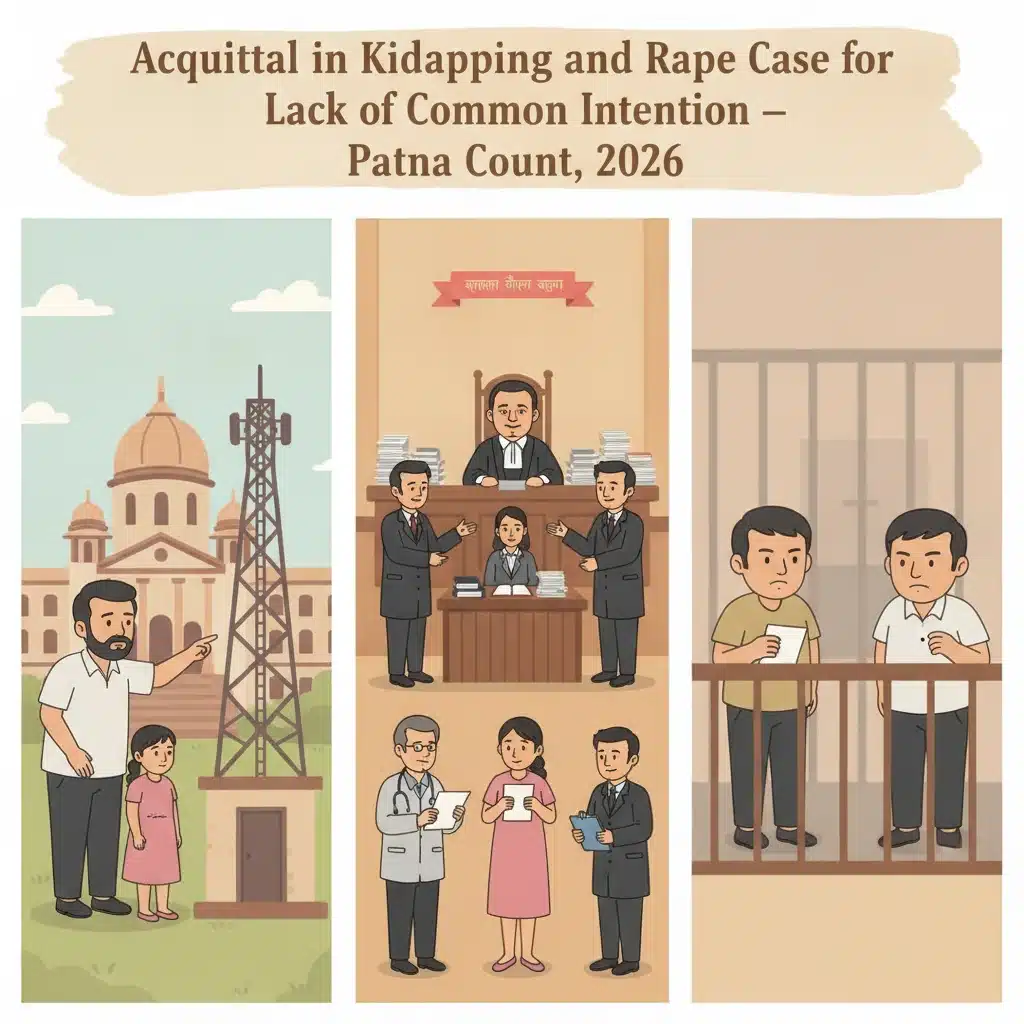
This criminal appeal arose from a 2011 incident in Saharsa district. The informant, father of a 14‑year‑old school‑going girl, alleged that his daughter went to school on 12.09.2011 at about 10 a.m. with another girl. After keeping her books in class, she went out with a friend to buy chocolates from a nearby shop.
According to the written report, when the girl was returning and reached near a tower (described as “Voda’s Tower”), two boys, Chandan Kumar and Munna Kumar, along with 3–4 unknown persons, called her and locked her in a room built in the tower. Her companion, Doli Kumari, later informed the informant that the girl had not returned to school.
The informant went searching and was told by one Bhushan Yadav that the girl had been seen going inside the tower. He reached there and found the room locked. He alleged that the room in the tower was a shelter for criminals and that Chandan Kumar was an anti‑social element involved in similar acts earlier.
On 13.09.2011, the informant submitted a written petition to the police. A case was registered at Saur Bazar Police Station and investigated. The prosecutrix was later recovered at Madhepura along with accused Chandan Kumar. During investigation she gave a statement under Section 164 of the Code of Criminal Procedure and was medically examined.
The case went to trial as Sessions Trial No. 187 of 2012 before the Adhoc Additional Sessions Judge‑1st, Saharsa. Two men, later appellants before the Patna High Court, were tried along with other accused for offences under Sections 366‑A/34 and 376/34 of the Indian Penal Code (IPC). On 01.04.2013, they were convicted, and on 04.04.2013 they were sentenced to rigorous imprisonment of five years under Section 366‑A/34 IPC and ten years under Section 376/34 IPC, with fines. Sentences were to run concurrently.
Feeling aggrieved, the two convicted accused filed the present criminal appeal under Section 374(2) read with Section 389(1) CrPC before the Patna High Court, challenging both the conviction and sentence.
What the Court Examined and Decided
The appeal was heard by Hon’ble Mr. Justice Purnendu Singh. The appellants were represented by an Amicus Curiae appointed by the Court, and the State was represented by the Additional Public Prosecutor. The hearing took place through virtual hybrid mode.
The appellants’ main argument was that there was no specific allegation in the First Information Report (FIR) or in the evidence of the victim that they had kidnapped, induced, or raped her. According to them, from the very beginning the prosecution case was focused on Chandan Kumar and Munna Kumar, who allegedly took the victim near the tower, confined her and, in the case of Chandan, raped her.
The Amicus Curiae pointed out that in court the victim (P.W.7) clearly stated that Chandan Kumar alone committed rape upon her. She did not say that the present appellants committed rape or that they were present at the time when she was first taken from near the tower and locked inside. The only allegation linked to the appellants was that, on the next day, they were in a vehicle that transported her from Banmankhi to Madhepura, and that they threatened her along the way.
On this basis, the defence argued that there was no direct evidence of any act of kidnapping, confinement, or sexual assault by the appellants. They also argued that Section 34 IPC (common intention) had been wrongly applied because there was no evidence of any pre‑planned meeting of minds or shared intention to kidnap or rape. In fact, the trial court itself had recorded that prosecution failed to prove conspiracy. Once conspiracy and pre‑arranged plan were not proved, mere presence in the vehicle could not make them equally liable for rape and kidnapping.
The defence further highlighted investigative lapses. The Investigating Officer (P.W.2) admitted that he never visited the hotel at Banmankhi where the rape allegedly occurred, did not examine any hotel employee, did not trace the vehicle number or driver, and did not examine any independent witness from Banmankhi or Madhepura. No material evidence like hotel records, vehicle details, or other independent corroboration connecting the appellants to the alleged offences was collected. According to the defence, when the only evidence was the uncorroborated claim of their presence in the vehicle, the prosecution had not proved its case beyond reasonable doubt.
The State, on the other hand, submitted that the trial court had considered all evidence and exhibits and rightly convicted the appellants.
The High Court carefully examined the lower court record, including the depositions of witnesses and documentary exhibits such as the medical report, forwarding of the written report, charge‑sheet, FIR, and the victim’s statement under Section 164 CrPC.
P.W.1, the doctor, confirmed that the girl’s age was between 14–16 years and that there was confirmatory evidence of sexual intercourse. There were no external injuries but the hymen was not intact and there was slight erosion in the vaginal wall. However, the doctor’s evidence did not identify who committed the sexual act.
P.W.5, the informant and father of the victim, largely repeated what he had heard, admitting in cross‑examination that he had no opportunity to speak to his daughter between her kidnapping and recovery. He accepted that some parts of his account were based on presumption.
P.W.6, a hearsay witness, claimed that on 12.09.2011 he saw Chandan Kumar and Munna Kumar forcibly drag the victim away from near the shop. He further deposed that the victim later told him that Chandan Kumar, Munna Kumar, Raju Kumar and Shankar Singh took her to Banmankhi, kept her in a hotel and committed rape. But in cross‑examination he admitted that his police statement was recorded on 13.09.2011 at about 6:45 p.m., before he met the victim or went to Madhepura. He also denied having earlier said that the victim disclosed the names of all four accused or that she was kept in a hotel for 3–4 days. These contradictions weakened his reliability on the crucial point about the appellants’ role in rape.
The most important evidence was that of the victim herself, P.W.7. She described how she went to school, then to buy a pen, and was caught near the tower by Munna Kumar and Chandan Kumar. They locked her in the tower and made her inhale something, causing her to lose consciousness. She said that she was taken to Banmankhi and kept in a hotel, where she regained consciousness around midnight. There she clearly stated that “Chandan Kumar committed rape upon her.”
Regarding the appellants, she said that on 13.09.2011 around 1:30–2:00 p.m., three persons — Shankar Singh, Raju Singh, and Munna Kumar — came in a vehicle and transported her towards Madhepura, threatening her during the journey. When they reached Madhepura and saw the police, these three fled, leaving her with Chandan Kumar, who was then caught by the police along with her. She confirmed that she knew Shankar Singh and Raju Singh from earlier.
In cross‑examination she could not give the hotel’s name, its description, the vehicle number or the driver’s name, but she stood firm that Chandan Kumar alone raped her. She denied defence suggestions that she had a love affair with Chandan Kumar or that no such occurrence took place.
From this, the Patna High Court drew a clear conclusion: the allegation of rape was directed only against Chandan Kumar. No overt act of sexual assault was alleged or proved against the two appellants. Their alleged role was limited to accompanying the vehicle once, on the day after the kidnapping, and threatening her while taking her to Madhepura.
The Court then examined whether Section 34 IPC (common intention) could be used to hold the appellants guilty of rape and procurement of a minor girl under Sections 376/34 and 366‑A/34, even without any direct act on their part. Referring to Supreme Court decisions in Krishnan v. State of Kerala, (1996) 10 SCC 508, and Jasdeep Singh v. State of Punjab, (2022) 2 SCC 545, as well as a later reiteration in Constable 907 Surendra Singh & Anr. v. State of Uttarakhand (2025 INSC 114), the Court noted that:
- Common intention cannot be presumed merely from presence or association.
- There must be proof of a pre‑arranged plan, prior meeting of minds, or conscious participation from the beginning of the criminal act.
- Section 34 creates vicarious liability and therefore requires clear and concrete evidence that all accused shared the same intention.
The Court also discussed the principle that the testimony of a victim of sexual assault can, in appropriate cases, be treated as that of a “sterling witness” and relied on without independent corroboration, provided it is consistent and of high credibility. However, an unreliable or incomplete version suffering from notable gaps cannot safely be the sole basis for conviction.
Applying these legal standards, the Court held that:
- The victim’s consistent testimony fixed responsibility for rape solely on Chandan Kumar.
- There was no evidence that the appellants were present at the time of initial kidnapping or at the hotel in Banmankhi when rape occurred.
- There was nothing to show that they shared any prior plan or common intention with Chandan Kumar and Munna Kumar to kidnap or rape the victim.
- At best, the evidence suggested their presence in the vehicle on 13.09.2011, which was insufficient to prove common intention beyond reasonable doubt.
Therefore, the essential ingredients of offences under Sections 366‑A and 376, read with Section 34 IPC, were not made out against the appellants. The trial court had erred in extending the principle of common intention to them without solid evidentiary foundation.
On this reasoning, the Patna High Court quashed and set aside the judgment of conviction dated 01.04.2013 and the order of sentence dated 04.04.2013 passed by the trial court. The appellants were acquitted of all charges. As they were on bail, they were discharged from their bail bonds, and any fine deposited by them was directed to be refunded.
The Court also directed that the Patna High Court Legal Services Committee pay Rs. 10,000 as consolidated fee to the Amicus Curiae for her professional assistance in the appeal. The lower court records were ordered to be sent back to the District Court.
Why This Judgment Matters
This judgment is important for families and young men in Bihar and elsewhere who may be dragged into serious criminal cases like kidnapping and rape because of mere association with the main accused.
The Patna High Court made it clear that, for such grave offences, a person cannot be convicted only because he was present in a vehicle or known to the main offender. Courts must see whether there is real proof that he shared the criminal plan and took part in it from the beginning.
At the same time, the Court did not doubt that the victim was a minor and that she had been subjected to sexual intercourse. The acquittal of these appellants does not deny the fact of the crime; it only says that the prosecution failed to show, beyond reasonable doubt, that these particular two men were legal participants in that crime.
The decision also shows how contradictions in witness statements and lapses in investigation can weaken a case, especially when the prosecution tries to use Section 34 IPC to widen liability. For ordinary readers, it underlines that in criminal law, strong and specific evidence is necessary before someone can be found guilty and sent to prison for many years.
Legal Issues and Answers
Issue: Whether the appellants could be held guilty of rape under Section 376 read with Section 34 IPC when the victim attributed the actual act of rape only to co‑accused Chandan Kumar.
Answer: No. The Court held that in the absence of any allegation or evidence that the appellants committed rape or actively participated in it, the conviction under Section 376/34 IPC could not be sustained.
Issue: Whether mere presence of the appellants in a vehicle transporting the victim from Banmankhi to Madhepura was enough to establish common intention for kidnapping and rape under Sections 366‑A/34 and 376/34 IPC.
Answer: No. The Court held that common intention requires prior meeting of minds or active participation from the start; mere subsequent presence or association is not sufficient without clear proof of shared intention.
Issue: Whether investigative lapses and contradictory witness statements created reasonable doubt about the appellants’ involvement.
Answer: Yes. The Court noted that failure to examine hotel staff, trace the vehicle, or record relevant independent witnesses, along with contradictions in P.W.6’s statement, weakened the prosecution case against the appellants and entitled them to benefit of doubt.
Cases Cited by the Court
- Krishnan v. State of Kerala, (1996) 10 SCC 508 – on when Section 34 IPC can apply even without proof of an overt act, and the need to prove shared common intention.
- Jasdeep Singh v. State of Punjab, (2022) 2 SCC 545 – explaining the nature of vicarious liability under Section 34 IPC and the requirement of substantial, concrete evidence of common intention.
- Constable 907 Surendra Singh & Anr. v. State of Uttarakhand, (2025) INSC 114 – reiterating principles on common intention and shared liability.
Case Details
Case Number: Criminal Appeal (SJ) No. 261 of 2013, arising out of Saur Bazar P.S. Case No. 249 of 2011; Sessions Trial No. 187 of 2012.
Case Title: Shankar Singh & Anr. v. The State of Bihar.
Citation: 2026 (4) PLJR 554
Coram: Hon’ble Mr. Justice Purnendu Singh.
Advocates: Ms. Sarandha Suman, Amicus Curiae for the appellants; Mr. S.N. Prasad (also referred as Mr. S.N. Pd.), A.P.P. for the State.
Nature of the Case: Criminal appeal against conviction and sentence under Sections 366‑A/34 and 376/34 of the Indian Penal Code.
Date of Patna High Court Judgment: 01.07.2026 (CAV Judgment; CAV date 18.06.2026).
Outcome: Appeal allowed; conviction and sentence set aside; appellants acquitted; bail bonds discharged; fine, if deposited, to be refunded.
LINK: https://patnahighcourt.gov.in/viewjudgment/MjQjMjYxIzIwMTMjMSNO-bGeHdcqM430=
If you found this explanation helpful and wish to stay informed about
how legal developments may affect your rights in Bihar,
you may consider following Samvida Law Associates for more updates.




