

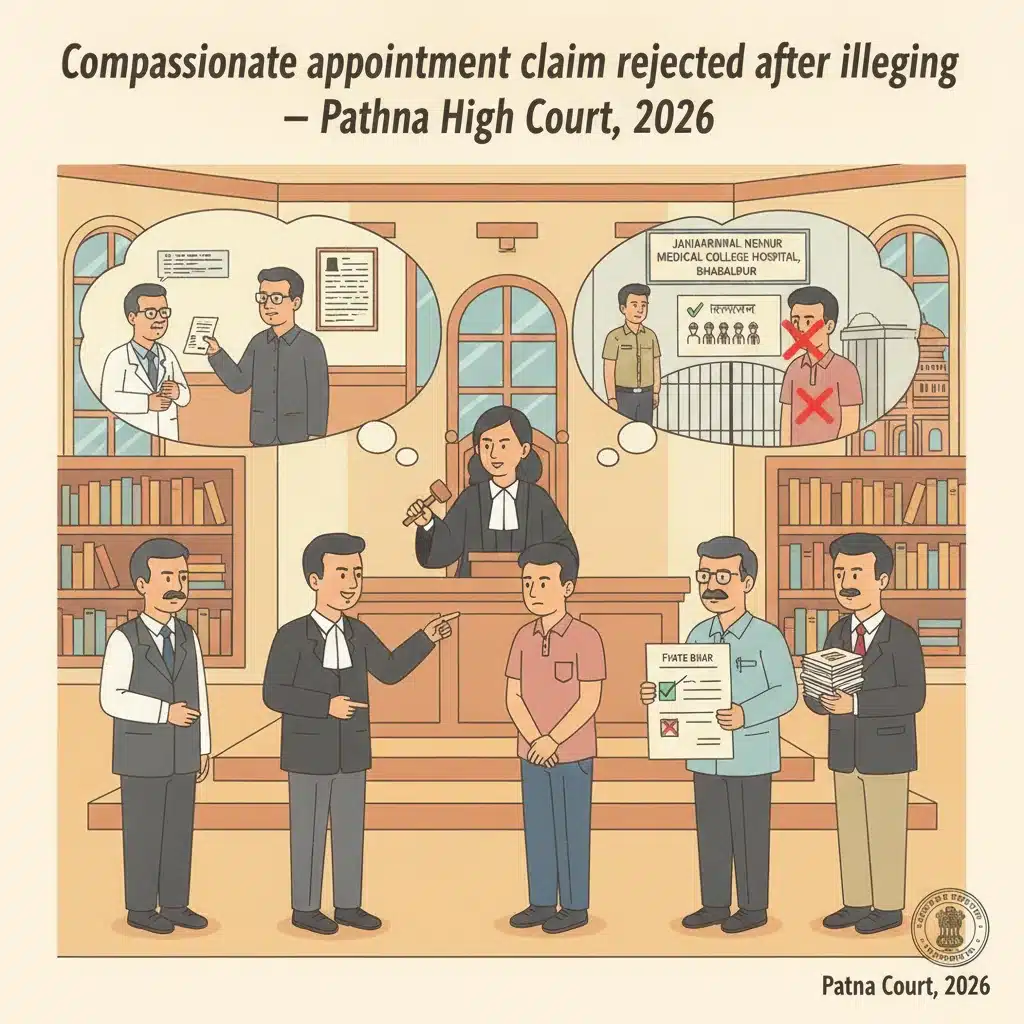
Case Background
This case arises from employment in the Health Department at Jawaharlal Nehru Medical College Hospital, Bhagalpur.
The respondent’s father was first engaged as a daily wage worker in 1987, and then shown as regularised as a Darban in 1990.
In 1991, the Health Department detected large-scale problems in appointments made by various regional offices.
Under Memo No. 928 dated 29.05.1991, salaries of such employees, including the respondent’s father, were stopped and they were barred from duty.
The father challenged these actions through multiple writ petitions.
One writ petition was disposed of in 2004 with liberty to question the termination order, which he did by filing another writ.
That writ was later heard with other similar cases, leading to a Division Bench direction in 2006 (in L.P.A. No. 946 of 2003, State of Bihar v. Purinder Solanki) to examine all such appointments in light of the Supreme Court’s decision in Secretary, State of Karnataka v. Uma Devi (3), (2006) 4 SCC 1.
A Five-Men Committee under the Director-in-Chief, Health Services, was constituted.
In 2008, the Committee categorised employees into three groups: “irregular”, “illegal”, and “forged”.
Only 91 “irregular” appointees were recommended for one-time regularisation.
The respondent’s father was placed in the “illegal” category.
The Committee’s report was challenged through several writ petitions, including one by the respondent’s father.
On 06.10.2009 a Single Judge set aside the report.
The State filed multiple Letters Patent Appeals; in the father’s case, L.P.A. was filed on 19.12.2011 and later numbered as L.P.A. No. 300 of 2015.
While this litigation was ongoing, the respondent’s father filed a contempt case (M.J.C. No. 1848 of 2010).
He was reinstated, but expressly subject to the result of the pending L.P.A.
He died in harness on 15.04.2012.
Later, death-cum-retiral benefits were released in his favour by order in M.J.C. No. 3944 of 2013.
Meanwhile, cases of other similarly situated employees went up to the Supreme Court in Civil Appeal No. 8469 of 2018 and connected matters (State of Bihar v. Kirti Narayan Prasad, (2019) 13 SCC 250) and then in State of Bihar v. Devendra Sharma, (2020) 15 SCC 466.
The Supreme Court accepted the Five-Men Committee’s findings and held that such appointments were void ab initio, illegal back-door entries not fit for regularisation.
When L.P.A. No. 300 of 2015 was taken up on 18.12.2018, counsel for the respondent sought to await an SLP pending before the Supreme Court.
The State later moved for substitution; the son, Ravi Shankar Kumar, was substituted as legal heir.
However, on 14.12.2020, the Division Bench disposed of L.P.A. No. 300 of 2015 as abated on the submission that the original petitioner had died and legal heirs had not been substituted in time.
A modification application (M.J.C. No. 2605 of 2022) was disposed of with liberty to file review, and Civil Review No. 176 of 2024 is pending.
Separately, in C.W.J.C. No. 12607 of 2014, the son sought compassionate appointment after his father’s death.
The Superintendent of the Medical College Hospital issued Memo No. 1533 dated 27.03.2014, saying his claim would be considered only after disposal of the L.P.A. related to his father.
During the writ’s pendency, Memo No. 1323 dated 23.02.2023 was issued rejecting his compassionate appointment request.
He challenged both memos.
On 28.02.2025, a Single Judge allowed the writ, set aside both memos, and directed fresh consideration of the son’s compassionate appointment.
The State then preferred the present Letters Patent Appeal, L.P.A. No. 971 of 2025.
What the Court Examined and Decided
The Division Bench, speaking through Hon’ble Mr. Justice Harish Kumar, with Hon’ble the Chief Justice concurring, examined several key questions:
whether the Supreme Court’s rulings in Kirti Narayan Prasad and Devendra Sharma applied to this case;
whether the father’s appointment could still be treated as illegal after his death;
whether payment of salary and retiral dues tied the State’s hands;
whether the son could claim compassionate appointment; and
whether he could demand equal treatment with another person allegedly granted compassionate appointment.
For the State, it was argued that:
- the Five-Men Committee had already found the father’s appointment to be “illegal”;
- the Supreme Court had upheld the Committee’s report in Kirti Narayan Prasad and Devendra Sharma;
- an appointment declared illegal and void ab initio cannot give rise to any service rights, including compassionate appointment; and
- benefits given under contempt orders, and subject to the outcome of appeals, cannot legalise an otherwise illegal appointment.
For the respondent son, it was argued that:
- the father’s termination had been quashed by the Single Judge in 2009 and, according to him, that order had attained finality;
- the father had been reinstated and given salary and death-cum-retiral benefits;
- since the father died in harness, his dependent was entitled, at least, to consideration for compassionate appointment; and
- another similarly placed person, Munna Kumar, had been directed to be considered for compassionate appointment in C.W.J.C. No. 1322 of 2018 and had been appointed, so denying similar treatment to the respondent would be discriminatory.
The Court first dealt with whether the Supreme Court’s decisions bind this case even though the father or son were not parties in those appeals.
It noted the common background: the same Five-Men Committee, the same class of employees, and the same method of recruitment.
The Supreme Court in Kirti Narayan Prasad had upheld the Committee’s finding that many appointees had used fake or forged appointment letters or were surreptitiously inducted by the concerned Civil Surgeon-cum-Chief Medical Officer without any proper recruitment process.
Such appointments were held illegal and void ab initio, making paragraph 53 of Uma Devi (3) inapplicable.
As the Supreme Court said, these employees could not be treated as civil servants at all.
In Devendra Sharma, the Supreme Court reiterated that these were not mere irregularities but full-fledged illegal appointments:
no sanctioned posts, no advertisement, no due process, and clear elements of back-door entry, nepotism, and favouritism.
The Patna High Court observed that the father of the present respondent had also been examined by the same Committee and classified as an “illegal appointee”.
The Supreme Court had expressly approved the Committee’s approach and findings.
On that basis, the Division Bench held that the law declared by the Supreme Court squarely covers this case, even if the father was not on the party array in those appeals.
Next, the Court considered whether the father’s service could still be termed illegal after his death.
It explained that while disciplinary proceedings normally abate if the employee dies in the middle of an inquiry, the position is different where an inquiry is completed and the matter is at the stage of final orders or appeal.
Then, the right to “sue” or contest survives to the legal heirs.
They may carry appeals to challenge findings or penalties.
The Bench referred to a Division Bench ruling in State of Bihar v. Shanti Kumari, L.P.A. No. 247 of 2015, which clarified that death during a pending appeal does not automatically wipe out earlier findings once the inquiry had concluded.
Order XXII of the Code of Civil Procedure and Section 394 of the Code of Criminal Procedure illustrate that legal heirs can pursue such proceedings.
In this case, the Court noted that:
- the father’s appointment had been examined by the Committee and declared “illegal” during his lifetime;
- the Single Judge’s interference with the Committee’s report was already under challenge in L.P.A. No. 300 of 2015 when the father died; and
- the Supreme Court, in the connected group of cases, later upheld the Committee’s findings.
On these facts, the Bench concluded that accepting and reaffirming the “illegal” status of the father’s appointment, even after his death, was legally permissible.
The proceedings had not abated at the stage when the Committee’s conclusions were reached and examined on appeal.
Turning to the effect of reinstatement, salary and payment of retiral dues, the Court stressed that these were granted during litigation, under contempt pressure, and expressly made “subject to” the final result of the L.P.A.
When an employee is reinstated or paid benefits on that basis, those acts automatically follow whatever final legal determination emerges.
Once the Supreme Court upheld the Committee’s view that such appointments were illegal and void ab initio, any interim advantage could not convert an invalid appointment into a valid one.
The Division Bench held there was “no legal impediment” in still treating the father’s appointment as illegal despite salary and death-cum-retiral benefits having been released.
On compassionate appointment, the Court emphasised that it is not an automatic right.
It is an exception to the normal rule of equal opportunity in public employment under Article 14, and it arises only where the deceased employee held his or her post lawfully.
The Bench cited the Full Bench judgment in Rita Mishra v. Director, Primary Education, 1987 SCC OnLine Pat 159, where the Patna High Court held that the right to salary and related benefits flows only from a valid appointment.
If the appointment itself is illegal and non-existent in the eye of law, claims for salary, pension, or other consequential benefits simply cannot arise.
Applying that principle, the Bench reasoned that when the root appointment is illegal and void, there can be no branch of compassionate appointment growing out of it.
The State was, therefore, justified in rejecting the son’s request for compassionate appointment.
Lastly, the Court dealt with the plea of parity with Munna Kumar, another person said to have obtained compassionate appointment by court order.
The Bench invoked settled Supreme Court law, particularly Basawaraj v. Special Land Acquisition Officer, (2013) 14 SCC 81, and R. Muthukumar v. Chairman and Managing Director, TANGEDCO, 2022 SCC OnLine SC 151.
These decisions make it clear that Article 14 does not offer “negative equality”.
If the Government or a court has mistakenly granted a benefit without legal basis in some other case, others cannot demand the same illegal benefit.
Wrong decisions cannot be multiplied in the name of equality.
The Patna High Court accepted this line of reasoning.
It held that even if Munna Kumar or others had been wrongly given compassionate appointment, that could not give a legal right to the present respondent to demand the same.
Equality before law is a positive concept and cannot be used to perpetuate illegality.
After addressing each of the five framed issues, the Division Bench summarised its conclusions:
the Supreme Court’s rulings do apply; the father’s services can be treated as illegal; interim benefits do not bind the State; compassionate appointment cannot arise from an illegal appointment; and parity with others wrongly favoured is not permissible.
On this basis, the Bench found that the Single Judge’s order dated 28.02.2025 suffered from “patent illegality” and was contrary to the binding Supreme Court judgments.
It therefore set aside that order, dismissed C.W.J.C. No. 12607 of 2014, and allowed L.P.A. No. 971 of 2025.
No costs were awarded.
Why This Judgment Matters
This judgment has direct implications for dependents of employees whose original appointments were later found to be illegal or forged.
It clearly states that if a person entered government service through an illegal route, their family cannot claim compassionate appointment on the basis of that illegal service.
For low-income families who may have fought long battles to secure salary or retiral dues, this decision clarifies that such interim benefits, even if paid, do not prove that the job itself was valid.
The root question will always be whether the original appointment complied with law and proper procedure.
The ruling also warns that just because another person in a similar situation has obtained some benefit—whether by mistake, oversight, or otherwise—it does not mean everyone else can demand the same.
Courts will not repeat a wrong simply to appear “equal”.
In short, the Patna High Court has reinforced that compassionate appointment is tightly linked to the legality of the deceased employee’s own appointment, and that broader Supreme Court findings on illegal mass appointments can govern individual claims even where the individuals were not parties in those appeals.
Legal Issues and Answers
- Issue: Does the Supreme Court’s law in Kirti Narayan Prasad and Devendra Sharma apply here, though the employee was not a party?
Answer: Yes. The father’s appointment arose from the same batch of illegal Health Department appointments examined by the same Committee whose report the Supreme Court upheld, so the rulings squarely apply. - Issue: Can the father’s service be treated as “illegal” even after his death, and despite interim reinstatement and benefits?
Answer: Yes. The Committee had already categorised his appointment as illegal during his lifetime, the right to contest survived on appeal, and later Supreme Court decisions confirmed that such appointments were void ab initio. - Issue: Is the son entitled to compassionate appointment or parity with others allegedly appointed on that basis?
Answer: No. Compassionate appointment can arise only from a lawful appointment; an illegal appointment cannot give such a right. Article 14 does not permit claiming benefits based on earlier wrong or illegal decisions in favour of others.
Cases Cited by the Court
- Secretary, State of Karnataka v. Uma Devi (3), (2006) 4 SCC 1
- State of Bihar & Ors. v. Kirti Narayan Prasad, (2019) 13 SCC 250
- State of Bihar & Ors. v. Devendra Sharma, (2020) 15 SCC 466
- Rita Mishra v. Director Primary Education, 1987 SCC OnLine Pat 159
- The State of Bihar & Ors. v. Shanti Kumari & Ors., L.P.A. No. 247 of 2015
- Basawaraj v. Special Land Acquisition Officer, (2013) 14 SCC 81
- R. Muthukumar & Ors. v. Chairman and Managing Director, TANGEDCO & Ors., 2022 SCC OnLine SC 151
- State of Bihar & Ors. v. Upendra Sharma, L.P.A. No. 1138 of 2024
Case Details
Case Number: Letters Patent Appeal No. 971 of 2025 in C.W.J.C. No. 12607 of 2014
Case Title: The State of Bihar & Ors. v. Ravi Shankar Kumar
Coram: Hon’ble the Chief Justice; Hon’ble Mr. Justice Harish Kumar
Date of Judgment: 13-05-2026
Citation: 2026 (4) PLJR 353
Advocates:
- For the appellants (State): Mr. Kinkar Kumar, Standing Counsel-9; Ms. Vagisha Pragya Vacaknavi, AC to SC-9
- For the respondent (writ petitioner): Mr. Shiv Kumar, Advocate; Ms. Sweta Burnwal, Advocate
Nature of the Case: Intra-court Letters Patent Appeal against a Single Judge order in a writ petition (service law, compassionate appointment)
Link to Judgment: https://patnahighcourt.gov.in/viewjudgment/MyM5NzEjMjAyNSMxI04=-X1OTm1xPf–ak1–I=
If you found this explanation helpful and wish to stay informed about
how legal developments may affect your rights in Bihar,
you may consider following Samvida Law Associates for more updates.




