

Case Background
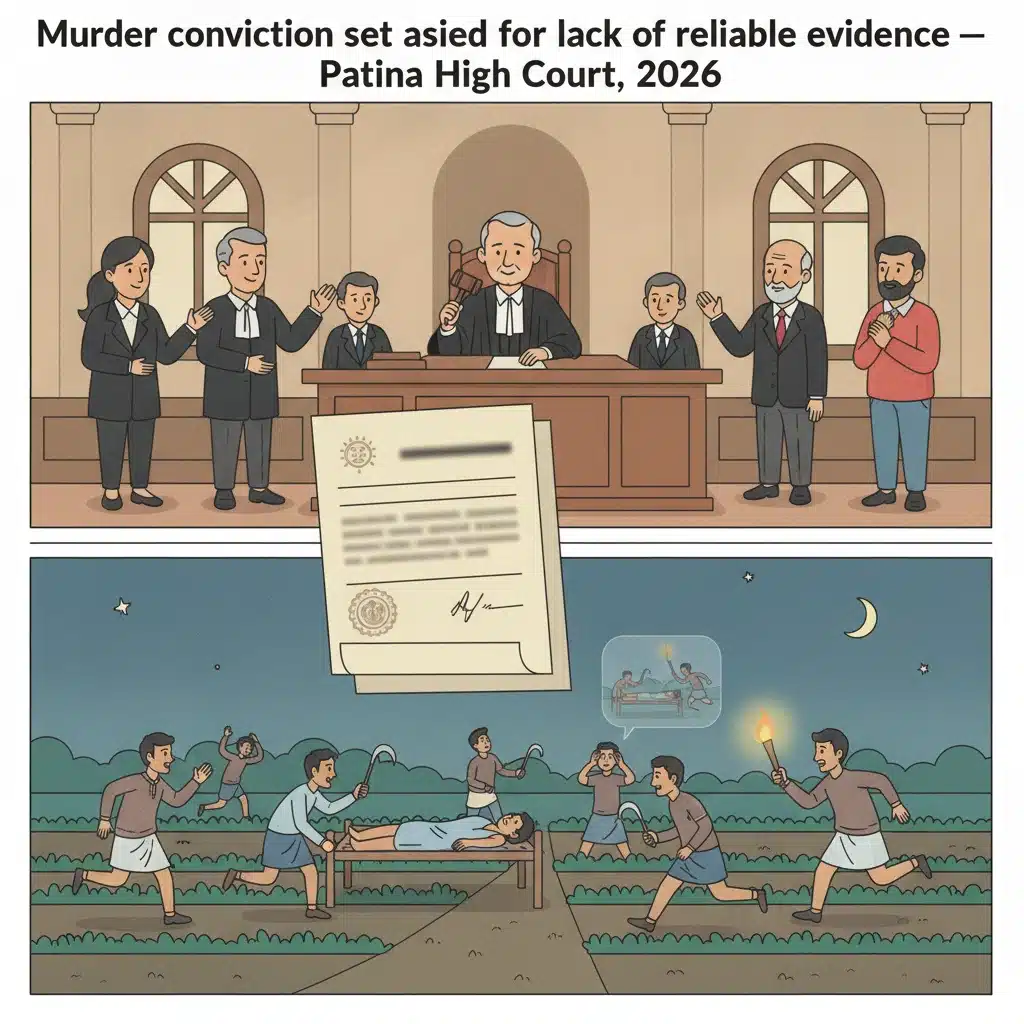
The case arose from an incident said to have taken place around midnight on 5 March 1996 in a village in Saran district, Bihar. According to the prosecution, the informant’s brother, Kamaldeo Rai, went to sleep on a cot kept near his field around 11 PM, while the informant continued looking after the fields.
It was alleged that around 12 o’clock at night, the appellant, along with some named and unknown associates, came armed with sharp cutting weapons and assaulted Kamaldeo Rai on the cot. On hearing noise, the informant and other villagers rushed to the spot and found him dead.
The prosecution also alleged that, five to six days before the occurrence, the accused had threatened Kamaldeo Rai with dire consequences if he did not execute a sale deed in their favour. This was projected as the motive for the crime.
Amnaur (Bheldi) Police Station Case No. 32 of 1996 was registered and, after investigation, the case was committed to the Sessions Court. The 3rd Additional Sessions Judge, Saran at Chapra, conducted Sessions Trial No. 300 of 1997/135 of 1997. By judgment of conviction and order of sentence dated 30 November 1998, the trial court held the appellant guilty under Sections 302 and 34 of the Indian Penal Code and sentenced him to rigorous imprisonment for life.
The appellant challenged this conviction and sentence by filing Criminal Appeal (DB) No. 23 of 1999 before the Patna High Court. Mr. Ravi Bhardwaj was appointed Amicus Curiae to assist the Court on behalf of the appellant. The State was represented by the Additional Public Prosecutor. The appeal was finally decided on 18 June 2026.
What the Court Examined and Decided
The Patna High Court carefully went through the oral and documentary evidence brought by the prosecution. Eight witnesses were examined in the trial. No defence evidence was produced.
P.W.1, Shivchela Rai, stated in his examination-in-chief that, on hearing hulla, he rushed to the spot and found the deceased lying dead on the cot. In cross-examination, however, he went further and claimed that he had seen the accused killing the victim and fleeing when villagers approached. There was no mention of a torch by him.
P.W.2, Thakur Rai, stated that after hearing cries, he rushed to the place of occurrence and saw Kamaldeo Rai lying dead. He also claimed that he saw three persons, including the appellant, armed with sharp-cut weapons assaulting the deceased and that he identified them in the light of a torch. Yet, in cross-examination, he admitted that when he reached the place of occurrence, the victim was already lying dead, which contradicts his earlier version of witnessing the assault.
P.W.3, Lalbabu Rai, claimed to be an eye-witness. He stated that on hearing “bachao bachao”, he and another person, Kamta Rai, lit a torch and went to the place of occurrence. There, he allegedly saw the appellant and two named co-accused running away, while three others could not be identified. He clearly admitted that he did not actually see the assault; he only saw some persons running away after the alarm.
In cross-examination, P.W.3 admitted that he did not disclose the names of the accused to the police, nor did he say that he had seen them fleeing. He also admitted that he did not go near the place of occurrence at night and went there only in the morning along with the police. This made his claim of seeing anyone in the torchlight at night doubtful.
P.W.4, Ramyodhya Rai, was a formal witness to the inquest report and seizure list, and did not speak about the occurrence itself.
P.W.5, Ishwari Rai @ Kishori Rai, was the full brother of the informant and a hearsay witness. He stated that co-villagers informed him that the appellant, along with others, assaulted and killed the deceased. He admitted existing animosity with the accused persons and also spoke of caste rivalry. Importantly, in paragraph 9 of his deposition, he said that on the night of the occurrence there was a village meeting in which the Mukhiya, Sarpanch and others participated, and after discussion they decided to lodge the FIR the next morning. The High Court read this as indicating deliberation and not a spontaneous narration of events.
P.W.6, Kamta Rai, the informant and brother of the deceased, was projected as the main eye-witness. He stated that both brothers were irrigating the onion field around 9 PM after dinner. Later, the deceased went to sleep on the cot while P.W.6 stayed awake. He claimed that he saw several persons approaching from the western side and identified them as the appellant, two named co-accused and others. According to him, they surrounded the deceased and assaulted him. On his alarm, the assailants fled. He also spoke about the appellant’s alleged attempt to purchase the land of the deceased, which the deceased refused, showing alleged motive.
P.W.7, Dr. Uma Shankar Prasad Shrivastav, conducted the post-mortem examination and found multiple injuries on the body of the deceased. This confirmed that the death was homicidal. However, his evidence did not throw light on the identity of the assailants.
P.W.8, the Investigating Officer, Altaf Ali Khan, gave evidence which seriously weakened the prosecution case. In paragraph 16 of his evidence, he stated that no witness produced any torch before him, nor did he seize any torch during investigation. In paragraph 17, he said that P.W.1 never told him that he had been irrigating the field along with the deceased, nor that he saw the accused killing the deceased; rather, P.W.1 only said he saw the accused fleeing from the place of occurrence. In paragraph 18, he stated that P.W.2 also never told him that he saw the accused killing the deceased or that he identified them in torchlight. He further deposed that P.W.3 told him that he came to know the names of the accused only from the informant and denied having witnessed them fleeing.
The prosecution also produced documents such as the inquest report, seizure list, fard beyan, post-mortem report and formal FIR. The defence did not bring any evidence.
On appeal, the Amicus Curiae argued that the prosecution had failed to prove its case beyond reasonable doubt. He highlighted that the supposed eye-witnesses, P.Ws.1, 2 and 3, did not actually witness the assault and that their trial statements contradicted what they told the police earlier. He also argued that the entire case of identification at midnight in torchlight was doubtful because there was no mention of torchlight in the FIR, no seizure of any torch, and no production of torch before the trial court. He also stressed that there was no independent, unbiased witness to support the prosecution and pointed out the meeting of villagers before lodging the FIR.
The State, on the other hand, argued that the evidence on record clearly established the appellant’s guilt and justified the conviction under Sections 302 and 34 IPC.
The Patna High Court examined the rival submissions and the evidence, keeping in mind precedents of the Supreme Court. It noted that P.Ws.1, 2 and 3, though described as eye-witnesses, had not actually seen the assault. Their statements carried serious contradictions between their examination-in-chief, cross-examination and earlier statements to police under Section 161 Cr.P.C.
The Court pointed out that P.W.1 admitted in chief that, when he reached, the deceased was already lying dead. Yet in cross-examination, he claimed to have seen the assault. P.W.2 similarly changed his stand about whether he saw the assault and how he identified the accused. P.W.3 denied going to the place of occurrence at night, although he claimed earlier to have gone there with a lit torch. The Court found these improvements at the stage of trial to be material contradictions.
The informant, P.W.6, in paragraph 1 of his deposition, introduced for the first time the claim that identification of the accused was made in torchlight and moonlight at 12 o’clock in the night. The Court found it significant that:
- There was no mention of any torch or moonlight as source of identification in the FIR.
- No torch was seized by the Investigating Officer.
- No torch was produced before the trial court.
- The Investigating Officer specifically stated that no torch was ever produced before him and that witnesses did not claim identification in torchlight during investigation.
Relying on Supreme Court judgments, including Kapil Deo Mandal and others versus State of Bihar (2008) 16 SCC 99 and Durbal versus State of Uttar Pradesh (2011) 2 SCC 676, the High Court held that introducing such important facts for the first time in court, which were absent from the FIR and Section 161 Cr.P.C. statements, lacks credibility and is liable to be discarded.
The Court also discussed the legal approach to contradictions and omissions. It noted, with reference to Mahendra Pratap Singh versus State of Uttar Pradesh (2009) 11 SCC 334, that minor discrepancies on trivial matters should not lead to rejection of evidence. However, when contradictions go to the root of the prosecution story and affect the core of the case, they make the evidence unreliable.
In this appeal, the Court held that the improvements and contradictions were not minor. They directly affected the reliability of the eyewitness accounts and the alleged identification of the accused in darkness. The Court emphasised that in criminal cases, where life and liberty of an accused are at stake, the prosecution must prove guilt beyond reasonable doubt. It is not enough that the story “may be true”; it must be firmly proved. The burden always lies on the prosecution.
After weighing the entire evidence, the Patna High Court concluded that the prosecution had “miserably failed” to prove the guilt of the appellant beyond reasonable doubt. The material contradictions in the depositions undermined the prosecution case and created substantial doubt about its truthfulness.
Accordingly, the Court held that maintaining the conviction would be untenable. It set aside the judgment of conviction and order of sentence dated 30 November 1998 passed by the 3rd Additional Sessions Judge, Saran at Chapra in Sessions Trial No. 300 of 1997/135 of 1997, so far as the appellant was concerned.
The appellant was discharged from the liability of his bail bonds in connection with the case. The appeal was allowed, and any interlocutory applications stood disposed of. The Court also appreciated the assistance of the Amicus Curiae and directed that he be paid Rs. 10,000/- by the Patna High Court Legal Services Committee as professional fee.
Why This Judgment Matters
This judgment is important for people facing serious criminal charges, especially in cases based mainly on eyewitness accounts from a village setting.
The Patna High Court has made it clear that courts will not uphold a conviction for murder where the main witnesses change their version later or add new facts during trial that were missing from the FIR and police statements. If critical details like how the accused were identified in the dark are not mentioned from the start, later improvements will be treated with suspicion.
The decision reinforces the rule that, in criminal cases, the prosecution must prove guilt beyond reasonable doubt. Suspicion, however strong, is not enough. Life imprisonment cannot be sustained on weak or doubtful evidence.
For villagers and ordinary citizens, this case shows that if there is delay or deliberation in lodging the FIR, and if witness statements are inconsistent, the benefit of doubt will go to the accused. For lawyers, it underlines the importance of cross-examining witnesses on omissions and contradictions and of examining whether the investigation collected and produced basic physical evidence like torches used for identification at night.
Legal Issues and Answers
- Issue: Whether the prosecution had proved beyond reasonable doubt that the appellant participated in the murder of the deceased under Sections 302/34 IPC.
Answer: No. The Patna High Court held that due to material contradictions, improvements and doubtful identification at night, the prosecution failed to establish the appellant’s guilt beyond reasonable doubt, and the conviction could not stand. - Issue: Whether late introduction of torchlight and moonlight as sources of identification, absent in the FIR and Section 161 Cr.P.C. statements, could be relied upon to uphold conviction.
Answer: No. The Court held that such important facts, introduced for the first time at trial without any supporting seizure or production of torches, lacked credibility and were liable to be discarded. - Issue: How should courts treat contradictions and omissions in witness statements in a criminal trial.
Answer: The Court reiterated that while minor discrepancies can be ignored, omissions and contradictions on material particulars that go to the root of the case render the evidence unreliable and can be a basis for acquittal.
Cases Cited by the Court
- Kapil Deo Mandal and Others versus State of Bihar, (2008) 16 SCC 99.
- Durbal versus State of Uttar Pradesh, (2011) 2 SCC 676.
- Mahendra Pratap Singh versus State of Uttar Pradesh, (2009) 11 SCC 334.
Case Details
Case Number: Criminal Appeal (DB) No. 23 of 1999
Trial Court Case: Sessions Trial No. 300 of 1997/135 of 1997 arising out of Amnaur (Bheldi) P.S. Case No. 32 of 1996
Case Title: Vijay Mahto v. State of Bihar
Citation: 2026 (4) PLJR 414
Court: High Court of Judicature at Patna
Date of Judgment: 18.06.2026
Coram: Hon’ble Mr. Justice Prabhat Kumar Singh; Hon’ble Mr. Justice Girijish Kumar
Advocates: Mr. Ravi Bhardwaj, Amicus Curiae, for the appellant; Mr. Ajay Mishra, Additional Public Prosecutor, for the State
Nature of the Case: Criminal appeal (Division Bench) against conviction and sentence under Sections 302 and 34 of the Indian Penal Code.
Final Outcome: Appeal allowed; conviction and life sentence set aside; appellant discharged from bail bond liability.
Link: https://patnahighcourt.gov.in/viewjudgment/NSMyMyMxOTk5IzEjTg==-MEhrZjYoxYk=
If you found this explanation helpful and wish to stay informed about
how legal developments may affect your rights in Bihar,
you may consider following Samvida Law Associates for more updates.




