

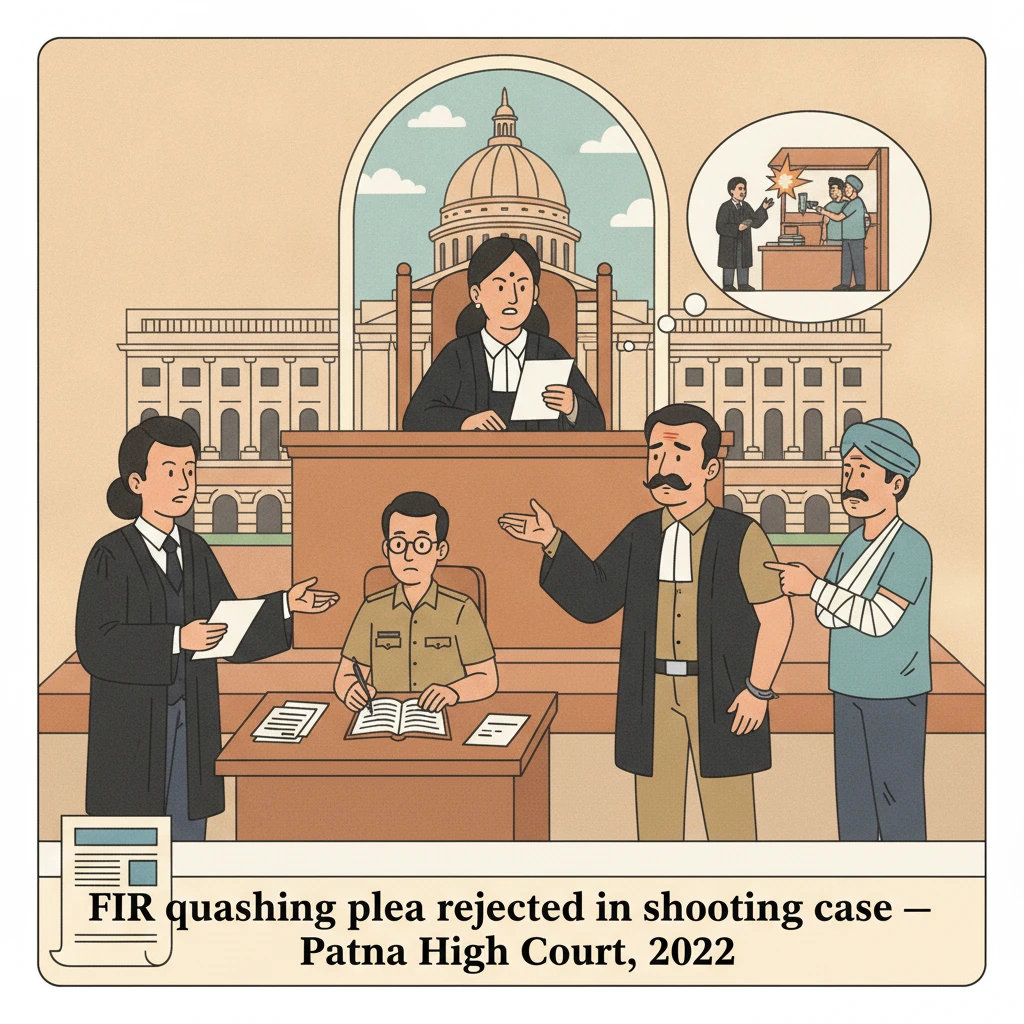
Case Background
The matter arose from Konch P.S. Case No. 187 of 2019, District Gaya. The FIR was lodged on 16.06.2019 on the written report of the informant, Uma Shankar Yadav.
According to the FIR, around 8:30 a.m. on 16.06.2019, the informant was standing at the kiosk (gumti) of his co-villager, Shiv Pujan Yadav. His nephew Pankaj Kumar was with him and his grandson Raju Kumar was already sitting there.
The informant alleged that the accused persons arrived there and began abusing his nephew and grandson. When the grandson protested, the present petitioner allegedly came to the spot in an inebriated condition and also started abusing them.
The FIR further stated that the petitioner took out a pistol from his waist, pointed it at the temple of the informant’s nephew and fired, causing injuries to him. After this, the accused persons allegedly assaulted the informant and others present, causing them grave injuries.
On this basis, Konch P.S. Case No. 187/2019 was registered under Sections 147, 148, 149, 341, 323, 337, 307, 326, 379, 504 of the Indian Penal Code and Section 27 of the Arms Act. The case was pending before the court of the ACJM-III, Gaya as G.R. No. 3115/2019.
The petitioner, Kapil Yadav @ Kapil Dev Yadav, moved an anticipatory bail petition before the Patna High Court, registered as Criminal Miscellaneous No. 78939 of 2019. On 04.12.2019, the High Court heard that matter and the case diary was called for. This is reflected in the order dated 07.12.2019 of the court below.
While the anticipatory bail petition was pending, the ACJM-III, Gaya, on 13.01.2020, directed issuance of warrant of arrest against the petitioner. Later, on the prayer of the Investigating Officer, the court below allowed issuance of advertisement/proclamation against the petitioner on 22.02.2020. On 29.09.2020, the court directed initiation of process under Section 83 of the Code of Criminal Procedure, 1973.
Feeling aggrieved, the petitioner approached the Patna High Court in Criminal Miscellaneous No. 11087 of 2021, seeking quashing of the FIR and the entire criminal proceedings, essentially on the ground that the Magistrate and the Investigating Officer had acted in a biased and arbitrary manner while his anticipatory bail application was pending.
What the Court Examined and Decided
The petition was heard by Hon’ble Mr. Justice Mohit Kumar Shah. The Court examined the FIR, the materials on record and the entire order-sheet of the case from the court of ACJM-III, Gaya.
The petitioner’s main submission, as recorded by the Court, was that since his anticipatory bail petition was already pending before the High Court, the police and the Magistrate should not have taken coercive steps such as issuing warrant, proclamation and process under Section 83 CrPC.
According to the petitioner, these steps showed bias and arbitrariness on the part of the Investigating Officer and the learned Magistrate. On this basis alone, he urged that the entire criminal proceeding, including the FIR, should be quashed.
The Court noted an important aspect at the outset. The petitioner’s counsel had not argued that, on a plain reading of the FIR, no offence was made out. Nor had any legal argument been advanced as to why the criminal proceedings, on their merits, deserved to be quashed.
The only argument pressed was that the conduct of the court below and the Investigating Officer was arbitrary, and for that reason, the FIR should be quashed and the court below should be “punished”. The High Court recorded this limitation in the petitioner’s case.
Justice Mohit Kumar Shah then turned to the settled legal principles on quashing of FIRs under Section 482 of the CrPC. The Court emphasised that these powers are to be exercised sparingly, with great care and only in the “rarest of rare” cases.
The judgment discussed at length the Supreme Court decision in Mahendra K.C. vs. State of Karnataka, (2022) 2 SCC 129. Quoting paragraphs 19 to 22, the Patna High Court reiterated that the High Court’s inherent power exists to prevent abuse of legal process and to secure the ends of justice, but it does not function like an appellate or revisional court at this stage.
The Supreme Court in Mahendra K.C. had referred to earlier landmark rulings, such as:
State of Orissa v. Saroj Kumar Sahoo, where the Court said that inherent jurisdiction must be exercised sparingly, carefully and with caution, and only when justified by the tests in Section 482 CrPC.
State of Haryana v. Bhajan Lal, which famously laid down illustrative categories of cases where FIRs or criminal proceedings can be quashed, such as when the FIR does not disclose any offence even if taken at face value, or when the allegations are so absurd and inherently improbable that no prudent person could conclude there is sufficient ground to proceed, or where proceedings are manifestly attended with mala fides.
State of M.P. v. Surendra Kori, where the Supreme Court again stressed that at the quashing stage, the High Court should normally refrain from giving a prima facie decision when the facts are incomplete and evidence is yet to be collected.
Based on these authorities, Mahendra K.C. crystallised two key tests for quashing: (i) whether the allegations prima facie constitute an offence; and (ii) whether the allegations are so improbable that a prudent person would not find sufficient ground to proceed.
The Patna High Court also cited State of Telangana vs. Habib Abdullah Jeelani, (2017) 2 SCC 779, where the Supreme Court again underlined that quashing of FIR must be done very sparingly, and that the High Court cannot use its inherent powers arbitrarily or to act according to whim or caprice. The Court reproduced paragraphs 13 to 15 of that judgment, including the reference to Kurukshetra University v. State of Haryana, which criticised quashing an FIR even before investigation had commenced.
Further, the Court discussed the recent decision in M/s Neeharika Infrastructure Pvt. Ltd. vs. State of Maharashtra & Others, Criminal Appeal No. 330 of 2021. In paragraph 23 of that judgment, the Supreme Court laid down exhaustive guidelines on when High Courts may interfere in investigation, grant interim orders of “no coercive steps”, or stay investigations while hearing quashing petitions.
These guidelines stress that:
Police have a statutory right and duty to investigate cognizable offences under Chapter XIV of the CrPC.
Court should not normally interfere at the stage of investigation.
Quashing is an exception, not the rule.
The High Court must be cautious and give reasons even for interim protective orders.
Having set out this legal background, the Patna High Court returned to the facts of the present case.
First, the Court found that the ACJM-III, Gaya had not adopted any “unusual procedure”. From the orders passed by the court below, it appeared that the sole aim was to secure the presence of the petitioner, who had been absconding for more than a year.
Importantly, there was no stay of arrest from the High Court in the anticipatory bail proceedings. Therefore, the Magistrate and the Investigating Officer were within their rights to issue warrant, proclamation and process under Section 83 CrPC to ensure the petitioner’s presence for proper investigation.
The Court also observed that the allegations in the FIR were of a grave nature, including firing at the informant’s nephew with a pistol and causing injuries, and assaulting the informant and others.
Secondly, the Court noted that if the petitioner was aggrieved by any particular order of the ACJM-III, Gaya — such as the warrant, proclamation or attachment proceedings — he could have challenged those specific orders in accordance with law. He had not done so.
Since none of those orders were ever assailed, the petitioner could not, at this later stage, rely on those same orders to claim that the entire criminal proceeding, including the FIR, should be quashed.
Thirdly, the Court examined the FIR itself and held that, on a bare reading, the allegations clearly disclosed the commission of cognizable offences as against the petitioner. With such allegations on record, the criminal proceedings could not be “scuttled at this stage”.
The Court underlined that an accused person should be discouraged from preventing the culmination of criminal cases by resorting to “uncalled for and unjustified litigation”.
In light of the principles laid down by the Supreme Court in the cited judgments and applying them to the present facts, the Patna High Court concluded that there was no legal ground to quash the FIR or the criminal proceedings.
Accordingly, Justice Mohit Kumar Shah held that the petition was devoid of merit and dismissed Criminal Miscellaneous No. 11087 of 2021.
Why This Judgment Matters
This judgment is important for accused persons who think that once they file an anticipatory bail application, the police and Magistrate cannot take steps to arrest them.
The Patna High Court has made it clear that unless there is a specific stay order, the police can continue investigation and the Magistrate can issue warrants, proclamations and even attachment under Section 83 CrPC to secure the accused’s presence.
The decision also stresses that FIRs, especially in serious offences like firing and causing grievous injuries, will not be quashed lightly. Mere allegations of “bias” against the Investigating Officer or Magistrate, without challenging specific orders, are not enough.
For victims and informants, this judgment reassures that criminal proceedings in cognizable offences should ordinarily run their course, and attempts to derail them at an early stage are discouraged.
Legal Issues and Answers
Issue: Can an FIR and entire criminal proceedings be quashed mainly on the ground that, while an anticipatory bail petition was pending, the Magistrate and Investigating Officer took coercive steps like warrant, proclamation and attachment against the accused?
Answer: No. The Patna High Court held that, in absence of any stay of arrest, such steps to secure the presence of an absconding accused are not unusual or illegal. Since the FIR clearly disclosed cognizable offences and no other ground for quashing was made out, the criminal proceedings could not be quashed.
Issue: Do the allegations in the FIR in Konch P.S. Case No. 187/2019 justify continuation of investigation and proceedings?
Answer: Yes. The Court found that the FIR alleged serious offences, including firing with a pistol causing injuries and assault, which clearly disclosed cognizable offences. Therefore, the proceedings could not be scuttled at the initial stage.
Cases Cited by the Court
- Mahendra K.C. vs. State of Karnataka, (2022) 2 SCC 129
- State of Orissa v. Saroj Kumar Sahoo, (2005) 13 SCC 540
- State of Haryana v. Bhajan Lal, 1992 Supp (1) SCC 335
- State of M.P. v. Surendra Kori, (2012) 10 SCC 155
- State of Telangana v. Managipet, (2019) 19 SCC 87 : (2020) 3 SCC (Cri) 702
- State of Telangana vs. Habib Abdullah Jeelani, (2017) 2 SCC 779
- Kurukshetra University v. State of Haryana, (1977) 4 SCC 451 : 1977 SCC (Cri) 613
- M/s Neeharika Infrastructure Pvt. Ltd. vs. State of Maharashtra & Others, Criminal Appeal No. 330 of 2021
Case Details
Case Number: Criminal Miscellaneous No. 11087 of 2021
Arising out of: Konch P.S. Case No. 187 of 2019, G.R. No. 3115/2019, District Gaya
Case Title: Kapil Yadav @ Kapil Dev Yadav vs. The State of Bihar
Court: High Court of Judicature at Patna
Coram: Hon’ble Mr. Justice Mohit Kumar Shah
Date of Judgment: 18.04.2022
Citation: 2022 (3) PLJR 207
Advocates:
- For the Petitioner: Mr. Manisha Prakash
- For the State/Opposite Party: Mr. A.G
Nature of the Case: Petition under Section 482 CrPC seeking quashing of FIR and criminal proceedings
Relevant Statutes and Sections: Sections 147, 148, 149, 341, 323, 337, 307, 326, 379, 504 of the Indian Penal Code; Section 27 of the Arms Act; Sections 82 and 83 of the Code of Criminal Procedure, 1973 (as reflected through proclamation and attachment process); Section 482 CrPC (inherent powers of High Court)
Link to Judgment: Official Patna High Court Judgment
If you found this explanation helpful and wish to stay informed about
how legal developments may affect your rights in Bihar,
you may consider following Samvida Law Associates for more updates.




