
Case Background
The petitioner was appointed as an Assistant Professor on contract basis in the Department of Humanities and Social Sciences at the National Institute of Technology, Patna (NIT Patna). He was placed in the regular pay scale and joined his post on 30 September 2014.
After joining, he attended an International Conference on Well-Being and Human Development at the Department of Psychology, Aligarh Muslim University, Aligarh, from 24 to 26 November 2014. His visit was approved later on a post facto basis. On 8 December 2014, he submitted his travel bills for reimbursement.
On 20 March 2015, a show cause notice was issued to him by NIT Patna, alleging discrepancies in the travel bills and accusing him of producing forged tickets. He submitted his reply on 31 March 2015.
The matter was placed before the Board of Governors (BoG) of NIT Patna in its 27th meeting. The Board resolved to issue a show cause notice to the petitioner as to why disciplinary proceedings, including termination from service, should not be initiated against him for producing forged tickets.
Subsequently, a departmental enquiry was ordered. Dr. Rajiv Sinha, Professor, Earth Science Department, IIT Kanpur, and a member of the BoG of NIT Patna, was appointed as Enquiry Officer. On the basis of the enquiry report, the Director, NIT Patna, passed an order dated 15 October 2019, removing the petitioner from his contractual post.
The petitioner, feeling aggrieved by the punishment order and the manner of enquiry, approached the Patna High Court by filing this civil writ petition.
What the Court Examined and Decided
The core dispute before the Patna High Court was whether the departmental enquiry leading to the petitioner’s termination had been fair, unbiased and in accordance with law, and whether the punishment order dated 15 October 2019 could stand.
The petitioner’s main factual stand was that he had actually travelled and was only seeking reimbursement for genuine journeys. He stated that he had earlier been working in Rourkela and travelled with his wife to Patna to join NIT Patna, for which he claimed travelling allowance. Similarly, he had travelled from Patna to Aligarh Muslim University and back for the conference, and submitted travel allowance reimbursement on that basis.
According to the petitioner, the travel tickets were purchased through a travel agent in New Delhi, who booked tatkal e-tickets for the journeys from Rourkela to Patna and then from Patna to Aligarh. He argued that the discrepancy in PNR numbers in the bills occurred because the travel agent had sent duplicate travel details containing erroneous particulars. He maintained that this mistake should not be treated as misconduct, especially when the travel itself was genuine and admissible.
The petitioner further alleged serious procedural lapses and bias in the enquiry. He contended that Dr. Rajiv Sinha, the Enquiry Officer, was already a member of the BoG that had resolved to take departmental action and consider termination. Because of this prior role, he claimed, Dr. Sinha was prejudiced and should not have been appointed as Enquiry Officer.
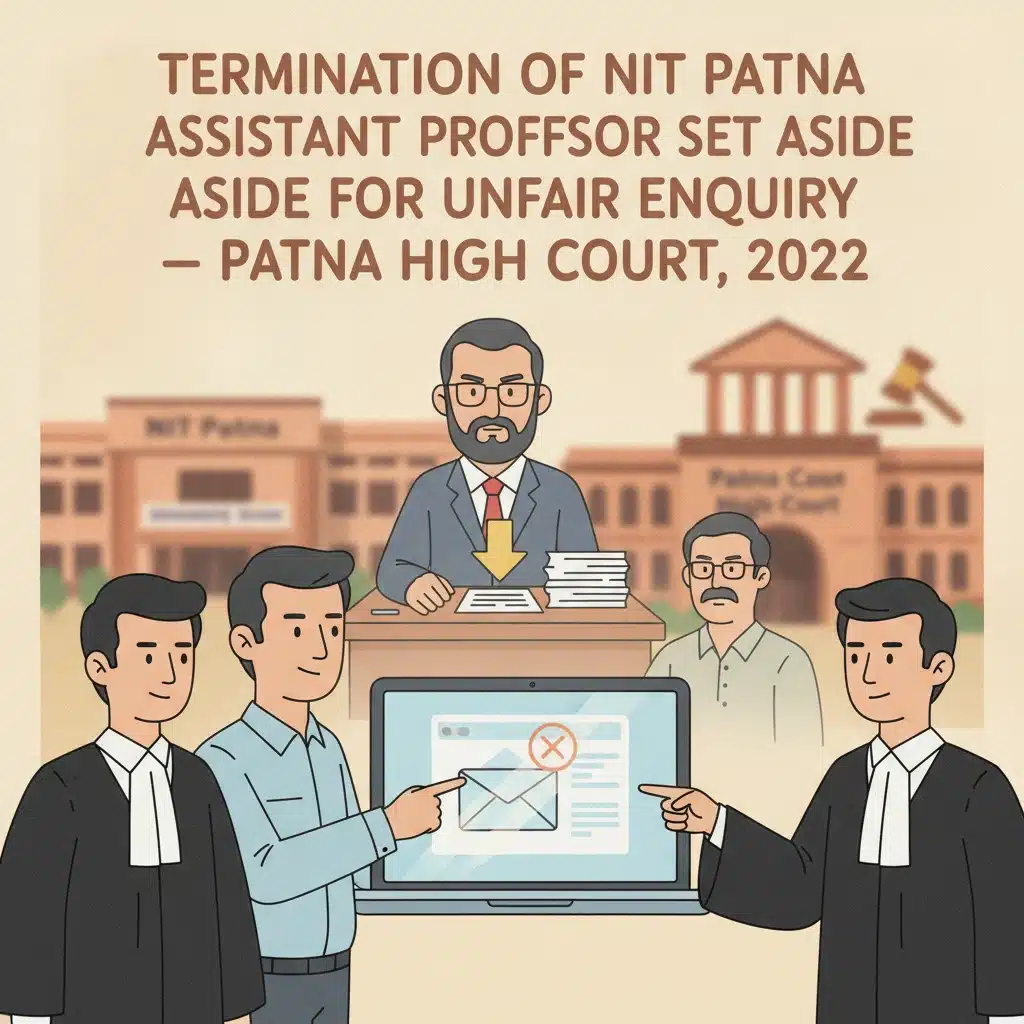
During the enquiry, one prosecution witness, Dr. Sunil Kumar Yadav, allegedly asked the petitioner to show the email through which the travel agent had sent the tickets. The petitioner had earlier submitted a snapshot of this email. The Enquiry Officer then asked the petitioner to log into his email account, downloaded the PDF tickets, and, as alleged by the petitioner, tampered with the account by deleting the relevant email. The petitioner lodged a detailed complaint about this to the Director, NIT Patna, on 17 October 2015.
The petitioner also claimed that the enquiry was concluded in a single sitting on 10 February 2016 without giving him a real chance to present a defence or examine witnesses. The Enquiry Officer’s report not only held him guilty of all charges but also recommended that “an exemplary punishment must be awarded to him for his misconduct.”
He further argued that crucial documents referred to in Annexure 3 of the charge-sheet, said to support the charges, were neither supplied to him nor proved by any departmental witness during the enquiry. He emphasised that there was no evidence from any railway official to prove that the tickets were forged or that the PNR numbers did not match valid journeys.
On the other side, NIT Patna’s counsel supported the disciplinary action. They argued that the petitioner had been given adequate opportunity and that the Enquiry Officer had fairly examined the materials on record. They contended that the enquiry could lawfully be completed in one day and that no adverse inference should be drawn merely on that basis.
They stressed that the High Court’s power in departmental matters under Article 226 is limited and supervisory. Relying on Supreme Court judgments, including Union of India v. P. Gunasekaran (2015) 2 SCC 610, State Bank of Bikaner and Jaipur v. Nemi Chand Nalwaya (2011) 4 SCC 584, and General Manager, Electrical v. Sri Gridhari Sahu (2019) 10 SCC 695, they submitted that the Court should not re-appreciate evidence or substitute its view for that of the disciplinary authority if some legal evidence exists.
The Patna High Court first surveyed the settled legal position on judicial review of departmental enquiries. Referring to several Supreme Court decisions, including P. Gunasekaran, Syed Yakoob v. K.S. Radhakrishnan (AIR 1964 SC 477), H.C. Goel (AIR 1964 SC 364), Kashinath Dikshita (1986) 3 SCC 229, Moni Shanker (2008) 3 SCC 484, Roop Singh Negi (2009) 4 SCC 570 and others, the Court reiterated that:
• The High Court cannot act as a second appellate court to re-assess or weigh the evidence.
• Its role is confined to seeing whether the enquiry was conducted by a competent authority, followed prescribed procedure, respected natural justice, and whether findings are supported by some legal evidence.
• Interference is warranted where there is bias, violation of natural justice, non-supply of relied-upon documents, or findings based on no evidence, or where extraneous considerations have vitiated the process.
Against this legal background, the Court closely examined the manner in which the enquiry against the petitioner had been held.
First, on the allegation of bias, the Court noted that respondent no. 5, the Enquiry Officer, was indeed a member of the BoG which had resolved to take departmental action and consider termination if the petitioner was found guilty. The Court held that once a person is party to such a decision, he ought not to be appointed as Enquiry Officer, particularly when it was not the respondents’ case that no other officer was available.
The Court also noted that in the writ proceedings, the Enquiry Officer had been impleaded as a respondent, but he chose not to file an affidavit denying the allegations of bias. This silence, along with the surrounding circumstances, weighed against him. Relying on the principle discussed in Professor Rameshchandra v. University of Delhi (2015) 5 SCC 549 and earlier cases like A.K. Kraipak and Ranjit Thakur, the Court held that bias could be inferred from such supervening circumstances.
Secondly, the Court found serious procedural defects in the enquiry itself. It recorded that:
• The enquiry was conducted and concluded in a single day.
• No prosecution witness was produced to prove the documents or substantiate the charges.
• The petitioner was not given an opportunity to examine any witness.
• The Enquiry Officer himself put questions to the petitioner and drew conclusions from those answers, effectively acting as prosecutor.
• The Enquiry Officer appeared to have relied on documents from the file which had not been supplied to the petitioner, nor formally proved during enquiry.
The Court held that this approach was contrary to the basic principles of a fair departmental enquiry, which require an impartial inquest based on evidence produced by the department and the delinquent, with copies of relied-upon documents being supplied in advance.
In particular, the Court was troubled by the allegation that the Enquiry Officer accessed the petitioner’s email, downloaded tickets, and allegedly deleted relevant mail. The Court observed that the fact of such an incident was borne out even from the Enquiry Officer’s report, yet the disciplinary authority had not examined the petitioner’s complaint dated 17 October 2015 about this alleged tampering.
The Court further noted that the Enquiry Officer had strongly recommended “exemplary punishment” in his report. This recommendation, in the Court’s view, underscored the element of prejudice and went beyond the neutral role expected of an enquiry officer.
On the issue of evidence, the Court highlighted that the allegation of forged tickets rested heavily on a report of a Railway Officer. However, this Railway Officer was never examined during the enquiry, and the report itself was not supplied to the petitioner. Yet, the Enquiry Officer treated the tickets as forged. The Court held that for such a serious conclusion, at least some admissible evidence had to be produced and tested in the enquiry, which had not been done.
The Court also observed that it was undisputed that the petitioner had actually travelled from Rourkela to Patna to join his post, and from Patna to Aligarh for the conference. The Enquiry Officer did not say that the petitioner had not travelled on the dates in question. Instead, the entire case focused on alleged discrepancies in PNR numbers. The Court held that when the fact of travel itself was not in dispute, a mere error in PNR should not by itself lead to a finding of misconduct without proper proof of forgery.
From these facts, the Court concluded that the Enquiry Officer and departmental authorities had allowed extraneous considerations to influence them, disabled themselves from reaching a fair conclusion, and violated the principles laid down by the Supreme Court in P. Gunasekaran and related cases.
Because of the clear bias, non-supply of documents, lack of evidence, and violation of natural justice, the Court held that the entire decision-making process was vitiated, and therefore the punishment order itself was unsustainable.
Accordingly, the Patna High Court quashed and set aside the Director, NIT Patna’s order dated 15 October 2019 terminating the petitioner’s services. The Court directed that the petitioner be reinstated with continuity of service for all intents and purposes. It further ordered that he would be entitled to salary for the intervening period, provided he had not worked elsewhere during that time. For this, he must submit a certificate along with a sworn affidavit to the University. The writ petition was allowed with all consequential benefits, and costs were made easy.
Why This Judgment Matters
This Patna High Court judgment is significant for teachers, government employees and staff in public institutions who face departmental enquiries for alleged misconduct.
First, it reinforces that enquiries cannot be a mere formality to justify a pre-decided punishment. The Enquiry Officer must be impartial and must not have taken part in earlier decisions to proceed against the employee. If a person already involved in deciding to take action later conducts the enquiry, the process is likely to be struck down.
Second, the judgment highlights that charges of forgery or fraud in travel claims require proper proof. If an employee has genuinely travelled, a clerical mistake in ticket details or PNR numbers, especially when tickets are arranged through agents, cannot automatically be treated as deliberate cheating without solid evidence and fair procedure.
Third, the Court stresses that basic rules of natural justice must be followed: supply of all relied-upon documents, opportunity to cross-examine witnesses, and a chance to present a defence. Enquiries concluded in haste, without witnesses and without sharing documents, will not stand judicial scrutiny.
Finally, the decision shows that even under the limited scope of judicial review, the High Court will intervene where there is bias, malice or “no evidence” to support serious findings. This offers some protection to contractual staff and others who may otherwise feel helpless against powerful institutional decisions.
Legal Issues and Answers
Issue: Whether the departmental enquiry against the petitioner, leading to his termination by NIT Patna, was fair, unbiased and in accordance with law.
Answer: No. The Patna High Court held that the enquiry was vitiated by bias, non-supply and non-proof of documents, absence of proper evidence, and violation of natural justice.
Issue: Whether the punishment order dated 15.10.2019 removing the petitioner from service could legally stand on the basis of such an enquiry.
Answer: No. As the decision-making process was found to be vitiated, the Court quashed the termination order and directed reinstatement with continuity of service and back wages subject to conditions.
Cases Cited by the Court
- Union of India v. P. Gunasekaran, (2015) 2 SCC 610
- State Bank of Bikaner and Jaipur v. Nemi Chand Nalwaya, (2011) 4 SCC 584
- General Manager, Electrical v. Sri Gridhari Sahu & Ors., (2019) 10 SCC 695
- State of Andhra Pradesh v. S. Sree Rama Rao, AIR 1963 SC 1723
- State of Andhra Pradesh & Ors. v. Chitra Venkata Rao, (1975) 2 SCC 557
- Railway Board v. Niranjan Singh, (1969) 1 SCC 502
- Syed Yakoob v. K.S. Radhakrishnan & Ors., AIR 1964 SC 477
- State of Uttar Pradesh & Ors. v. Saroj Kumar Sinha, (2010) 2 SCC 772
- Kashinath Dikshita v. Union of India & Ors., (1986) 3 SCC 229
- Trilok Nath v. Union of India, 1967 SLR 759 (SC)
- State of Punjab v. Bhagat Ram, 1975 (2) SCR 370
- State of Uttar Pradesh v. Mohd. Sharif (dead) through LRs, 1982 (2) LLJ 180
- Union of India v. H.C. Goel, AIR 1964 SC 364
- Moni Shanker v. Union of India & Anr., (2008) 3 SCC 484
- Roop Singh Negi v. Punjab National Bank & Ors., (2009) 4 SCC 570
- Professor Rameshchandra v. University of Delhi & Ors., (2015) 5 SCC 549
- A.K. Kraipak & Ors. v. Union of India & Ors., (1969) 2 SCC 262
- Ranjit Thakur v. Union of India & Ors., (1987) 4 SCC 611
- Amar Nath De v. State of West Bengal & Ors., (2002) 1 SLR 215
Case Details
Case Number: Civil Writ Jurisdiction Case No. 23415 of 2019
Case Title: Dr. Amjad Ali v. The National Institute of Technology, Patna & Ors.
Citation: 2022 (3) PLJR 184
Court: High Court of Judicature at Patna
Coram: Hon’ble Mr. Justice Sanjeev Prakash Sharma
Date of Judgment (Reserved Judgment Pronounced): 19.04.2022
Advocates:
- M/s Satyendra Rai & Shekhar Singh, Advocates – for the petitioner
- Mr. Y.V. Giri, Senior Advocate with M/s Sanjay Kumar Giri & Sumit Kumar, Advocates – for the respondents
Respondents: National Institute of Technology, Patna through its Registrar; Director, NIT Patna; Registrar, NIT Patna; Board of Governors, NIT Patna through its Chairman; and Dr. Rajiv Sinha (Enquiry Officer).
Nature of the Case: Writ petition under Article 226 of the Constitution challenging departmental enquiry and order of termination from contractual service.
Outcome: Writ petition allowed. Termination order dated 15.10.2019 quashed. Petitioner directed to be reinstated with continuity of service and salary for the intervening period subject to filing a certificate and sworn affidavit that he has not worked elsewhere.
Link to Full Judgment: Patna High Court Judgment – CWJC No. 23415 of 2019
If you found this explanation helpful and wish to stay informed about how legal developments may affect your rights in Bihar, you may consider following Samvida Law Associates for more updates.




