

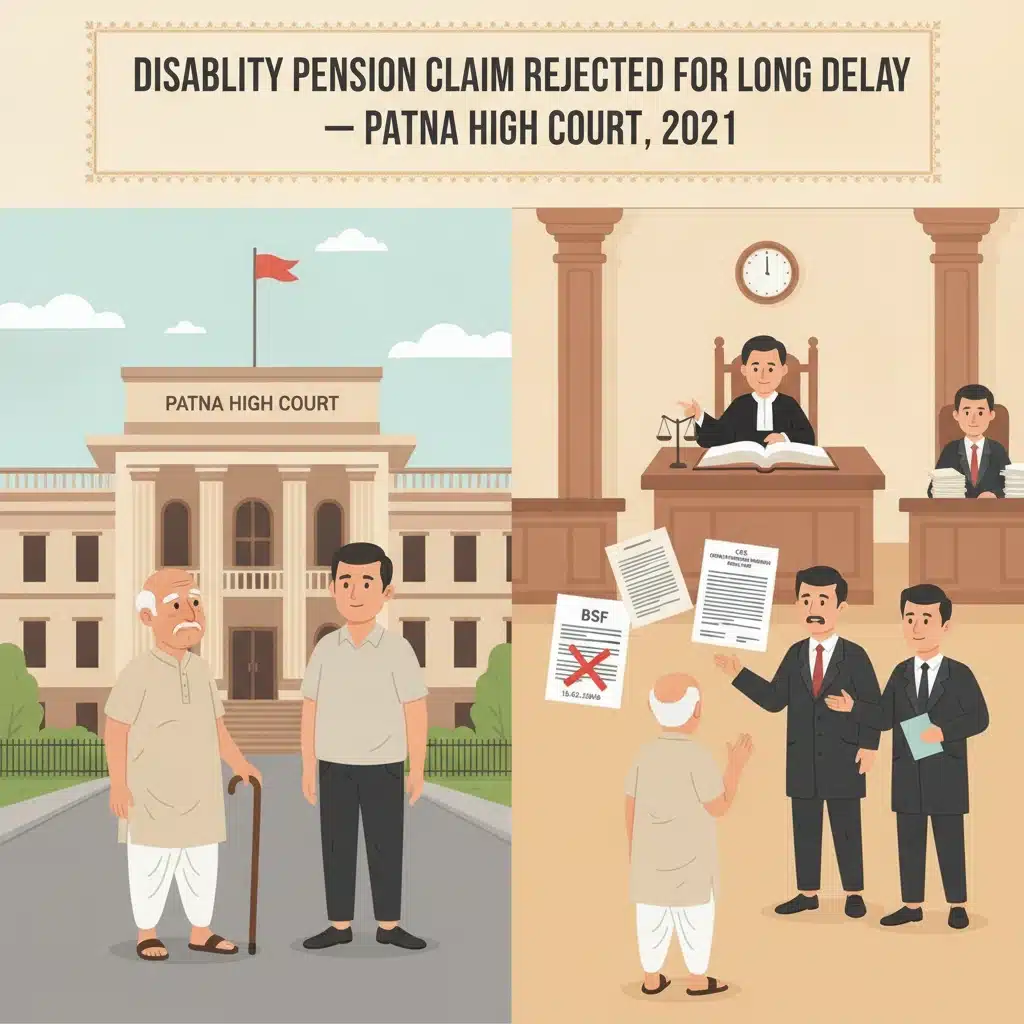
Case Background
The petitioner had joined the Border Security Force as a General Duty constable at Balurghat, West Bengal, on 16.03.1970.
Soon after joining service, he fell ill. He was referred to hospital on 28.12.1973 and remained admitted there until 16.06.1974, when he was discharged.
According to the case record, a sanction order was later issued on 20.03.1978. This order mentioned 10.10.1977 as the date of invalidation and sanctioned financial assistance of Rs. 50 per month to the petitioner from the BSF Contributory Benevolent Fund for a period of ten years with effect from 01.11.1977.
The petitioner was medically boarded out on 16.03.1978. However, no disability pension was released to him at that time.
Several decades later, the petitioner started raising the issue of disability pension. On 12.08.2015, the Deputy Commandant/Adjutant for the Commandant, 70 Battalion BSF, issued a letter informing him that he had been medically boarded out on 16.03.1978. The letter further informed him that disability pension could not be released because he had not completed ten years of service and that the matter was with higher headquarters for clarification or decision on entitlement.
Subsequently, by another letter dated 13.02.2016, the authorities informed the petitioner that he was not eligible for disability pension. They stated that under Rule 3A of the Central Civil Services (Extraordinary Pension) Rules, 1939, disability pension could be granted only if the disability was directly attributable to or aggravated by government service. The Medical Board had held that his disability was neither attributable to nor aggravated by service, and therefore he was not entitled to disability pension.
In 2017, nearly four decades after his medical invalidation, the petitioner approached the Patna High Court by filing a writ petition.
What the Court Examined and Decided
The petitioner asked the Patna High Court for three main reliefs. First, he wanted the Court to set aside the letters dated 19.08.2015 (Memo No. 13285-86) and 13.02.2016 (Memo No. 2357), by which he was informed that his disability was not attributable to or aggravated by service and that he did not qualify for disability pension under Rule 3A of the CCS (EOP) Rules, 1939.
Second, he sought a direction (by way of mandamus) to the Union of India and BSF authorities to grant him pension and all pensionary benefits, including compassionate appointment of his son, on the ground that his medical disability had occurred during service.
Third, he requested any other reliefs that the Court might consider appropriate in the facts of his case.
The petitioner’s central grievance was that he had been medically boarded out without being properly informed and without being given an opportunity to challenge the Medical Board’s findings. He argued that only in 2015 did he first come to know, through the letter dated 12.08.2015, that his case for disability pension was under consideration and that he had been medically boarded out earlier. Thereafter, in 2016, he was told he was not eligible for disability pension because the disability was neither attributable to nor aggravated by service.
His counsel submitted that under Rule 18(3) of the Border Security Force Rules, 1969, when a Medical Board gives its findings about an officer’s fitness, the Central Government is required to communicate those findings to the officer. After such communication, the officer has a right to make a representation within fifteen days.
The petitioner claimed that no such communication was ever made to him at the time of his medical invalidation. On this basis, he argued that his right to disability pension was never properly decided, and that the later letters in 2015 and 2016 constituted fresh causes of action.
He also contended that the grant of Rs. 50 per month from the BSF Contributory Benevolent Fund did not take away his entitlement to disability pension. According to him, this financial assistance could not be treated as a substitute for a pension to which he was legally entitled.
On the other hand, counsel for the Union of India opposed the writ petition. They pointed out that the writ petition had been filed only in 2017, after a delay of more than three decades from the time the petitioner was medically boarded out in 1978.
The respondents relied heavily on the sanction letter dated 20.03.1978, which granted the petitioner Rs. 50 per month as financial assistance from the BSF Contributory Benevolent Fund for a period of ten years. They explained that such financial assistance was sanctioned only in those cases where the individual was not eligible for disability pension because he had not completed ten years of service.
From this, the respondents argued that the petitioner was fully aware of his medical invalidation and the fact that he was not being given disability pension at that time. They stressed that he did not render any service after being boarded out on 16.03.1978.
The authorities characterised the letters dated 12.08.2015 and 13.02.2016 as merely “informatory” in nature. In their view, these letters only conveyed the existing position and did not create any fresh rights or obligations. Therefore, they could not be treated as giving rise to a fresh cause of action that would enable him to overcome the huge delay.
After hearing both sides, the Patna High Court examined the documents on record. The Court noted that it was not in dispute that the petitioner had been granted Rs. 50 per month from the BSF Contributory Benevolent Fund for ten years, starting from 01.11.1977, in terms of the sanction letter dated 20.03.1978.
The Court observed that this financial assistance was accepted by the petitioner “without demur,” meaning he did not object to it for a long time. The sanction letter clearly recorded the date of invalidation as 10.10.1977, which formed the basis for extending this financial assistance.
Significantly, the Court pointed out that it was not the petitioner’s case that he had rendered any service after being boarded out. This meant that he must have known that his service had come to an end due to medical reasons in 1978.
The Court therefore found it difficult to accept his plea that he came to know for the first time about his medical boarding out only in 2015.
The Court further referred to the petitioner’s own representation dated 08.12.2013 (Annexure-4). In that representation, the petitioner had specifically written that “The Department gave me retirement medically unfitted.” The Court treated this as a clear admission that he was aware he had been medically retired.
Regarding the argument that the Medical Board’s report had not been communicated to him, the Court held that the petitioner had not acted with due diligence. It noted that he obviously knew he had been medically examined by a Medical Board, yet he did not take any step or file any representation for over three decades after 1978.
Instead, he accepted the financial assistance and did not attempt to rejoin duty or challenge the medical invalidation.
On these facts, the Court concluded that his belated challenge was not justified. The petitions seeking to set aside the letters and to claim disability pension and compassionate appointment were found to be devoid of merit.
Ultimately, the Patna High Court refused to interfere and dismissed the writ petition.
Why This Judgment Matters
This judgment is important for retired personnel of armed and paramilitary forces, especially those seeking disability pension years after leaving service.
The Court has made it clear that if a person accepts alternative financial assistance and does not challenge medical retirement for decades, it becomes very difficult to later claim that he was unaware of his invalidation.
The decision also shows that informatory letters issued after many years, merely restating the old position, will not usually create a fresh right to approach the Court.
For serving or retired personnel, this case underlines the need to act promptly if they wish to contest medical board findings or claim disability pension. Waiting too long and remaining silent can weaken or completely destroy their legal claim.
Legal Issues and Answers
-
Issue: Whether the petitioner could, after more than three decades, claim disability pension and related benefits by challenging the 2015 and 2016 letters as fresh causes of action.
Answer: No. The Court held that the petitioner had long been aware of his medical invalidation, had accepted financial assistance without objection, and had not acted with due diligence. The later letters were only informatory and did not revive any claim. -
Issue: Whether non-supply of the Medical Board report or non-communication of its findings entitled the petitioner to relief in 2017.
Answer: No. The Court held that, despite knowing he had been medically examined and retired as “medically unfitted,” the petitioner took no steps for over three decades. His lack of diligence barred relief.
Cases Cited by the Court
- No earlier judgments are cited or relied upon in the text of this decision.
Case Details
Case Number: Civil Writ Jurisdiction Case No. 6536 of 2017
Case Title: Ram Naresh Singh v. Union of India & Ors.
Coram: Hon’ble Mr. Justice Vikash Jain
Citation: 2022(4) PLJR 314
Advocates: For the petitioner – Mr. Rajeev Kumar Singh, Advocate. For the Union of India – Mr. Awadhesh Kumar Pandey, Advocate; Mr. Ravinder Kumar Sharma, Advocate.
Nature of the Case: Writ petition under Article 226 of the Constitution seeking quashing of communications denying disability pension and seeking directions for grant of disability pension, pensionary benefits and compassionate appointment.
Link to the Judgment: Patna High Court Judgment
If you found this explanation helpful and wish to stay informed about
how legal developments may affect your rights in Bihar,
you may consider following Samvida Law Associates for more updates.




