

Case Background
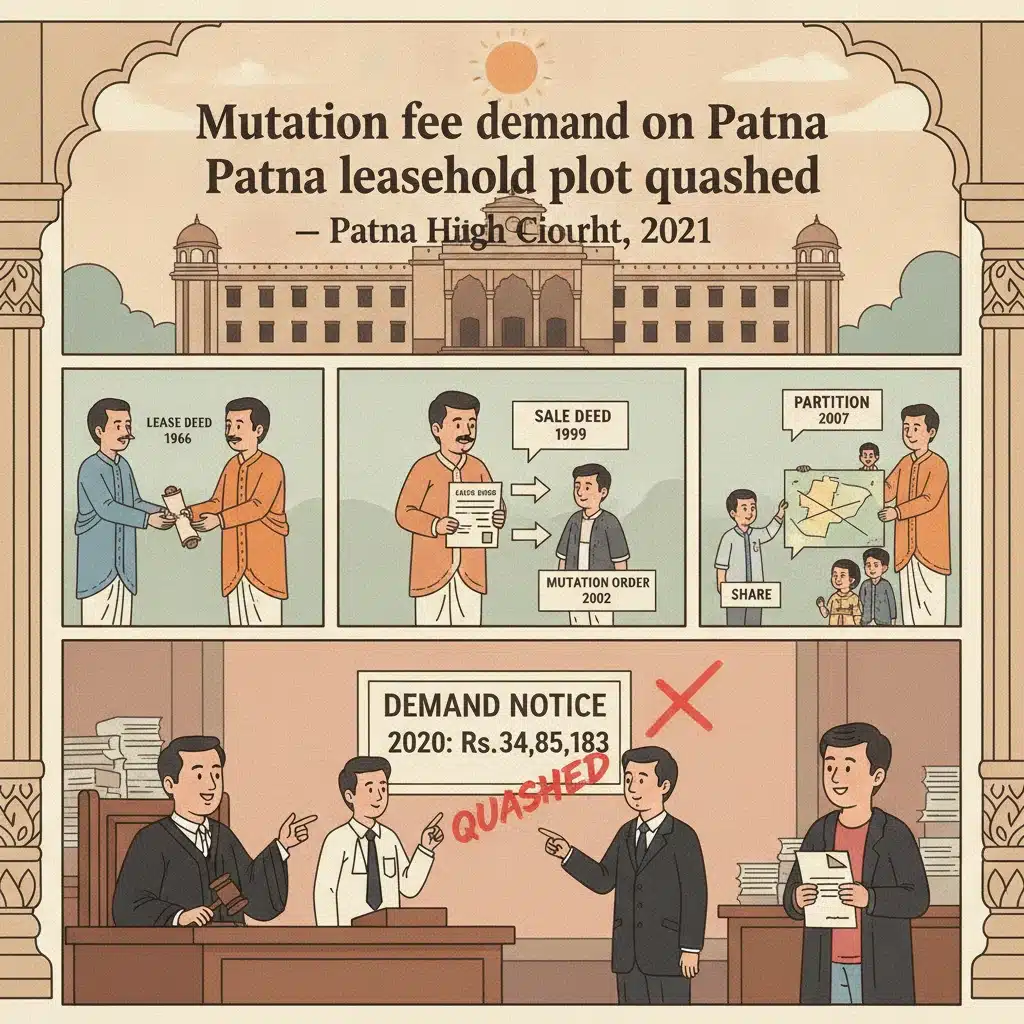
This case arises from a long-term lease of a residential plot in Rajendra Nagar, Patna. Plot No. 10-X in Block B, measuring 840 square yards, was originally leased by the then development authority to one Ramesh Singh through a registered lease deed dated 15.03.1966. The lease was for 99 years and was renewable at the option of the lessee. After this deed, the original lessee came into possession of the property.
Many years later, on 07.04.1999, the original lessee sold the same plot to the father of the present petitioner by a registered sale deed. The petitioner states that he was put in possession under this transaction. For the purpose of stamp duty, the value of the land mentioned in the deed was Rs. 15,95,000, which, according to the petitioner, reflected the valuation assessed by the Government for payment of stamp duty.
Following this purchase, the petitioner’s father came into possession of the property. Mutation of the land in his name was approved by the authority through an order dated 10.10.2002, bearing Memo No. 3095. Thus, his title and name in the records stood recognised.
The petitioner’s father passed away on 01.09.2007. After his death, the property was partitioned among the legal heirs, including the petitioner. The petitioner then acquired his specific share in this plot through this family partition.
After acquiring his share, the petitioner applied on 10.03.2018 for mutation of his name in the municipal records with respect to his portion of the property. Instead of a simple mutation, the Estate Officer of Patna Municipal Corporation, by letter dated 24.09.2020 bearing Memo No. 11163, demanded mutation fee amounting to Rs. 34,85,183. This demand letter is Annexure-P/6 to the writ petition.
Feeling that this huge amount was illegal and contrary to the original lease conditions, the petitioner approached the Patna High Court by filing Civil Writ Jurisdiction Case No. 8508 of 2020. He prayed for quashing of the mutation fee demand letter as without authority.
What the Court Examined and Decided
The central dispute before the Patna High Court was whether the Patna Municipal Corporation could demand such a high mutation fee relying on the Patna Regional Development Authority (Disposal of Land) Rules, 1978, despite what was written in the original lease deed of 1966.
The petitioner’s specific grievance was that the mutation fee demand violated the terms of his father’s lease. The Court therefore examined the lease deed. Clause 12 of the lease was particularly relevant. It restricted transfer of the leased plot by way of sale, exchange or otherwise within ten years from the date of the lease, unless written consent of the lessor was obtained and conditions prescribed by the lessor were followed.
However, this clause also clearly stated that no such consent would be required in case of a gift to an heir or relative or a transfer under a Will. Importantly, Clause 12 did not speak about any obligation to pay a mutation fee at the time of later transfers beyond ten years, nor did it provide for sharing any portion of profit or sale consideration with the authority.
On the other hand, the respondents relied on Rule 20 of the Patna Regional Development Authority (Disposal of Land) Rules, 1978, framed under the Bihar Regional Development Authority Act, 1981. The counter affidavit of the respondents reproduced this rule.
Rule 20 states that no plot or part of a plot leased by the authority shall be transferred by sale or gift within ten years from the date of the lease without permission of the authority. It further provides that even when ten years have expired, the intention to transfer the land along with the lease conditions must be intimated in writing before transfer. The authority is given a first right to resume the land by reimbursing the premium along with 6% interest per annum.
Crucially, Rule 20 also lays down that if the authority grants permission for transfer of land, the allottee shall pay a mutation fee equal to 50% of the excess of sale price over the premium originally paid by the allottee. It further stipulates that this mutation fee shall not be less than 10% of the premium charged by the authority while leasing out the plot. An additional proviso governs bifurcation or change of use of the leased land, requiring prior approval of the authority.
In the present case, the respondents relied on this Rule 20 of the 1978 Rules to justify the demand of Rs. 34,85,183 as mutation fee. Their stand was that this rule authorised them to demand 50% of the profit or excess sale price as mutation fee whenever the leasehold property was transferred.
The Court, however, did not consider this argument in isolation. It examined a prior decision of the Patna High Court in the case of Sanjay Singh vs. State of Bihar & Others, reported in 2015 (2) PLJR 58. In that earlier case, a similar demand for mutation fee had been raised by the authorities on the basis of the same 1978 Rules.
The Court in Sanjay Singh had analysed Rule 20 and concluded that permission of the authority for transfer of the leased plot is required only when the transfer takes place within ten years of the original settlement. It held that even assuming Rule 20 applies, the requirement to pay mutation fee equal to 50% of the profit arises only where such permission is necessary and actually granted.
The judgment in Sanjay Singh further observed that, where the transfer occurs beyond ten years from the date of the original lease, the rule regarding payment of 50% of the profit would not apply. In that context, the Court held that if no permission is required, the question of paying mutation fee linked to such permission does not arise.
The Sanjay Singh judgment also examined how deeds of lease originally executed by the Patna Improvement Trust were to be treated after the creation of the Patna Regional Development Authority (PRDA). It held that such leases would be considered as if executed by PRDA itself, and therefore PRDA would be bound by the specific terms and conditions inserted in those lease deeds.
On a conjoint reading of the lease conditions and Rule 20, that judgment decisively held that PRDA could not ask the allottee to part with 50% of the amount earned from transfer of the plot in view of Rule 20 when the transfer takes place beyond ten years of the original lease.
Relying on this reasoning, the Division Bench in the present case noted that the very same issue had already been decided in Sanjay Singh. The Bench observed that the earlier judgment had clearly held that PRDA was bound by its own lease terms and could not override them by invoking the 1978 Rules to unilaterally impose financial burdens such as mutation fee.
The Court in the present writ petition accepted that the terms and conditions inserted in the 1966 lease deed were binding between the parties. Therefore, the authority could not alter these contractual terms on its own by issuing rules or orders under the 1978 Rules. In simple terms, once the authority had signed the lease with certain conditions, it could not later change those conditions and demand new charges unless the lease itself permitted such changes.
The Bench emphasised that, as already held in Sanjay Singh, the PRDA (and thereby, in effect, the municipal authority dealing with the property) could not raise a demand based on Rule 20 of the 1978 Rules in such a situation. The terms of the lease prevailed.
When this legal position was put to the learned Senior Counsel appearing for the PRDA, he fairly acknowledged that he faced difficulty in defending the mutation fee demand. In view of the settled law laid down in Sanjay Singh, he accepted that the present matter was a “covered case”, meaning that the earlier decision squarely applied to these facts.
After considering the rival submissions, the Division Bench, speaking through Hon’ble Mr. Justice Madhuresh Prasad (with Hon’ble Mr. Justice Chakradhari Sharan Singh agreeing), held that the demand raised by letter dated 24.09.2020 bearing Memo No. 11163 by the Estate Officer, Patna Municipal Corporation, could not be sustained in law.
Accordingly, the Court quashed the impugned letter demanding Rs. 34,85,183 as mutation fee. With this finding, the writ petition was allowed. There is no further direction recorded regarding any other relief, indicating that the quashing of the demand itself fully redressed the grievance of the petitioner.
Why This Judgment Matters
This judgment is important for leasehold property owners in Patna and similar urban areas. Many such properties were originally leased decades ago with specific written terms. Over time, authorities have framed new rules and sometimes try to collect heavy amounts like mutation fee based on those later rules.
The Patna High Court has clearly held that where a lease deed already sets out the rights and limitations, the authority cannot later change the deal by unilaterally applying new rules to demand extra money. The original contract between the parties continues to bind both sides.
For ordinary citizens who inherit or buy such leasehold properties, this decision shows that demands for large mutation fees based purely on the 1978 Rules, without support from the lease deed and without the situation of transfer within ten years, can be challenged. The judgment reinforces that authorities must act within the four corners of the documents they themselves have executed.
Legal Issues and Answers
Issue: Can the Patna Municipal Corporation demand a large mutation fee on transfer or partition of a leasehold plot by relying on Rule 20 of the 1978 Disposal of Land Rules, when the original lease deed does not provide for such a fee and the transfer is well beyond ten years from the date of lease?
Answer: No. Following the earlier decision in Sanjay Singh, the Court held that the authority is bound by the terms of the original lease deed. Rule 20 of the 1978 Rules cannot be used to unilaterally alter those terms or to demand mutation fee where permission for transfer is not required.
Cases Cited by the Court
- Sanjay Singh vs. State of Bihar & Others, 2015 (2) PLJR 58
Case Details
Case Number: Civil Writ Jurisdiction Case No. 8508 of 2020
Case Title: Arvind Kumar Singh vs. The State of Bihar & Others
Citation: 2022 (4) PLJR 189
Coram: Hon’ble Mr. Justice Chakradhari Sharan Singh; Hon’ble Mr. Justice Madhuresh Prasad
Date of Judgment: 10.12.2021
Advocates:
- For the Petitioner: Mr. Patanjali Rishi with Ms. Prerna Rishi, Advocates
- For Patna Municipal Corporation: Mr. Bindhyachal Singh, Senior Advocate with Mr. Vipin Kumar Singh
- For Respondent Nos. 1 and 2 (State of Bihar): Mr. Satyeshwar Prasad, AC to SC-7
Nature of the Case: Writ petition (civil) challenging demand of mutation fee by Patna Municipal Corporation.
Link to Full Judgment: Click here to read the official Patna High Court judgment
If you found this explanation helpful and wish to stay informed about
how legal developments may affect your rights in Bihar,
you may consider following Samvida Law Associates for more updates.




