

Case Background
These connected writ petitions arose from agricultural land disputes in Mauja Rampur Tola, Ammaghaud, P.S. Shikarpur, District West Champaran. The lands originally belonged to Late Ishwari Prasad Jhunjhunwala, who was admitted as “Proprietor” under Section 3(2) of the Bihar Tenancy Act, 1885. After his death, his sons, the present petitioners, continued as owners in possession.
Several cultivators from the same village claimed that they were Sikmidars or Bataidars (sharecroppers) on different plots or portions of this land. Each cultivator filed a separate Bataidari case under Section 48-D of the Bihar Tenancy Act before the Sub-Divisional Magistrate, Narkatiaganj, who is the “Collector” under Section 3(16) of the Act.
Respondent No.4 in each writ petition had filed individual Bataidari cases in the year 1998-99. Apart from them, some other persons also filed similar Bataidari cases, making a total of 14 cases. In all these cases, the claim was that the applicants were Bataidars on the land of the petitioners’ father and that he was trying to dispossess them.
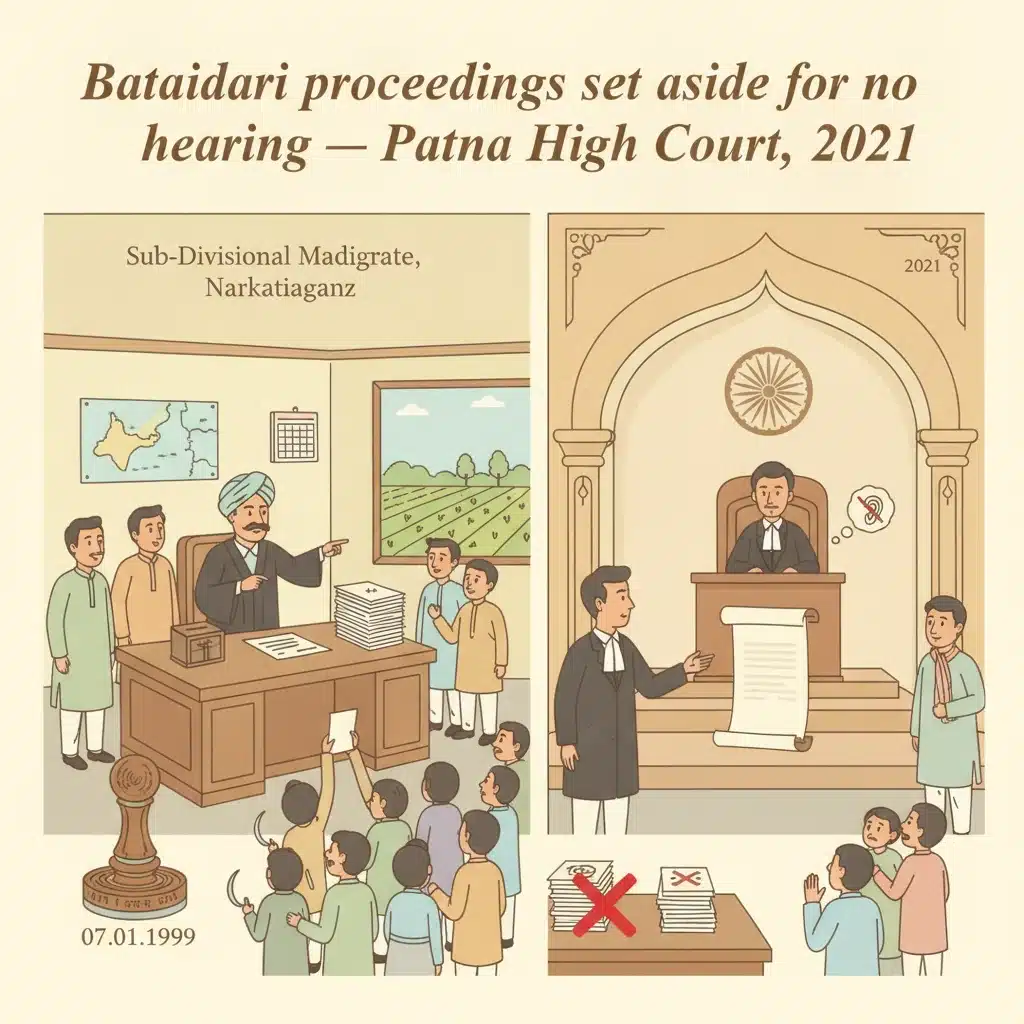
All 14 Bataidari cases were heard together by the Sub-Divisional Magistrate, Narkatiaganj. By a common operative order dated 07.01.1999, passed in Bataidari Case No. 88 of 1998-99 (Saiful Hasan v. Ishwari Prasad Jhunjhunwala), the Collector dismissed all the Bataidari claims. The individual case records of the other 13 Bataidari cases carried brief orders dated 07.01.1999 referring to this main order in Case No. 88 of 1998-99.
Later, some of the unsuccessful Bataidari applicants, except Saikh Saiful Hasan himself, approached the Land Reforms Deputy Collector, Narkatiaganj. They claimed that since the detailed order was not separately written and signed in their individual case files, no valid order had been passed in their matters. Proceeding on this contention, the Land Reforms Deputy Collector, by order dated 23.12.1999, directed constitution of a Board under Section 48-E of the Bihar Tenancy Act for these disputes and ordered that the same direction would apply in all the related Bataidari cases.
The present petitioners, being landowners, were later noticed in the Section 48-E proceedings. They appeared and filed a petition dated 31.05.2000, asserting that all Bataidari cases had already been dismissed on merits by the detailed order dated 07.01.1999 in Case No. 88 of 1998-99. They maintained that the order had attained finality and that the Deputy Collector’s order dated 23.12.1999 was contrary to law. Their request to review that order was rejected on 14.06.2000 on the ground that the authority had no power of review. Aggrieved, the landowners approached the Patna High Court in these writ petitions.
What the Court Examined and Decided
Hon’ble Mr. Justice Birendra Kumar heard all the connected writ petitions together. The petitioners sought a writ of certiorari to quash all orders passed after 07.01.1999 in the concerned Bataidari cases, especially the order dated 23.12.1999 of the Land Reforms Deputy Collector under Section 48-E.
The Court first looked at the status of the petitioners with respect to the land. In paragraph 4 of each writ petition, the petitioners had stated that their father, Late Ishwari Prasad Jhunjhunwala, was owner in possession of the specified lands in Mauja Rampur Tola, Ammaghaud. The Court noted that respondent No.4 in each case, in his separate counter affidavit, had admitted that the statements in paragraph 4 of the writ petition were correct.
From this admission, the Court held that the private respondents had impliedly accepted the possession of the petitioners over the land. The respondents were claiming Bataidari rights over the same land. However, for protection under Section 48-E of the Bihar Tenancy Act, a Bataidar must be in possession. If the landowners are in possession and the alleged Bataidars are not, they cannot seek protection under Section 48-E.
The Court then examined the sequence of the Bataidari proceedings. The Sub-Divisional Magistrate, Narkatiaganj, as Collector, had passed a detailed, reasoned order on 07.01.1999 in Bataidari Case No. 88 of 1998-99. In that order, he recorded the submissions of both sides. The applicants in all 14 cases claimed that they were Bataidars on the land and feared dispossession. The landowners, in their defence, asserted that:
- the claim of Bataidari was falsely made,
- the land was under their own cultivating possession through their labour,
- the applicants had no evidence of sharing crops or ploughing the fields,
- other persons (Md. Ayub and Abdul Qyum) had also claimed Bataidari over the same land in Bataidari Case Nos. 98 and 99 of 1998-99,
- earlier Bataidari cases in 1975-76 (Case Nos. 1370 and 1379 of 1975-76) in respect of the same land had been dismissed after a Batai Board’s report, and
- even in 1997-98, another Bataidari case (Case No. 09 of 1997-98, Seikh Bijali v. Ishwari Prasad Jhunjhunwala) had been dismissed by the Land Reforms Deputy Collector on the basis of a compromise.
In the 07.01.1999 order, the Collector, after hearing both sides and examining the records, found that the lands over which Bataidari was claimed were the same lands which were the subject of the earlier Bataidari cases and also of the pending cases of Md. Ayub and Abdul Qyum. Considering the previous dismissals and absence of supporting materials, the Collector held that the claim of the applicants was wrong and baseless and made only to harass the landowner and grab his land. He therefore dismissed the application of all 14 applicants and expressly stated that the same order would apply to the other 13 Bataidari cases.
In each of the other Bataidari files, a short order was recorded on 07.01.1999. These entries noted the presence of the parties and stated that the order had been passed as per the order in Case No. 88 of 1998-99. The Patna High Court treated these entries, read with the detailed order in Case No. 88, as sufficient evidence that all 14 cases had been disposed of on merits by a common order.
Despite this, the applicants in the other Bataidari cases (excluding Saikh Saiful Hasan) later contended before the Land Reforms Deputy Collector that, since there was no signed, detailed order in their individual files, their cases remained undecided. Acting on this purely technical objection, the Deputy Collector, by order dated 23.12.1999, proceeded under Section 48-E and ordered constitution of a Board. He also directed that this order would apply to all the related Bataidari cases.
The High Court examined Section 48-E of the Bihar Tenancy Act in some detail. This provision empowers the Collector to initiate proceedings to prevent unlawful ejectment of an under-raiyat (such as a Bataidar), or to restore possession where an under-raiyat has been unlawfully ejected. It further provides for temporary protective orders, and for constitution of a Board to help settle disputes between landlord and under-raiyat.
The Court noted that under the Bihar Tenancy Act, there is no alternative statutory remedy against an order passed under Section 48-E. Therefore, the petitioners were justified in approaching the High Court directly.
More importantly, the Court found that the Deputy Collector’s order dated 23.12.1999 had been passed without giving any opportunity of hearing to the petitioners. At that time, there was already a final order in their favour dismissing all the Bataidari claims. Any fresh step under Section 48-E which disturbed that position could not be taken without hearing them.
The Court held that this failure amounted to violation of the principles of natural justice. The Deputy Collector had acted contrary to basic judicial procedure. He did not examine the detailed and reasoned order dated 07.01.1999 in Bataidari Case No. 88 of 1998-99, although the individual case records clearly showed that the other cases had been disposed of in the light of that order.
The Court also pointed out that the Deputy Collector was himself aware that a common order passed in one case could be applied to others. While constituting Boards under Section 48-E in these Bataidari disputes, he had passed a single order in Bataidari Case No. 89 of 1998-99 on 23.12.1999 and made it applicable to all other Bataidari cases. Therefore, ignoring the similar common order dated 07.01.1999 was inconsistent and arbitrary.
During the hearing before the High Court, the learned counsel for the State respondents, Mr. Aditya Nath Jha, did not dispute the legal position that the order dated 23.12.1999 was passed without hearing the petitioners and without examining the main order dated 07.01.1999 which had dismissed all the Bataidari cases on merits.
In view of these findings, the Court concluded that the impugned order dated 23.12.1999 had been issued in flagrant violation of natural justice and without applying ordinary judicial prudence. It led to miscarriage of justice by reopening disputes that had already been finally decided. Accordingly, the High Court quashed the order dated 23.12.1999 and all subsequent orders in the Bataidari cases which were contrary to the effect of the 07.01.1999 order. All the writ petitions were allowed, with no order as to costs.
Why This Judgment Matters
This judgment is important for landowners and cultivators involved in Bataidari disputes under the Bihar Tenancy Act. It confirms that once Bataidari cases are heard on merits and dismissed by a competent authority, they cannot be quietly reopened on technical grounds without hearing the landowners.
The Patna High Court emphasised that entries in connected case records referring to a common detailed order are sufficient to show that all cases were decided, even if a separate long order is not written in each file. Authorities cannot ignore such records to favour one side.
The decision also reinforces that Section 48-E is meant to protect genuine under-raiyats who are in possession or have been unlawfully ejected, not to be used to harass landowners after claims have been rejected. Any action under Section 48-E that affects existing rights must follow the principles of natural justice, including notice and hearing to the affected parties.
Legal Issues and Answers
Issue: Could the Land Reforms Deputy Collector initiate fresh proceedings under Section 48-E of the Bihar Tenancy Act by constituting a Board on the basis that separate signed orders were not present in each Bataidari case file, despite a common detailed order dismissing all 14 cases?
Answer: No. The Patna High Court held that all the Bataidari cases had already been dismissed on merits by the common order dated 07.01.1999, and the subsequent order dated 23.12.1999, passed without hearing the landowners and without examining the earlier order, was arbitrary and in violation of natural justice. It was therefore quashed, along with all consequential orders.
Issue: Are alleged Bataidars who are not in possession entitled to protection under Section 48-E of the Bihar Tenancy Act?
Answer: The Court indicated that protection under Section 48-E is meant for under-raiyats in possession or unlawfully ejected. Here, the private respondents had admitted the petitioners’ possession, and therefore could not legitimately claim protection as Bataidars under Section 48-E.
Cases Cited by the Court
- No previous judicial decisions were cited or relied upon in this judgment. The Court decided the matter on the basis of the Bihar Tenancy Act, 1885 and the records of the Bataidari proceedings.
Case Details
Case Numbers:
Civil Writ Jurisdiction Case No. 6485 of 2000
Civil Writ Jurisdiction Case No. 6486 of 2000
Civil Writ Jurisdiction Case No. 6490 of 2000
Civil Writ Jurisdiction Case No. 6492 of 2000
Civil Writ Jurisdiction Case No. 6493 of 2000
Civil Writ Jurisdiction Case No. 6503 of 2000
Civil Writ Jurisdiction Case No. 6511 of 2000
Civil Writ Jurisdiction Case No. 6512 of 2000
Civil Writ Jurisdiction Case No. 6534 of 2000
Civil Writ Jurisdiction Case No. 6542 of 2000
Case Title:
Bishwanath Jhunjhunwala and another v. The State of Bihar and others (with connected matters as listed above)
Coram:
Hon’ble Mr. Justice Birendra Kumar
Date of Judgment:
02.12.2021
Citation:
2022 (4) PLJR 195
Advocates:
For the petitioners (in all writ cases): Mr. Ganpati Trivedi, Senior Advocate
For the respondent-State (in all writ cases): Mr. Aditya Nath Jha, A.C. to S.C. 18
Names of counsel for private respondents are not mentioned in the judgment.
Nature of the Case:
Civil writ petitions under Article 226 of the Constitution of India, seeking certiorari to quash orders passed under Section 48-E of the Bihar Tenancy Act, 1885 in relation to multiple Bataidari cases.
Link to Judgment (Patna High Court official website):
Click here to access the full judgment text
If you found this explanation helpful and wish to stay informed about
how legal developments may affect your rights in Bihar,
you may consider following Samvida Law Associates for more updates.




