

Case Background
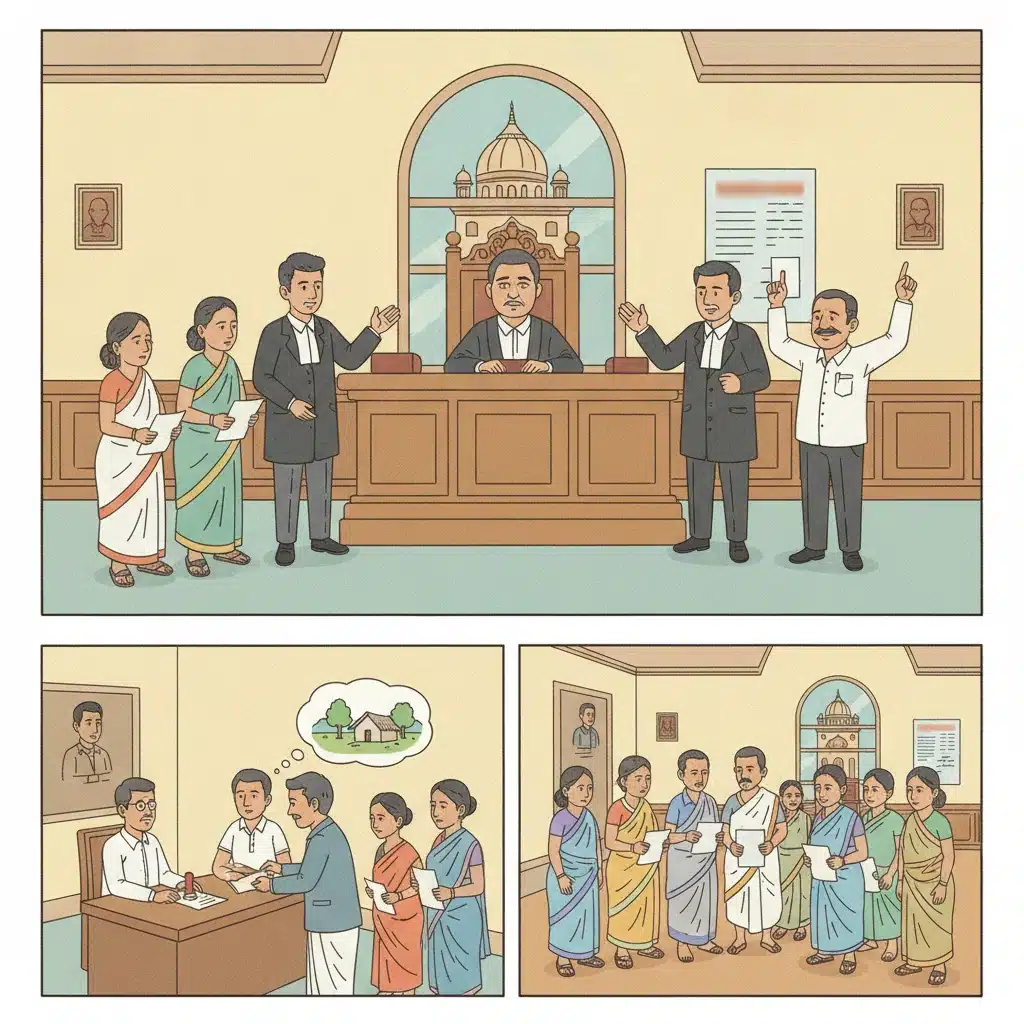
The case arises from allotment of land to several landless persons in district Supaul through provisional purchas. These purchas were issued after acquisition of certain lands under the ceiling law and were followed by mutation of the petitioners’ names in revenue records.
Later, the authorities themselves found that the acquisition of the land was illegal. By a District Gazette Notification dated 27.11.1985, the acquisition was cancelled. This meant that the very basis on which the purchas had been issued no longer existed.
The earlier landholders had approached the Patna High Court in CWJC No.1581 of 1989. On 16.03.1999, the Court held that the action of the Collector in not cancelling the provisional purchas was illegal and arbitrary. It set aside the Collector’s refusal under Section 37 of the Ceiling Act and directed the Collector to withdraw the provisional purchas granted with respect to the petitioners’ lands.
In compliance with this specific mandamus from the Patna High Court, the Collector, Supaul, passed an order dated 17.01.2015 in Miscellaneous Ceiling Case No.40 of 2001. By this order (Annexure-6), he withdrew the provisional purchas issued in favour of the present petitioners.
The petitioners challenged the Collector’s order before the Bihar Land Tribunal, Patna. On 13.07.2017, the Tribunal dismissed their challenge (Annexure-2), holding that the Collector had only followed the previous High Court directions.
Aggrieved by both the Collector’s order and the Bihar Land Tribunal’s order, the petitioners filed the present writ petition, Civil Writ Jurisdiction Case No.22206 of 2018, before the Patna High Court.
What the Court Examined and Decided
Hon’ble Mr. Justice Anil Kumar Upadhyay heard the matter. The petitioners were represented by learned counsel, and the State and its officers were represented by Government counsel.
The central grievance of the petitioners was that they had been residing and cultivating the land for a long time on the strength of provisional purchas and their names had been duly mutated. They argued that the Collector passed the order dated 17.01.2015 (Annexure-6) cancelling the purchas without hearing them.
They emphasised that, as landless persons, the cancellation of purchas and resulting dispossession would severely affect them and their families. They raised the issue of lack of opportunity of hearing and the hardship caused by displacement.
On the other side, the record before the Court showed that:
- The land in question had been acquired and then distributed through provisional purchas.
- Subsequently, the acquisition was found to be illegal by the very respondents who had acquired it.
- This illegality led to cancellation of the acquisition through a District Gazette Notification dated 27.11.1985.
- The earlier writ petition, CWJC No.1581 of 1989, had already been allowed by the Patna High Court on 16.03.1999 with a clear direction to the Collector to withdraw the provisional purchas.
The High Court in the earlier case had considered the materials on record and concluded that the Collector’s initial refusal to cancel the provisional purchas under Section 37 of the Act was “highly unjust and improper”. It set aside that refusal and positively directed the Collector to withdraw the provisional purchas relating to the petitioners’ lands. There was no order as to costs, but the direction was categorical.
In the present writ, the Court noted that the Collector was “helpless” in view of the binding direction given by the Patna High Court in 1999. Once such a mandamus had been issued, the Collector was duty-bound to comply. He could not disregard or modify the earlier order.
The Court reasoned that, since the acquisition itself had been cancelled by the Government through the District Gazette, the very “foundation of issuance of Purcha” was gone. Provisional purchas were only a consequence of the acquisition; they could not survive on their own when the acquisition was declared illegal and withdrawn.
Therefore, there was “absolutely no occasion for the Collector to allow the purcha-holder to continue and retain the land on the strength of issuance of Purcha” after the acquisition was cancelled. The Collector’s subsequent order withdrawing the purchas was thus a necessary consequence of both:
- The Government’s cancellation of acquisition via Gazette Notification dated 27.11.1985, and
- The Patna High Court’s direction dated 16.03.1999 in CWJC No.1581 of 1989.
The Court also took note that the decision of the Collector had already been challenged before the Bihar Land Tribunal. The Tribunal had recognised that the Collector’s order was in “compliance of the direction” issued by the High Court in the earlier writ. Since the Collector was acting under a judicial mandate, the Tribunal found no fault with his order and dismissed the challenge.
Faced with this background, the present Patna High Court bench examined whether there was any “infirmity” in the Collector’s decision (Annexure-6). The Court concluded that, once the underlying acquisition and the earlier judicial direction both required withdrawal of the purchas, the Collector had acted correctly. Hence, the Court refused to interfere with the Collector’s and the Tribunal’s orders.
On the argument that the petitioners were not heard before the Collector passed the impugned order, the judgment does not record any separate finding accepting this as a ground to overturn the order. Instead, the Court focused on the legal position that the purchas could not stand when the acquisition had already been cancelled through Gazette Notification and the earlier High Court judgment had directed withdrawal of those very purchas.
However, the Court did not ignore the human aspect raised by the petitioners. It acknowledged that the petitioners and their families were landless people and that cancellation of the provisional purchas would displace them from the land on which they were living or dependent.
To address this concern, the Court adopted a balanced approach. While upholding the legality of the Collector’s action, it sought to provide a path for potential rehabilitation of the petitioners.
The Court recorded the petitioners’ grievance that their family members would be displaced and that they, being landless, required rehabilitation at an alternative place. Recognising this, the Court “in order to do justice to the petitioners” disposed of the writ petition with a specific liberty in their favour.
The petitioners were given liberty to approach the Collector, Supaul, with a representation. The purpose of this representation would be to “explore the possibility of providing another land for rehabilitation of these petitioners who are landless people.”
The Court directed the Collector, Supaul, to take a “necessary decision” on the representation within six months from the date of receipt of a copy of the Court’s order. Thus, while declining to restore the withdrawn provisional purchas, the Court built in a time-bound mechanism for the administrative authority to consider alternative allotment or rehabilitation.
With these directions, the writ petition was disposed of. No further relief was granted to the petitioners regarding the impugned orders themselves, which effectively remained in force.
Why This Judgment Matters
This judgment is important for landless families who receive land through government schemes, particularly via provisional purchas. It clarifies that if the original acquisition of land is later cancelled as illegal, the purchas granted on that basis cannot continue.
For affected persons, this means that long possession and mutation entries may not protect their rights if the very foundation of their allotment is removed. At the same time, the Patna High Court has indicated that authorities should consider rehabilitation of such landless persons, even where their legal claim to the particular piece of land fails.
The judgment reinforces that Collectors and other officers must comply with prior binding directions of the High Court. They cannot ignore or refuse to implement such orders, even if it leads to hardship for those currently in possession.
For lawyers and activists working with landless communities, the case underlines the need to verify the legality of the underlying acquisition and to pursue rehabilitation or alternative land where cancellation has already been ordered by the courts or the government.
Legal Issues and Answers
-
Issue: Whether the Collector’s order dated 17.01.2015 withdrawing provisional purchas issued in favour of the petitioners was illegal or liable to be quashed.
Answer: No. The Patna High Court held that the Collector was bound by the earlier High Court direction dated 16.03.1999 and by the Gazette cancellation of the acquisition, so the withdrawal of purchas was valid and disclosed no infirmity. -
Issue: What relief, if any, should be given to landless petitioners displaced due to cancellation of their provisional purchas.
Answer: The Court did not restore the purchas but granted liberty to the petitioners to approach the Collector, Supaul, for possible alternative land for rehabilitation, directing a decision within six months of receipt of the order.
Cases Cited by the Court
- The judgment expressly refers to an earlier decision of the Patna High Court dated 16.03.1999 in CWJC No.1581 of 1989, where the Court directed the Collector to withdraw the provisional purchas relating to these lands.
Case Details
Case Number: Civil Writ Jurisdiction Case No.22206 of 2018
Case Title: Hare Krishna Ram and Ors v. The State of Bihar and Ors
Coram: Hon’ble Mr. Justice Anil Kumar Upadhyay
Citation: 2022(4) PLJR 301
Advocates:
For the Petitioners: Mr. Manish Kumar No. 13, Mr. Rohit Kumar, Advocates
For the Respondents: Mr. Subash Chandra Yadav, GP 15; Mr. Rakesh Kumar Srivastava, AC to GP 15
Nature of the Case: Writ petition challenging the Collector’s order in Miscellaneous Ceiling Case No.40 of 2001 and the subsequent order of the Bihar Land Tribunal, Patna.
Link to the Judgment: View full judgment on Patna High Court website
If you found this explanation helpful and wish to stay informed about
how legal developments may affect your rights in Bihar,
you may consider following Samvida Law Associates for more updates.




