

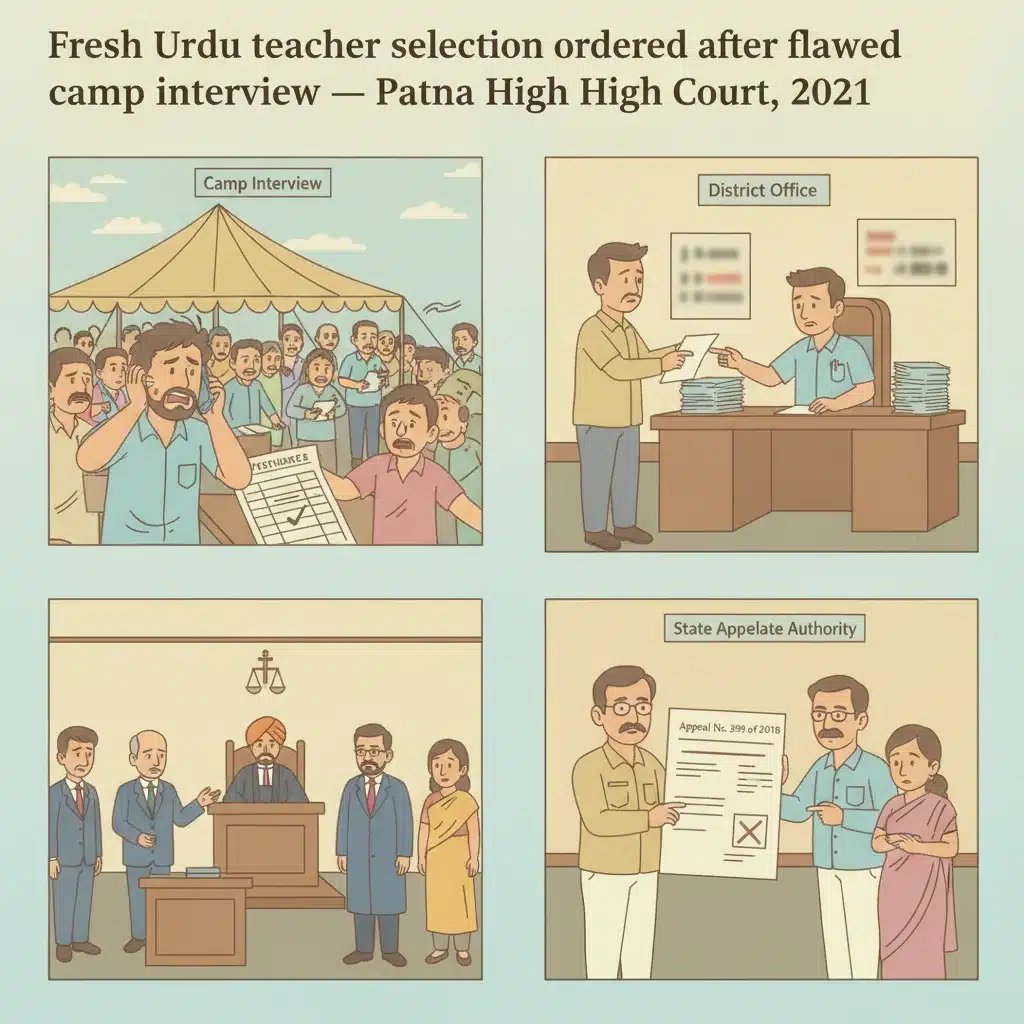
Case Background
The case arose from recruitment of Urdu Teachers through a camp interview in K. Nagar Block, District Purnea.
The petitioner had applied for the post of Urdu Teacher in the general category. There were 92 applicants in the general category for three Urdu Teacher posts.
According to the petitioner, he had higher marks than private respondent no. 10, who was ultimately appointed. However, he was not selected on the ground that he was “not available” when his name was called during the camp interview.
Feeling aggrieved, the petitioner first complained before the authorities involved in the selection process. As these complaints did not result in any relief, he approached the District Teachers Employment Appellate Authority (District Teachers Appellate Tribunal), Purnea.
The District Teachers Appellate Tribunal considered the materials and found the petitioner’s claim to be genuine. It noted that the petitioner had higher marks than private respondent no. 10 and that the process did not appear to have been carried out fairly. The Tribunal directed that the petitioner be reinstated on the post of Urdu Teacher after removing private respondent no. 10.
Private respondent no. 10 challenged this order before the State Appellate Authority by filing Appeal No. 399 of 2018. The State Appellate Authority reversed the District Tribunal’s decision, effectively restoring the appointment of respondent no. 10 and rejecting the petitioner’s claim.
It was this State Appellate Authority order, along with the District Tribunal’s order, that the petitioner brought under challenge before the Patna High Court in Civil Writ Jurisdiction Case No. 10879 of 2019.
What the Court Examined and Decided
Hon’ble Mr. Justice Ashutosh Kumar heard the writ petition on 30.11.2021. The Court heard the arguments of the petitioner’s counsel and the counsel for private respondent no. 10. The State was represented through its counsel.
The core complaint of the petitioner was that although he had higher marks than respondent no. 10, he was denied appointment solely on the allegation that he was not present when his name was called in the camp interview. He claimed that he was present at the camp site throughout.
Before the District Teachers Appellate Tribunal, the petitioner had raised a serious doubt about the conduct of the camp interview. He pointed out that though 92 candidates were in the general category for Urdu Teacher posts, the attendance register signed by the authorities showed only one candidate as present on the day of interview.
The Patna High Court highlighted this undisputed fact. It observed that, in the wake of 92 applicants in the unreserved category for three Urdu Teacher posts, it was “rather strange” that only one candidate was shown present and recorded in the register. The Court noted that this was particularly surprising in “these times of distress” when large numbers of people are unemployed.
The petitioner had also alleged that there was “pandemonium” at the camp site. Because of the chaos, he went to look for the nodal officer to complain that his name was not being called. According to him, not finding any responsible officer, he made a telephonic complaint to the authorities and later approached the District Teachers Appellate Tribunal.
The District Teachers Appellate Tribunal accepted that the petitioner had higher marks than respondent no. 10 and that the interview process did not appear to be fair. It therefore directed his appointment in place of respondent no. 10.
However, the State Appellate Authority did not accept this view. It held that the District Tribunal’s observation—that the petitioner was present at the time of interview—was not based on any cogent evidence.
The State Appellate Authority also stressed another point. It found that the petitioner’s first complaint had not been made against respondent no. 10, but against respondent no. 11 (Margoob Quamar). From this, the State Authority drew an inference that the petitioner was not present when his name was called, and therefore his later complaint was not trustworthy.
The State Appellate Authority further recorded that the procedure for camp interviews is that the names of candidates are called out three times. A candidate, even with higher marks, cannot claim appointment if he is not present when called, unless he appears while the process is still going on. It justified camp interviews as a method for avoiding delay in teacher appointments.
The High Court did not directly dispute the general rule about camp interviews. It accepted that in such a system, higher marks alone do not automatically guarantee appointment if the candidate is not present when called.
However, the Court focused on whether there was reliable material to say that the petitioner was indeed absent when called.
The Court observed that only one candidate was shown present in the register, despite there being 92 applicants in the category. This unusual situation weakened the credibility of the record and of the selection process itself.
Next, the Court examined how the State Appellate Authority had treated the petitioner’s telephonic complaint. The Authority had effectively used this phone complaint as evidence against the petitioner, treating it as if it proved his absence at the camp site.
The Patna High Court held that making a telephonic complaint in such circumstances cannot be treated as evidence establishing that the petitioner was absent. If there was pandemonium at the camp site and the nodal officer could not be located, the Court reasoned, using a telephone call was the only feasible way for the petitioner to register his grievance.
Therefore, the phone call should not have been used as a strong piece of evidence against him. Rather, it showed that he was trying to complain about what was happening at the camp site.
The Court then considered the point that the petitioner had initially made a complaint against respondent no. 11, not respondent no. 10. The State Authority had treated this as decisive proof that the petitioner was not present at the time of interview.
The High Court rejected this inference. It held that the fact that the first complaint mentioned respondent no. 11 was “not a conclusive piece of evidence” leading to the “only inescapable conclusion” that the petitioner was absent. Thus this circumstance was not strong enough to discredit the petitioner’s claim of presence.
On the contrary, the petitioner had placed two pieces of evidence in support of his presence at the camp site. First, there was an affidavited statement by one candidate in another subject. Second, there was an affidavited statement of a member of the Panchayat Samiti, both asserting that the petitioner was present at the camp site.
The Court noted that these two affidavits had been “totally ignored” by the State Appellate Authority, without any discussion.
The High Court further pointed out that the State Authority had partially accepted and partially rejected the findings of the District Teachers Appellate Tribunal, but without giving reasons. One part of the District Tribunal’s finding was accepted, while another part was ignored, again without justification.
It was an admitted position that the petitioner had more marks than private respondent no. 10. While this might not be decisive in a camp interview system, the Court considered it along with the other circumstances. There was also mention of a newspaper report suggesting that the process was not conducted fairly and that candidates with higher marks like the petitioner were being kept out on the ground of alleged absence.
Taking all of this together—the strange attendance record showing only one candidate present, the telephonic complaint, the ignored affidavits, and the newspaper report—the Court found it difficult to accept the factual position presented by the State Appellate Authority.
The Court candidly acknowledged that there might not be definite evidence proving the petitioner’s presence at the exact time of interview. But it added that the evidence against his claim of presence was “equally deficient”. In other words, neither side had strong, conclusive proof on the question of presence or absence.
In such a situation, where the process itself appeared doubtful, the Court decided that the proper course was not to uphold either of the earlier orders.
Accordingly, the Patna High Court set aside both the order of the District Teachers Appellate Tribunal and the order of the State Appellate Tribunal.
Instead of directly ordering appointment of any particular person, the Court directed that a fresh process for appointment of Urdu Teachers in the concerned block be conducted. The same camp interview method could be followed, but there had to be proper communication to “all and sundry” about the date and the process to be used.
The Court fixed a time frame: this fresh selection exercise must be completed within three months from the date a copy of the order is received or produced before the concerned authority. After completion of the process, necessary follow-up steps were to be taken.
Finally, the Court ordered that, in the meantime, “status quo” with respect to the appointment of Urdu Teacher in the particular block should be maintained. This means the existing appointment would continue until the fresh process is completed and new decisions are implemented.
With these directions and observations, the writ petition was disposed of.
Why This Judgment Matters
This judgment is important for teachers and other job seekers facing camp interviews and mass recruitment drives in Bihar.
First, the Patna High Court clearly signalled that authorities must conduct such interviews fairly and maintain reliable records. A register showing only one candidate present out of 92 was treated as a serious red flag.
Second, it protects candidates who try to complain about irregularities. The Court refused to treat the petitioner’s telephonic complaint as proof against him. Instead, it recognised it as a natural step where the situation on the ground is chaotic.
Third, the Court emphasised that appellate authorities cannot ignore affidavits and other evidence without reason. When candidates and local representatives swear that someone was present, that material has to be considered.
Finally, rather than choosing between competing claims without solid evidence, the Court opted for a fresh, transparent selection process. This approach ensures that all eligible candidates get a fair chance, and that public confidence in recruitment is protected.
Legal Issues and Answers
- Issue: Whether the petitioner’s claim of being wrongly marked absent in the camp interview could be rejected on the basis of the State Appellate Authority’s reasoning and the existing record.
Answer: No. The High Court held that both the evidence supporting the petitioner’s presence and the evidence disputing it were weak. The State Appellate Authority had ignored relevant affidavits and drawn unjustified inferences. Its order, as well as the District Tribunal’s order, was therefore set aside. - Issue: What was the appropriate remedy where the recruitment process itself appeared doubtful and conclusive evidence of presence or absence was lacking.
Answer: The Court directed a fresh recruitment process for Urdu Teachers in the concerned block, with proper public communication and adherence to the prescribed method, to be completed within three months, while maintaining status quo in the meantime.
Cases Cited by the Court
- No previous judgments or case law are cited or relied upon in the text of this decision.
Case Details
Case Number: Civil Writ Jurisdiction Case No. 10879 of 2019
Case Title: Md. Wasim Reza v. The State of Bihar & Ors.
Coram: Hon’ble Mr. Justice Ashutosh Kumar
Citation: 2022 (4) PLJR 135
Date of Judgment: 30-11-2021
Advocates:
- For the petitioner: Mr. Nasrul Hoda, Advocate; Mr. Nadimul Hasan, Advocate
- For the State respondents: Mr. Jitendra Kr. Roy 1 (SC13); Mr. Hitesh Suman, AC to SC 13
- For respondent no. 10: Mr. Shambhu Sharan Kumar, Advocate
- For respondent no. 11: Md. Imtiyaz Hussain, Advocate
Nature of the Case: Writ petition challenging orders of the District Teachers Employment Appellate Authority and the State Appellate Authority relating to appointment as Urdu Teacher in a camp interview process.
Link to Judgment: Click here to read the full Patna High Court judgment
If you found this explanation helpful and wish to stay informed about
how legal developments may affect your rights in Bihar,
you may consider following Samvida Law Associates for more updates.




