

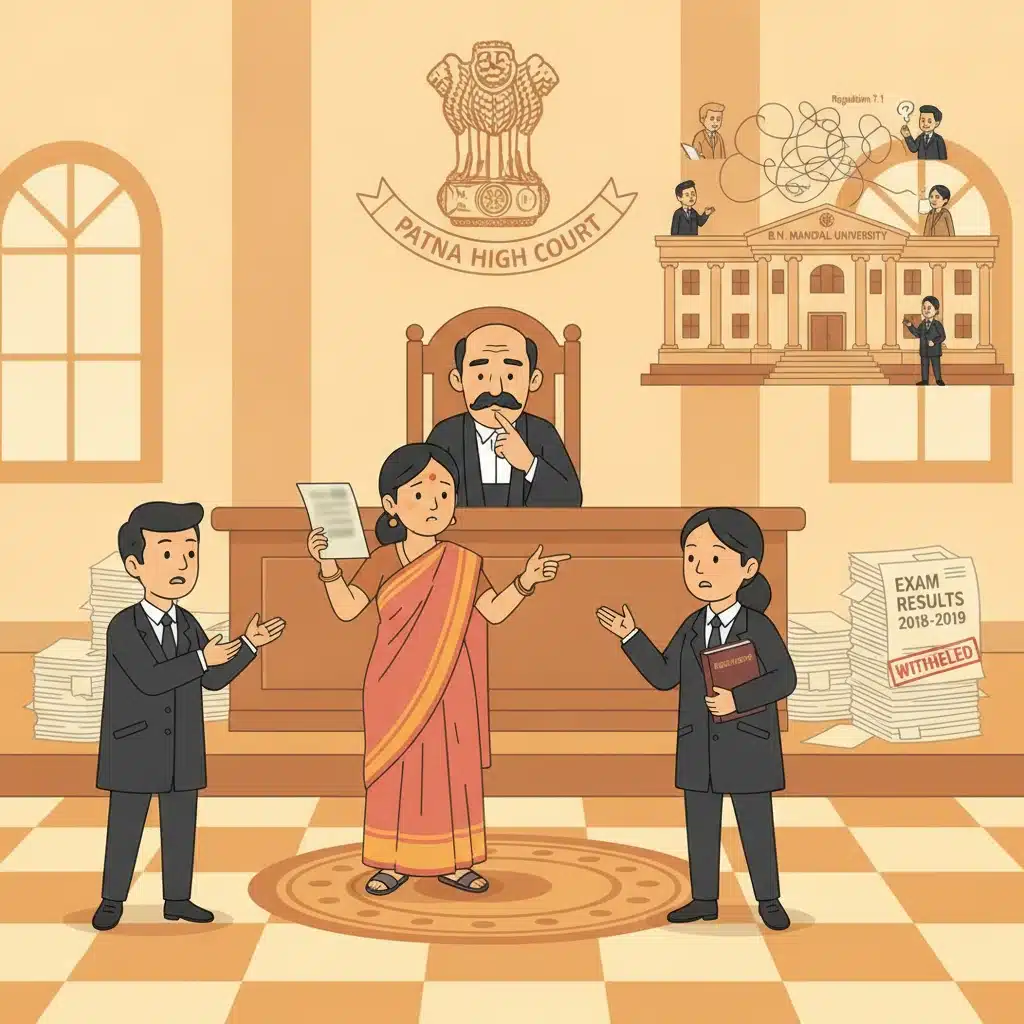
Case Background
The petitioner was a student of B.A. (Honours) in Psychology under B.N. Mandal University, Madhepura. She was admitted in the academic session 2012–13 and was allotted Registration No. 53549/2013.
She first appeared in the B.A. Part I (Honours) Examination, 2013, but failed. In 2014 she did not appear in the B.A. Part I examination at all.
She again appeared in B.A. Part I in 2015. That year she secured 12 marks in Rashtrabhasha (R.B.) Hindi, 6 and 19 marks respectively in the two Psychology papers, and 34 marks in practical. On this performance she was declared “disqualified”.
In 2016, she once more sat for B.A. Part I but this time only in R.B. Hindi. She did not appear in the Honours papers. She scored 33 marks in R.B. Hindi.
In 2017, she appeared yet again in B.A. Part I and obtained 37 and 40 marks in the two Psychology papers. According to the University, her appearance in the 2017 B.A. Part I examination itself was contrary to the University’s Examination Regulations.
Despite this, she was later allowed to appear in B.A. Part III Psychology (Honours) Examination, 2018, which was held in 2019. When the results were published, her result was withheld. Feeling aggrieved, she approached the Patna High Court under Article 226 of the Constitution, seeking a direction to the University to declare her Part III result.
What the Court Examined and Decided
The central question before the Patna High Court was whether a student who had appeared in B.A. Part III examination without fulfilling the conditions in the Examination Regulations could insist that the University declare her result, merely because she was allowed to sit in the final exam.
The University’s stand was that the petitioner was entitled, under the Examination Regulations, to appear in B.A. Part I examinations for the years 2014, 2015 and 2016 only. When she appeared in 2017, that attempt was beyond the maximum permitted chances. Therefore, her appearance in 2017 and the subsequent permission to sit in Part III were both in violation of Regulation 7.1. On this ground, the University justified withholding her Part III result.
The Court first reproduced and examined Regulation 7.1 of the Examination Regulations. The Regulation states that there shall be University examinations at the end of the first, second and third years of study, known as B.A. (General/Honours) Part I, Part II and Part III examinations.
It clearly provides that no student shall be admitted to B.A. (General) or B.A. (Honours) Part II class unless he or she has passed the B.A. Part I examination, and similarly no admission to Part III is allowed unless the student has passed Part II.
The first proviso to Regulation 7.1 permits a student who fails or fails to appear in not more than two subjects in Part I or Part II to be promoted to the next higher class. However, such a student is not eligible for admission to Part III unless he or she has passed Part I examination in the relevant subject or subjects.
The second proviso strictly limits the “carry over” facility. A student can appear in such pending subject or subjects in not more than three consecutive examinations.
Applying this Regulation to the facts, the Court accepted the University’s position that the petitioner could lawfully take B.A. Part I examinations in 2014, 2015 and 2016 as her three consecutive chances. Her attempt in 2017 was beyond these three chances and hence was not permissible under Regulation 7.1.
The Court observed that, “by virtue of the said Regulation, the petitioner was entitled to appear at B.A. Part I examination for the years 2014, 2015 and 2016. She appeared rather in 2017, which was impermissible.” Therefore, when she was later allowed to sit for B.A. Part III examination, this was in clear breach of the Examination Regulations.
On behalf of the petitioner, it was argued that once the University had allowed her to appear in B.A. Part III Examination, 2018, it could not withhold her result on technical grounds. Her counsel relied on the Supreme Court decision in Shri Krishan v. Kurukshetra University, reported in 1976 (1) SCC 311.
The Court noted that the petitioner’s counsel, however, could not dispute the factual position flowing from Regulation 7.1: she was not eligible to appear in Part III because she had not validly cleared B.A. Part I within the prescribed chances.
On the other hand, learned counsel for the University relied on several prior decisions of the Patna High Court dealing with similar situations where students had been wrongly permitted to take examinations in violation of regulations.
First, reliance was placed on the Division Bench decision in L.P.A. No. 904 of 2014, Mihir Kumar Jha v. Bhupendra Narayan Mandal University & Ors., decided on 07.01.2015. In that case, the Court had refused to order the University to supply mark-sheet and provisional certificate of having passed B.A. Part III examination, because the student’s appearance itself was against Regulation 7.1. While doing so, the Division Bench had considered and distinguished the Supreme Court’s ruling in Shri Krishan.
Second, the University cited another Division Bench judgment in Sunil Kumar v. Bhupendra Narayan Mandal University & Ors., reported in 2020 (4) PLJR 129. In Sunil Kumar, a candidate had been allowed to appear in an examination contrary to the University’s Examination Regulations. The Division Bench distinguished the Supreme Court’s decision in Guru Nanak Dev University v. Sanjay Kumar Katwal & Anr., (2009) 1 SCC 610, noting that in that Supreme Court case, the lapse was on the part of a private institution and not the University.
The Division Bench in Sunil Kumar held that failure in sessional work attracted the consequence of re-admission, and a private institution’s conduct in facilitating an illegal appearance could not bind or estop the University. Therefore, the Court declined to direct the University to declare the result.
Third, the University referred to a decision of the Patna High Court dated 04.01.2021 in CWJC No. 7882 of 2020, Md. Helal v. The State of Bihar & Ors. There too, the Court rejected the plea for declaration of result where the candidate had appeared in Part III contrary to the Examination Regulations.
The Court in Md. Helal had held that it could not pass an order in breach of the Examination Regulations because publication of the result in such circumstances would “permit and perpetuate illegality”. If a student somehow managed to appear in Part III examination contrary to regulations, the Court could not aid such illegality by directing the University to publish the result. It was also held that granting such relief would violate Article 14 of the Constitution, as similarly placed students who obeyed the Regulations might not have received, or might not have availed, an illegal chance to appear.
The Patna High Court in the present case also noted two other earlier decisions: in Sima Bharti v. State of Bihar & Ors. (CWJC No. 4605 of 2018), where similar relief was refused because the permission for Part III examination itself was contrary to the Regulations, and in Ruchi Rachna v. The State of Bihar & Ors. (CWJC No. 6114 of 2018). In Ruchi Rachna, the Court had clearly held that it could not issue a mandamus contrary to the Ordinance and that a student’s result cannot be ordered to be published only because the student was allowed to appear despite violating the rules.
After reviewing this consistent line of authority, the Court concluded that it was bound by these decisions. The principle running through them is that Courts will not direct a University to declare results or grant benefits when the student’s very appearance in the examination violated binding Regulations. Allowing such relief would amount to endorsing illegality and would be unfair to other students who followed the rules.
Applying this principle, the Court held that the petitioner’s case had no merit. Her appearance in B.A. Part III examination, 2018, was itself in breach of Regulation 7.1, because she had not validly passed B.A. Part I within the three permitted chances. Therefore, the University was justified in withholding her result, and the Court could not compel it to declare the result or treat her as having lawfully appeared.
In conclusion, the Patna High Court dismissed the writ application, refusing to grant any relief to the petitioner.
Why This Judgment Matters
This judgment is important for students and families across Bihar and especially those studying under B.N. Mandal University and similar institutions.
It makes clear that examination rules and regulations are strict and binding. Even if a student is mistakenly allowed to sit for an exam, that alone does not create a right to get the result or degree if the basic eligibility conditions were not met.
The decision protects fairness among students. Many students may strictly follow the rules, repeat classes or skip exams when they are not eligible. If Courts ordered results for those who appeared illegally, it would create inequality and encourage attempts to bypass regulations.
The Patna High Court also underlines that it will not direct Universities to act against their own Regulations. Publishing results in violation of clear rules would, in the Court’s view, “permit and perpetuate illegality” and go against Article 14 of the Constitution, which guarantees equality before law.
For affected students, the case shows the importance of carefully understanding University rules on number of attempts, promotions, and carry-over subjects. Relying on permission slips or mistakes at the college or exam centre will not save them later in Court.
Legal Issues and Answers
- Issue: Can the Court direct B.N. Mandal University to declare a student’s B.A. Part III result when her appearance in the examination itself violated Regulation 7.1 of the Examination Regulations?
Answer: No. The Patna High Court held that since the petitioner had not cleared B.A. Part I within the three permitted chances and was therefore not eligible to appear in Part III, her appearance was illegal and the Court could not compel the University to publish her result. - Issue: Does the University’s act of allowing a student to sit in the examination create an enforceable right to result publication, even if it breaches the Regulations?
Answer: No. Relying on earlier Division Bench judgments, the Court held that mistaken permission or conduct of the college or University cannot bind the University or estop it from enforcing its Regulations, and the Court will not endorse such illegality.
Cases Cited by the Court
- Shri Krishan v. Kurukshetra University, 1976 (1) SCC 311 (relied upon by petitioner; distinguished in earlier Division Bench decisions).
- L.P.A. No. 904 of 2014, Mihir Kumar Jha v. Bhupendra Narayan Mandal University & Ors., decision dated 07.01.2015.
- Sunil Kumar v. Bhupendra Narayan Mandal University & Ors., 2020 (4) PLJR 129.
- Guru Nanak Dev University v. Sanjay Kumar Katwal & Anr., (2009) 1 SCC 610 (discussed and distinguished in Sunil Kumar).
- Sima Bharti v. State of Bihar & Ors., CWJC No. 4605 of 2018, order dated 17.05.2018.
- Ruchi Rachna v. The State of Bihar & Ors., CWJC No. 6114 of 2018.
- Md. Helal v. The State of Bihar & Ors., CWJC No. 7882 of 2020, decision dated 04.01.2021.
Case Details
Case Number: Civil Writ Jurisdiction Case No. 11923 of 2021
Case Title: Manorama Kumari v. The B.N. Mandal University, Laloo Nagar, Madhepura & Ors.
Coram: Hon’ble Mr. Justice Chakradhari Sharan Singh
Date of Judgment: 08.12.2021
Citation: 2022 (4) PLJR 141
Advocates: Mr. Umesh Prasad, Advocate for the petitioner; Mr. Shashi Bhushan Singh, Advocate and Mr. Ritesh Kumar, Advocate for the respondents.
Nature of the Case: Writ petition under Article 226 of the Constitution of India seeking direction to the University to declare result of B.A. Psychology (Honours) Part III Examination, 2018 held in 2019.
Link to Judgment: Click here to view the full judgment of the Patna High Court
If you found this explanation helpful and wish to stay informed about
how legal developments may affect your rights in Bihar,
you may consider following Samvida Law Associates for more updates.




