

Case Background
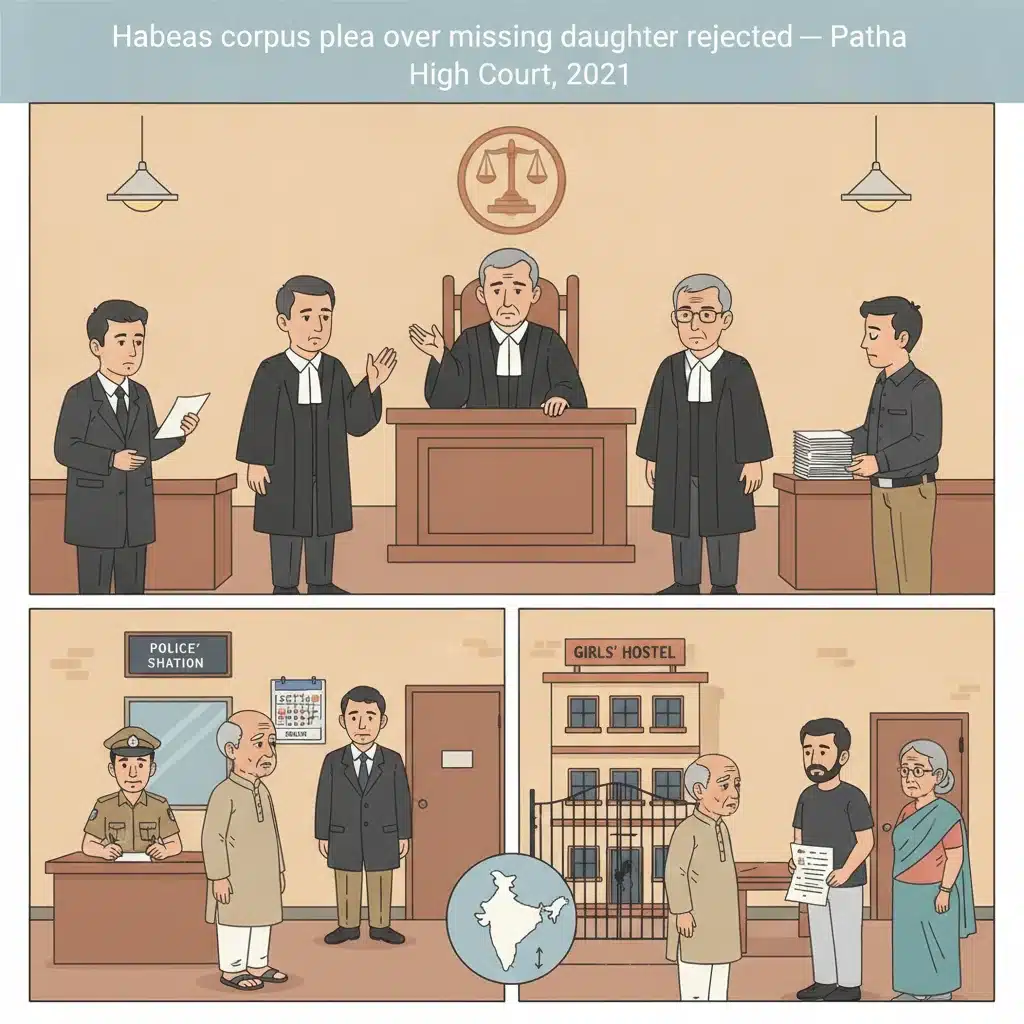
The petitioner is the father of a woman who had completed an MBA and was doing a private job while staying in a girls’ hostel on Boring Canal Road, Patna.
On 11.04.2021, he tried to contact his daughter on her mobile phone, but her number could not be reached. Worried, he went to the girls’ hostel, where he was told that she had been absent for the last 15 days.
With the consent of the caretaker, the lock of her room was broken. During the search, a marriage certificate was found in the room. On reading it, the petitioner discovered that his daughter had married respondent no. 5, Ambuj Kumar Srivastava.
The petitioner called respondent no. 5 on his mobile number to ask about his daughter’s whereabouts. According to the petitioner, respondent no. 5 did not give any satisfactory reply. The petitioner then suspected that his daughter might have been taken to Himachal Pradesh and killed by respondent no. 5.
On 13.05.2021, the petitioner submitted a written report to the Officer-in-Charge of Buddha Colony Police Station, Patna, making allegations against respondent no. 5 and his parents. On this basis, Buddha Colony P.S. Case No. 160 of 2021 was registered under Sections 363, 365, 420 and 406 read with Section 34 of the Indian Penal Code against respondent no. 5, his mother Sunita Devi and his father Suresh Prasad.
The police investigated and submitted a chargesheet against respondent no. 5. On 15.07.2021, the jurisdictional Magistrate took cognizance of the offences under Sections 363, 365, 420, 406 and 34 IPC.
Even after this, the daughter had not been traced. Feeling that his efforts with the police had failed, the petitioner approached the Patna High Court under Article 226 of the Constitution seeking a writ of habeas corpus for recovery and production of his daughter.
What the Court Examined and Decided
The Division Bench of the Patna High Court, comprising Hon’ble Mr. Justice Ashwani Kumar Singh and Hon’ble Mr. Justice Rajeev Ranjan Prasad, heard the matter. The oral judgment was delivered on 29.11.2021 by Justice Ashwani Kumar Singh.
On behalf of the petitioner, it was argued that despite registration of the FIR and filing of the chargesheet, the police had failed to recover his daughter. According to the petitioner, the police had mechanically submitted the chargesheet against respondent no. 5 under the same sections mentioned in the FIR without properly investigating the disappearance.
The petitioner’s counsel submitted that after lodging of the FIR he had been running from pillar to post for recovery of his daughter, but without any result. Because of this, he felt compelled to invoke the extraordinary remedy of habeas corpus before the High Court.
On the other hand, the State’s counsel informed the Court that the police report under Section 173(2) of the Code of Criminal Procedure had been filed only against respondent no. 5 and that the investigation was still continuing.
The State argued that the chargesheet had been submitted because the 60-day period from the date of arrest of respondent no. 5 was about to expire. If no chargesheet was filed within this period, respondent no. 5 would have become entitled to what the law calls “compulsive bail” under Section 167(2) Cr.P.C. Therefore, to avoid this statutory consequence, the police filed a partial report.
According to the State, the police had not yet reached any final conclusion about whether the petitioner’s daughter was in the illegal confinement of respondent no. 5. It was therefore contended that this was essentially a law and order situation under active investigation, not a case of definite illegal detention suitable for a writ of habeas corpus.
After hearing both sides, the Court closely examined the FIR, the police report and the nature of the relief sought.
First, the Bench noted that there was a delay between the alleged incident on 11.04.2021 and lodging of the report on 13.05.2021. The Court also observed that the allegations in the FIR mainly showed a suspicion that respondent no. 5 and his parents might have abducted and killed the petitioner’s daughter.
The Court underlined that this was not a case where the petitioner could clearly state that his daughter was in the illegal custody of any particular person, including respondent no. 5. Instead, the FIR itself showed that he did not know her whereabouts and only suspected foul play.
The Bench acknowledged that investigation under Section 173(2) Cr.P.C. appeared to have been conducted only partially. It went further and recorded its inference that the chargesheet had been submitted on the basis of a “half baked” investigation, mainly to frustrate the right of respondent no. 5 to default bail under Section 167(2) Cr.P.C. if the 60-day limit expired.
The Court expressed serious concern about this mode of investigation. It reminded the police that their duty is not to keep someone in jail but to bring the investigation to a logical end. A report under Section 173(2) Cr.P.C. should not be filed merely to prevent an accused from being released on statutory bail.
The Bench stressed that in every case the police must conduct a sensitive and committed investigation so that people can have confidence in the system.
However, after expressing these concerns, the Court turned back to the core legal question: whether a writ of habeas corpus could be issued on the facts of this case.
The Court explained that when there is no certainty that someone is in illegal confinement of a specific person, habeas corpus is not the appropriate remedy. If a person is aggrieved by the quality or speed of investigation, the proper relief is to seek a writ of mandamus or other direction regarding investigation, not habeas corpus.
The judgment then set out the legal meaning and purpose of habeas corpus. Relying on Halsbury’s Laws of England and on the Constitution Bench decision of the Supreme Court in Kanu Sanyal v. District Magistrate, Darjeeling, the Court explained that habeas corpus is a prerogative writ aimed at securing immediate release from unlawful detention. It is mainly a procedural tool to test the legality of a detention.
Further, the Court referred to the Supreme Court’s decision in State v. H. Nilofer Nisha, (2020) 14 SCC 161. That decision clarifies that habeas corpus can be issued only when a person’s detention or confinement is without authority of law.
Although over time the writ has been used in varied situations such as preventive detention matters, disputes over spouses and child custody, the Supreme Court has emphasized that courts must first be satisfied that the person is under illegal detention before issuing such a writ.
Based on these principles, the Patna High Court held that illegal confinement is a pre-condition for issuing a writ of habeas corpus. The remedy, though a writ of right, is not automatic or routine. It is an extraordinary relief and cannot be granted on mere asking.
The Court then applied this law to the facts. In the present case, it was still a matter of investigation who, if anyone, had abducted or confined the petitioner’s daughter, and whether she was alive or in the custody of any private person. There was no definite material to show she was in illegal custody of respondent no. 5 or any other identified person.
The Bench also referred to a decision of the Allahabad High Court in Madhav Das Agrawal & Anr. v. State of U.P., which had held that in every case of kidnapping or abduction, the correct course is to lodge an FIR and get it investigated, not to seek habeas corpus. That decision also stressed that when habeas corpus is sought against a private party, there must be prima facie proof that the detenu is alive and in that party’s illegal custody.
The Patna High Court reiterated that decisions about what steps should be taken in a criminal investigation fall within the exclusive domain of the police. The Court noted that it was not the petitioner’s case that his daughter was unlawfully confined by the police themselves. Therefore, questions about the adequacy of investigation could not be brought within a habeas corpus petition.
The Court further observed that investigation of a cognizable offence is the sole domain of the police, and at this stage the Court had no role to play in supervising specific steps within that investigation through a petition of this type.
Habeas corpus, the Court added, is a “festinum remedium” – a speedy remedy – and the power can be exercised only in a clear case of illegal detention. Since such clarity was absent here, the writ petition was held to be not maintainable.
Accordingly, the writ petition was dismissed.
Before closing, however, the Court gave an important direction. It cautioned that dismissal of the habeas corpus petition should not be taken by the police as a licence to reduce the intensity of investigation. The Court expected the investigation to continue in accordance with law, with due sensitivity and sincerity.
Why This Judgment Matters
This judgment has practical importance for families whose adult members go missing under suspicious circumstances.
It makes clear that the Patna High Court will not use habeas corpus to monitor criminal investigations where there is only suspicion and no clear proof that the missing person is illegally detained by a particular individual or authority.
For such families, the proper route is to ensure that a criminal case is registered and to pursue directions regarding fair and proper investigation, rather than expecting immediate relief through habeas corpus.
At the same time, the judgment sends a strong message to the police. Filing incomplete chargesheets simply to block an accused person’s statutory bail rights is unacceptable. Investigations must be sincere, complete and aimed at reaching the truth, especially where a person is missing.
Thus, the decision balances two concerns: preventing misuse of habeas corpus and insisting on responsible police investigation in serious missing person cases.
Legal Issues and Answers
- Issue: Can a writ of habeas corpus be issued when a missing adult’s whereabouts are unknown and there is only suspicion, not proof, that a particular person is illegally detaining her?
Answer: No. The Patna High Court held that illegal confinement by a specific person or authority is a pre-condition for issuing habeas corpus. Where it is uncertain who, if anyone, is confining the missing person, habeas corpus is not maintainable. - Issue: Can habeas corpus be used to control or correct alleged deficiencies in a police investigation of a cognizable offence?
Answer: No. The Court held that the proper remedy against inefficient investigation is to seek appropriate directions such as a writ of mandamus, not habeas corpus. Investigation of cognizable cases remains the sole domain of the police.
Cases Cited by the Court
- Kanu Sanyal v. District Magistrate, Darjeeling & Ors., (1973) 2 SCC 674 – Constitution Bench decision of the Supreme Court explaining the nature and scope of the writ of habeas corpus.
- State v. H. Nilofer Nisha, (2020) 14 SCC 161 – Supreme Court decision on the expanding but limited scope of habeas corpus, stressing that detention must be without authority of law.
- Madhav Das Agrawal & Anr. v. State of U.P., 2007 (59) All.Cr.Cases 202 – Allahabad High Court decision stating that kidnapping/abduction cases should be dealt with through FIR and investigation, and that habeas corpus against private parties requires prima facie proof of illegal custody.
Case Details
Case Number: Criminal Writ Jurisdiction Case No. 1270 of 2021, arising out of Buddha Colony P.S. Case No. 160 of 2021
Case Title: Sachidanand Sah @ Sachchidanand Sah v. The State of Bihar & Ors.
Coram: Hon’ble Mr. Justice Ashwani Kumar Singh and Hon’ble Mr. Justice Rajeev Ranjan Prasad
Citation: 2022 (4) PLJR 78
Advocates: Mr. Sanjay Kumar, Advocate for the petitioner; Mr. Prabhu Narain Sharma, Advocate for the State
Nature of the Case: Criminal writ petition under Article 226 of the Constitution seeking a writ of habeas corpus
Date of Judgment: 29.11.2021
Link to Judgment: https://patnahighcourt.gov.in/viewjudgment/MTYjMTI3MCMyMDIxIzEjTg==-G1glyDLMk–ak1–k=
If you found this explanation helpful and wish to stay informed about how legal developments may affect your rights in Bihar, you may consider following Samvida Law Associates for more updates.




