

Case Background
This criminal appeal arose from a judgment of the Special Judge, POCSO, East Champaran in POCSO Trial No. 47 of 2017, corresponding to CIS No. 47 of 2017, arising out of Raxaul P.S. Case No. 242 of 2016.
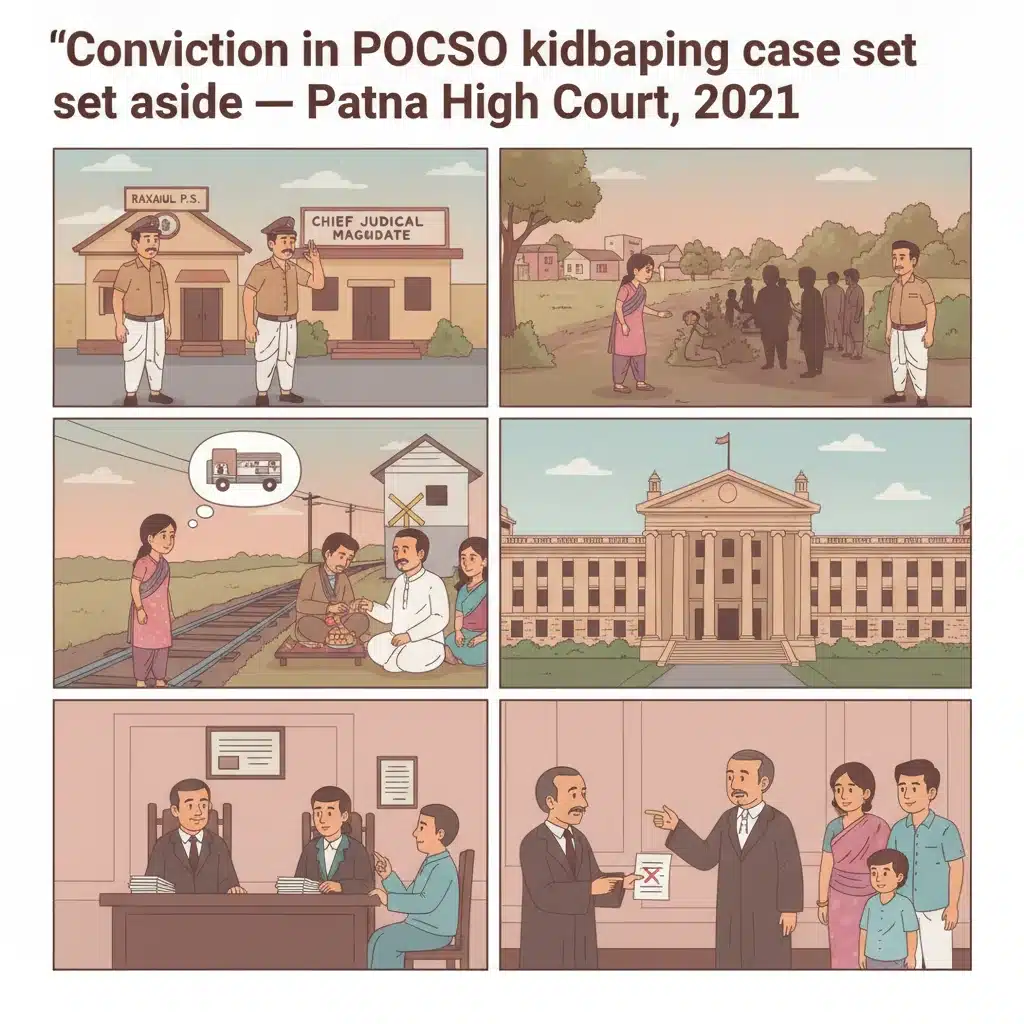
The case started when PW-1, the informant and father of the girl, filed a complaint case before the Chief Judicial Magistrate, Raxaul on 22.09.2016 (Complaint Case No. 240 of 2016). He alleged that his minor daughter had been kidnapped and sexually assaulted.
On 25.10.2016, the Magistrate transmitted the complaint for institution of a police case. Based on this, Raxaul P.S. Case No. 242 of 2016 was registered on 03.11.2016 for offences under Sections 366A, 376, 323, 341 and 504/34 of the Indian Penal Code and under Sections 4 and 5 of the POCSO Act.
The allegation in the complaint-based FIR was that on 18.09.2016, at about 7 PM, the informant’s daughter, said to be about 14 years old and a student of Class VIII, went out to attend the call of nature. At that time, the appellant and six others, described as his father and siblings, allegedly kidnapped her with the intention to ravish her.
The informant claimed that when he asked the accused persons about his daughter, they abused and assaulted him. He further stated that the police initially refused to register his case, so he filed the complaint on 22.09.2016 after the girl was allegedly recovered on 21.09.2016 in an unconscious condition near a railway crossing. On regaining consciousness, she was said to have disclosed that she had been taken to Nepal by the kidnappers.
After investigation, the police submitted charge-sheet only against the present appellant. Investigation against the other named persons was kept pending. The case went to trial before the Special Judge, POCSO.
On 14.11.2019, the trial court convicted the appellant under Sections 341, 323 and 366 of the Indian Penal Code and under Section 8 of the POCSO Act. By order dated 19.11.2019, the court sentenced him to:
- One month simple imprisonment under Section 341 IPC,
- Six months imprisonment under Section 323 IPC,
- Six years imprisonment and fine of Rs. 10,000/- under Section 366 IPC,
- Four years imprisonment and fine of Rs. 10,000/- under Section 8 of the POCSO Act.
The trial court, however, acquitted him of charges under Sections 376(D) and 504 IPC.
Aggrieved by the conviction and sentence, the appellant filed Criminal Appeal (SJ) No. 569 of 2020 before the Patna High Court.
What the Court Examined and Decided
The Patna High Court examined the entire evidence placed before the trial court. A key starting point was that during trial, seven prosecution witnesses were examined, all projected as occurrence witnesses. However, the investigating officer and the doctor who had medically examined the victim were not produced. No medical evidence was brought on record.
PW-1, the informant and father of the girl, repeated in court that his daughter had gone to ease at about 7 PM on the date of occurrence when she was kidnapped. But in cross-examination he admitted that he had not seen the occurrence himself. He also denied any love affair between the victim and the appellant. Significantly, he stated that he did not wish to proceed with the criminal case because he had already married his daughter to someone else.
PW-2 was a hearsay witness about the kidnapping. He clearly said he did not know who had kidnapped the daughter of PW-1. He was not declared hostile by the prosecution.
PW-3 stated that he knew nothing about the occurrence. Although he was declared hostile, his statement before the police was also only hearsay.
PW-4 similarly did not support the prosecution and was declared hostile. His cross-examination showed that he too was only a hearsay witness.
PW-5, Urmila Devi, gave a very different version. She was not declared hostile. She deposed that there was a prior relationship between the victim and the appellant and because of that, quarrels had occurred between the two families. She clearly stated that she had seen the daughter of the informant going along with the appellant, that the girl was about 19–20 years of age, and that she had voluntarily left her house.
PW-5 added that no one had forcibly taken the girl, that she voluntarily returned the next day, and that the informant had lodged a false case. Because she was not treated as hostile, the prosecution formally accepted her as its witness.
PW-7, Radhika Devi, mother of the victim, also did not support the kidnapping story. She said that her daughter left the house to attend the call of nature and then went missing. After two days, she was found near the railway crossing. She stated that the girl was about 20 years old at the time, and that she had a habit of going away and returning. According to PW-7, the victim did not disclose anything about the occurrence either to her or to the father.
PW-7 further said that in fact the girl had gone to her maternal uncle’s house after getting irritated at home. She too was not declared hostile by the prosecution.
PW-6, the victim herself, supported the prosecution version in her examination-in-chief. She said that at about 6 PM on the date of occurrence, she had gone to ease when the appellant came, pressed her mouth and took her first to Raxaul and then to Nepal, and later brought her back to Raxaul from where her father took her home. She stated that she made a statement before the police and was medically examined.
She also admitted that the appellant was her neighbour and that there had been earlier disputes between the two families, which were compromised in a panchayati. Even after the panchayati, relations remained strained. She further stated that her father had already married her off three months earlier, and that she had no documentary proof of her date of birth.
On behalf of the appellant, it was argued that the victim was not a “sterling witness” as her evidence was not fully consistent and, more importantly, it was contradicted by other prosecution witnesses who were not declared hostile. Particularly, PW-2, PW-5 and PW-7 gave versions damaging the prosecution story and favourable to the defence.
The defence relied on the principle that when a prosecution witness is not declared hostile, his or her evidence can be used by the defence and becomes binding on the prosecution. For this, reliance was placed on two Supreme Court decisions: Raja Ram v. State of Rajasthan, (2005) 5 SCC 272 and Mukhtiar Ahmed Ansari v. State (NCT of Delhi), (2005) 5 SCC 258. The Patna High Court quoted paragraphs 29 to 31 of the Mukhtiar Ahmed Ansari judgment, where the Supreme Court held that the accused can rely on the evidence of a prosecution witness not declared hostile, even if that evidence goes against the prosecution case.
The Additional Public Prosecutor argued that the sole testimony of the victim was sufficient for conviction. He submitted that the victim had consistently stated that she was taken out of India by the appellant, that she was a minor at the time, and that there was no bar on basing a conviction on her sole evidence.
The High Court, however, examined the evidence of PW-5 and PW-7 carefully. It observed that PW-5 was consistent in her testimony that the victim was in an affair with the appellant, was 19–20 years old, and had gone with him voluntarily. She also said that the informant’s case was false. There was nothing on record to show that this witness was unreliable.
The Court found that the testimony of PW-5, read with that of PW-7, created serious doubt about the prosecution’s version. PW-7, the mother, had clearly said that the girl had not been kidnapped, that she left home as she was annoyed and went to her maternal uncle’s house, that she was about 20 years old, and that she often left home and came back. Importantly, according to PW-7, the victim did not narrate any incident of kidnapping or assault to her or to the father.
These two witnesses were prosecution witnesses and not declared hostile. Their evidence, therefore, could be fully relied upon by the defence and was binding on the prosecution, as per the Supreme Court rulings.
In the light of these contradictions, the High Court held that the testimony of the victim appeared “shaky”. The prosecution evidence on record, instead of supporting her version, contradicted it. The trial court, in the High Court’s view, had failed to properly consider these contradictions while recording conviction.
Applying the settled criminal law principle that when there is serious doubt in the prosecution story the benefit must go to the accused, the High Court concluded that the appellant was entitled to acquittal.
Accordingly, the Patna High Court set aside the judgment of conviction and the order of sentence dated 14.11.2019 and 19.11.2019. The criminal appeal was allowed and the Court directed that the appellant be set free at once.
Why This Judgment Matters
This Patna High Court judgment is important for complainants, accused persons, and practitioners in POCSO and kidnapping cases. It shows that courts do not merely look at the allegation in the FIR or the testimony of the victim in isolation. All prosecution witnesses are weighed together.
If key prosecution witnesses, such as neighbours or family members, give a version that weakens the allegation and they are not declared hostile, their evidence can be used to grant benefit of doubt to the accused. The prosecution cannot simply ignore such testimony.
The decision also underlines that, where the age of the victim is disputed and no documentary proof or medical evidence is produced, courts may not assume minority only on the word of the informant or victim, especially when other witnesses suggest an adult age and voluntary conduct.
For ordinary readers, the message is that criminal law requires strong, consistent evidence. Serious charges like kidnapping for marriage or sexual offences under the POCSO Act can fail if the story is not supported by reliable, non-contradictory testimony from prosecution witnesses.
Legal Issues and Answers
Issue: Whether the appellant’s conviction for kidnapping and sexual assault under IPC and POCSO could stand when several prosecution witnesses did not support the prosecution story.
Answer: No. The Patna High Court held that non-hostile prosecution witnesses (especially PW-5 and PW-7) contradicted the victim’s version and created serious doubt, entitling the appellant to benefit of doubt and acquittal.
Issue: Can the defence rely on the evidence of prosecution witnesses who were not declared hostile, even if their evidence helps the accused?
Answer: Yes. Relying on Supreme Court decisions in Raja Ram and Mukhtiar Ahmed Ansari, the Court reaffirmed that evidence of such witnesses is binding on the prosecution and can be used by the defence.
Cases Cited by the Court
- Raja Ram v. State of Rajasthan, (2005) 5 SCC 272
- Mukhtiar Ahmed Ansari v. State (NCT of Delhi), (2005) 5 SCC 258
Case Details
Case Number: Criminal Appeal (SJ) No. 569 of 2020; arising out of Raxaul P.S. Case No. 242 of 2016
Case Title: Srilal Yadav v. The State of Bihar
Coram: Hon’ble Mr. Justice Birendra Kumar
Date of Judgment: 07.12.2021
Citation: 2022 (4) PLJR 166
Advocates:
- For the Appellant: Mr. Krishna Kant Singh, Advocate
- For the Respondent/State: Mr. Sunil Kumar Pandey, APP
Nature of the Case: Criminal appeal against conviction and sentence passed by Special Judge, POCSO, East Champaran
Trial Court Details: Special Judge, POCSO, East Champaran in POCSO Trial No. 47 of 2017 corresponding to CIS No. 47 of 2017
Link to Judgment: Patna High Court Judgment
If you found this explanation helpful and wish to stay informed about
how legal developments may affect your rights in Bihar,
you may consider following Samvida Law Associates for more updates.




