

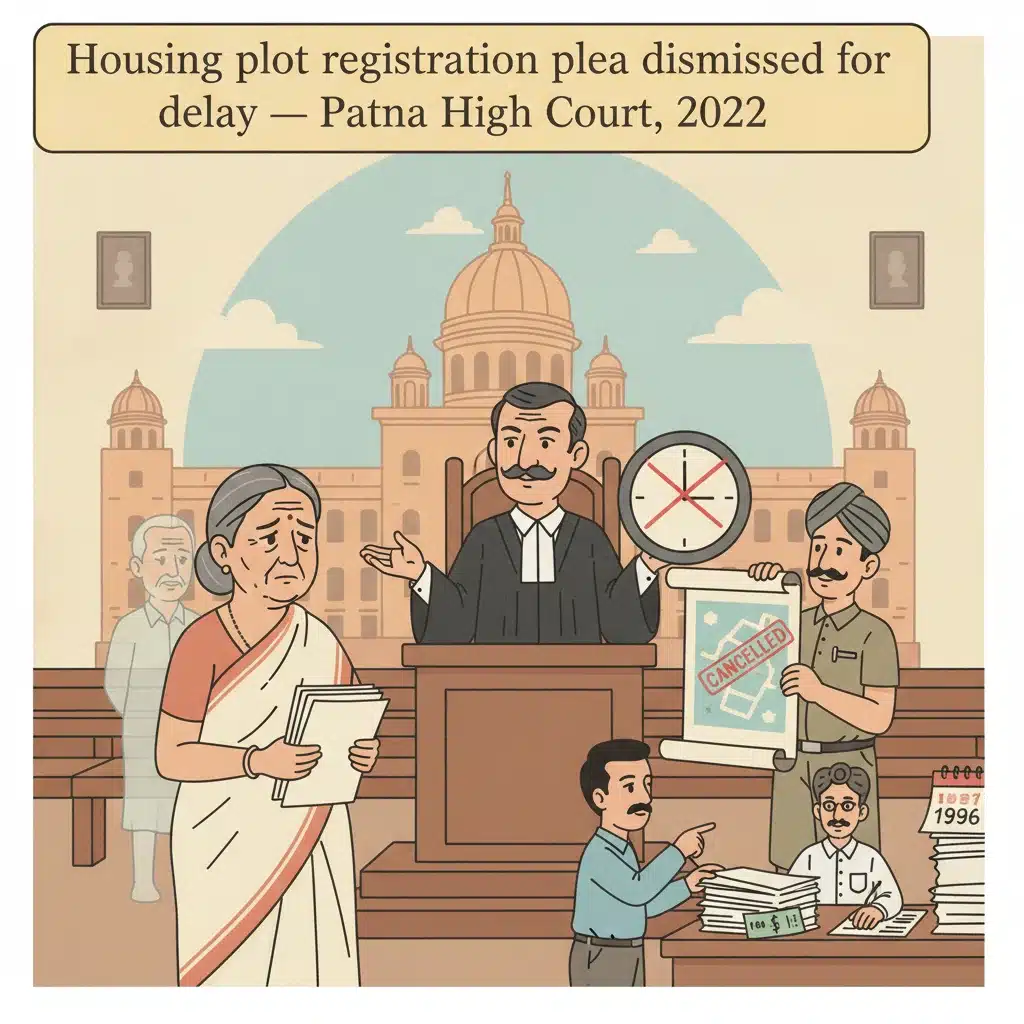
Case Background
The case arose from an allotment of a residential plot at Sadha, Chhapra, made by Bihar State Housing Board in favour of the petitioner’s late husband.
On 08.11.1996, the Board allotted Plot No. HP-142 to him at a tentative price of Rs. 1,23,480. Under the allotment order (Letter No. 112 dated 08.11.1996), he had to deposit Rs. 31,744 within 30 days and get an agreement executed within 60 days, i.e., by 31.12.1996.
The petitioner’s husband unfortunately died on 04.11.1998. According to the petitioner, she went to the office of the Land Estate Officer of the Board to inform them about his death and to request transfer of the plot in her name. However, the agreement in respect of the plot was never executed.
Much later, by letter dated 22.08.2017, the Land Estate Officer informed the petitioner that after the death of the original allottee, Plot No. HP-142 was being transferred in her name, subject to fulfilment of all the terms and conditions applicable to the original allottee.
The petitioner claimed that her late husband had deposited Rs. 31,744 towards the plot and that despite this, the Bihar State Housing Board had not registered the plot in her name. She therefore approached the Patna High Court by filing Civil Writ Jurisdiction Case No. 1581 of 2019 seeking a direction to register the plot in her favour.
What the Court Examined and Decided
The Patna High Court, through Hon’ble Mr. Justice Mohit Kumar Shah, examined the allotment conditions, the timing of payments, the correspondence between the parties, and the Housing Board’s current policy on revival of cancelled allotments.
In the counter affidavit, the Bihar State Housing Board (respondents 2 to 4) confirmed that Plot No. HP-142 at Sadha, Chhapra had indeed been allotted to the petitioner’s husband vide letter dated 08.11.1996 at a tentative price of Rs. 1,23,480.
The Board highlighted Clause 4(a) of the allotment order, which required the allottee to deposit Rs. 31,744 within 30 days of the allotment order and to get the agreement executed within 60 days. The allotment further stated that if the allottee failed either to deposit the amount within 30 days or to get the agreement executed within 60 days, it would be assumed that the allottee did not require the plot and the allotment would automatically stand cancelled. In that case, 20% of any deposited amount would be confiscated.
The Court noted that the petitioner’s husband died on 04.11.1998. The Board’s Head Office and Divisional Office were initially unaware of his death. Therefore, the Executive Engineer, Muzaffarpur Division, sent letters to the original allottee asking him to complete the formalities and get the agreement registered within 30 days. These letters were numbered 1183 dated 08.03.1999 and 281 dated 17.03.1999.
According to the Board, the required payment was not made in time. It stated that the amount of Rs. 31,744 was paid belatedly. The counter affidavit mentions the payment date as 31.12.1996, while the judgment ultimately records that the petitioner deposited Rs. 31,744 on 23.03.1999 vide Money Receipt No. 767/35 in the name of her deceased husband, with the office of the Executive Engineer, Magadh Division.
The Court treated this later date as the relevant one and found that the amount ought to have been deposited on or before 31.12.1996 under the allotment terms. The deposit in March 1999 was therefore clearly outside the permitted time limit, resulting in automatic cancellation of the allotment as per Clause 6 of the allotment letter.
The Board further stated that the petitioner initially submitted incomplete documents for change of name in her favour. Complete documents were provided only in 2017. After that, by letter dated 22.08.2017, the Board changed the name in its records to that of the petitioner, but expressly stated that all terms and conditions applicable to the original allottee would also apply to her.
The Court carefully considered this letter of 22.08.2017. It held that the change of name was done only to facilitate communication with the dependents of the allottee in future, and not to revive or validate any cancelled allotment. In other words, simply recording the petitioner’s name did not undo the earlier automatic cancellation that had already taken place due to non-compliance with time limits.
Counsel for the Housing Board also relied on Office Order No. 8499 dated 26.09.2012. This office order allowed revival of cancelled allotments after collecting outstanding amounts, calculated either on the basis of the up-to-date market value of the cancelled property or the market value revised by the Board, whichever was higher.
The Court was informed that by Order No. 10216 dated 28.11.2012, the Board extended the period for applying for revival of cancelled allotments up to 31.01.2013. This deadline was further extended to 30.04.2014. However, at present, the process of revival of cancelled allotments was stated to be under suspension.
The Board also pointed out that the petitioner had already pursued a grievance case, bearing No. 999950127111701550/2A, before the Principal Secretary, Urban Development and Housing Department-cum-Second Appellate Authority, Bihar. By final order dated 12.02.2019, that authority had noted that the revival process was under suspension and had advised the complainant to await a decision of the Board of Directors of Bihar State Housing Board regarding revival of allotments, as the Board of Directors alone had the power to revive.
In the High Court, the Board reiterated that if any revival scheme was later brought by the Board, it would consider the petitioner’s case sympathetically, but no revival was possible in the present policy situation.
After hearing both sides and examining the material, the Patna High Court focused on Clause 6 of the allotment letter dated 08.11.1996. It observed that this clause clearly provided that if the allottee failed to deposit the amount within the stipulated period and failed to get the agreement executed, it would be deemed that he did not require the plot and the allotment would automatically stand cancelled.
The Court recorded, as a matter not disputed by the petitioner, that she had deposited Rs. 31,744 on 23.03.1999, long after the last date of 31.12.1996. On this basis, the Court held that automatic cancellation of the allotment had taken place.
The Court also recorded that several opportunities had been given to the petitioner to deposit the revised value of the plot and execute the agreement, but she did not avail them. Moreover, the Board had taken a policy decision not to revive lapsed or cancelled allotments at present.
In light of the gross delay and laches by both the original allottee and the petitioner in complying with payment and agreement conditions, the Court held that the allotment had “inevitably stood cancelled automatically”. Since there was no existing revival scheme, the Court concluded that no relief could be granted in the writ petition.
Accordingly, the writ petition was dismissed as being devoid of merit. No direction was issued to register the plot in the petitioner’s name.
Why This Judgment Matters
This judgment shows how strictly time limits in housing allotment letters can be applied. If the initial payment and agreement are not completed within the specified period, the allotment may stand cancelled automatically.
For allottees of Bihar State Housing Board and similar authorities, it underlines the risk of delay, even in difficult family circumstances like death of the original allottee. Merely depositing money late, or getting one’s name entered later in Board records, may not restore rights that have already lapsed.
The case also highlights that courts may not intervene where cancellation follows clear contract terms and where the Housing Board has, as a matter of policy, suspended revival of cancelled allotments. In such situations, affected persons may have to wait for a fresh revival scheme rather than expect direct court orders for registration.
Legal Issues and Answers
Issue: Whether the petitioner, as widow of the original allottee, could compel Bihar State Housing Board through a writ to register Plot No. HP-142 in her name despite delay in payment and non-execution of the agreement.
Answer: No. The Court held that due to non-compliance with the time-bound conditions of the allotment, the plot allotment had automatically stood cancelled. With no current scheme for revival of cancelled allotments, no direction for registration could be issued.
Issue: Whether the 2017 letter changing the name in Board records in favour of the petitioner revived or validated the cancelled allotment.
Answer: No. The Court found that the name change was only to facilitate communication with dependents and did not amount to revival of the allotment or confer any enforceable right to registration.
Cases Cited by the Court
- No previous judgments or case law are cited in the text of this decision.
Case Details
Case Number: Civil Writ Jurisdiction Case No. 1581 of 2019
Case Title: Manju Sathi v. The State of Bihar & Ors.
Coram: Hon’ble Mr. Justice Mohit Kumar Shah
Citation: 2022 (4) PLJR 484
Advocates: Mr. Anil Kumar Mukund, Advocate for the petitioner; Mr. Subash Prasad Singh (GA 3) for the respondents.
Nature of the Case: Writ petition seeking direction for registration of allotted housing plot in favour of the petitioner.
Link to Full Judgment: Click here to read the judgment of the Patna High Court
If you found this explanation helpful and wish to stay informed about
how legal developments may affect your rights in Bihar,
you may consider following Samvida Law Associates for more updates.




