

Case Background
This case began with an agreement between a landowner and a developer for construction of a multi‑storeyed building on land located in a residential zone in Patna.
A registered Architect of Patna Municipal Corporation sanctioned a building plan on 30.10.2011. The plan permitted construction of basement plus ground plus six floors with a total height of 28.92 metres.
According to the sanctioned map, only the sixth floor contained a bedroom shown explicitly for residential purpose, while the ground to fifth floors were largely shown as “community facility”. The land itself was in a residential zone.
The developer started construction in accordance with the sanctioned plan. On 12.04.2014, Patna Municipal Corporation carried out an inspection. The inspection report alleged deviation in set‑back and raised objection that, up to the fifth floor, the building was not reflecting residential habitation and therefore could amount to commercial use in a residential area.
On this basis, the Municipal Commissioner initiated a suo motu vigilance proceeding, Vigilance Case No. 172A of 2014, against the landowner and the developer. At that stage, construction had progressed only up to the third floor. The building was not yet in use, either residential or commercial.
After hearing, the Municipal Commissioner passed an order on 29.08.2016. He cancelled the architect‑sanctioned plan, declared the entire structure illegal and ordered demolition of the whole construction. The order also warned that if the owner and developer did not demolish the structure within 30 days, the Corporation would do so and recover the demolition cost from them.
Aggrieved, the developer filed Appeal No. 12 (North Bihar) of 2016 before the Municipal Building Tribunal‑I. During the pendency of that appeal, the original landowner died and his wife came on record.
On 12.09.2018, the Tribunal partly modified the Commissioner’s order. It held that the calculation of condonable and non‑condonable set‑back area by the Corporation was erroneous. It directed that non‑condonable portions be demolished, but allowed the basic structure to be retained and converted to a purely residential building after submission and sanction of a revised plan and payment of condonation fee.
The Patna Municipal Corporation then approached the Patna High Court under writ jurisdiction (CWJC No. 10054 of 2019) challenging the Tribunal’s order.
What the Court Examined and Decided
The Patna High Court heard arguments from the Corporation, the developer, the landowner’s legal heir, and the State of Bihar, which was a formal party.
The Corporation argued that the architect had wrongly sanctioned commercial facilities in a residential zone, in breach of the Bihar Building Bye‑laws. It alleged collusion between the architect and the developer, described the developer as a professional builder who had used “unfair methods”, and maintained that the Commissioner had rightly cancelled the map and ordered total demolition.
According to the Corporation, the Tribunal exceeded its jurisdiction by:
1. Allowing change of the nature of the building from mixed/community facility to purely residential, an issue that was never before the Commissioner.
2. Directing the Commissioner to sanction a revised plan despite the earlier finding that the very sanction was illegal.
3. Miscalculating condonable areas contrary to the Modified Building Bye‑laws.
The Corporation also argued that Section 315 of the Bihar Municipal Act, 2007 mandated demolition of buildings erected in contravention of bye‑laws, and that the Tribunal had ignored this mandate. It further claimed the Tribunal could not instruct the Commissioner to sanction a revised map under the bye‑laws prevailing at the time of interference by the Corporation (i.e., post‑2014 bye‑laws).
On the other side, the developer pointed out that the map was duly sanctioned by the registered architect on 30.10.2011, long before the 2014 Building Bye‑laws came into force. He submitted that the building was always intended for residential use and that “community facility” shown in the plan did not automatically make it a commercial building.
The developer stressed that when the vigilance case was initiated and the map was cancelled, the construction had not gone beyond the third floor and the building was not being used at all, let alone used commercially.
He argued that any deviation from the sanctioned map had to be judged strictly under the bye‑laws applicable when the plan was sanctioned in 2011, not under later bye‑laws. He also contended that the Commissioner’s conclusion that the building was commercial in nature was based purely on suspicion, not on any actual use or clear provision of law.
The developer relied on the statutory appeal provisions. Section 323 of the Bihar Municipal Act, 2007 allows a person aggrieved by a demolition order of the Chief Municipal Officer to file an appeal before the Municipal Building Tribunal. Section 329 empowers the State Government to constitute such Tribunals to decide appeals related to building plans. Section 340 further gives a right of appeal to the Tribunal against orders stopping “unauthorized use” of buildings.
Before the High Court, the developer also filed an affidavit undertaking that the building on the specified survey plots at Sheikhpura, Patna, would be used only for residential purposes by him and/or his purchasers. He undertook not to exceed the height permitted in the sanctioned map and not to seek condonation regarding height.
The Court then closely examined various statutory provisions and bye‑laws. It reviewed Sections 312, 313, 314, 315, 316, 317, 323, 329 and 340 of the Bihar Municipal Act, 2007, and relevant provisions of the Bihar Building Bye‑laws, 1993 and the Bihar Building Bye‑laws, 2014. It also referred in detail to Appendix‑‘M’ of the 1993 bye‑laws, which lists uses permitted in residential zones.
The key findings of the Court were:
First, the building was being constructed in accordance with a plan duly approved by the registered architect. The Corporation’s own case was not that the developer was constructing contrary to the sanctioned plan, but that the sanction itself was erroneous or collusive.
Under Rule 11 of the 1993 Bye‑laws, cancellation of permission is allowed only if the Authority is satisfied that permission was obtained by material misrepresentation or fraudulent statement. The High Court noted that in the Commissioner’s demolition order dated 29.08.2016 there was no clear finding of such misrepresentation or fraud in the application for sanction.
Second, the conclusion that the building was “commercial” was found unsustainable. The Commissioner had assumed that because the ground to fifth floors were called “community facility” and only the sixth floor had a bedroom, the building was essentially commercial and therefore impermissible in a residential zone.
The Court compared this assumption with Appendix‑‘M’ of the 1993 Bye‑laws. That Appendix expressly allows, within residential zones, several uses including residences, hostels, clinics, social and cultural institutions, retail shopping and community facilities, all with adequate parking. On this basis, the Court held that treating “community facility” as necessarily commercial was based on conjecture and surmise. It was not a case where a type of structure totally banned in residential areas was being erected; at most the dispute was about the way it might be used.
Third, on the question of jurisdiction of the Tribunal, the Court held that Sections 323(3), 323(6) and 323(7) clearly confer appellate jurisdiction on the Municipal Building Tribunal over demolition orders passed by the Chief Municipal Officer. Such appellate orders are described as “final and conclusive”. Similarly, Section 340(6) provides for appeal to the Tribunal against orders stopping unauthorized use. Therefore, the objection that the Tribunal lacked jurisdiction to interfere with the demolition order was rejected.
Fourth, the Court addressed Section 315, which makes a building constructed in contravention of bye‑laws liable to demolition and also provides for penalties from Rs. 1 lakh to Rs. 10 lakhs depending on size and extent of deviation. The Court read this together with Clause 10 of the 1993 Bye‑laws and Section 317 of the 2007 Act, which allow condonation of minor deviations within permitted limits subject to payment of fine.
The Court held that where deviations are within the condonable or “permitted level”, the Chief Municipal Officer is obliged not to demolish but to regularise them on payment of penalty. Only deviations beyond that limit are to be demolished. The 1993 Bye‑laws being in the nature of regulations must be harmoniously read with Section 315.
Fifth, the Court found that in this case the construction so far (up to the third floor) was in line with the sanctioned plan. Any deviations had to be tested under the 1993 Bye‑laws applicable when the plan was sanctioned. Rule 4 of the 2014 Bye‑laws itself states that permissions granted under the old bye‑laws remain valid and that, where a building was constructed with deviation of an approved plan before notification of the 2014 Bye‑laws, the provisions of the old bye‑laws would continue to apply.
Since it was not the Corporation’s case that the building was without any approved plan, resort to the 2014 Bye‑laws to judge the earlier sanction was impermissible.
Finally, the Court carefully examined the Tribunal’s order. It noted that the Tribunal had not authorised commercial use at all. Instead, it directed that:
• the developer submit a revised map for purely residential use, based on the parameters of the bye‑laws prevailing at the time of interference by the Corporation;
• non‑condonable areas and illegal constructions, as mathematically assessed, be demolished;
• deviations within condonable limits be regularised upon payment of condonation fee and other penalties; and
• a 1.5 metre strip be left in front for road widening.
The High Court found this approach balanced and within the Tribunal’s jurisdiction. It emphasised that demolition of an entire building purely on technical grounds, when the basic structure is compatible with the bye‑laws and can be regularised with penalties and limited demolition, would be a “harsh punishment”.
For all these reasons, the High Court held that there was no illegality in the Tribunal’s decision and dismissed the writ petition filed by Patna Municipal Corporation. No order as to costs was passed.
Why This Judgment Matters
This judgment is significant for landowners and developers in Patna and across Bihar who face demolition threats even when they have a sanctioned building plan.
The Patna High Court made it clear that municipal authorities cannot lightly cancel an architect‑approved plan and order demolition without showing fraud or misrepresentation in obtaining the sanction, or clear contravention of the bye‑laws.
The Court also underlined that community facilities are among the uses permitted in residential zones under the 1993 Building Bye‑laws. Merely labelling floors as “community facility” does not automatically convert a building into an illegal commercial complex.
Another important takeaway is that minor deviations within permitted limits can be condoned on payment of penalty. Total demolition is not the first option where regularisation is allowed by law.
For ordinary citizens, the judgment shows that there is a right of appeal to the Municipal Building Tribunal and then to the High Court if a municipal demolition order appears arbitrary or based only on suspicion about future use.
Legal Issues and Answers
-
Issue: Could the Municipal Building Tribunal modify the Municipal Commissioner’s demolition order and direct sanction of a revised residential plan?
Answer: Yes. Under Sections 323 and 329 of the Bihar Municipal Act, 2007, the Tribunal has appellate jurisdiction over demolition orders, and its orders are final and conclusive. The Tribunal lawfully directed submission of a revised plan and partial demolition only of non‑condonable deviations. -
Issue: Did the law require demolition of the entire structure merely because it allegedly violated building bye‑laws or contained community facilities in a residential zone?
Answer: No. Reading Section 315 with Section 317 and Clause 10 of the 1993 Bye‑laws, the Court held that minor, condonable deviations should be regularised on payment of penalties, and that community facilities are themselves a permitted use in residential zones under Appendix‑‘M’. -
Issue: Were the 2014 Building Bye‑laws applicable to a building plan sanctioned in 2011?
Answer: No. Rule 4 of the 2014 Bye‑laws preserves the validity of earlier permissions and mandates application of the old bye‑laws where construction with deviation had been undertaken before the 2014 bye‑laws came into force. The 1993 Bye‑laws therefore governed the case.
Cases Cited by the Court
- The judgment does not refer to or rely upon any other reported case law. All reasoning is based on the Bihar Municipal Act, 2007 and the Bihar Building Bye‑laws, 1993 and 2014.
Case Details
Case Number: Civil Writ Jurisdiction Case No. 10054 of 2019
Case Title: Patna Municipal Corporation & Anr. v. State of Bihar & Ors.
Citation: 2022 (4) PLJR 891
Coram: Hon’ble Mr. Justice Ashwani Kumar Singh; Hon’ble Mr. Justice Nawneet Kumar Pandey
Advocates:
- For the Petitioners (Patna Municipal Corporation and Municipal Commissioner): Mr. Bindhyachal Singh, Senior Advocate; Mr. Shailendra Kumar Singh, Advocate
- For Respondent No.5 (Developer): Mr. Suraj Samdarshi, Advocate
- For Respondent No.6 (Landowner’s legal heir): Mr. Rajiv Kumar Singh, Advocate; Mr. Sajal Kumar Sinha, Advocate
- For the State of Bihar: Ms. Deepika Sharma, AC to SC‑9
Nature of the Case: Writ petition under Article 226 challenging an appellate order of the Municipal Building Tribunal that modified a demolition order passed in a vigilance proceeding regarding building construction.
Date of Judgment: 16.08.2022
Link to Full Judgment: Patna High Court Judgment in CWJC No. 10054 of 2019
If you found this explanation helpful and wish to stay informed about
how legal developments may affect your rights in Bihar,
you may consider following Samvida Law Associates for more updates.
Meta Description: Patna High Court upholds Municipal Building Tribunal order setting aside full demolition of a Patna building, allowing regularisation with penalties.
Focus Keyword: building demolition dispute Patna High Court
Permalink: patna-high-court-building-demolition-tribunal-appeal
Image Alt Text: Exterior view of Patna High Court building in Bihar.
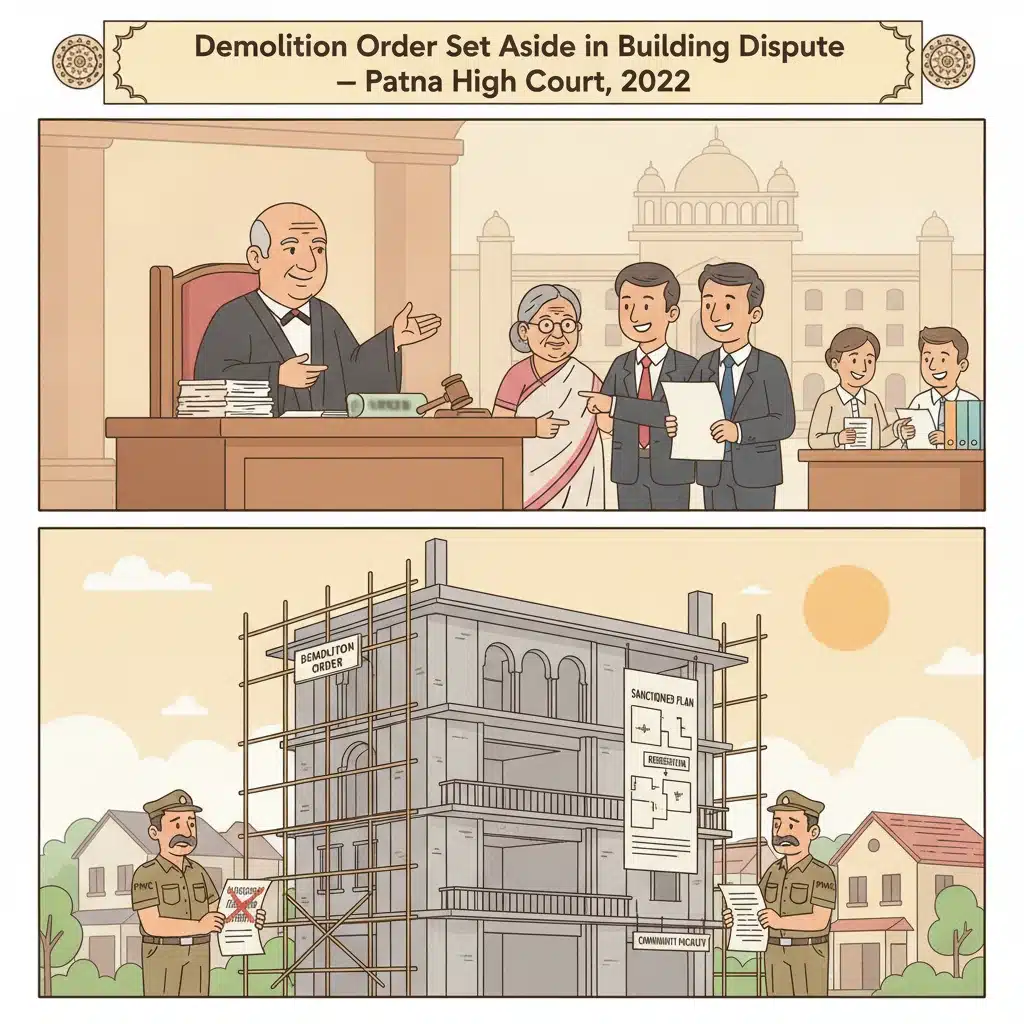
Image Caption: Patna High Court ruling on a demolition dispute between Patna Municipal Corporation and a private developer.




