

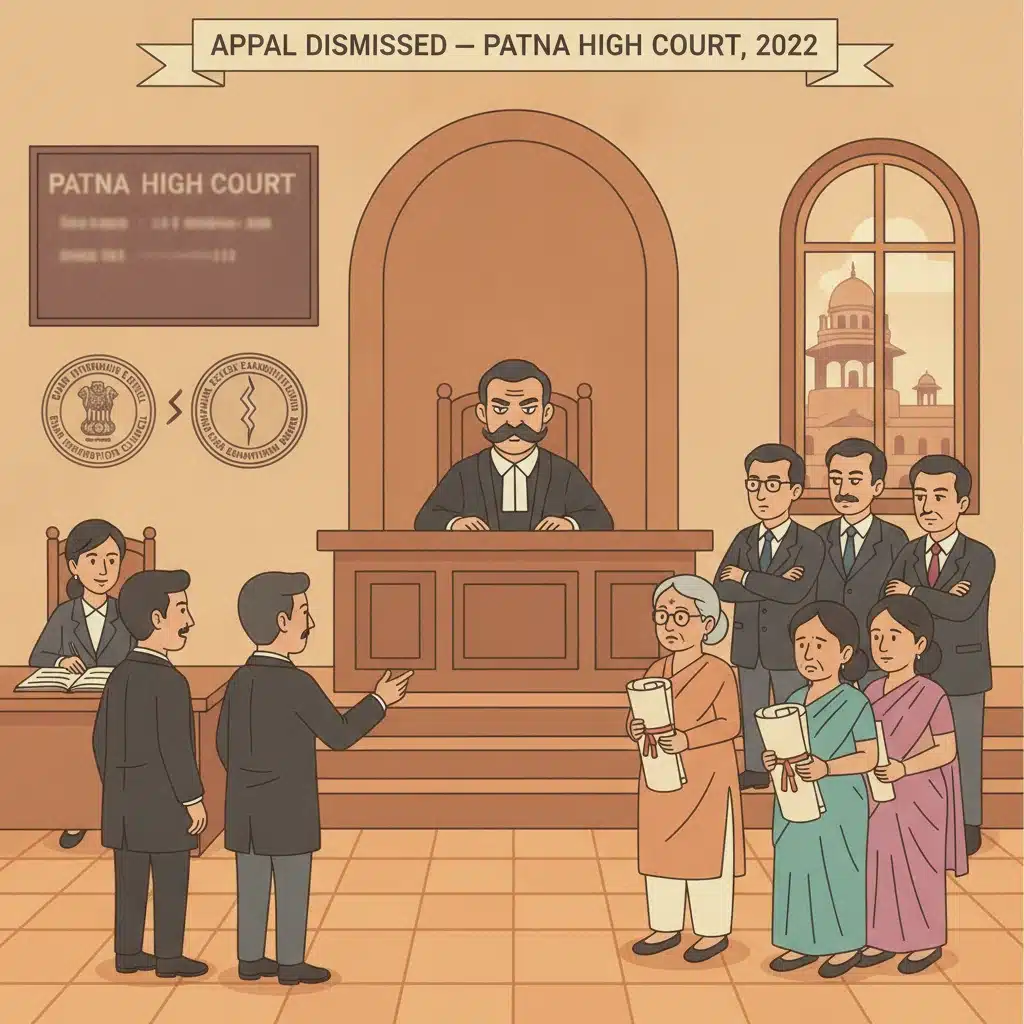
Case Background
This case arose from the closure of the Bihar Intermediate Education Council. After the Council was dissolved, its assets and liabilities were taken over by the State of Bihar. Employees of the former Council were adjusted into the Bihar School Examination Board.
The employees’ side was represented through an association called Bihar Intermediate Education Council Employees Association, Patna. The association consisted of employees from different cadre posts in the former Council. Once they were placed in the Bihar School Examination Board, a key question emerged: how would their earlier service be treated for purposes like seniority, pension and career advancement?
According to the association, the government had counted their earlier service in the Council only for pension and Assured Career Progression (A.C.P.) benefits. Their service in the Council was not counted when fixing their seniority in the Bihar School Examination Board.
Feeling aggrieved, the association and some individual employees first approached the Patna High Court by filing Civil Writ Jurisdiction Case No. 17414 of 2013. They requested that their earlier service in the former Council be counted for seniority in the Board, not just for pension and A.C.P. The learned Single Judge of the Patna High Court dismissed that writ petition by order dated 24.10.2016.
Against that dismissal, the association and one of the employees filed a Letters Patent Appeal, numbered L.P.A. No. 2168 of 2016, before a Division Bench of the Patna High Court. The judgment in this appeal, delivered on 07.11.2022 by Hon’ble Mr. Justice P. B. Bajanthri for the Bench also comprising Hon’ble Mr. Justice Purnendu Singh, is the subject of this article.
What the Court Examined and Decided
The Division Bench closely examined what exactly the appellants were asking for, and whether they had approached the Court in the correct manner.
The association’s main complaint was that the State and the Bihar School Examination Board had refused to count the period of service rendered by the employees in the former Bihar Intermediate Education Council for seniority in the Board. They argued that this denial of seniority, while giving only pension and A.C.P. benefits, violated Articles 14 and 16 of the Constitution of India, which deal with equality and equality of opportunity in public employment.
To support this, the appellants pointed to provisions of the Bihar Intermediate Education Council Act, 1992, which was later repealed by the Bihar Intermediate Education Council (Repeal) Act, 2007. Under the repeal framework, and particularly in terms of sub-section (2) of Section 3 of the Repeal Act and a State Government Resolution dated 12.07.2012, the employees were adjusted into the Bihar School Examination Board.
The appellants argued that when the Council was dissolved “in public interest” and its employees were compulsorily adjusted into the Board, their entire past service should be protected and counted for all service benefits, including seniority. They claimed that this was not a case of voluntary transfer or absorption at the request of individual employees, but a forced shift due to State action, and therefore fairness demanded full recognition of their past service.
On the other side, the State and the Bihar School Examination Board resisted these arguments and supported the earlier judgment of the learned Single Judge.
The State pointed out that the key government document governing the position of these employees is the Resolution dated 12.07.2012. Clause 13 of this Resolution made it very clear that the past service of the adjusted employees would be counted only for pension and A.C.P. benefits. It did not extend this recognition to seniority or other service benefits.
The State emphasised that the appellants had never challenged the validity of Clause 13 of the Resolution. As long as Clause 13 remained unchallenged and in force, the Court could not ignore it. Therefore, the appellants could not claim seniority benefits beyond what was provided in that Resolution.
The State also raised an objection regarding the very maintainability of the writ petition filed by the association. It was argued that the association had not produced a proper registration certificate to show it was a registered association. The certificate produced related to a different association. Further, the dispute over seniority, according to the State, was an individual issue and not something that could be raised in a collective writ petition by an association, especially one that covered multiple cadres.
The Division Bench identified three main questions for consideration:
First, whether the writ petition filed by the Employees Association was maintainable at all. Second, whether seniority is an individual grievance or a collective one that an association can raise. Third, whether, by granting the relief sought, the Court would affect the rights of third parties, namely, other employees who had already gained seniority in the Bihar School Examination Board.
On the first point, the Court held that the association’s writ petition was not maintainable. It noted that the association was not a registered association. Even though counsel for the appellants claimed that the association was affiliated to another registered association and placed some documents on record, the Court found that this did not give the appellant association the status of a registered body. Merely having some clause in the bye-laws of another association could not confer such status.
On the second point, the Court underlined that seniority is essentially an individual grievance. It explained this with a clear example. The appellant association contained employees from different cadres: clerks, under secretaries and others. Take the case of an individual ‘X’, an under secretary who is part of the association. If the Court were to grant seniority to ‘X’ from the date of his service in the former Council, this would directly affect the rights of other under secretaries who were regularly appointed in the Bihar School Examination Board and who might then be pushed down in the seniority list.
The Court observed that because of this, seniority disputes have to be treated as individual disputes. They cannot be agitated by a broad association covering multiple cadres. A class association for one single cadre might sometimes be entertained if it is a clear common cause of a defined class, but here the association covered several different cadres. It therefore did not represent a single, homogeneous class of employees.
On the third point, the Court noted that if it accepted the association’s claim and ordered that past service in the Council be counted for seniority in the Board, many employees who had been appointed in the intervening period would be affected. These employees had entered particular cadres in the Bihar School Examination Board and had already acquired certain seniority. If the association’s members were now pushed above them based on past service in the Council, their established rights would be disturbed.
The Court specifically noted that those potentially affected employees had not been made parties to the case as necessary and proper parties. While two employees were joined as respondents in a “representative capacity” for others who had become senior to the petitioners, the Court still considered that the broader class of affected persons was not properly before the Court. Because seniority changes can significantly affect the careers of many individuals, the Court was unwilling to interfere in their absence.
The Division Bench then examined the legal framework that governed the employees’ claims. It reproduced Clause 13 (Item No. XIII) of the Resolution dated 12.07.2012 which clearly stated:
“XIII. Past service of the adjusted employees will be counted for the purpose of pension and A.C.P.”
The Court highlighted that this clause expressly limited the use of past service to pension and A.C.P. It did not provide that past service would count for seniority or any other service benefit. Importantly, the appellants had not challenged this clause at all. There was no prayer to strike it down or to read it differently.
The Court also noted that during the time between the Resolution (12.07.2012) and the filing of the writ petition, seniority lists for various cadres in the Bihar School Examination Board would naturally have been prepared and notified. In fact, such seniority lists were placed on record as Annexures 2 and 14 to the writ petition.
Even though the appellants had questioned these seniority lists, the Court held that it could not interfere with them for a simple yet important reason: those whose seniority would be affected by quashing or altering the lists had not been made parties to the litigation.
The appellants had cited a Supreme Court decision, Akhil Bharatiya Soshit Karamchari Sangh (Railway) represented by its Assistant General Secretary on behalf of the Association v. Union of India and Ors., reported in 1981 (1) SCC 246, particularly paragraph 62, to support the maintainability of their association petition. However, the Division Bench distinguished this precedent. It pointed out that the Supreme Court decision was under Article 32 of the Constitution and that the facts were different. In the present case, the appellant association was not limited to one particular cadre but covered more than two cadres. For this reason, the Court found that the precedent did not assist the appellants.
Summing up, the Division Bench held that:
- The writ petition by the unregistered, multi-cadre association was itself not maintainable.
- Seniority is an individual grievance, not normally fit to be pursued through such an association writ.
- Past service was, under the unchallenged Clause 13 of the Resolution dated 12.07.2012, countable only for pension and A.C.P., not seniority.
- Interfering with seniority lists would affect the rights of many employees who were not impleaded as parties.
Accordingly, the Court concluded that the appellants had not made out any case for interference with the order of the learned Single Judge. The Letters Patent Appeal was therefore dismissed, and the order in C.W.J.C. No. 17414 of 2013 was affirmed.
Why This Judgment Matters
This judgment is important for employees who are shifted from one government body to another due to closure or restructuring of institutions. It clarifies that past service may not automatically count for all purposes, and employees must carefully read the government resolutions governing their adjustment.
Here, the Patna High Court underlined that when a Resolution clearly limits recognition of past service to pension and A.C.P. alone, courts will not expand it to cover seniority, especially if the clause itself is not challenged.
The judgment also sends a clear message about how service associations should approach court. An unregistered association covering multiple cadres may not be allowed to file a general writ over individual issues like seniority. Individual employees, or a properly constituted cadre-specific association, may need to approach the court instead.
Finally, the decision shows that courts are very cautious about disturbing existing seniority lists. If granting relief would push down others who are not present before the court, the court is likely to refuse such relief.
Legal Issues and Answers
- Issue: Can an unregistered, multi-cadre employees’ association maintain a writ petition challenging denial of seniority benefits?
Answer: No. The Court held that the association was not a registered body and represented different cadres; therefore, its writ petition was not maintainable. - Issue: Does past service in the abolished Bihar Intermediate Education Council have to be counted for seniority in the Bihar School Examination Board when the State Resolution counts it only for pension and A.C.P.?
Answer: No. Clause 13 of the Resolution dated 12.07.2012 expressly limited recognition of past service to pension and A.C.P., and the appellants did not challenge this clause, so they could not claim seniority on that basis. - Issue: Can a court interfere with seniority lists when affected employees are not made parties?
Answer: Generally no. The Court held that changing seniority would affect third-party rights, and since such employees were not properly impleaded, interference with the seniority lists was not permissible.
Cases Cited by the Court
- The appellants relied on Akhil Bharatiya Soshit Karamchari Sangh (Railway) represented by its Assistant General Secretary on behalf of the Association v. Union of India and Ors., reported in 1981 (1) SCC 246, paragraph 62. The Court, however, held that this decision, delivered under Article 32, was distinguishable on facts and did not assist the appellants.
Case Details
Case Number: Letters Patent Appeal No. 2168 of 2016 in Civil Writ Jurisdiction Case No. 17414 of 2013
Case Title: Bihar Intermediate Education Council Employees Association, Patna & Anr. v. The State of Bihar & Ors.
Citation: 2022 (4) PLJR 850
Coram: Hon’ble Mr. Justice P. B. Bajanthri and Hon’ble Mr. Justice Purnendu Singh
Date of Judgment: 07.11.2022
Advocates:
- For the appellants: Mr. Arun Kumar Sinha, Advocate; Mr. Ajit Narayan Lall, Advocate.
- For the State of Bihar: Mr. Shashi Shekhar Tiwari, AC to AAG-13.
- For the Bihar School Examination Board: Mr. Satyabir Bharti, Advocate.
- For Respondent Nos. 7 to 9: Mr. Harsh Singh, Advocate.
Nature of the case: Letters Patent Appeal arising from dismissal of a writ petition (civil writ jurisdiction) challenging denial of seniority benefits to adjusted employees of an abolished statutory council.
Link to the Judgment: Click here to access the full judgment of the Patna High Court
If you found this explanation helpful and wish to stay informed about
how legal developments may affect your rights in Bihar,
you may consider following Samvida Law Associates for more updates.




