

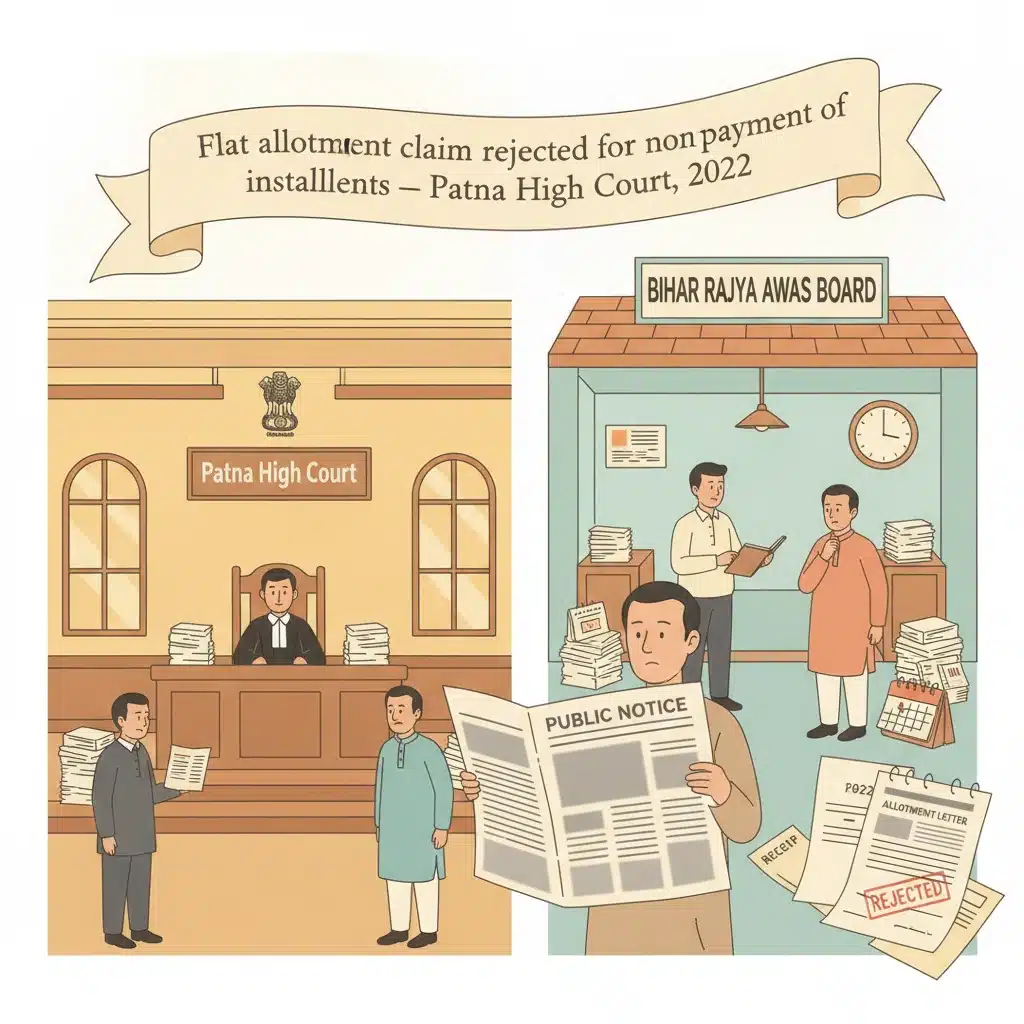
Case Background
The matter arose from an old allotment of a Janta Flat in Bahadurpur Housing Colony, Patna, made by the Bihar State Housing Board in favour of the petitioner.
The Housing Board had first issued a general notice in September 1974 inviting applications from the general public for allotment of housing sites and dwellings. In response, the petitioner applied for a flat.
On 29.10.1983, the Board allotted Janta Flat No. FF-211 to the petitioner. As per the allotment letter, he had to deposit Rs. 2,660 within 30 days in the Board’s account. The balance amount of Rs. 12,240 was to be paid in 120 monthly installments of Rs. 142 each.
The petitioner deposited Rs. 2,660 on 23.11.1983, that is, within the prescribed time. He then requested the Board to execute an agreement for the flat. According to him, the Board did not respond.
After about 15 years, by letter dated 18.12.1998, the Board informed the petitioner regarding execution of the agreement within 15 days. The petitioner says he approached the concerned Executive Engineer on 08.01.1999, but no action was taken.
Subsequently, by letter dated 07.03.2002, the Executive Engineer of the Housing Board informed the petitioner that the price of the flat had been revised. The balance outstanding amount was stated as Rs. 85,966, to be paid in 120 installments at the rate of Rs. 1,196.35 per month.
The petitioner then applied again on 09.03.2004 to the Executive Engineer for execution of the agreement. However, no agreement was executed. Instead, by letter dated 20.04.2004, the Board informed him that the cost of the flat had been raised further to Rs. 1,19,547.
The petitioner’s counsel also pointed out that on 17.02.2013, the Housing Board published a notice in the daily newspaper “Hindustan”. The notice related to revival of allotted flats on the basis of revised rates and the scheme remained valid till 31.03.2013.
What the Court Examined and Decided
The writ petition was filed in Civil Writ Jurisdiction Case No. 9046 of 2018 before the Patna High Court. The petitioner sought a direction to the Bihar State Housing Board and its officials to execute a deed of agreement in respect of Janta Flat No. FF-211 at Bahadurpur Housing Colony, Patna, and to deliver possession of the flat.
On behalf of the petitioner, it was argued that the flat had been allotted way back in 1983. He had deposited the initial amount of Rs. 2,660 within the time fixed by the Board. According to him, the Board did not execute the agreement despite his request.
He further relied on the later correspondence, including the letters in 1998, 2002 and 2004, and the 2013 newspaper notice about revival of allotted flats. The broad stand of the petitioner was that the Board had allotted the flat and therefore should now be compelled by the Court to execute the agreement and hand over possession.
On the other side, the Housing Board contested the claim. Its counsel submitted that the petitioner had not fulfilled his financial obligations under the allotment.
The Board stated that the Executive Engineer, Patna Division-I, had written to the petitioner on 20.03.2004. In this letter, the petitioner was asked to deposit Rs. 2,639, and also Rs. 95,638 towards outstanding EMIs, for the purpose of execution of the registered deed. However, the petitioner did not deposit these amounts.
Later, the Executive Engineer, Patna Division-II, again wrote to the petitioner by letter dated 30.11.2018. In this letter, the petitioner was called upon to pay the outstanding amount of Rs. 95,638, failing which his allotment would be cancelled.
The Board also pointed out the actual payments made by the petitioner. According to its records, he had deposited only two amounts: Rs. 550 on 27.02.1978 and Rs. 2,660 on 23.11.1983. No monthly installments were paid thereafter.
Because of this long-standing default, the petitioner failed to deposit the EMI amount demanded. The Board submitted that, therefore, the allotment had been cancelled and no agreement could be executed between the parties. It was also specifically stated that there was no existing policy of the Board for revival of cancelled allotments. For this reason, the Board argued that no relief could be granted to the petitioner.
Justice Mohit Kumar Shah, after hearing both sides and examining the materials on record, analysed the situation. The Court noted that the flat had been allotted on 29.10.1983. Under the allotment letter, the petitioner was required to deposit the initial amount and then pay the balance amount through monthly installments.
The Court found that apart from depositing the sum of Rs. 2,660 on 23.11.1983, which was only the initial deposit, the petitioner had failed to pay any of the monthly installments as fixed in the allotment letter.
The Court also noted that the price of the flat was revised later and fresh demands were raised. The petitioner did not pay the revised price either. The revision of the price, according to the Court, had become necessary due to the lapses on the part of the petitioner in not paying the installments in time.
The Court further recorded that the Housing Board had, in fact, “sympathetically accommodated” the petitioner from time to time by extending the period for payment of monthly installments. Even then, the petitioner did not honour those opportunities.
As a result of continuous non-payment, the allotment of the flat in favour of the petitioner was cancelled. The Court specifically noted that this cancellation was as per the provisions clearly contained in the allotment letter itself.
Against this background, the Court evaluated the main relief sought: a direction to the Board to execute an agreement and deliver possession of the flat, even though the petitioner had not paid the price and the allotment had already been cancelled.
The Court held that the fault lay squarely with the petitioner. He was seeking execution of the agreement and possession of the flat “without realizing the price of the Flat in question”. The Court held that such a claim was impermissible in law.
Justice Shah observed that insisting on execution of the agreement without payment of the due amount would be contrary to law. Once the allotment itself stood cancelled, there was no subsisting right in favour of the petitioner which the Court could enforce.
The Court also took note of the Board’s submission that there was no current policy to revive cancelled allotments. On the facts before it, and in view of the terms of the allotment letter, the Court concluded that no relief could be granted.
Finally, having regard to all the facts and circumstances, the Court found no merit in the writ petition. The petition was accordingly dismissed on 29.08.2022.
Why This Judgment Matters
This judgment from the Patna High Court is important for anyone dealing with housing board flats or similar government allotments.
It shows that merely getting an allotment letter does not give a permanent right to the flat. The buyer must pay the installments and any revised price demanded under the scheme. If payments are not made, the allotment can be cancelled as per the terms.
The Court also highlighted that even when a housing authority gives extra time or makes sympathetic concessions, the allottee must still comply. If he repeatedly defaults, the Court will not force the authority to execute an agreement or hand over possession.
For allottees in Bihar and elsewhere, this decision is a reminder to strictly follow payment schedules and respond promptly to notices. Delay and non-payment over many years can completely wipe out the right to the allotted flat, leaving no remedy in writ jurisdiction.
Legal Issues and Answers
- Issue: Can the Patna High Court direct the Bihar State Housing Board to execute an agreement and deliver possession of a flat when the allottee has failed to pay the required installments and the allotment stands cancelled under the allotment terms?
Answer: No. The Court held that the petitioner had not paid the installments or the revised price, the allotment had already been cancelled as per the allotment letter, and there was no policy for revival of cancelled allotments. Therefore, no relief could be granted and the writ petition was dismissed.
Cases Cited by the Court
- No previous judgments or case law have been cited or relied upon in the text of this judgment.
Case Details
Case Number: Civil Writ Jurisdiction Case No. 9046 of 2018
Case Title: Yogendra Ray v. The Bihar State Housing Board & Ors.
Citation: 2022(4) PLJR 924
Coram: Hon’ble Mr. Justice Mohit Kumar Shah
Advocates:
- For the petitioner: Mr. Ajoy Kumar Chakraborty, Advocate
- For the respondents: Mr. Anil Kumar Sinha, Advocate
- For Bihar State Housing Board: Dr. Anand Kumar, Advocate
Nature of the case: Writ petition seeking direction to the Bihar State Housing Board to execute deed of agreement and deliver possession of an allotted flat.
Date of Judgment: 29.08.2022
Link to the Judgment: Click here to read the full judgment of the Patna High Court
If you found this explanation helpful and wish to stay informed about
how legal developments may affect your rights in Bihar,
you may consider following Samvida Law Associates for more updates.




