

Case Background
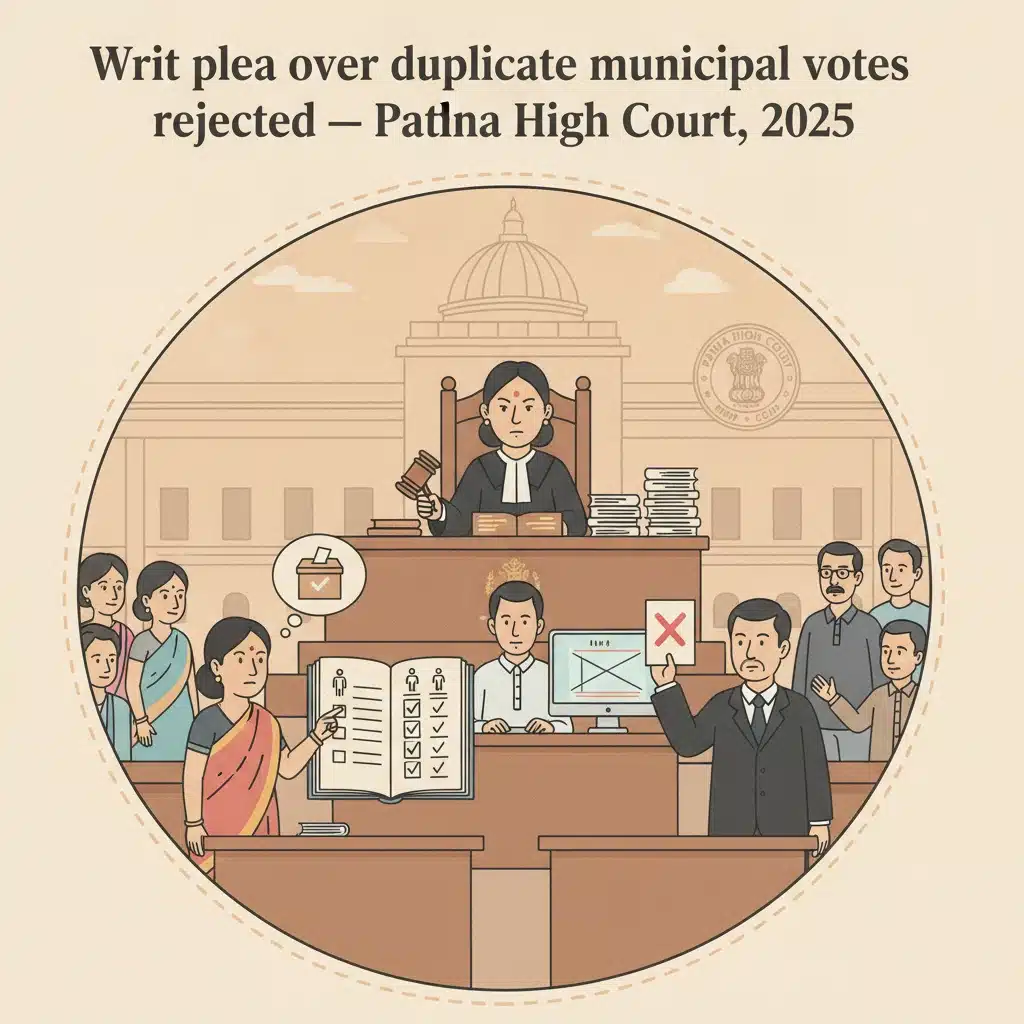
The case arose from the election for Chief Councillor/Chairperson of Khusropur Nagar Panchayat, Patna, held on 28.06.2025. The election was conducted by the State Election Commission, Bihar, using both traditional offline voting and an e‑voting system, as per the guidelines issued by the authorities.
The petitioner, a contesting candidate in this election, claimed that there were serious irregularities in the voting process. According to her, the same individual voters were allegedly able to cast votes both through e‑voting and through offline voting. She alleged that this “dual voting” led to duplicate counting of votes, which in turn affected the final result and caused her defeat.
The petitioner stated that she had compiled a tabular list of such alleged duplicate voters, mentioning their EPIC (Elector Photo Identity Card) numbers. She claimed that she had sent representations to the Chief Electoral Officer, the District Magistrate and the Sub‑Divisional Officer, pointing out that certain voters appeared in both the offline and online records.
In paragraph 18 of her writ petition, she further alleged that duplicate voting had occurred not only through two modes in the same area but also across two different panchayat jurisdictions, using two EPIC numbers or slightly varied names within the same family line. She contended that this allowed some individuals or families to vote more than once and distorted the mandate of the people.
Dissatisfied with the response of the authorities, she approached the Patna High Court in Civil Writ Jurisdiction Case No.12818 of 2025. She sought intervention at the writ stage, directly against the State of Bihar, the State Election Commission, the District Magistrate, and the Sub‑Divisional Officer, Patna City.
What the Court Examined and Decided
The petitioner sought multiple directions from the Court. She asked for a comprehensive inquiry into alleged duplicate and cross‑panchayat voting in the 28.06.2025 election for Khusropur Nagar Panchayat. She also asked the Court to:
(a) stay the final certification of the election result for Chairperson, Nagar Panchayat, Khusropur, until illegal votes were identified and removed from the final tally;
(b) cancel all votes allegedly cast twice by the same individuals, through e‑voting and offline voting, and declare the whole election null and void if the cancellations materially affected the outcome;
(c) direct disciplinary and penal action against officials and others under Section 171 of the Bharatiya Nyaya Sanhita, 2023, and the Bihar Panchayat Election Rules, 2025 (amended); and
(d) pass any other appropriate order in the facts of the case.
To support her plea, the petitioner relied on two Supreme Court judgments. First, she cited Kishansing Tomar v. Municipal Corporation of Ahmedabad & Ors., (2006) 8 SCC 352, to argue that the State Election Commission has a duty to ensure free and fair elections. She argued that failure to synchronise e‑voting records with the physical polling list violated this mandate.
Second, she relied on Mohinder Singh Gill & Anr. v. Chief Election Commissioner & Ors., AIR 1978 SC 851, where the Supreme Court emphasised that electoral fairness is a fundamental feature of democracy and that substantial subversion of this fairness permits judicial scrutiny.
On the other side, counsel for the State Election Commission focused not on the factual allegations, but on the legal bar on the Court’s jurisdiction in such matters. He pointed out that the dispute related to a municipal election governed by Part IXA of the Constitution of India, introduced by the 74th Constitutional Amendment, 1992.
He drew specific attention to Article 243ZG of the Constitution, titled “Bar to interference by courts in electoral matters.” Under clause (b) of Article 243ZG, “no election to any Municipality shall be called in question except by an election petition presented to such authority and in such manner as is provided for by or under any law made by the Legislature of a State.”
He submitted that this constitutional bar is reflected in the Bihar Municipal Act, 2007. Section 478 of the Act substantially adopts the same position, expressly stating that no election to any Municipality shall be called in question except by an election petition presented to the prescribed authority under the Act.
The Court reproduced both Article 243ZG and the relevant provisions of the Bihar Municipal Act, 2007, in detail. Section 476 of the Act makes it clear that the election to any office of a Municipality can be challenged only through an election petition. It also specifies the forum: where the election to a Nagar Panchayat office is in dispute, the election petition must be filed before the Munsif within whose jurisdiction the Nagar Panchayat is situated.
Section 476(2) further clarifies who must be made parties to such an election petition. In particular, where a petitioner seeks a declaration that he or she is duly elected, all contesting candidates other than the petitioner, or at least all returned (winning) candidates, have to be joined as respondents.
The Court then looked at Section 479 of the Bihar Municipal Act, 2007, which lists the grounds on which an election can be declared void by the prescribed authority. One of these grounds, in Section 479(1)(d)(iii), is that the election result has been materially affected by “the improper reception, refusal or rejection of any vote or reception of any vote which is void.”
Justice Dr. Anshuman noted that the petitioner’s main grievance—duplicate voting, and counting of votes that should be void—fell squarely within this clause. Therefore, even if the allegations were assumed for argument’s sake, the proper remedy was through an election petition on the ground of improper reception of votes or reception of void votes, not through a writ petition.
The Court also put a specific question to the petitioner’s counsel: if the writ petition were allowed, would the elected candidate be affected? Counsel candidly admitted that the elected candidate would indeed be affected. However, on examining the array of parties in the writ petition, the Court found that the elected candidate had not been made a party at all.
This omission was significant because, under Section 476(2), returned candidates are necessary parties when their election is under challenge. Proceeding in writ jurisdiction to affect the status of the successful candidate, without his or her presence, would be contrary to the statutory scheme and the principles of natural justice.
Against this background, the Court framed a central legal question for itself:
“Whether the Court in the writ jurisdiction should interfere in the process of election which was alleged to be taken with procedural irregularity and result has been published or not and even after publication of result, any remedy left to the petitioner?”
Answering this, the Court held that once the municipal election has been conducted and the result has been declared, the High Court’s writ jurisdiction is barred from interfering with the election process. Instead, the Constitution and the Bihar Municipal Act expressly require that such grievances be pursued only through an election petition before the prescribed authority.
Justice Dr. Anshuman concluded that, in the light of the constitutional mandate in Article 243ZG and the specific provisions of Sections 476, 478 and 479 of the Bihar Municipal Act, 2007, the petitioner had a clear statutory remedy. The issues raised in paragraphs 17 and 18 of the writ petition about duplicate voting and improper reception of votes were “well covered” under Section 479(1)(d)(iii).
Considering also that the winner had not been joined as a party, the Court declined to entertain the writ. The writ petition was dismissed.
However, the Court did not close the door on the petitioner. It expressly clarified that, if the petitioner files an election petition within 30 days from the date of the judgment (18.08.2025), the appropriate forum under Section 476 of the Bihar Municipal Act, 2007, must decide the matter within one year. This direction ensures that the statutory remedy remains meaningful and time‑bound.
Why This Judgment Matters
This judgment is important for candidates and voters involved in municipal elections in Bihar, especially where electronic voting and offline voting are used together. It clarifies that complaints about faulty counting, duplicate votes, or improper inclusion or exclusion of votes cannot be taken directly to the High Court through a writ once the result is declared.
Instead, affected candidates must file an election petition before the Munsif or Sub‑Judge specified under Section 476 of the Bihar Municipal Act, 2007. The grounds for challenge, including improper reception of votes or acceptance of void votes, are clearly laid down in Section 479.
The judgment also highlights a basic but crucial procedural point: if you challenge an election result, the winning candidate must be made a party. Without this, even a properly framed legal challenge may fail.
For ordinary citizens, the ruling reinforces that there is a dedicated legal route for disputing municipal elections, and that courts will insist on following that route rather than bypassing it through writ petitions.
Legal Issues and Answers
-
Issue: Can the Patna High Court, in its writ jurisdiction, interfere with a concluded municipal election on allegations of duplicate or improper voting?
Answer: No. Article 243ZG of the Constitution and Sections 476, 478 and 479 of the Bihar Municipal Act, 2007 bar such interference and require that the election be challenged only through an election petition before the prescribed authority. -
Issue: Do allegations of duplicate voting and counting of void votes fall within the scope of an election petition remedy under the Bihar Municipal Act, 2007?
Answer: Yes. Such allegations are covered by Section 479(1)(d)(iii), which deals with improper reception, refusal or rejection of any vote or reception of any vote which is void, affecting the election result. -
Issue: Can relief be granted in an election dispute when the elected candidate is not made a party to the proceedings?
Answer: No. When the election of a returned candidate is under challenge, that candidate is a necessary party under Section 476(2), and proceedings cannot properly continue in his or her absence.
Cases Cited by the Court
-
The judgment records reliance by the petitioner on:
- Kishansing Tomar v. Municipal Corporation of Ahmedabad & Ors., (2006) 8 SCC 352.
- Mohinder Singh Gill & Anr. v. Chief Election Commissioner & Ors., AIR 1978 SC 851.
The Patna High Court, however, decided the matter primarily on the basis of Article 243ZG of the Constitution and the Bihar Municipal Act, 2007.
Case Details
Case Number: Civil Writ Jurisdiction Case No.12818 of 2025
Case Title: Puja Kumari v. The State of Bihar & Ors.
Coram: Hon’ble Mr. Justice Dr. Anshuman
Date of Judgment: 18.08.2025
Citation: 2025(4) PLJR 79
Advocates:
- For the petitioner: Mr. Apurv Harsh, Advocate; Mr. Manu Tripurari, Advocate; Mr. Sujit Kumar, Advocate; Mr. Raghu Raj Pratap, Advocate; Ms. Jaya Singh, Advocate; Ms. Aditi Sahay, Advocate; Mr. Pransho Prakash, Advocate; Mr. Hritik, Advocate.
- For the State: Mr. Subhash Pd. Singh (GA‑3); Mr. Indeshwari Pd (AC to GA‑3).
- For the State Election Commission: Mr. Ravi Ranjan, Advocate.
Nature of the Case: Writ petition under Article 226 of the Constitution challenging the municipal election process and result for the post of Chairperson, Khusropur Nagar Panchayat, Patna.
Link to Judgment: Patna High Court Judgment in CWJC No.12818 of 2025
If you found this explanation helpful and wish to stay informed about
how legal developments may affect your rights in Bihar,
you may consider following Samvida Law Associates for more updates.




