

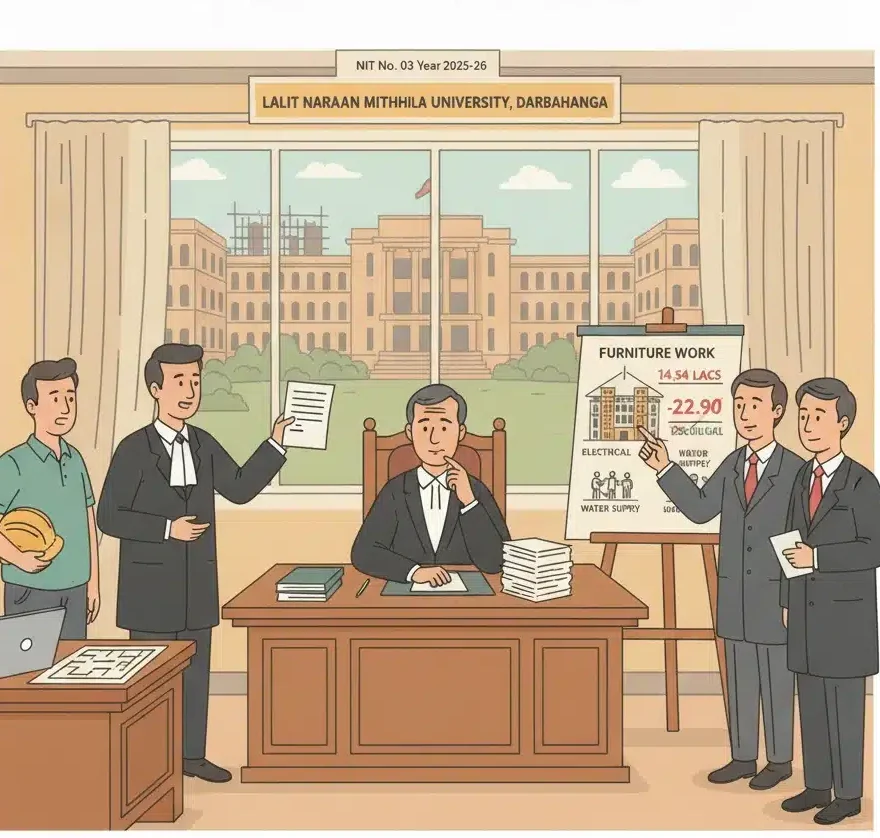
The Court held that the bidder did not meet the required past experience in furniture work.
It also ruled that the contractor could not rely on a sub-contractor’s agreement to fill this gap.
The writ petition and related applications were dismissed, allowing the tender process to continue.
Case Background
The case arose from a government tender issued by the Bihar State Educational Infrastructure Development Corporation Ltd. for several works, including construction of a Girls Hostel Building at Lalit Narayan Mithila University, Darbhanga.
The Notice Inviting Tender (NIT) No. 03 Year 2025-26 was dated 14.05.2025. One of the items at Serial No. 21 related to the construction of the Girls Hostel building. The petitioner, a proprietary construction concern, submitted its bid for the furniture component of this work.
The petitioner claimed to be a registered Class-I Contractor and asserted that it was fully eligible to participate. However, in the meeting of the Technical Committee of the Corporation held on 07.07.2025, the petitioner’s technical bid was rejected.
The Committee’s decision recorded that the “Executed Furniture quantity not found as per the NIT hence, disqualified SBD Clause ITB 4.5A(A).” Aggrieved by this rejection, the petitioner filed a writ petition under Article 226 of the Constitution of India before the Patna High Court.
During the pendency of the writ petition, the Corporation opened the financial bid of another bidder, M/s Mothers India Construction Pvt. Ltd. The petitioner then filed an interlocutory application seeking to implead this entity as Respondent No. 7, and another application seeking amendment of the prayer clause.
What the Court Examined and Decided
The Division Bench comprising Hon’ble the Chief Justice Vipul M. Pancholi and Hon’ble Mr. Justice Dr. Anshuman heard the matter. Arguments focused on whether the rejection of the technical bid was lawful and whether the petitioner could rely on a sub-contractor’s experience to satisfy the tender’s eligibility criteria.
Counsel for the petitioner argued that the rejection was wrongful. He pointed to the eligibility criteria in the Standard Bidding Document (SBD) for Procurement of Civil Works, particularly Clause 4.5A(c), read with Clauses 4.5A(d), 4.5A(e) and 4.6.
Clause 4.5A(c) provides that, to qualify for award of the contract, each bidder in its own name should have, in the last five years, executed in any one year the minimum quantities of specified items of work. For furniture work, the minimum amount specified in the Appendix is Rs. 22.90 lacs.
The petitioner admitted that it had personally executed furniture work worth Rs. 14.54 lacs in one year, which is below Rs. 22.90 lacs. To overcome this gap, the petitioner relied on Clauses 4.5A(d) and 4.5A(e), along with Clause 4.6.
Clause 4.5A(d) deals with building electrification works. It states that the contractor or his identified sub-contractor should possess a valid electrical licence and should have executed similar electrical works for a minimum amount indicated in the Appendix in any one year.
Clause 4.5A(e) deals with water supply and sanitary engineering works. It similarly allows reliance on the contractor or his identified sub-contractor who must possess the required licence and must have executed similar water supply or sanitary engineering works for a minimum amount indicated in the Appendix in any one year.
Clause 4.6 provides that the experience and resources of sub-contractors shall not be taken into account in determining the bidder’s compliance with qualifying criteria, “except to the extent stated in 4.5(A) above.”
On the strength of these clauses, the petitioner contended that there was a relaxation in the SBD allowing the experience of an identified sub-contractor to be counted. The petitioner stated that it had entered into an agreement with a sub-contractor for furniture work of approximately Rs. 30 lacs. According to the petitioner, this agreement should have been taken into account, and the Corporation should have considered the total work (its own plus the sub-contractor’s) while evaluating eligibility.
The petitioner argued that, since such consideration was not given and the bid was rejected solely on the basis of its own furniture work of Rs. 14.54 lacs, the rejection was arbitrary and must be set aside. A further prayer was made that, because the financial bid of M/s Mothers India Construction Pvt. Ltd. had already been opened, the Corporation should be restrained from executing any agreement with that firm.
The Corporation, through its counsel, strongly opposed the petition. It maintained that there was no illegality or arbitrariness in rejecting the petitioner’s technical bid. The Corporation submitted that the reliance on Clauses 4.5A(d), 4.5A(e) and 4.6 by the petitioner was misconceived.
According to the Corporation, Clauses 4.5A(d) and (e) applied only to electrification work and sanitary engineering work respectively, and not to furniture work. Therefore, any relaxation allowing the use of sub-contractor experience was confined strictly to those two types of works.
The Corporation underlined that the minimum qualifying quantity for furniture work in any one year was Rs. 22.90 lacs, clearly spelt out in Clause 4.5A(c). As the petitioner had executed furniture work worth only Rs. 14.54 lacs in one year, it did not meet the mandatory threshold. Hence, the bid was rightly rejected.
The Court carefully examined the NIT, the decision of the Technical Committee, and the relevant clauses of the SBD. It noted that the Committee’s decision explicitly stated that the petitioner’s executed furniture quantity was not found as per SBD Clause ITB 4.5A(A), and therefore the technical bid was rejected.
The Bench reproduced Clause 4.5A(c), (d), (e) and Clause 4.6 in the judgment to analyse them. From these clauses, the Court drew a clear distinction between:
- the general requirement that each bidder must, in its own name, have executed minimum quantities of specified works in one year of the last five years, and
- the specific relaxations for electrification and sanitary engineering works, where sub-contractor experience could be counted.
The Court held that, for furniture work, the minimum qualifying amount was Rs. 22.90 lacs in one year. It was an admitted position on record that the petitioner had executed furniture work only worth Rs. 14.54 lacs in one year.
The Court considered the petitioner’s reliance on the sub-contractor agreement for furniture work of approximately Rs. 30 lacs. It held that this argument was misconceived.
The Bench reasoned that Clause 4.5A(d) provided certain relaxation only for building electrification works, and Clause 4.5A(e) provided relaxation only for sanitary engineering works. Both these clauses allowed counting the experience of an identified sub-contractor, provided the sub-contractor had the necessary licence and experience.
In the present case, the dispute related solely to furniture work. The petitioner had submitted the technical bid only for the furniture component. There was no clause in the SBD that allowed the experience of a sub-contractor to be taken into account for furniture work.
Therefore, the Court held that, in the absence of any such specific provision, the Corporation was right in taking into account only the petitioner’s own executed furniture work. The agreement between the petitioner and its sub-contractor for furniture work could not be used to meet the eligibility criteria.
On this basis, the Court concluded that the Corporation had not committed any error in rejecting the technical bid of the petitioner.
The Bench then reminded that the scope of judicial review under Article 226 in contractual and tender matters is very limited. The High Court cannot sit in appeal over decisions taken by specialised authorities in tender evaluation, particularly on technical aspects, unless there is clear arbitrariness, mala fides, or violation of statutory provisions.
In the present case, the Court found no such infirmity. It saw no reason to interfere with the decision of the Technical Committee. Consequently, the writ petition was dismissed.
As a result of the dismissal of the main writ petition, all interlocutory applications, including those seeking impleadment of M/s Mothers India Construction Pvt. Ltd. and amendment of the prayer clause, were also disposed of.
Why This Judgment Matters
This decision is important for contractors and agencies participating in government tenders in Bihar, especially those dealing with construction and allied works.
The Patna High Court has made it clear that eligibility conditions in tender documents will be strictly applied as written. If the tender requires a contractor to show a minimum amount of completed work in a particular field, that requirement cannot be bypassed by relying on sub-contractors unless the tender explicitly allows it.
For furniture work in this case, there was no relaxation similar to that given for electrification and sanitary engineering works. The Court refused to extend the benefit of those clauses by analogy.
The judgment also reinforces that courts will rarely interfere with technical decisions of tender committees. Judicial review is limited to checking for illegality or arbitrariness, not to re-evaluating the merits of bids.
For small and medium contractors, the message is that they must carefully read the Standard Bidding Documents and ensure that their own past work experience satisfies each eligibility requirement. Reliance on future agreements with sub-contractors will not cure a present shortfall in experience.
Legal Issues and Answers
- Issue: Whether the Bihar State Educational Infrastructure Development Corporation Ltd. acted illegally in rejecting the petitioner’s technical bid for furniture work under NIT No. 03 Year 2025-26 on the ground that executed furniture quantity was below the required minimum of Rs. 22.90 lacs in one year.
Answer: No. The Patna High Court held that the rejection was valid because the petitioner had executed furniture work worth only Rs. 14.54 lacs in one year, below the prescribed minimum, and there was no clause permitting inclusion of sub-contractor experience for furniture work. - Issue: Whether Clauses 4.5A(d), 4.5A(e) and 4.6 of the Standard Bidding Document allowed the petitioner to rely on an agreement with a sub-contractor for furniture work to satisfy the eligibility criteria.
Answer: No. The Court held that Clauses 4.5A(d) and (e) provide limited relaxation only for electrification and sanitary engineering works, and not for furniture work. Therefore, the sub-contractor’s agreement for furniture work could not be considered. - Issue: Whether the High Court should exercise its writ jurisdiction under Article 226 to interfere with the tender evaluation decision of the Technical Committee in this case.
Answer: No. The Court reiterated that judicial review in contractual and tender matters is very limited and found no reason to interfere, as the decision was in line with the tender conditions and showed no arbitrariness.
Cases Cited by the Court
- No prior judicial decisions are cited or relied upon in the text of this judgment.
Case Details
Case Number: Civil Writ Jurisdiction Case No. 12322 of 2025
Case Title: Madhav Construction v. Bihar State Educational Infrastructure Development Corporation Ltd. & Ors.
Coram: Hon’ble the Chief Justice Vipul M. Pancholi; Hon’ble Mr. Justice Dr. Anshuman
Citation: 2025(4) PLJR 66
Advocates: Mr. Akshansh Ankit, Advocate for the petitioner; Mr. Girijish Kumar, Advocate for the respondent-Corporation
Nature of the Case: Writ petition under Article 226 of the Constitution of India challenging rejection of technical bid in a government tender process
Date of Judgment: 14.08.2025
Court: High Court of Judicature at Patna
Link to Judgment: Click here to view the official Patna High Court judgment
If you found this explanation helpful and wish to stay informed about
how legal developments may affect your rights in Bihar,
you may consider following Samvida Law Associates for more updates.




