

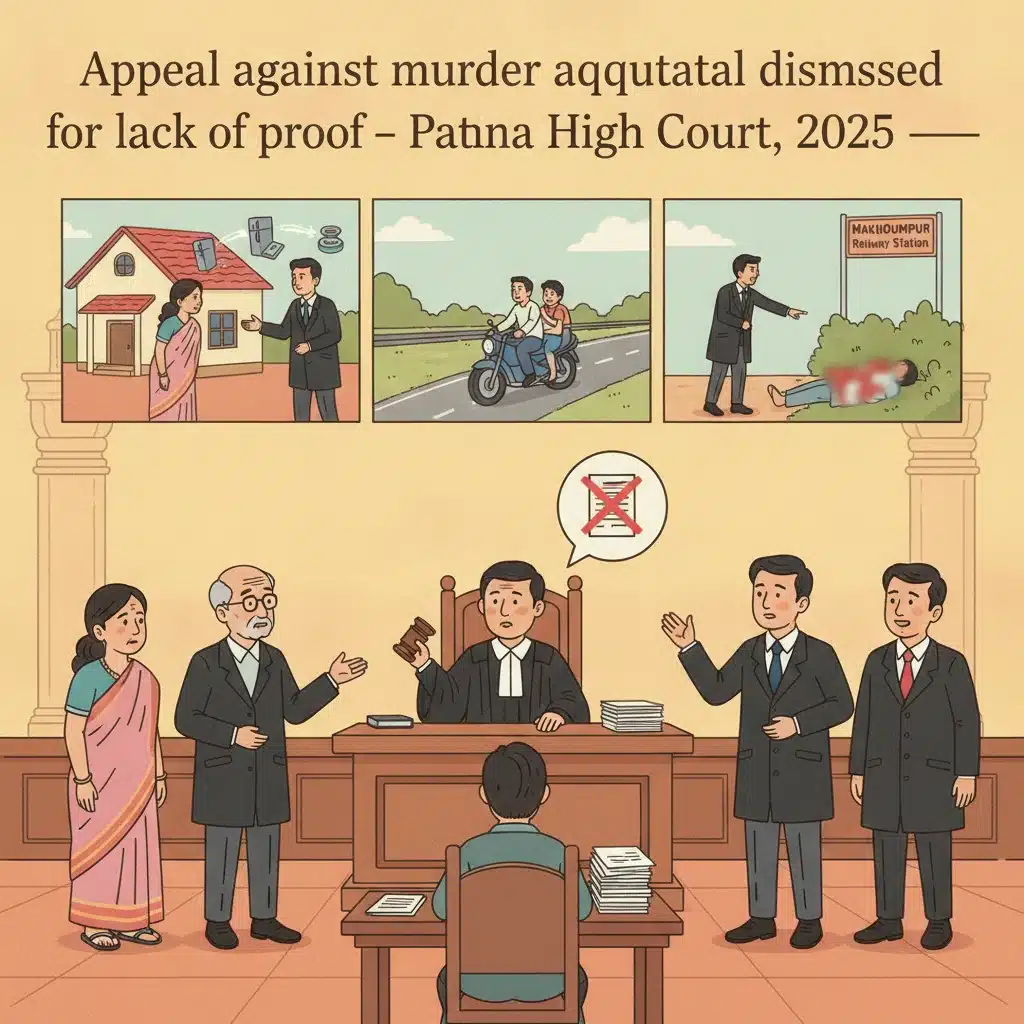
Case Background
This criminal appeal was filed by the informant–father of the deceased against a judgment of acquittal dated 05.03.2024 in Sessions Trial Case No. 27 of 2021, arising out of Makhdumpur P.S. Case No. 21 of 2020, District Jehanabad.
The FIR was lodged on the basis of a written complaint by the father (later appellant), alleging that his daughter Priti Kumari had been killed by her husband and in-laws after dowry demands. Initially, Makhdumpur P.S. Case No. 21 of 2020 was registered under sections 304B and 120B of the Indian Penal Code.
After investigation, the police did not file charge-sheet for dowry death under section 304B IPC. Instead, they submitted Charge-sheet No. 116 of 2020 dated 25.03.2020 against two persons – the husband (respondent no. 2) and the husband’s maternal uncle (respondent no. 3) – for offences under sections 302 and 201 read with section 34 IPC, and sections 3/4 of the Dowry Prohibition Act. Investigation against other named persons was kept pending.
The trial court (Additional District & Sessions Judge-II, Jehanabad) framed charges under sections 302/34, 201/34 IPC and 3/4 Dowry Prohibition Act. The accused pleaded not guilty. After full trial, including examination of seven prosecution witnesses and one defence witness, the trial court acquitted both accused, holding that the prosecution failed to prove the case beyond reasonable doubt.
Aggrieved by the acquittal, the informant–father approached the Patna High Court in Criminal Appeal (DB) No. 541 of 2024. The State did not file a separate appeal against acquittal.
What the Court Examined and Decided
The Patna High Court, speaking through Hon’ble Mr. Justice Shailendra Singh (for the Division Bench with Hon’ble Mr. Justice Rajeev Ranjan Prasad), re-examined the entire record to see whether the acquittal was perverse or based on misreading of evidence.
According to the FIR, the deceased Priti Kumari was married to respondent no. 2 in 2019. At marriage, the father had given a motorcycle, gold chain, furniture and other items. He alleged that after one month, the husband, his parents and brother started demanding a refrigerator, cooler and cash. Because of financial difficulty, he could not meet the demands. The daughter was allegedly ousted from her matrimonial home after her ornaments were taken.
On 13.01.2020, the husband is said to have come to his sasural (in-laws’ house), taken meals, and slept in the same room with Priti Kumari. At about 3:00 a.m., he woke the informant and said that she was missing. A search was started in nearby areas but without success.
During the search, according to the FIR, the husband went towards Makhdumpur with the informant’s minor son Vineet. On the way he rang the informant’s other daughter, Kanchan Kumari, and told her that Priti was missing and should be searched near Makhdumpur railway station. Around 6:00 a.m., the husband allegedly took Kanchan and Vineet on a motorcycle towards the railway line and showed them Priti’s dead body lying in bushes near the track, with multiple stab injuries. Based on these facts, the informant asserted that respondent nos. 2 and 3 and their family members had murdered his daughter and disposed of her body there pursuant to a conspiracy.
The prosecution case at trial rested entirely on circumstantial evidence. No one claimed to have seen the murder. The appellant argued in the High Court that, although there was no direct evidence, the circumstances formed a complete chain pointing only to the guilt of respondents 2 and 3.
The main circumstances relied upon by the appellant were:
- the alleged dowry demands and cruelty after marriage;
- the fact that the husband was staying in the parental home on the fateful night and slept with the victim;
- his conduct in informing the family about her missing status at 3:00 a.m.;
- his alleged phone call to Kanchan suggesting that the body would be near Makhdumpur railway station; and
- mobile tower location evidence collected by the Investigating Officer.
The High Court carefully examined the testimony of each prosecution witness.
PW-1 Umesh Rai, the deceased’s uncle, said he and the informant searched the nearby areas till around 5:30 a.m., then again went towards Makhdumpur railway station and reached Kansara More at about 7:00 a.m. According to him, till 7:00 a.m. the body had not been found. Importantly, he did not support any claim that the husband had earlier pointed out the place where the body lay. He also stated that both accused went to the police station along with the family, which the Court viewed as a conduct inconsistent with someone trying to hide a crime.
PW-2 Shambhu Prasad Yadav, the informant’s brother, gave similar evidence. He said that Kanchan called the informant, saying that the body had been found in bushes near Makhdumpur railway station, and that they reached there at about 7:45 a.m. He also did not speak to any incriminating act of the accused other than being part of the search.
PW-3, the informant–father, stated in cross-examination that respondent no. 2 also went to search for the victim on a motorcycle with his son Vineet. He himself, with relatives and co-villagers, searched up to a nearby river around 5:00 a.m. He said they reached the bushes where the body was found at about 6:00 a.m. However, his versions differed: in chief, he claimed that when they reached the bushes, Kanchan and Vineet were crying and said the accused had already taken away the body, which was later found at the doorstep of his house. The Court noted that this alleged conduct of the accused – taking the body from the bushes to the house – was not mentioned in his written FIR lodged on 14.01.2020, after recovery of the dead body. This omission made his improved version unreliable.
PW-4, the Investigating Officer, deposed that at the place where the body was said to have been found, he noticed bloodstained grass and a coconut rope, though the body was no longer there. He obtained call detail records of the mobile phones of the two accused. Based on this, he stated that the tower location of respondent no. 2’s phone was near the place of occurrence during certain hours, while that of respondent no. 3 was at Sukiyawan village.
However, the prosecution never produced the CDRs in proper documentary form, nor any certificate under section 65B of the Evidence Act. In cross-examination the IO admitted that he had not seized the phones of the victim, informant or accused, and that the tower locations of respondent no. 2 and 3 were at Chhariyari and Sukiyawan villages respectively on 13.01.2020, which were different from the informant’s village Jamalpur. The High Court agreed with the trial court that such unproved and confused tower location evidence could not safely establish presence of the accused at the exact place and time of murder.
Regarding motive, the Court looked at the alleged dowry demands. PW-1 admitted that no case or complaint had ever been lodged about dowry or cruelty, nor any approach made to the mukhiya or other public representative. Similar admissions were made by PW-2 and PW-3. Police had themselves not found material to support dowry death and had therefore not charge-sheeted under section 304B IPC. The trial court had also not taken cognizance of section 304B.
The Court further stressed that on 13.01.2020 the husband had come during the day to his sasural, stayed there, and slept in the same room with his wife. This indicated that relations had not deteriorated to such an extent that a strong motive to kill could be presumed.
The most important gap noted by the Court was that the victim went missing from her parental house at night, while her parents and relatives were present there, yet nobody saw her leaving with the husband or anyone else. No villager saw the husband taking her through the village to the railway station side. This made the prosecution’s story that the husband secretly took her away at midnight difficult to believe.
PW-6 Kanchan Kumari, sister of the deceased, said that respondent no. 2 first phoned her to say that Priti was missing and suggested searching near Makhdumpur railway station. According to her, when she reached the station, the husband came there with the victim’s brother on a motorcycle, took them towards the north and told her that the dead body was lying in the bushes. She claimed that thereafter the husband arranged a tempo and brought her and the body to their village.
The High Court found this story inherently unreliable. As the judgment notes, a person who had murdered someone and secretly disposed of the body at an isolated place would not, in normal course, himself reveal the exact location to the deceased’s close relatives and then assist in bringing the body home. This conduct instead suggested that he was part of the search, not necessarily the killer.
Overall, the Court held that the two main circumstances relied upon by the prosecution — (i) the husband’s suggestion to search near the railway station and (ii) his leading relatives to the body — were not proved by cogent, consistent evidence. Even if taken as proved, they were not strong enough to form a complete chain of circumstances excluding every reasonable hypothesis of innocence.
The Bench invoked the well-known “five golden principles” of circumstantial evidence laid down by the Supreme Court in Sharad Birdhichand Sarda v. State of Maharashtra, AIR 1984 SC 1622. It reiterated that circumstances must be fully established, be consistent only with guilt, be of conclusive nature, exclude every other hypothesis, and form a complete chain pointing to the accused.
The Court also recalled recent Supreme Court guidance on appeals against acquittal, including Susheela Yogish Bungle & Anr. v. M/s V.T. Impex Ltd. & Anr. and Brijesh Singh v. State of U.P. & Ors.. It noted that an appellate court should interfere with acquittal only when the trial court’s view is perverse, or where the only possible conclusion from the evidence is guilt beyond reasonable doubt. Merely because another view is possible is not enough.
Applying these principles, the Patna High Court found the trial court’s assessment to be “well reasoned” and free from perversity. The evidence did not inspire sufficient confidence to hold that respondents 2 and 3 had committed murder. Since there remained a “possible hypothesis of innocence,” the benefit of doubt had to go to the accused.
Accordingly, the Division Bench dismissed the informant’s appeal and affirmed the acquittal of both accused under sections 302/34, 201/34 IPC and sections 3/4 Dowry Prohibition Act.
Why This Judgment Matters
This decision is significant for families who lose daughters under suspicious circumstances and hope for criminal conviction. The Patna High Court makes it clear that strong suspicion, family doubts and partial mobile tower data are not enough for conviction in a murder case.
The judgment also shows that allegations of dowry harassment must be supported by timely complaints, consistent statements and proper investigation. Courts will not automatically treat every unnatural death of a married woman as a proved dowry death or murder.
For investigating officers, the case highlights the importance of properly seizing mobile phones, collecting call detail records with certificates under section 65B of the Evidence Act, and presenting them in court. Faulty or incomplete investigation can seriously weaken a case.
Finally, the ruling reinforces that appellate courts, including the Patna High Court, are very slow to disturb an acquittal unless the trial court’s view is plainly unreasonable. Once acquitted, an accused enjoys a strong presumption of innocence.
Legal Issues and Answers
-
Issue: Did the circumstantial evidence on record clearly prove that the husband and his maternal uncle murdered the victim and disposed of her body near Makhdumpur railway station?
Answer: No. The Court held that the alleged circumstances were not fully proved, were not conclusive, and did not form a complete chain pointing only to the guilt of the respondents. -
Issue: Was the trial court’s acquittal so perverse or unreasonable that the Patna High Court should interfere in appeal?
Answer: No. The High Court found the trial court’s view to be a possible and well‑reasoned appreciation of evidence and therefore declined to overturn the acquittal. -
Issue: Could unproved mobile tower location data and inconsistent witness statements be relied upon to sustain a conviction for murder and dowry-related offences?
Answer: No. In the absence of properly proved call detail records and reliable testimony, the Court refused to treat such material as sufficient to establish guilt beyond reasonable doubt.
Cases Cited by the Court
- Sharad Birdhichand Sarda v. State of Maharashtra, AIR 1984 SC 1622 – on the five golden principles governing conviction based on circumstantial evidence.
- Susheela Yogish Bungle & Anr. v. M/s V.T. Impex Ltd. & Anr., Criminal Appeal Nos. 3351-3352 of 2024 (arising out of SLP (Crl.) Nos. 12862-12863/2022) – on the limited scope of interference with acquittal in appeal.
- Brijesh Singh v. State of U.P. & Ors., SLP (Crl.) Dy. 23115/2025 – reiterating that interference with acquittal is justified only where the view of the courts below is perverse and only one logical conclusion of guilt is possible.
Case Details
Case Number: Criminal Appeal (DB) No. 541 of 2024; arising out of Makhdumpur P.S. Case No. 21 of 2020; Sessions Trial Case No. 27 of 2021.
Case Title: Bintu Yadav @ Bindu Yadav v. The State of Bihar & Ors.
Citation: 2025(4) PLJR 27.
Court: High Court of Judicature at Patna.
Coram: Hon’ble Mr. Justice Rajeev Ranjan Prasad and Hon’ble Mr. Justice Shailendra Singh.
Date of Judgment: 31.07.2025.
Advocates:
- For the Appellant: Mr. Paras Nath, Advocate.
- For the State: Mr. Binod Bihari Singh, Additional Public Prosecutor.
- For Respondent Nos. 2 and 3: Mr. Abhishek Anand, Advocate.
Nature of Case: Criminal appeal (Division Bench) against judgment of acquittal in a sessions trial for offences under sections 302/34, 201/34 IPC and sections 3/4 Dowry Prohibition Act.
Link to Judgment: Click here to read the full judgment of the Patna High Court
If you found this explanation helpful and wish to stay informed about
how legal developments may affect your rights in Bihar,
you may consider following Samvida Law Associates for more updates.




