

Case Background
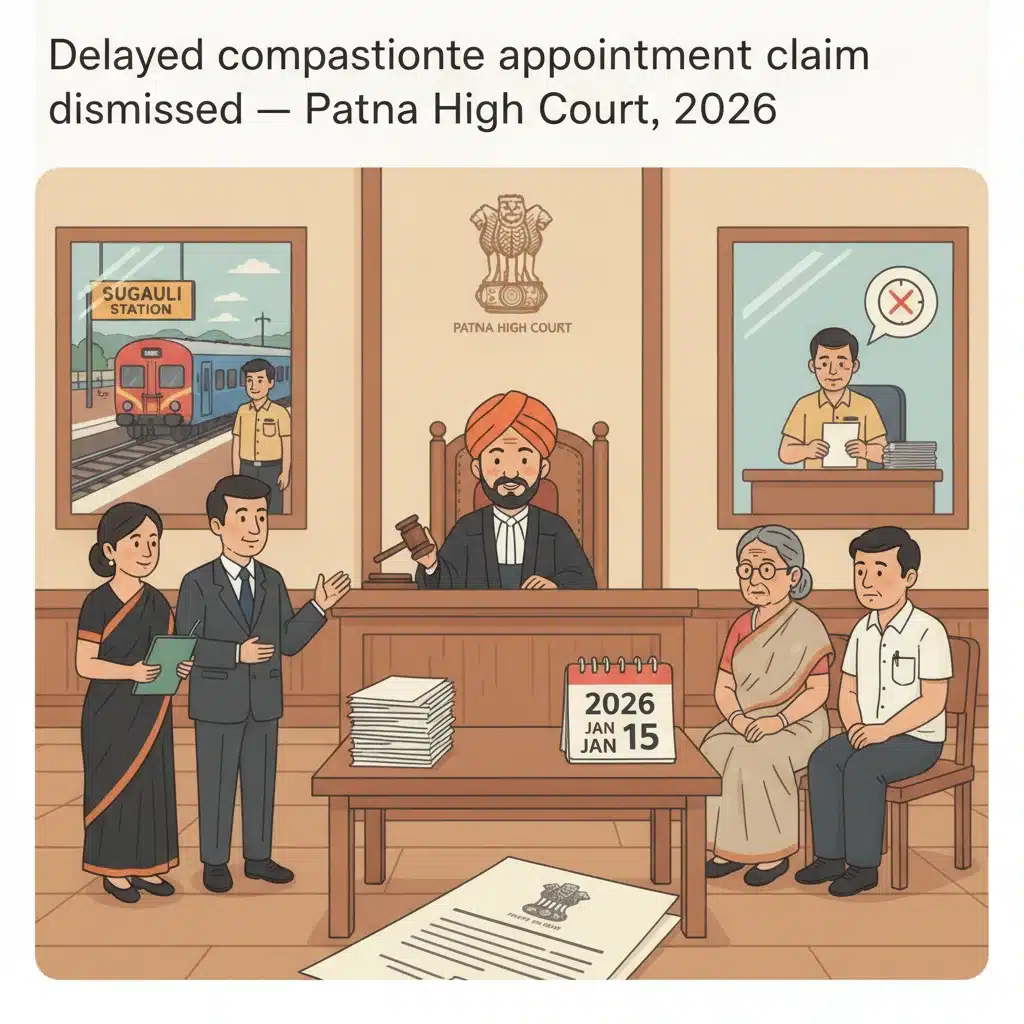
The matter arose from the death in harness of a railway employee, late Mushan Paswan, who was working as a Gangman at Sugauli Station. He died on 15.01.2013 while still in service with East Central Railway.
After his death, his family included his widow (petitioner no. 1) and at least two sons, including petitioner no. 2. The judgment records that another son, Ranjit Paswan, was bed-ridden. Because of his health, he wrote to the railway authorities stating that he was unable to take up a job on compassionate ground and requested that the younger brother, petitioner no. 2, be considered instead.
However, for several years after the employee’s death, no formal application for compassionate appointment was filed by the family. The first recorded application from the widow is dated 17.07.2018, about five years and six months after the death.
In that 2018 application, petitioner no. 1 sought compassionate appointment for petitioner no. 2, but also mentioned that both her sons had not yet passed the matriculation examination. She requested that the younger son be given compassionate appointment after he cleared matriculation.
Petitioner no. 2 subsequently passed matriculation in 2018. On 09.09.2019, petitioner no. 1 again applied to the railway authorities, seeking compassionate appointment for him.
By this time, approximately six years and nine months had passed since the death of the employee. After examining the case, the Senior Divisional Personnel Officer, East Central Railway, Samastipur, rejected the request by order dated 07.09.2020.
The family challenged this before the Central Administrative Tribunal, Patna Bench, in O.A. No. 050/00087/2023. On 26.09.2025, the Tribunal dismissed their application, upholding the railway authorities’ rejection. The family then approached the Patna High Court through Civil Writ Jurisdiction Case No. 1536 of 2026.
What the Court Examined and Decided
The Division Bench of the Patna High Court, consisting of Hon’ble Mr. Justice Mohit Kumar Shah and Hon’ble Mr. Justice Rana Vikram Singh, heard the writ petition. The challenge was specifically to the Tribunal’s order dated 26.09.2025 and, indirectly, to the railway authority’s order dated 07.09.2020 refusing compassionate appointment.
The High Court first noted the contents of the order dated 07.09.2020. The Senior Divisional Personnel Officer had recounted that:
• The employee died on 15.01.2013.
• The widow first applied for compassionate appointment only on 17.07.2018.
• In that application, she herself stated that both sons were not matriculate and requested that the younger son be appointed after passing matriculation.
• A further application dated 09.09.2019 was then made for the younger son, after he had passed the matric exam in 2018.
The authority also examined relevant Railway Board circulars. A letter dated 09.12.2011 showed that, at that time, the minimum educational qualification for appointment on compassionate ground in the “1S pay band without any grade pay” was only 8th pass.
Later, as per Railway Board’s letter dated 18.12.2017, the minimum qualification for compassionate appointment in Level-1 posts became matriculation. This meant that when the employee died in January 2013, and even for some period afterwards, the sons could have applied despite being non-matriculate, as only 8th pass was required. Still, no timely application was made.
On this basis, the competent authority concluded that the very late application—almost six years and nine months after the death—did not fit within the purpose of compassionate appointment. Compassionate appointment, as clarified by the Supreme Court and notified by the Railway Board, is only to help a family tide over an immediate financial crisis caused by sudden death of the breadwinner, not after the family has already overcome the crisis.
The Tribunal, in its order dated 26.09.2025, accepted this reasoning. It found that the family had managed to sustain themselves for more than six years without seeking compassionate appointment. Therefore, the element of “immediate financial destitution” at the time of death was missing. According to the Tribunal, in such a situation no compassionate appointment could be granted.
Before the High Court, counsel for the petitioners argued that petitioner no. 2 had not been educationally qualified at the time of his father’s death and that is why the family delayed the application. Only after he passed matriculation in 2018 could an application be made, which was done on 09.09.2019. The petitioners requested that a sympathetic view be taken, and that the authorities be directed to consider the son’s appointment on compassionate ground.
The Central Government Counsel, appearing for the railway authorities, opposed the writ petition. Referring to the written statement filed before the Tribunal, he pointed out that:
• There was no requirement of matriculation at the time of the employee’s death; even 8th pass candidates could be appointed in Level-1S.
• No application at all was made within a reasonable period after death.
• The first effective application seeking appointment for petitioner no. 2 was submitted only on 09.09.2019, almost six years and nine months later.
From these facts, the respondents argued that the family was not under immediate financial hardship, and that they had already tided over any crisis by the time they applied. Therefore, the very basis of compassionate appointment was absent.
The respondents relied heavily on the Supreme Court judgment in Umesh Kumar Nagpal v. State of Haryana & Ors., reported in (1994) 4 SCC 138. Paragraph 6 of that decision, reproduced in the High Court judgment, makes clear that:
• Compassionate employment cannot be granted after a long lapse of time.
• It is not a vested right that can be claimed at any future point.
• The objective is to help the family overcome the financial crisis at the time of death of the sole breadwinner.
On this foundation, the respondents argued that, since around thirteen years had by then passed from the death in 2013 to the High Court’s decision in 2026, no relief could be granted.
The Patna High Court agreed with the respondents. After examining the record, the Court reiterated several legal principles:
First, it confirmed that the father of petitioner no. 2 died on 15.01.2013, but the application for compassionate appointment for the son was made only on 09.09.2019. The delay was thus about six years and nine months. The rejection order dated 07.09.2020 was based on a finding that the family had survived that entire period without seeking such appointment, showing that there was no immediate financial hardship.
Second, the Court emphasized the settled law from Umesh Kumar Nagpal that:
• The purpose of compassionate employment is only to enable the bereaved family to tide over the immediate financial crisis.
• It is not meant to give the heir the same post as the deceased or any other post as a matter of right.
• Mere death in harness does not automatically entitle the family to a job.
• Compassionate appointment is neither a vested right nor an alternate recruitment method.
Third, the Court referred to another Supreme Court judgment: Central Coalfields Limited and Others v. Parden Oraon, reported in (2021) 16 SCC 384. Paragraphs 8 and 9 of that judgment, quoted in the High Court’s decision, again underline that:
• The family must face a sudden financial crisis to justify compassionate appointment.
• Authorities must assess the family’s financial condition.
• The appointment cannot be claimed after a “significant lapse of time” once the crisis is over.
In Parden Oraon, the Supreme Court refused compassionate appointment even though it found the employer’s reasoning flawed, because the application was made more than ten years after the employee went missing.
By placing the petitioners’ case against these Supreme Court decisions, the Patna High Court held that the object of the compassionate employment scheme would be defeated if appointment were granted after about thirteen years of the employee’s death.
The Court concluded that no relief could be given to petitioner no. 2 at this late stage. It found no infirmity in the Tribunal’s order dated 26.09.2025 upholding the railway authority’s rejection of 07.09.2020.
Accordingly, the writ application was dismissed as being devoid of merit.
Why This Judgment Matters
This judgment is important for families of government and public sector employees, especially in Bihar, who may hope for jobs on compassionate ground long after the employee’s death.
The Patna High Court has clearly reinforced that compassionate appointment is not a general right to employment. It is only an emergency support to help the family survive the sudden financial jolt caused by the death of the breadwinner.
If a family waits for many years to apply, or manages to live without seeking help for a long time, the courts are likely to treat the original financial emergency as over. In such cases, even genuine hardship later may not revive the claim.
The decision also shows that families should not assume higher educational qualifications are necessary if the rules at the time of death allowed lower qualifications. Authorities and courts will look at the rules and the family’s actions during the period immediately after the death.
Legal Issues and Answers
- Issue: Can a family claim compassionate appointment for a deceased railway employee’s dependent nearly seven years after the death in service?
Answer: No. The Patna High Court held that such a delayed claim defeats the purpose of compassionate appointment, which is limited to dealing with immediate financial crisis. - Issue: Was the Central Administrative Tribunal right in upholding the railway authority’s refusal of compassionate appointment in this case?
Answer: Yes. The Court found no infirmity in the Tribunal’s order and agreed that the family had already tided over the financial crisis, making compassionate appointment unwarranted.
Cases Cited by the Court
- Umesh Kumar Nagpal v. State of Haryana & Ors., (1994) 4 SCC 138.
- Central Coalfields Limited and Others v. Parden Oraon, (2021) 16 SCC 384.
Case Details
Case Number: Civil Writ Jurisdiction Case No. 1536 of 2026
Case Title: Basanti Devi & Anr. v. The Union of India & Ors.
Coram: Hon’ble Mr. Justice Mohit Kumar Shah; Hon’ble Mr. Justice Rana Vikram Singh
Date of Judgment: 13.07.2026
Advocates: Mr. Ajay Kumar, Advocate for the petitioners; Mr. Arjun Kumar, Central Government Counsel for the respondents
Nature of the Case: Writ petition under civil writ jurisdiction challenging dismissal of an original application (O.A. No. 050/00087/2023) by the Central Administrative Tribunal, Patna Bench, concerning denial of compassionate appointment.
Impugned Orders: Order dated 26.09.2025 of the Central Administrative Tribunal, Patna Bench, Patna in O.A. No. 050/00087/2023; order dated 07.09.2020 of the Senior Divisional Personnel Officer, East Central Railway, Samastipur, rejecting request for compassionate appointment.
Link to Judgment: https://patnahighcourt.gov.in/viewjudgment/MTUjMTUzNiMyMDI2IzEjTg==-jOxrjMDFVok=
If you found this explanation helpful and wish to stay informed about how legal developments may affect your rights in Bihar, you may consider following Samvida Law Associates for more updates.




