

Case Background
The matter arose from two writ petitions filed by private self-financing colleges in Patna that run professional courses, including BBA, BCA and B.Sc-IT, under Patliputra University.
Both colleges were earlier affiliated to Magadh University, Bodh Gaya. After creation of Patliputra University, their affiliation shifted to this new university.
For the years 2020 and 2021, one of the petitioner colleges received affiliation for one academic session each. Later, on the basis of Education Department Memo No. 2225 dated 28.07.2022 and University Memo No. 2701/22 dated 24.11.2022, the college was granted affiliation for three academic sessions — 2022-23, 2023-24 and 2024-25.
On 29.11.2024, the college applied to Patliputra University for permanent affiliation for its BBA, BCA and B.Sc-IT courses, and for enhancement of BCA seats from 120 to 240. The application was supported by the claim that all conditions under the Bihar State Universities Act, 1976 were fulfilled.
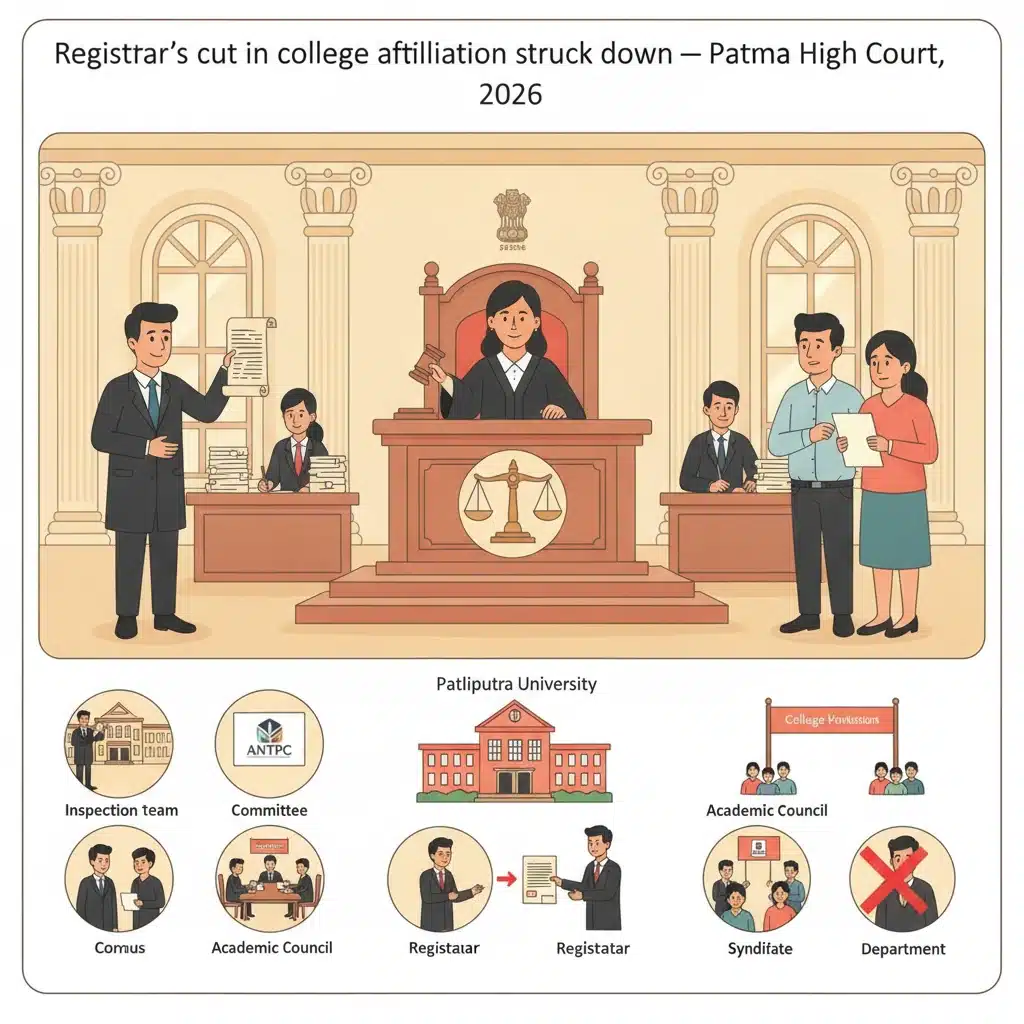
The University then followed its internal statutory process. An Inspection Team visited the institution and prepared a report. This report went before the Affiliation and New Teaching Programme Committee (ANTPC) in its 19th meeting on 26.03.2025.
The ANTPC recommended permanent affiliation and enhancement of BCA intake from 120 to 240. The 16th Academic Council, in its meeting on 28.03.2025, accepted this through Resolution No. 16.2.
The 25th Syndicate meeting held on 29.03.2025 also approved the ANTPC proposal through Resolution No. 25:4, although it suggested that requests for permanent affiliation be re-examined and then forwarded to the State if found in order.
The issue then went to the 9th Senate meeting on 03.04.2025 under the Vice-Chancellor, authorized by the Chancellor. The Senate modified the Syndicate’s decision by rejecting the idea of re-examination and clearly approved permanent affiliation with enhanced BCA seats from 120 to 240.
Acting on this chain of approvals, the University issued Letter No. INS/PPU/384/25 dated 14.06.2025 granting permanent affiliation to the college with 240 BCA seats, and forwarded the proposal to the State Government for final approval under Section 21(2)(d) of the Bihar State Universities Act.
However, within ten days, the Registrar issued Corrigendum No. R/PPU/946/25 dated 24.06.2025. This unilaterally changed the status from permanent to temporary affiliation and reduced BCA seats back from 240 to 120, without giving any reasons on the face of the document.
Feeling aggrieved, the college submitted a representation dated 21.07.2025 to the Vice-Chancellor seeking withdrawal of the corrigendum and restoration of the original decision. During this time, the college also approached AICTE for extension of approval for the 2025-26 session.
By corrigendum dated 31.07.2025, AICTE approved 240 seats for BCA and 120 seats for BBA for the institution. The college then wrote on 05.08.2025 to the Chancellor, Vice-Chancellor and Education Department, again demanding withdrawal of the 24.06.2025 corrigendum.
While the writ petition was pending, the Registrar issued another letter, No. R/PPU/1476/25 dated 28.08.2025, recommending affiliation only for the single academic session 2025-26 instead of permanent affiliation. This new letter was also challenged through an interlocutory application.
In the parallel writ (CWJC No. 14439 of 2025), a similarly placed college under Patliputra University faced the same pattern of events and orders, and its case was decided on the same reasoning.
What the Court Examined and Decided
The Patna High Court, through Hon’ble Mr. Justice Alok Kumar Sinha, focused on three main questions:
First, whether the Registrar could lawfully issue the letters dated 24.06.2025 and 28.08.2025 changing permanent affiliation to temporary, despite unanimous decisions of ANTPC, Academic Council, Syndicate and Senate.
Second, whether the fact that AICTE grants only yearly “Extension of Approval” for technical and professional courses barred the University from recommending permanent affiliation under Section 21(2)(d) of the Bihar State Universities Act.
Third, whether the Registrar’s actions without reasons or hearing were arbitrary and violated natural justice.
On the first issue, the Court carefully traced the statutory scheme under the Bihar State Universities Act. It observed that the proposal for permanent affiliation was not a casual or individual administrative act. It arose after inspection and collective decision-making by the statutory bodies of the University — ANTPC, Academic Council, Syndicate and finally Senate.
Once these bodies had unanimously resolved to recommend permanent affiliation and the University issued Letter No. INS/PPU/384/25 dated 14.06.2025 forwarding this recommendation to the State Government, “institutional finality” was reached within the University structure. From that point, the University’s role was essentially to support and facilitate the State Government’s consideration under Section 21(2)(d).
The Court found no material to suggest that after 14.06.2025, any of the statutory bodies — ANTPC, Academic Council, Syndicate or Senate — met again and reversed or modified their earlier resolutions. The impugned corrigendum of 24.06.2025 appeared to be an administrative move by the Registrar alone.
According to the Court, an administrative authority like the Registrar cannot override or dilute a decision of the University’s statutory bodies unless specific power is given by law or those bodies themselves reconsider their decision. No such power or reconsideration was shown.
The subsequent letter dated 28.08.2025, again recommending only session-wise affiliation, suffered from the same flaw. It also did not refer to any fresh statutory decision authorising the change from permanent affiliation to one-year affiliation.
The University tried to justify its action by saying that the initial permanent affiliation recommendation was “inadvertent” because it did not fully match the then AICTE-approved intake, and that the corrigendum merely aligned the recommendation to AICTE norms.
The Court rejected this as a legal defence to the Registrar’s unilateral action. Even if there was concern about conformity with AICTE approval, the correct course was either:
to place the issue back before the statutory bodies for reconsideration; or
to send the proposal to the State Government along with a note highlighting the AICTE position.
The Registrar could not substitute the collective statutory decision with his own administrative decision. Accordingly, Issue No. 1 was answered in favour of the petitioner.
On the second issue, the Court examined the relationship between AICTE approval and University affiliation. It held that these are two separate but interlinked legal requirements.
AICTE regulates technical education by setting norms for infrastructure, teachers and intake. The University, under the Bihar State Universities Act, grants affiliation, which brings a college under its academic control.
The Court accepted that AICTE approvals are normally given as annual “Extension of Approval” (EoA), not as permanent approvals. But it noted that no provision of the Bihar State Universities Act was shown which says permanent affiliation can be given only if AICTE approval is itself permanent. Likewise, nothing from the AICTE Act or Regulations was shown to bar permanent affiliation just because AICTE uses a yearly renewal mechanism.
Instead, the Court clarified the correct legal position. Permanent affiliation can be granted, but the college’s actual running of courses, intake of students and continuation of admissions must always remain within whatever AICTE approves for each academic session.
Thus, permanent affiliation gives the college a continuing status with the University, but that status operates subject to compliance with AICTE norms every year.
The Court also noted that AICTE later enhanced the BCA intake to 240 seats by its corrigendum dated 31.07.2025, showing AICTE approval is flexible and may change with compliance. Such changes may require adjustments in seats or courses for particular sessions, but they do not decide whether the college is fit for permanent affiliation under the State Act.
Therefore, the Court held that AICTE’s annual EoA is not a legal bar to permanent affiliation under Section 21(2)(d). Both systems operate together: permanent affiliation at the University level, and yearly AICTE approvals for how many students and which courses can run.
On the third issue, the Court turned to natural justice and procedural fairness. It held that when an administrative decision withdraws or seriously alters an existing benefit or legitimate expectation, the affected person is entitled to reasons and an opportunity to be heard, unless a statute clearly says otherwise.
In this case, after a full statutory process, the college had a clear recommendation in its favour for permanent affiliation. This recommendation had already been sent to the State Government by Letter No. INS/PPU/384/25.
The later communications of 24.06.2025 and 28.08.2025 directly harmed the college’s position. They changed permanent affiliation to one-year affiliation, affecting its academic status and future planning. Despite this, there was no show-cause notice, no invitation to explain, and no hearing.
The Court noted that the impugned communications themselves did not give reasons. Reasons were only attempted later in the counter affidavits (such as the AICTE issue). This, the Court said, cannot cure the defect, because an order must stand or fall on the reasons written in it, not on new justifications offered in court.
The Court concluded that the decision-making process was arbitrary and violative of natural justice. The Registrar failed both to give reasons and to hear the college before altering its earlier recommendation.
Putting all these findings together, the Court held that:
(a) The Registrar had no legal authority to unilaterally modify the permanent affiliation recommendation; and
(b) AICTE’s annual approval system did not stop the University from recommending permanent affiliation; and
(c) The process adopted was unfair and illegal.
As a result, Corrigendum/Letter No. R/PPU/946/25 dated 24.06.2025 and Letter No. R/PPU/1476/25 dated 28.08.2025 were quashed.
The Court restored the original Letter No. INS/PPU/384/25 dated 14.06.2025 (and, in the connected case, Letter No. INS/PPU/383/25) recommending permanent affiliation, and directed the State Government to take a final decision on these restored proposals preferably within eight weeks of receiving the judgment.
At the same time, the Court clearly stated that permanent affiliation will always remain subject to the college obtaining and maintaining AICTE approval or Extension of Approval from time to time, and that student admissions and courses must not exceed what AICTE permits in any given year.
Why This Judgment Matters
This judgment is very important for private colleges running professional courses under Patliputra University and other Bihar universities.
First, it protects colleges from sudden, unexplained changes in affiliation by university administrators. Once the University’s statutory bodies have gone through inspection and granted a recommendation, a Registrar cannot quietly reverse this without proper authority, reasons and hearing.
Second, the judgment explains how AICTE approval and University affiliation should work together. Colleges now have clarity that yearly AICTE approvals do not, by themselves, stop them from seeking permanent affiliation. But they must continue to follow AICTE norms every year in terms of courses and seats.
Third, the ruling reinforces that administrative convenience cannot override natural justice. Before reducing or withdrawing an existing benefit, authorities must give reasons and a chance to respond.
For students and parents, the decision brings greater stability. It reduces the risk that a college’s status will be downgraded mid-way without transparent process, which can affect admissions and degrees.
Legal Issues and Answers
- Issue: Could the Registrar legally change the recommendation from permanent to one-year affiliation without fresh decisions of ANTPC, Academic Council, Syndicate or Senate?
Answer: No. The Registrar acted beyond his authority. The statutory bodies’ unanimous resolutions for permanent affiliation stood, and could not be altered administratively. - Issue: Does AICTE’s annual “Extension of Approval” prevent grant of permanent affiliation under Section 21(2)(d) of the Bihar State Universities Act, 1976?
Answer: No. AICTE approval and University affiliation are separate but complementary. Annual AICTE approvals regulate operations and intake, but are not a legal bar to permanent affiliation. - Issue: Were the Registrar’s actions, taken without reasons or hearing, arbitrary and against natural justice?
Answer: Yes. The impugned communications lacked recorded reasons and were issued without giving the college any opportunity to be heard, making them arbitrary and unsustainable in law.
Cases Cited by the Court
- The University relied on the Division Bench judgment in L.P.A. No. 1288 of 2018 (Arpana Kumar & Ors. vs. State of Bihar & Ors.), where it was observed that no admissions should be made without State Government approval of affiliation under Section 21(2)(d) of the Bihar State Universities Act, 1976.
- The University also referred to earlier orders of this Court in CWJC No. 11113 of 2017, CWJC No. 11628 of 2017 and MJC No. 2776 of 2018 relating to Arcade Business College, to distinguish that case from the present one. The Court noted these references while considering the University’s arguments.
Case Details
Case Numbers: Civil Writ Jurisdiction Case No. 14108 of 2025; Civil Writ Jurisdiction Case No. 14439 of 2025
Case Titles: Catalyst Institute of Management and Advance Global Excellence vs. The State of Bihar & Ors.; Catalyst College vs. The State of Bihar & Ors.
Court: High Court of Judicature at Patna
Coram: Hon’ble Mr. Justice Alok Kumar Sinha
Date of Judgment: 13.07.2026
Advocates (CWJC No. 14108 of 2025):
- For the petitioner: Mr. Mrigank Mauli, Sr. Adv.; Mr. Siddharth Prasad, Adv.; Ms. Venkatesh Kirti, Adv.
- For the State/Respondent Nos. 1 and 2: Mr. Government Pleader (11); Mr. Dimpal Kumari, AC to GP-11
- For Patliputra University: Mr. Dr. Anand Kumar, Adv.; Mr. Rabi Bhushan Prasad, Adv.; Md. Faiz Ahmad, Adv.
Advocates (CWJC No. 14439 of 2025):
- For the petitioner: Mr. Mrigank Mauli, Sr. Adv.; Mr. Siddhartha Prasad, Adv.; Ms. Venkatesh Kirti, Adv.
- For the State/Respondent Nos. 1 and 2: Mr. K.P. Gupta, GP-10; Mr. Satya Vrat, AC to GP-10
- For Patliputra University: Mr. Dr. Anand Kumar, Adv.; Md. Faiz Ahmad, Adv.
Nature of the Case: Writ petitions under Article 226 of the Constitution of India, challenging University corrigenda/letters that downgraded permanent affiliation recommendations to temporary affiliation for a single academic session.
Final Outcome: Writ petitions allowed. University letters/ corrigenda dated 24.06.2025 and 28.08.2025 quashed. Earlier University recommendations dated 14.06.2025 for permanent affiliation restored, subject to AICTE approvals, and directed to be considered by the State Government within eight weeks.
If you found this explanation helpful and wish to stay informed about
how legal developments may affect your rights in Bihar,
you may consider following Samvida Law Associates for more updates.




