

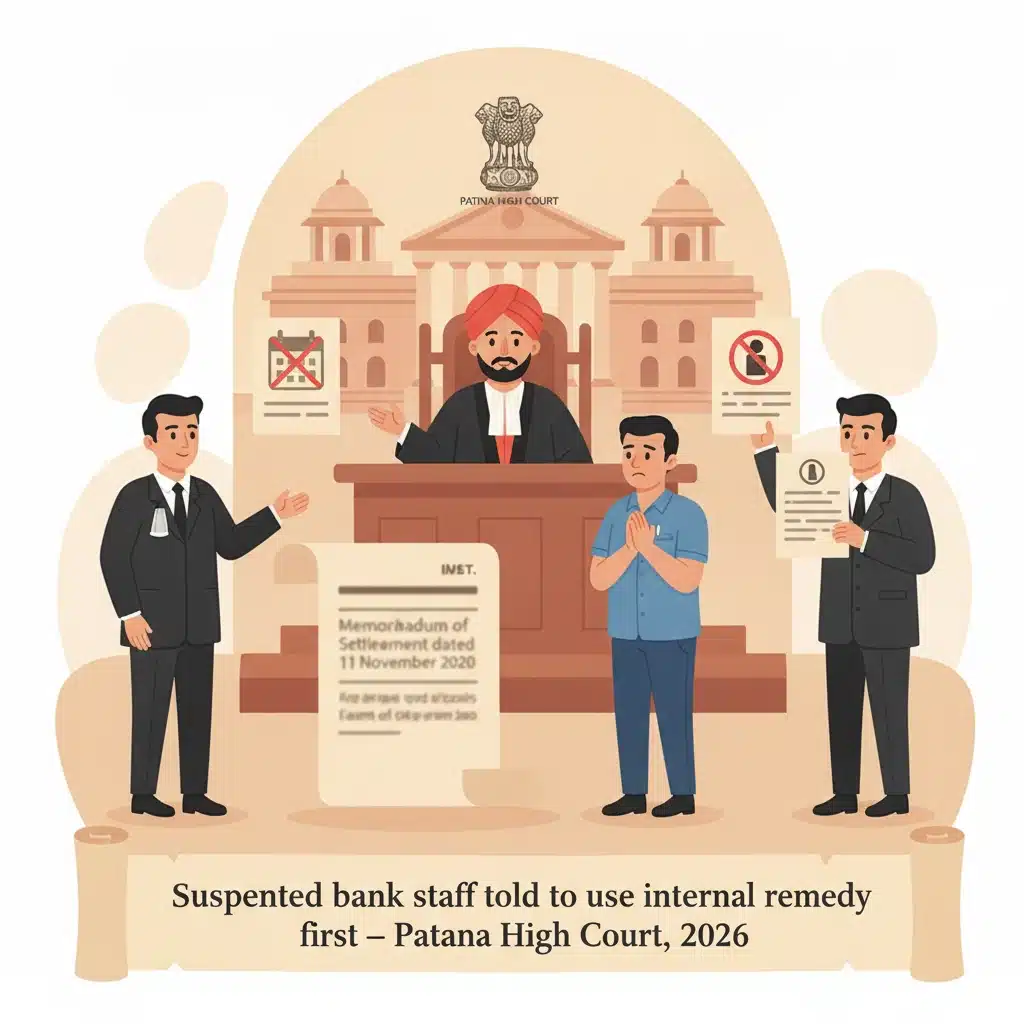
Case Background
The petitioner is an employee of Union Bank of India. On 02.01.2026, the Chief Manager, Central Office, Union Bank of India, issued letter No. CO:ERD:12318:2026. By this letter, the petitioner was placed under suspension with immediate effect. The letter also stated that he would get only subsistence allowance as per the bank’s rules.
Thereafter, on 14.01.2026, the Division Head Administration of the Institute of Banking Personnel Selection (IBPS) passed a speaking order. By this order, IBPS debarred the petitioner for life from appearing in any CRP examinations conducted by IBPS.
The IBPS order went further. It stated that if the petitioner gets selected in any organisation or bank in future recruitment processes, the decision in this proceeding would be conveyed to such organisation or bank. IBPS also reserved the right to refer the petitioner’s case to investigating authorities for appropriate criminal action, and to inform public examination authorities about the penal action imposed.
Feeling aggrieved, the petitioner approached the Patna High Court by filing Civil Writ Jurisdiction Case No. 9368 of 2026. He sought to challenge both the suspension order of Union Bank of India and the debarment order of IBPS.
What the Court Examined and Decided
The petitioner asked for four main reliefs. First, he wanted a writ in the nature of certiorari to set aside the suspension order dated 02.01.2026 issued by the Chief Manager, Central Office, Union Bank of India.
Second, he sought another writ of certiorari to quash the speaking order dated 14.01.2026 passed by the Division Head Administration, IBPS, by which he was debarred for life from IBPS CRP examinations and threatened with further consequences.
Third, he asked for a writ of mandamus directing the authorities not to start any disciplinary proceeding against him on the basis of the unilateral finding of IBPS. He claimed that IBPS had taken its decision behind his back, without giving him any opportunity of hearing.
Fourth, he requested any other relief considered fit by the Court.
The petitioner’s counsel argued that his case was rooted in the Memorandum of Settlement dated 11.11.2020. This settlement was between the management of banks represented by the Indian Banks’ Association and the workmen, represented by various unions, including the All India Bank Employees’ Association and others. According to the petitioner, this settlement governed the service conditions of bank employees like him.
On the other side, counsel for the bank raised a preliminary objection. He relied strongly on Clause 45 of the Memorandum of Settlement dated 11 November 2020. According to him, Clause 45 specifically lays down provisions about disciplinary action and procedure for bank employees (other than officers).
He submitted that this clause forms the present law applicable to such bank employees. Since Clause 45 provides a complete mechanism for disciplinary action, including suspension and related remedies, it creates a bar on directly approaching the High Court at this stage. In simple words, the bank’s stand was that the petitioner must first use the internal remedy under the settlement before filing a writ petition.
Counsel appearing for IBPS raised another objection. He argued that at this stage there was no role for IBPS in the matter before the Court, and the writ petition itself was not maintainable against IBPS.
To support this, he referred to consistent decisions of the Supreme Court and the Patna High Court. He particularly relied on the Patna High Court judgment in Vikash Kumar vs. IBPS & Others, decided in CWJC No. 1694 of 2026. Paragraphs 6 to 9 of that judgment were quoted in detail in the present decision.
From those paragraphs, the Court noted that the Supreme Court in Rajbir Surajbhan Singh vs. The Chairman, Institute of Banking Personnel Selection, Mumbai, Civil Appeal No. 4455 of 2019 (arising out of SLP (C) No. 18201 of 2015), had held that writ petitions under Articles 32 or 226 of the Constitution are not maintainable against IBPS.
In Vikash Kumar, this Court had also observed that where the petitioner is an employee of a bank, action against him must be taken according to the service regulations. If there is an appeal or other statutory/internal remedy against suspension, the High Court will normally ask the employee to use that remedy first, rather than directly entertaining a writ petition.
After hearing all sides, the Patna High Court examined Clause 45 of the 11 November 2020 Memorandum of Settlement. The full clause was reproduced in the judgment. It deals with “Disciplinary Action and procedure thereof”.
The clause records several modifications to an earlier bipartite settlement of 10 April 2002, effective from 1 November 2020. It revises the definition of certain misconducts, adds new misconducts, changes some punishments, and deletes the punishment of “be fined”.
Importantly for this case, Clause 45(h) states that an employee placed under suspension pending disciplinary action shall be given an opportunity to represent to the management to reconsider the order of suspension.
The Court read this clause carefully. It found that Clause 45(h) clearly creates an internal remedy for a suspended employee. The employee can submit a representation to the management asking for reconsideration of the suspension order.
In light of this, the Court held that the petitioner had not yet used the remedy made available by Clause 45(h). There was no material to show that he had made such a representation to the management and that the management had refused or failed to act.
Because of this, the Court concluded that the writ petition, at least as far as the challenge to the suspension was concerned, was premature. The doctrine followed is that where a specific alternative remedy exists under service rules or settlements, the High Court normally does not interfere under Article 226 until that remedy has been tried.
Taking guidance from the earlier judgment in Vikash Kumar, and from the Supreme Court decision concerning IBPS, the Court also noted that the question of challenging IBPS could be considered before the appropriate forum at the appropriate time, following the law laid down by the Supreme Court. The present judgment did not finally decide the validity of the IBPS debarment itself.
On this basis, the Court disposed of the writ petition instead of examining the merits of the allegations, the fairness of the suspension, or the correctness of the IBPS decision. The focus was limited to whether the petitioner had first used the remedy given by Clause 45(h).
Finally, the Court granted liberty to the petitioner to avail the remedy under Clause 45(h) of the Memorandum of Settlement. It clarified that this settlement applies to the petitioner as he is an employee of the bank (other than an officer).
The Court also gave a time-bound direction. It held that once the petitioner files his representation under Clause 45(h), the concerned authority of the bank must take a decision on his representation within 60 days.
Thus, while the Court did not quash the suspension or the IBPS order, it ensured that the petitioner gets an opportunity to be heard by the bank management and that his request for reconsideration of suspension is decided within a fixed timeframe.
Why This Judgment Matters
This judgment is important for bank employees facing suspension under service settlements. It shows that the Patna High Court expects employees to first use the remedies given in the bipartite settlements before directly approaching the Court.
For workmen of banks covered by the 2020 Memorandum of Settlement, Clause 45(h) is a key protection. It gives a right to make a representation against suspension and forces management to reconsider the order.
The judgment also quietly reinforces earlier rulings that writ petitions against IBPS may not be maintainable. Candidates and employees affected by IBPS decisions must carefully choose the proper forum and follow the legal route indicated by the Supreme Court.
Most importantly, the order secures a 60-day timeline for deciding the petitioner’s representation. This helps avoid indefinite suspension without any decision by the bank.
Legal Issues and Answers
- Issue: Can a suspended workman of Union Bank of India directly challenge his suspension before the Patna High Court without first using Clause 45(h) of the 11.11.2020 Memorandum of Settlement?
Answer: No. The Court held that Clause 45(h) provides an internal remedy to seek reconsideration of suspension, which the petitioner must exhaust first. - Issue: Did the Patna High Court decide on the legality of the IBPS order debarring the petitioner for life?
Answer: No. The Court did not decide the merits against IBPS and left it open for the petitioner to challenge before the relevant authority, guided by Supreme Court precedent.
Cases Cited by the Court
- The Patna High Court relied on its earlier decision in Vikash Kumar vs. IBPS & Others, CWJC No. 1694 of 2026.
- Within that discussion, reference was made to the Supreme Court decision in Rajbir Surajbhan Singh vs. The Chairman, Institute of Banking Personnel Selection, Mumbai, Civil Appeal No. 4455 of 2019 (arising out of SLP (C) No. 18201 of 2015).
Case Details
Case Number: Civil Writ Jurisdiction Case No. 9368 of 2026
Case Title: Chandan Kumar vs. Union Bank of India & Others
Coram: Hon’ble Mr. Justice Dr. Anshuman
Advocates:
- For the petitioner: Mr. Lalan Kumar, Advocate; Mr. Ashwani Kumar, Advocate
- For Respondent Nos. 1 to 4 (Union Bank of India and its officers): Mr. Nishi Nath Ojha, Advocate; Mr. Kundan Kumar Sinha, Advocate
- For IBPS: Mr. Siddharth Prasad, Advocate
Nature of the Case: Writ petition under Article 226 challenging suspension order of a bank employee and a debarment order of IBPS.
Link to Judgment: https://patnahighcourt.gov.in/viewjudgment/MTUjOTM2OCMyMDI2IzEjTg==-bCsmue46yF4=
If you found this explanation helpful and wish to stay informed about
how legal developments may affect your rights in Bihar,
you may consider following Samvida Law Associates for more updates.




