

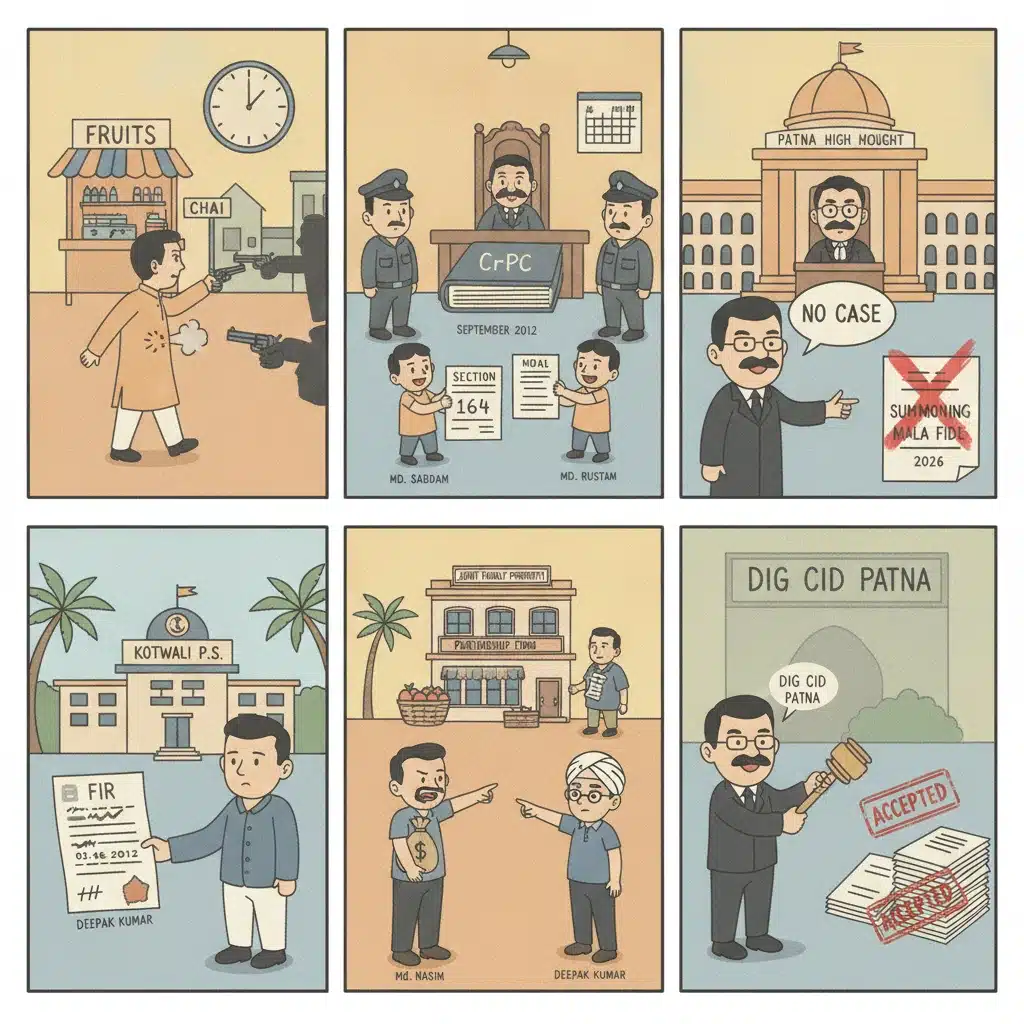
Case Background
The case started with an FIR lodged by Manoj Kumar Gupta on 03.06.2012 at 2:40 PM before the Sub-Inspector of Barari Police Station. He reported that on 02.06.2012 at about 5:45 AM, his younger brother Bishwanath Kumar Gupta had gone to a fruit shop. After taking tea at Bhariti Chowk and while returning, two unknown persons allegedly fired at him.
The victim suffered a gunshot injury in his stomach and was declared dead on 03.06.2012. Information about the firing reached the police station on 02.06.2012 at 7:30 PM, but the formal FIR appears to have been lodged much later at 9:45 PM on 03.06.2012, and it reached the Magistrate only on 06.06.2012.
Initially, no one was named in the FIR as the assailant. The case was registered as Kotwali P.S. Case No. 305 of 2012 for offences under Section 302/34 of the Indian Penal Code and Section 27 of the Arms Act. Later, Sessions Trial Case No. 492 of 2015 was instituted on this police case.
The petitioner, Deepak Kumar @ Deepak Sah, was not an accused in the charge-sheet. According to him, the deceased was a munshi-cum-caretaker in a partnership firm of his brother Manoj Kumar Gupta and one Md. Nasim, which operated from a tenancy belonging to the petitioner’s joint family. The petitioner’s counsel argued that the murder was likely due to business rivalry because the deceased had started his own independent fruit business which allegedly provoked his brother’s partner.
The petitioner alleged that the then Senior Superintendent of Police (SSP), Bhagalpur, who was related to him and had serious financial and property disputes with him, misused the situation. On the SSP’s instructions, the then SHO of Kotwali Police Station, Kumod Kumar, allegedly moved quickly to implicate the petitioner.
According to the petitioner, Kotwali police arrested two persons, Md. Saddam and Md. Rustam. Saddam allegedly named Rustam as the person who gave him money to kill, and Rustam allegedly stated that the petitioner had financed the killing. The petitioner claimed that on a court holiday both were taken to the house of a Judicial Magistrate and forced to give confessional statements under Section 164 CrPC, based on what the SHO dictated.
The alleged police theory was that the petitioner had directed his tenants to vote for a particular candidate in a municipal ward election. When that candidate lost by ten votes, he supposedly suspected that the deceased had not voted as directed and therefore got him killed. The petitioner’s counsel described this motive as “preposterous”.
The petitioner moved a detailed representation before the Director General of Police, Bihar. The DGP took away supervision of the case from the then SSP, Bhagalpur, and handed it over to a DIG rank IPS officer posted in Police Headquarters, Dr. Kamal Kishore Singh, then DIG CID (AD), Patna. On these directions, investigation in all related cases, including Kotwali P.S. Case No. 305 of 2012, culminated in final reports submitting that no case was made out against the petitioner. All such final forms were accepted by the competent courts.
In the meantime, the petitioner complained against SHO Kumod Kumar before the National Human Rights Commission (NHRC). The NHRC imposed a fine of Rs. 50,000/- on the SHO. Departmental Proceeding No. 50/2013 was also held against him, resulting in major punishment of three “black marks” and stoppage of three increments for wrongly investigating Kotwali P.S. Case No. 305 of 2012.
According to the petitioner, even one of the alleged assailants, Md. Rustam, later filed a complaint case against the SHO and two other SHOs stating that he had been forced to make his statement under Section 164 CrPC.
Sessions Trial No. 492 of 2015 arising out of Kotwali P.S. Case No. 305 of 2012 initially proceeded before the court of ADJ-VI, Bhagalpur (Rakesh Malviya) and was later transferred on 20.06.2017 to the court of ADJ-VII, Bhagalpur (Vinay Kumar Mishra).
What the Court Examined and Decided
The core challenge before the Patna High Court was the order dated 22.08.2019 passed by the learned ADJ-VII, Bhagalpur, in Sessions Trial No. 492 of 2015. Through that order, the trial court had used Section 319 CrPC to summon the petitioner as an additional accused for offences under Section 302/34 IPC and Section 27 Arms Act.
The petitioner alleged serious corruption and extortion by the presiding ADJ-VII. According to him, in late 2017 the judge sent an Assistant Public Prosecutor (APP), Pawan Thakur, who told the petitioner that the judge wanted him to be added as an accused under Section 319 CrPC and that money had to be paid because SHO Kumod Kumar had “managed” several witnesses.
The petitioner claimed that he was taken to the APP in the evening and, under extreme mental pressure, kept paying money as demanded. He stated that, in a one-to-one conversation, the judge admitted receiving only Rs. 2 lakhs out of Rs. 4.5 lakhs given to the APP; this conversation was allegedly audio-recorded. The petitioner also claimed to have videographed APP Pawan Thakur saying that he had collected Rs. 4.5 lakhs as advance on behalf of ADJ-VII. He further claimed that he had been forced to spend money on the judge’s family.
Separately, Sessions Trial No. 549 of 2015, in which Md. Rustam was complainant and three SHOs were accused, also came before ADJ-VII. Rustam allegedly felt that the judge had been “gained over” by the accused. This led to the filing of Transfer Petition No. 46 of 2019 on 28.06.2019 before the District and Sessions Judge, Bhagalpur. That case was transferred to ADJ-V, Bhagalpur.
The petitioner stated that after this transfer, ADJ-VII called him to Patna and demanded Rs. 35 lakhs, alleging that due to the transfer petition he had lost Rs. 20 lakhs. When the petitioner could not meet this demand, he alleged that on 09.08.2019 the Sessions Judge began prompting witnesses and even adding text to depositions which the witnesses had not spoken.
On 19.08.2019, the petitioner says he approached the Inspecting Judge of the Patna High Court for Bhagalpur district. He submitted a petition on affidavit giving details of money allegedly extracted by ADJ-VII through the APP. He also played a video and handed over a pen drive to the Inspecting Judge. This petition dated 19.08.2019 was brought on record before the High Court.
Unaware of these developments, ADJ-VII passed the order dated 22.08.2019 summoning the petitioner under Section 319 CrPC in Sessions Trial No. 492 of 2015 and then proceeded expeditiously. The petitioner was then compelled to file the present Criminal Miscellaneous Petition before the Patna High Court.
The informant’s counsel argued that the petitioner was highly influential and had managed to get his petition filed and heard by the High Court on the same day. The High Court observed that such comments imputing motives to the Court were “preposterous” and bordered on contempt.
The petitioner further filed a supplementary affidavit stating that, on his complaint, an enquiry had been conducted and the concerned ADJ-VII had been found guilty and punished by the Patna High Court. Though he repeatedly sought details of the disciplinary proceedings, he stated that such details were refused. He asked the Court to call for the disciplinary record. The informant’s counsel again termed this an example of the petitioner’s overreach, which the High Court again said bordered on contempt, as it implied motives to the Court.
The High Court declined to call for the disciplinary record, noting that doing so, where a judicial officer had been punished, would amount to “washing the dirty linen in public”. The Court remarked that the case had “the look of malafide written all over it”.
At the same time, the Court emphasised that, for deciding the validity of the Section 319 order, it would confine itself to the legal standard and to the witness statements on which the summoning was based. The entire trial court record had already been called for, and the Court closely examined the depositions of prosecution witnesses up to PW-11.
PWs 1 to 5 and 7 to 9, as well as PW-4 and PW-8, were either hostile or spoke to matters not incriminating the petitioner. PW-1 and PW-10 tried to establish an alibi for co-accused Md. Rustam. PW-6, Ramawatar Prasad Singh, stated in chief that after a ward commissioner election he had a dispute with one Pratap Sah and filed a case, which was later compromised. He said that in that case ASI Kumod got his statement recorded under Section 164 CrPC and told him to name the petitioner even though he did not know him. He was declared hostile and denied knowledge about the death of Bishwanath Gupta.
The only witness whose statement the Sessions Judge relied on for summoning the petitioner was PW-11, Manjula Devi, the mother of the deceased. She stated in chief that the petitioner had given Rs. 50,000/- to one “Minu Miya” to kill her son. However, in cross-examination she admitted that she did not know Minu Miya alias Rustam and added in paragraph 5 of her deposition that the information about Rs. 50,000/- came to her from a newspaper, not from any person’s direct knowledge.
The High Court pointed out that the trial court, in paragraph 4 of the impugned order, quoted only the chief-examination part of PW-11’s statement, ignoring paragraph 5 where she admitted that her knowledge came only from a newspaper report. Thus, the Sessions Judge failed to appreciate the complete deposition.
More seriously, the Sessions Judge went beyond trial evidence and relied extensively on statements of five witnesses recorded under Section 164 CrPC during investigation. He referred to these statements as “very specific” and a good ground to invoke Section 319 CrPC.
The Patna High Court held this approach to be “complete illegality”. Relying on the Constitution Bench judgment in Hardeep Singh v. State of Punjab (2014) 3 SCC 92 and a line of Supreme Court authorities like Kailash v. State of Rajasthan, Brindaban Das v. State of W.B., Sarojben Ashwinkumar Shah v. State of Gujarat, Periyasami v. S. Nallasamy, S. Mohammed Ispahani v. Yogendra Chandak, Rajesh v. State of Haryana, Juhru v. Karim and Ajay Kumar v. State of Uttarakhand, the High Court summarised the settled legal position:
First, “evidence” for the purpose of Section 319 CrPC means evidence given before the Court during inquiry or trial—oral or documentary—on oath. Statements under Section 164 CrPC are not substantive evidence. They are recorded during investigation and can only be used later to corroborate or contradict a witness, not as an independent basis to summon a new accused.
Second, the power under Section 319 CrPC is extraordinary and must be used sparingly and with great caution. The standard is higher than a simple prima facie case used at the stage of framing charge but lower than the standard for conviction. There must be “strong and cogent” evidence from the trial that, if unrebutted, could lead to conviction.
Third, the court must consider the stage of trial, the amount of evidence already recorded, and the serious consequence of starting a de novo trial against the newly added person, which may delay proceedings and prejudice the prosecution itself.
Applying these principles, the High Court found that in this case, out of eleven witnesses, ten had said nothing at all against the petitioner. The sole accusatory statement was PW-11’s claim that, as per a newspaper, the petitioner had paid Rs. 50,000/- to someone to kill her son. The Court held that an allegation based purely on a newspaper report is a very weak material that “in any case is not going to get even the charges framed”, let alone justify the higher threshold required under Section 319 CrPC.
Therefore, even if one left aside all allegations of police and judicial misconduct, the basic legal requirement for summoning an additional accused under Section 319 CrPC was not met. The material on record was “extremely insufficient” to exercise such power.
At the same time, the Court observed that from “beginning to end” the case was attended by mala fides at multiple levels. It noted that the petitioner was not named in the FIR; his name surfaced three months later in coerced Section 164 statements; the investigating officer was penalised by the NHRC and in departmental proceedings for wrongful investigation; the investigation was taken away from the SSP and given to another officer; final forms were submitted and accepted; and the judicial officer who later used Section 319 CrPC had been punished in disciplinary proceedings of the High Court, as per the petitioner’s affidavit.
In light of both the legal deficiency in evidence and the surrounding circumstances suggesting mala fide, the Patna High Court had “no hesitation” in quashing the summoning order dated 22.08.2019 passed by ADJ-VII, Bhagalpur in Sessions Trial No. 492 of 2015.
Accordingly, the Criminal Miscellaneous Petition was allowed, and the order summoning the petitioner to face trial for offences under Section 302/34 IPC and Section 27 Arms Act was set aside.
Why This Judgment Matters
This judgment is important for anyone who finds their name suddenly added in an ongoing criminal trial without strong evidence. The Patna High Court has clearly said that a person cannot be dragged into a murder trial on the basis of newspaper reports or investigation-stage statements alone.
For ordinary citizens, it shows that courts can and do intervene when police or trial courts act on weak material or under alleged pressure. The Court insisted that only solid evidence given in court during trial—on oath—can justify summoning a new accused under Section 319 CrPC.
For lawyers and trial courts, the judgment reinforces that Section 319 CrPC is an extraordinary power to be used sparingly. It cannot be a tool for fishing inquiries, for satisfying private vendettas, or for covering up earlier faulty investigation. Reliance on Section 164 CrPC statements as primary evidence for summoning is clearly disapproved.
The judgment also sends a signal that making unfounded allegations about the High Court’s motivations, or suggesting that orders are managed by influence, may amount to contempt. Arguments must focus on evidence and law, not personal attacks on the institution.
Legal Issues and Answers
- Issue: Could the Sessions Court validly summon the petitioner as an additional accused under Section 319 CrPC in a murder trial, mainly on the basis of Section 164 CrPC statements and a newspaper-based assertion by the deceased’s mother?
Answer: No. The Patna High Court held that Section 164 CrPC statements are not substantive evidence and can only be used for corroboration or contradiction. The only trial testimony against the petitioner came from PW-11, who admitted that her information was based on a newspaper report. This fell short even of a prima facie case, much less the “strong and cogent” evidence required for Section 319. The summoning order was quashed. - Issue: Whether surrounding circumstances and prior proceedings indicated mala fide in invoking Section 319 CrPC against the petitioner?
Answer: Yes. The Court noted that the petitioner was not named in the FIR; his name surfaced after three months via coerced statements; the SHO was penalised by NHRC and in departmental proceedings for wrongful investigation; the investigation was taken away from the SSP; final forms clearing the petitioner were accepted; and the ADJ who issued the summoning order was punished in High Court disciplinary proceedings. The Court concluded that the action was actuated by mala fide at many levels.
Cases Cited by the Court
- Hardeep Singh v. State of Punjab, (2014) 3 SCC 92
- Kailash v. State of Rajasthan, (2008) 14 SCC 51 : (2009) 1 SCC (Cri) 1006 : 2008 SCC OnLine SC 414
- Mohd. Shafi v. Mohd. Rafiq, (2007) 14 SCC 544 : JT (2007) 5 SC 562
- MCD v. Ram Krishan Rohtagi, (1983) 1 SCC 1 : 1983 SCC (Cri) 115
- Krishnappa v. State of Karnataka, (2004) 7 SCC 792 : 2004 SCC (Cri) 2093
- Michael Machado v. CBI, (2000) 3 SCC 262 : 2000 SCC (Cri) 609
- Brindaban Das v. State of W.B., (2009) 3 SCC 329 : (2009) 2 SCC (Cri) 79 : 2009 SCC OnLine SC 99
- Bholu Ram v. State of Punjab, (2008) 9 SCC 140 : (2008) 3 SCC (Cri) 710
- Shashikant Singh v. Tarkeshwar Singh, (2002) 5 SCC 738 : 2002 SCC (Cri) 1203
- Palanisamy Gounder v. State, (2005) 12 SCC 327 : (2006) 1 SCC (Cri) 568
- Guriya v. State of Bihar, (2007) 8 SCC 224 : (2007) 3 SCC (Cri) 521
- Sarojben Ashwinkumar Shah v. State of Gujarat, (2011) 13 SCC 316 : (2012) 3 SCC (Civ) 546 : (2012) 1 SCC (Cri) 867
- Periyasami v. S. Nallasamy, (2019) 4 SCC 342 : (2019) 3 SCC (Cri) 230 : 2019 SCC OnLine SC 379
- S. Mohammed Ispahani v. Yogendra Chandak, (2017) 16 SCC 226 : (2018) 2 SCC (Cri) 138 : 2017 SCC OnLine SC 1230
- Raj Kishore Prasad v. State of Bihar, (1996) 4 SCC 495 : 1996 SCC (Cri) 772 : AIR 1996 SC 1931
- Rajesh v. State of Haryana, (2019) 6 SCC 368 : (2019) 2 SCC (Cri) 801 : 2019 SCC OnLine SC 638
- Juhru v. Karim, (2023) 5 SCC 406 : 2023 SCC OnLine SC 171
- Sukhpal Singh Khaira v. State of Punjab, (2023) 1 SCC 289 : (2023) 1 SCC (Cri) 454
- Ajay Kumar v. State of Uttarakhand, (2021) 4 SCC 301 : 2021 SCC OnLine SC 48
Case Details
Case Number: Criminal Miscellaneous No. 56895 of 2019 (Arising out of Kotwali P.S. Case No. 305 of 2012; Sessions Trial Case No. 492 of 2015)
Case Title: Deepak Kumar @ Deepak Sah v. The State of Bihar
Court: High Court of Judicature at Patna
Coram: Hon’ble Mr. Justice Ansul
Date of Judgment: 18.06.2026 (CAV judgment; CAV date 24.03.2026)
Police Station Case: Kotwali P.S. Case No. 305 of 2012, District Bhagalpur, offences under Section 302/34 IPC and Section 27 of the Arms Act
Impugned Order: Order dated 22.08.2019 passed by learned ADJ-7, Bhagalpur in Sessions Trial Case No. 492 of 2015, summoning the petitioner under Section 319 CrPC
Nature of Case: Criminal miscellaneous petition (writ-type challenge) seeking quashing of an order under Section 319 CrPC adding the petitioner as an accused in a sessions trial for murder
Advocates:
- For the Petitioner: Mr. Nilanjan Chattarjee, Advocate
- For the State: Mr. Mohammed Arif, APP
- For the Informant: Mr. Madan Prasad Singh No. 2, Advocate; Mr. Dharmendra Kumar Raju, Advocate; Mr. Bipin Kumar, Advocate
Link to Judgment: https://patnahighcourt.gov.in/viewjudgment/NiM1Njg5NSMyMDE5IzEjTg==-3766tsZlynw=
If you found this explanation helpful and wish to stay informed about how legal developments may affect your rights in Bihar, you may consider following Samvida Law Associates for more updates.




