

Case Background
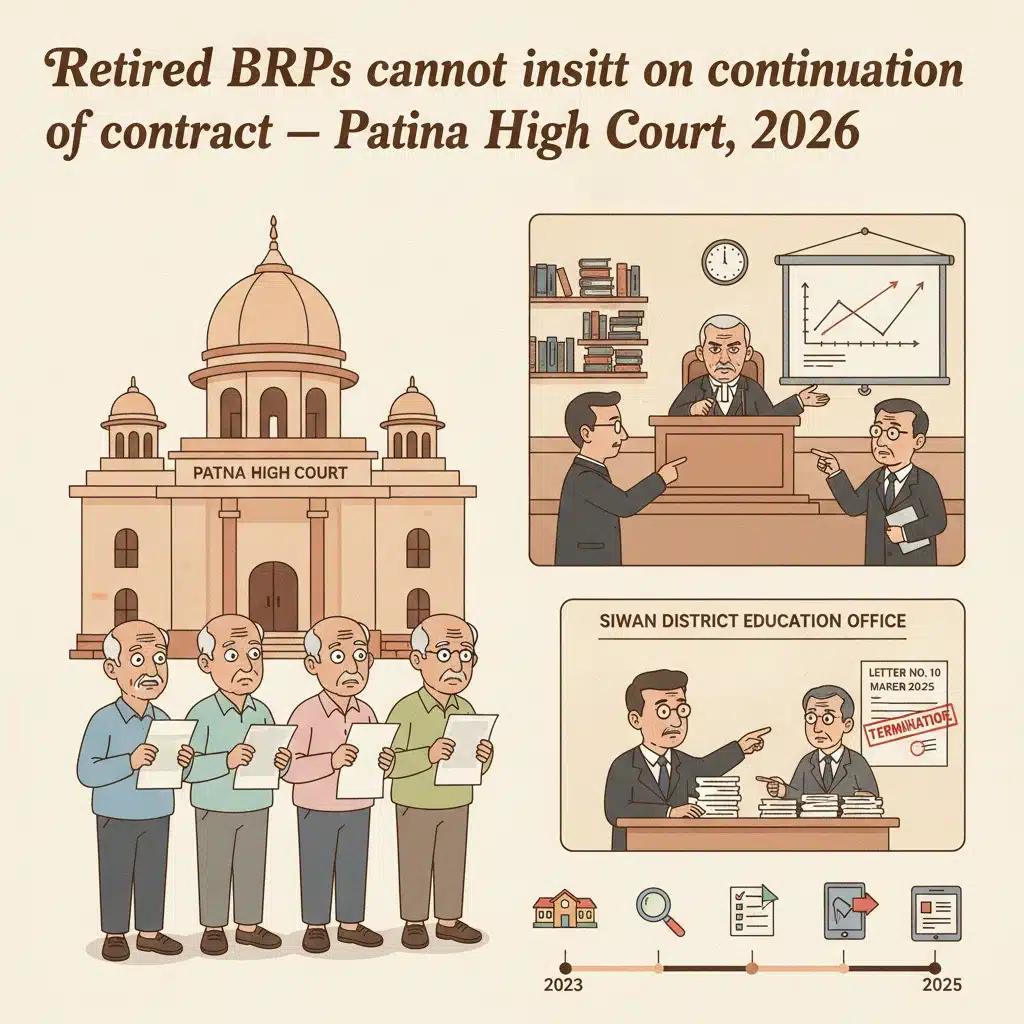
This case arose from a policy decision of the Government of Bihar concerning school inspections under the Sarv Shiksha Abhiyan (SSA). Retired government school teachers from Siwan district were engaged as Block Resource Persons (BRPs) to monitor and inspect schools.
The State Project Director, Bihar Education Project (BEP), had earlier issued directions through Memo No.4472 dated 05.07.2023 for engaging retired teachers as BRPs up to the age of 65 years. A District Level Selection Committee was constituted, and a newspaper advertisement invited applications for 537 BRP posts in Block Resource Centres and Urban Resource Centres.
The petitioners, all retired teachers below 65 years of age, applied and were selected. The District Education Officer-cum-Chairman, Selection Committee, Siwan, issued their engagement letters through Memo No.1861 dated 28.07.2023. They were to receive a consolidated honorarium of Rs. 20,000 per month, directly credited by the District Programme Officer.
The petitioners began working as BRPs, mainly handling school monitoring and inspection work. Later, the State noted serious discrepancies between inspection reports submitted by BRPs and private personnel and the actual condition of schools as found by State officials. This led to a shift in policy.
On 20.02.2025, the Additional Chief Secretary, Education Department, issued Letter No.10, directing that outsourced and short-term contractual staff should be relieved from inspection and monitoring work, and that inspections should instead be done by departmental officials. Based on this, the District Programme Officer, Primary Education and Sarv Shiksha Abhiyan, Siwan, issued Memo No.906 dated 28.03.2025, stating that BRP work had been stopped and their services should not be taken after 31.03.2025.
Aggrieved by this memo, the petitioners approached the Patna High Court under its civil writ jurisdiction in CWJC No.8242 of 2025, seeking quashing of Memo No.906 and continuation of their BRP engagement.
What the Court Examined and Decided
The writ petition was heard by Hon’ble Mr. Justice Dr. Anshuman. The petitioners challenged Memo No.906 dated 28.03.2025, issued by the District Education Officer, Siwan, directing that services of BRPs should not be taken after 31.03.2025. They also sought a mandamus to allow them to continue as BRPs in their respective blocks till the SSA scheme continues and until regular appointments are made.
The petitioners argued that they fulfilled all eligibility criteria laid down for BRP engagement and had been engaged through a proper selection process following the 2023 advertisement. They stressed that under the SSA, the Central Government provides major funding to ensure primary education for children, and Block Resource Centres were designed to support this through monitoring and inspection roles.
They relied on Memo No.4472 dated 05.07.2023 and Letter No.260/C dated 12.09.2023 of the Education Department, under which retired teachers could be engaged as BRPs up to 65 years of age. They said their engagement letters gave them a legitimate expectation that they would continue until 65 years, or until regular appointments were made.
The petitioners also highlighted that there were no adverse remarks against them regarding their performance. They claimed that Memo No.906 was arbitrary, illegal, and a colourable exercise of power. According to them, Letter No.10 dated 20.02.2025 dealt only with outsourced staff engaged through private agencies, not retired teachers directly engaged by BEP as BRPs.
They further contended that Memo No.906 was a “non-speaking” order that did not assign any reasons for ending their services while SSA continued. They complained of violation of the principles of natural justice, as their work was stopped without notice or hearing.
To support their case, they relied on:
- State of Haryana v. Piara Singh, (1992) 4 SCC 118, to argue that temporary/ad-hoc employees should not be replaced by other temporary/ad-hoc employees and must continue till regular appointments.
- Ramana Dayaram Shetty v. IAAI, (1979) 3 SCC 489, to argue that the State must act according to the standards it sets for itself.
They also pointed out that under a letter dated 03.04.2025 (Memo No.789) issued by the Director, Mid-day Meal Scheme, certain BRPs, District Programme Managers and District Accountants under the Mid-day Meal Scheme were allowed to continue till 31.12.2025, while they were discontinued, which they claimed was discriminatory.
On the other side, counsel for the Bihar Education Project Council and the State filed a detailed counter-affidavit. They explained that the State Government, as a policy matter, decided not to continue using outsourced personnel, vendors or contract workers for inspection and monitoring of schools after 31.03.2025.
The State submitted that inspection work had been carried out both by departmental officers and by private/outsourced personnel, including the petitioners as BRPs. Data from school inspections was uploaded on the e-shikshakosh web portal. On review, the government found “huge difference” between the data given by BRPs/private agencies and that given by State officials. In many cases, inspection reports from private personnel were described as fake, concocted, and inconsistent with the actual situation.
Because of these discrepancies, and keeping in view financial constraints, the government concluded that continuing with outsourced and contractual inspection personnel was a futile exercise and a waste of public funds. It decided that school inspections would be performed only by officials of the Education Department and BEP, as listed in Column 3 of Letter No.10 dated 20.02.2025.
The State also pointed out that the petitioners’ engagement letters themselves contained a condition that their work would be evaluated and, if found unsatisfactory, their contract could be terminated. Clause 7 of Memo No.1861 dated 28.07.2023 clearly stated that if services were not found satisfactory, they would be stopped with immediate effect.
The respondents argued that:
- The petitioners were not appointed to any civil post, but engaged purely on contract after retirement.
- Article 311 of the Constitution, which protects civil servants from dismissal/removal without due process, did not apply to them.
- The decision to discontinue BRP services was a policy decision of the State and BEP, based on data analysis and finances, with no replacement of the petitioners by other contractual staff.
- Similar challenges had earlier been dismissed by the Patna High Court in CWJC No.4556 of 2025 (order dated 25.03.2025) and CWJC No.11361 of 2025 (order dated 28.07.2025), where the Court had refused to interfere with BEPC’s decision not to continue BRPs.
After hearing both sides, the Court examined the nature of the petitioners’ engagement. It found that they were “admittedly retired teachers” whose services as BRPs were taken “on contractual basis.” Therefore, their claim to protection as government employees under Article 311 was not tenable. They had already superannuated from regular service and were re-engaged only for a specific purpose.
The Court noted that inspection data collected by the petitioners and other outsourced agencies for the same schools was “in complete contradiction” with data collected by departmental officers. The government concluded that such data collection had failed in its purpose and decided not to continue this system further. The Court viewed this as a legitimate policy decision intended to avoid waste of “huge money” from the public exchequer.
The Court also referred to Memo No.10 dated 20.02.2025 and held that the work of BEP was not hampered; instead, inspection work was merely reassigned to other officials identified in that memo. Thus, the scheme’s core objective could still be achieved without the petitioners’ services.
With respect to the Supreme Court decisions cited by the petitioners, the Court distinguished them. In Ramana Dayaram Shetty, the Court noted, the petitioners were regular employees, while here the petitioners were already retired and re-engaged on contract. In Piara Singh, the principle related to temporary/ad-hoc employees being replaced by others of the same category. In the present case, the petitioners were neither regular nor ad-hoc/temporary employees but contractual retirees, and there was no replacement of them by other contractual BRPs.
The Court also emphasised that the petitioners’ appointment as BRPs was “additional” and for a limited purpose. Once it was found that their reports contradicted departmental inspections and the purpose of their appointment was being defeated, continuing the engagement would be a “futile exercise and loss of public money.”
It further recorded that, as per Clause 7 of Memo No.1861, non-satisfactory services could be stopped immediately, and that the authorities had in fact taken a prospective decision not to take work from them from a future date. There was no allegation that the petitioners had worked and were denied payment.
In these circumstances, the Court held that it was not inclined to interfere with the impugned orders. It concluded that the writ petition was not maintainable in light of earlier similar decisions and the clear contractual and policy framework.
Accordingly, the Court dismissed the writ petition and declined to grant any of the reliefs sought by the petitioners.
Why This Judgment Matters
This judgment is important for retired government teachers and others engaged on contract in educational schemes like SSA. It clarifies that such contractual engagements, even when linked to government schemes and selection committees, do not create a right to continue up to a particular age.
The Patna High Court has reaffirmed that the State can change its policy and stop using contractual or outsourced staff if the work is not satisfactory or funds are limited, especially where data suggests serious discrepancies. In such cases, courts will be slow to interfere.
The decision also underlines that protection under Article 311 of the Constitution is reserved for civil servants holding a civil post. Retired teachers re-employed on contract do not get this protection.
For other BRPs, cluster coordinators and similar workers under government schemes, this judgment signals that their continuation depends on contract terms and policy decisions, not on mere expectation or past practice.
Legal Issues and Answers
- Issue: Can retired teachers engaged as contractual BRPs claim a right to continue till 65 years or till regular appointments are made, and seek quashing of a memo stopping their services?
Answer: No. The Court held that BRPs were contractual appointees after retirement, engaged for a specific purpose. The State’s policy decision to discontinue their services, based on unsatisfactory data and financial considerations, was valid and not open to interference. - Issue: Do such contractual BRPs enjoy protection under Article 311 of the Constitution as government employees?
Answer: No. The Court held that the petitioners were not appointed to any civil post. They were retired teachers working on contract, so Article 311 protection did not apply. - Issue: Do Supreme Court decisions relating to ad-hoc/temporary employees and fairness in State action (Piara Singh, Ramana Dayaram Shetty) compel continuation of the petitioners’ engagement?
Answer: No. The Court distinguished those cases, observing that the petitioners there were regular or ad-hoc employees, whereas here the petitioners were retired contractual appointees and were not being replaced by other contractual BRPs.
Cases Cited by the Court
- State of Haryana v. Piara Singh, (1992) 4 SCC 118 (relied on by petitioners; distinguished by the Court).
- Ramana Dayaram Shetty v. International Airport Authority of India (IAAI), (1979) 3 SCC 489 (relied on by petitioners; distinguished by the Court).
Case Details
Case Number: Civil Writ Jurisdiction Case No. 8242 of 2025
Case Title: Dhruvanath Singh & Ors. v. The State of Bihar & Ors.
Coram: Hon’ble Mr. Justice Dr. Anshuman
Date of Judgment: 14.05.2026
Advocates:
For the petitioners: Mr. Umesh Kumar Mishra, Advocate
For the respondents: Mr. Standing Counsel (24)
Nature of the Case: Writ petition under Article 226 of the Constitution challenging termination of contractual engagement as Block Resource Persons and seeking continuation of such engagement.
Link to Judgment: https://patnahighcourt.gov.in/viewjudgment/MTUjODI0MiMyMDI1IzEjTg==-R74TcQ3Xr7g=
If you found this explanation helpful and wish to stay informed about
how legal developments may affect your rights in Bihar,
you may consider following Samvida Law Associates for more updates.




