

Case Background
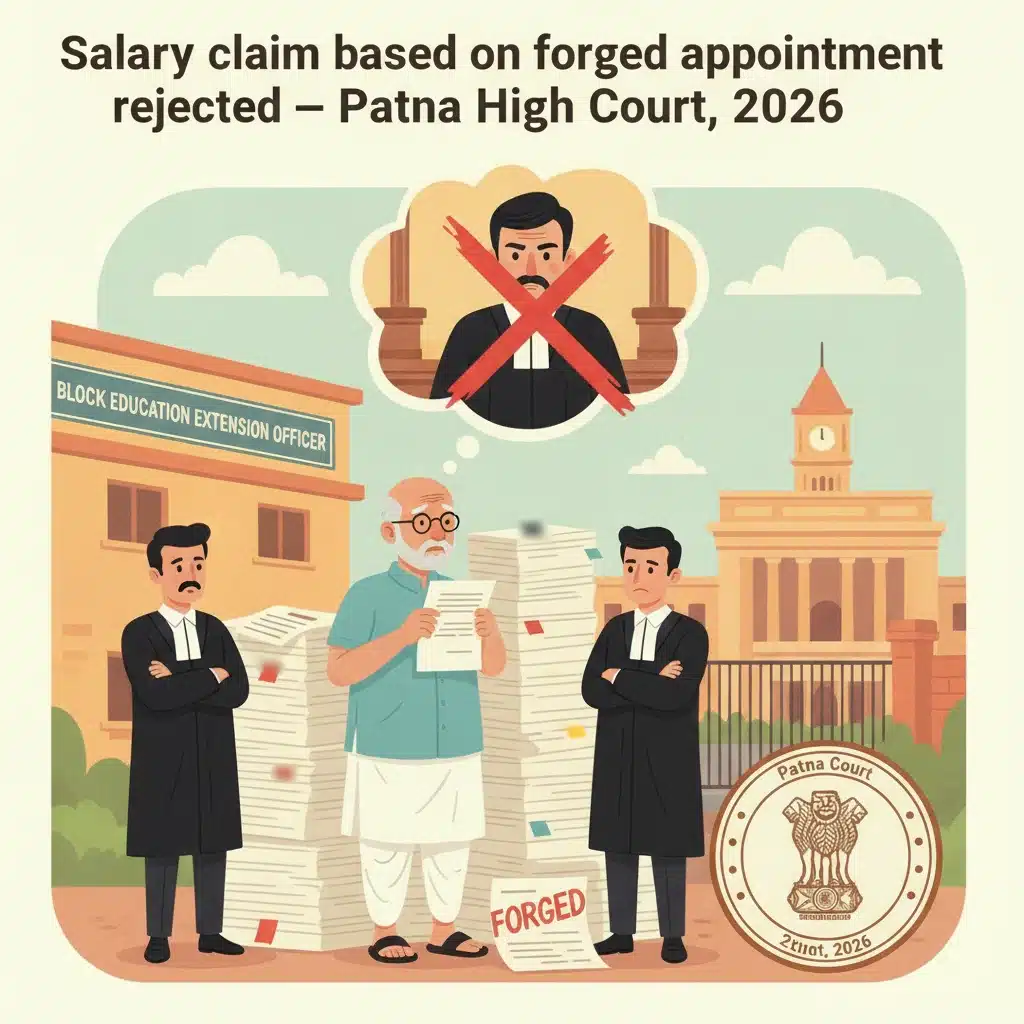
The appellant claimed that he had been appointed as a Peon on 26.06.1998 in the office of the Block Education Extension Officer, Brahmpur. This appointment was said to have been made by the District Education Officer, Bhojpur-cum-Buxar, through Memo No. 550.
According to him, he joined the post but was never paid salary. To claim salary from 03.07.1998 onwards, he first approached the Patna High Court in C.W.J.C. No. 1451 of 2006. He sought payment of his dues of salary and related benefits.
In that writ case, the State opposed his claim. The State said he was appointed on the order of a Minister, without any regular procedure, and that the documents he relied on were forged and fabricated. There was no advertisement, no invitation of applications, and no selection process on comparative merit.
On 16.01.2008, the learned Single Judge dismissed his claim for salary. The Court noted that the petitioner himself had not asserted that he was selected through any legal recruitment process and had raised the claim only in 2006 for salary allegedly due from 1998.
However, the Single Judge also directed the Secretary, Human Resources Development Department, Government of Bihar, to conduct a detailed inquiry. The Secretary was asked to examine how the petitioner gained entry into service, who allowed him to continue, the genuineness of the documents, and to decide on his appointment and continuance. Departmental or criminal action was to follow based on the inquiry result.
What the Court Examined and Decided
The earlier dismissal order was challenged before a Division Bench in L.P.A. No. 173 of 2008. On 20.05.2008, the Division Bench did not interfere with the Single Judge’s order. It clarified only one thing: if, after the inquiry ordered by the Single Judge, the appointment order of the appellant was found genuine and made after following due procedure, he would then be entitled to salary for the period he actually served.
Following this direction, the Principal Secretary, Human Resource Development Department, conducted the inquiry himself. The appellant participated in this inquiry. The report was submitted on 14.07.2008.
In that report, the Principal Secretary gave a clear and categorical finding. He concluded that the appellant’s appointment letter was a manufactured and forged document. The inquiry stated that the appellant was never allowed to join, work or continue in service by any officer of the department.
The report further recorded that, to make a grievance of non-payment of salary, the appellant had manufactured forged orders of appointment, approval of services, transfer, relieving, and payment of salary. Despite this, he never succeeded in either joining the service or getting salary.
The Principal Secretary also found indications that some employees in the District Education Officer’s office at Buxar and employees dealing with Section 11 of the Human Resources Development Department were involved in the forgery. Forged letters appeared in the dispatch register, and some relevant pages of that register were missing. The report recommended thorough investigation by a competent investigating agency and suggested that the matter be handed over to the Vigilance Department.
Despite participating in this inquiry, the appellant never challenged the report of 14.07.2008. That report, therefore, remained as it was, without any judicial or departmental reversal.
Years later, the appellant again approached the Patna High Court by filing C.W.J.C. No. 3015 of 2023. This time also, he essentially sought payment of salary on the basis of the same alleged appointment. The learned Single Judge, by order dated 21.04.2025, again refused relief. The present Letters Patent Appeal No. 593 of 2025 was filed against that order.
In the present appeal, the appellant raised several points. He argued that the inquiry report dated 14.07.2008 was manifestly wrong and that a copy was never served upon him. He claimed that this was a violation of the principles of natural justice.
He also relied heavily on a civil court decree. He pointed out that a Civil Court, in Title Suit No. 266 of 1994, had on 25.04.2006 declared Memo No. 550 (the appointment memo) as valid and genuine. Based on that decree, the Director, Secondary Education, Government of Bihar, Patna, had issued Memo No. 912 dated 13.04.2021 in his favour. Later, however, the Director recalled this order through Memo No. 2022 dated 02.11.2021, allegedly without hearing him.
On the other hand, the State opposed the appeal. It relied on its counter affidavit filed in the writ case and argued that the appellant’s claim had already been decided earlier. The State emphasized that the Principal Secretary’s inquiry report, which found the appointment letter fake and forged, was never challenged and had therefore attained finality.
The Division Bench, while hearing the present appeal, examined all these aspects. It first noted that the issue of salary had already been looked into by the Court in the earlier round of litigation and that the subsequent inquiry was conducted precisely on the direction of the High Court itself.
The Bench highlighted that the Principal Secretary’s report clearly concluded that the appellant’s appointment letter was forged, that he was never allowed to join, and that he never received salary. Therefore, there was no legal or factual basis for granting salary now.
The Court firmly rejected the appellant’s plea that he had not been served with the inquiry report. It observed that he had participated in the inquiry and was thus aware of it. Having such knowledge, he chose to remain silent and took no steps to challenge the report. In these circumstances, his later complaint of non-service could not stand.
The Bench then examined the argument based on the civil court decree in Title Suit No. 266 of 1994. The Court explained why that decree could not help the appellant. First, the appellant himself was not a party to that suit, whereas he was a party in C.W.J.C. No. 1451 of 2006, whose findings bind him.
Second, the conclusion in the title suit was based not on evidence but only on admissions made by State officials, which the State can later explain. Third, the appellant had not disclosed this decree in the earlier proceedings before the High Court in C.W.J.C. No. 1451 of 2006 or in L.P.A. No. 173 of 2008. This concealment showed that he had not approached the court with full honesty.
Fourth, the findings in the title suit directly contradicted both the High Court’s earlier observations in C.W.J.C. No. 1451 of 2006 and the subsequent inquiry report of the Principal Secretary. In such a situation, the High Court held that the title suit decree could not override the findings recorded in proceedings in which the appellant himself was a party and in an inquiry ordered by the High Court.
The Court further held that the issue of payment of salary stood concluded on the basis of the Principal Secretary’s inquiry report. Because the appellant never challenged that report, its findings attained finality and now “stare at the face” of the appellant.
The Bench also stressed that the appellant appeared to have used forged documents. Referring to the Supreme Court judgment in Ram Chandra Singh vs. Savitri Devi and others, reported in 2003 (4) PLJR 208 (SC), the Court reiterated that fraud and justice cannot co-exist. A person relying on forged documents cannot claim equitable or statutory relief.
The Division Bench then discussed the legal position on salary and service benefits. It relied on a Full Bench judgment of the Patna High Court in Rita Mishra and others vs. Director Primary Education, Government of Bihar and others, reported in AIR 1988 Patna 26. That judgment held that salary, pension and other service benefits are statutory rights that flow only from a legally valid appointment.
Applying this principle, the Court observed that the appellant’s initial appointment was tainted by forgery and not made according to law. Therefore, he could not claim salary or any service benefit.
The Court also commented on the Director, Secondary Education’s order in favour of the appellant, which was later recalled. It held that this order and its recall had no real impact on the case. A full-fledged inquiry had already been conducted by the Principal Secretary as per the Court’s direction, and that inquiry had found the appointment fake. Hence, the Director’s subsequent actions could not override or dilute those findings.
In conclusion, the Division Bench found no illegality in the order of the learned Single Judge dated 21.04.2025 in C.W.J.C. No. 3015 of 2023. Since the appellant’s claim was based on forged documents and the crucial findings against him had never been challenged, the Court held that no relief could be granted.
Accordingly, the Letters Patent Appeal No. 593 of 2025 was dismissed. The Single Judge’s order refusing arrears of salary and ancillary reliefs was upheld.
Why This Judgment Matters
This judgment sends a strong message that no one can secure government salary or service benefits on the strength of forged appointment documents. Even if a person manages to obtain some favourable orders elsewhere, those cannot stand against a clear finding of forgery given after a court-ordered inquiry.
For contract workers, daily wagers, or low-level staff who often depend on informal or politically influenced appointments, the case shows that courts will insist on proof of a lawful recruitment process. Without a valid appointment, there is no right to salary.
The judgment also underlines that when an inquiry report is issued after a court’s direction, and a person does not challenge it in time, they cannot later ignore its findings. Silence can mean that the report becomes final against them.
Finally, the decision reinforces that fraud and misuse of official records can invite not only loss of claims but also the possibility of criminal or vigilance action against all those involved.
Legal Issues and Answers
- Issue: Can a person claim arrears of salary and service benefits from the State on the basis of an appointment letter later found in inquiry to be forged and not made through any legal recruitment process?
Answer: No. The Patna High Court held that where the appointment itself is forged and invalid, no right to salary or service benefits arises. - Issue: Does a later civil court decree or administrative order validating the appointment override an earlier High Court-directed inquiry report finding forgery?
Answer: No. The Court held that the civil decree did not bind the appellant’s case and contradicted the High Court’s earlier findings and the Principal Secretary’s inquiry, which had attained finality. - Issue: Can a litigant, after participating in an inquiry, later claim violation of natural justice on the ground that he was not served with the inquiry report?
Answer: No. The Court rejected this plea, noting the appellant’s participation, knowledge of the inquiry, and failure to challenge the report.
Cases Cited by the Court
- Ram Chandra Singh vs. Savitri Devi and others, 2003 (4) PLJR 208 (SC) – cited for the principle that fraud and justice never dwell together.
- Rita Mishra and others vs. Director Primary Education, Government of Bihar and others, AIR 1988 Patna 26 – cited for the principle that salary and service benefits flow only from a legally valid appointment.
Case Details
Case Number: Letters Patent Appeal No. 593 of 2025 in C.W.J.C. No. 3015 of 2023
Case Title: Kamlesh Kumar vs. The State of Bihar & Others
Coram: Hon’ble the Chief Justice (Meenakshi Madan Rai, CJ) and Hon’ble Justice Smt. Soni Shrivastava
Advocates: Mr. Akshansh Ankit, Advocate and Mr. Bhola Kumar, Advocate for the appellant; Mr. Alok Ranjan, AC to AAG-5 for the respondents
Nature of the Case: Letters Patent Appeal against dismissal of writ petition seeking arrears of salary and ancillary reliefs
Date of Judgment: 08.07.2026
Earlier Related Proceedings: C.W.J.C. No. 1451 of 2006; L.P.A. No. 173 of 2008; departmental inquiry report dated 14.07.2008; Civil Court Title Suit No. 266 of 1994; departmental memos No. 912 dated 13.04.2021 and No. 2022 dated 02.11.2021
If you found this explanation helpful and wish to stay informed about
how legal developments may affect your rights in Bihar,
you may consider following Samvida Law Associates for more updates.




