

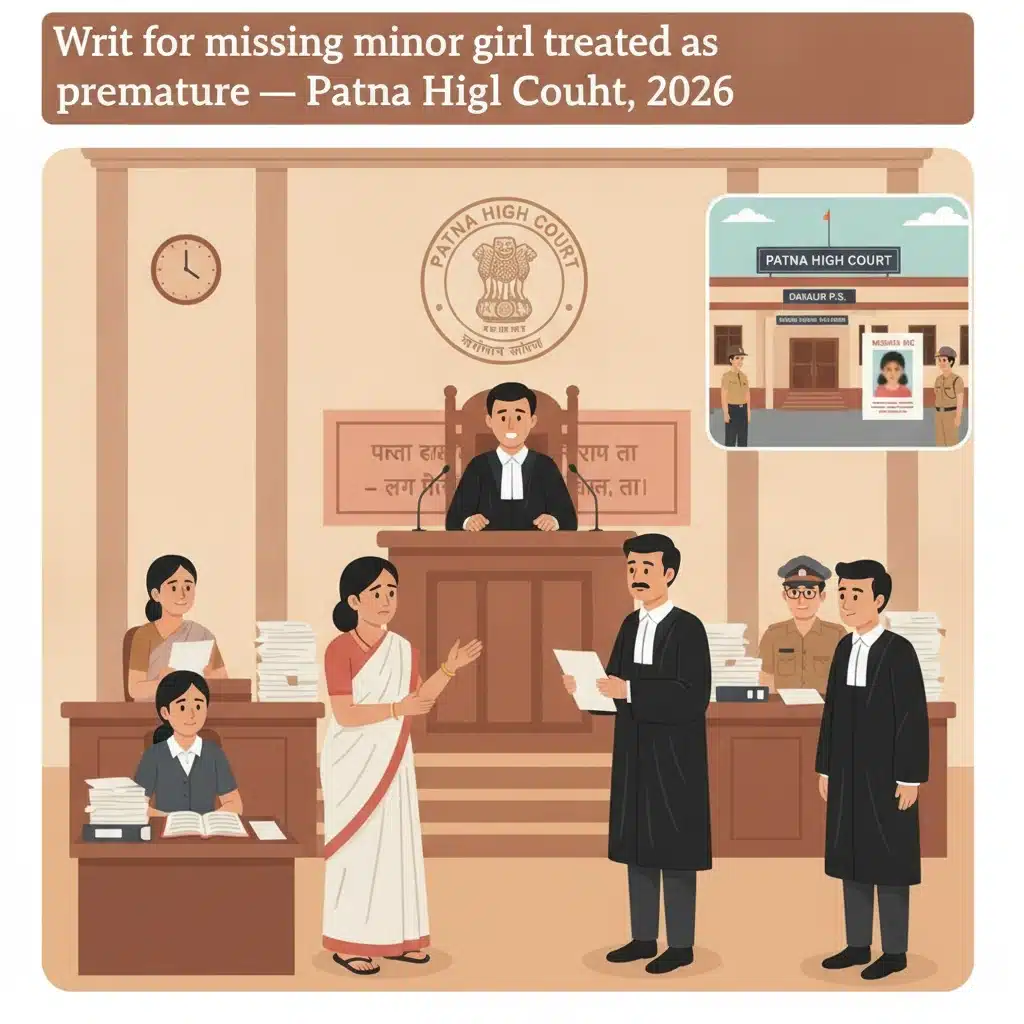
Case Background
The case arises from Danapur P.S. Case No. 9 of 2024 dated 02.01.2024, registered for offences under Sections 363 and 366-A of the Indian Penal Code. The complaint relates to the kidnapping of a 13-year-old girl.
The petitioner, the mother of the victim girl, approached the Patna High Court in Criminal Writ Jurisdiction Case No. 1625 of 2024. She sought directions for proper investigation of the FIR and recovery of her minor daughter.
By the time the writ petition was heard, the police had already submitted a charge-sheet. The case had been committed to the Sessions Court, Danapur, Patna, and was proceeding as Sessions Trial No. 1991 of 2025.
Despite this progress on paper, both sides accepted that the victim girl had still not been recovered. This failure of recovery, even after filing of charge-sheet and commencement of trial, led the petitioner to seek intervention of the Patna High Court.
What the Court Examined and Decided
The core question before the Patna High Court was whether, in these circumstances, the High Court should directly issue directions in its writ jurisdiction for further investigation and search, or whether the petitioner should be required to first approach the Jurisdictional Magistrate.
The State’s counsel informed the Court that despite best efforts, the police had not been able to recover the victim girl. There was no claim that the police had already exhausted all legally available measures for search and recovery.
The petitioner’s counsel argued that further recovery was still possible. According to him, the police had not taken all necessary steps to trace the child. On this basis, he pressed for the High Court’s intervention, treating this as a case requiring stronger supervision.
The Court then turned to the legal framework governing search and recovery of missing or allegedly confined persons. It referred to Section 97 of the Code of Criminal Procedure and its successor provision, Section 100 of the Bharatiya Nagarik Suraksha Sanhita (B.N.S.S.).
Under these provisions, a Judicial Magistrate is empowered to issue a search warrant if he has reason to believe that a person is confined in such circumstances that the confinement amounts to an offence. If the person is recovered under such a warrant, she must be immediately produced before a Magistrate.
The Court emphasised that search and recovery of a victim of any offence is part of “investigation”. It is the police’s duty to carry out a proper investigation. However, the Jurisdictional Magistrate is not powerless. The Magistrate can issue search warrants and monitor the steps taken by the police to search and recover the victim.
To support this understanding, the Court relied on a series of decisions from different High Courts across the country, and from the Supreme Court, dealing with two broad themes:
First, when habeas corpus or writ jurisdiction is appropriate for missing persons and alleged illegal detention.
Second, how the presence of an effective alternative remedy, such as approaching the Magistrate, affects the High Court’s discretion under Article 226 of the Constitution.
The Court cited Showkat Ahmad Mir v. Nighat Begum (High Court of Jammu and Kashmir and Ladakh, CRM(M) No. 240 of 2022). In that case, it was held that a Magistrate of the first class may issue a search warrant under Section 97 CrPC only when two conditions are satisfied: there must be “confinement” of a person, and the confinement must amount to an offence. Once the person is produced, the Magistrate must pass a proper order in the circumstances.
The Court then referred to Jaishree v. State of U.P. (2024 SCC OnLine All 162) from the Allahabad High Court. That decision discussed Section 97 CrPC and Section 98 CrPC in the context of wrongful confinement and restoration of abducted females, and clarified that habeas corpus is an extraordinary remedy. It is not usually invoked where facts are disputed or where other remedies under criminal and civil law are available.
Next, the Patna High Court reviewed a line of judgments where habeas corpus petitions were filed in “missing person” situations without any clear allegation of illegal detention. These included:
Selvaraj v. State (2018 SCC OnLine Mad 14215, Madras High Court). The Madras High Court held that man/woman missing cases should not routinely be converted into habeas corpus petitions. Personal liberty includes freedom of movement, and merely being untraceable from one’s usual residence does not automatically mean illegal detention. In the absence of prima facie material of illegal detention, habeas corpus is not maintainable. Missing person cases must be registered and investigated under the Penal Code and the Code of Criminal Procedure.
Mamonikakoty v. State of Assam (2021 SCC OnLine Gau 2584, Gauhati High Court). This judgment similarly held that habeas corpus will not lie in missing person cases where there is no allegation or suspicion of illegal detention. The proper course is to register a regular case under the Penal Code and proceed with investigation under CrPC.
Jaymati Sahu v. State of Chhattisgarh (2022 SCC OnLine Chh 737, Chhattisgarh High Court). The Court there held that, without pleading and establishing illegal detention, writ of habeas corpus cannot be issued merely because a person is missing or presumed harmed. Extra-ordinary jurisdiction cannot be used simply to secure production of a missing person.
Nimananda Biswal v. State of Odisha (2023 SCC OnLine Ori 5628, Orissa High Court). The Orissa High Court stressed that habeas corpus is not a casual remedy; illegal confinement is a pre-condition. It cannot be used just to trace a missing person or to assign investigation to a particular agency under Article 226.
Simmi Bai v. State (2025 SCC OnLine MP 893, Madhya Pradesh High Court) and Babita v. State of Rajasthan (2025 SCC OnLine Raj 5227, Rajasthan High Court) were also cited to reinforce that missing person cases are to be dealt with under ordinary criminal procedure, and the writ of habeas corpus is not meant to supervise the day-to-day police investigation.
After surveying this case law, the Patna High Court shifted to the second theme — the effect of alternative remedies on writ jurisdiction. The Court carefully distinguished between “maintainability” and “entertainability” of a writ petition. A writ may be legally maintainable, but the Court still has discretion whether to entertain it.
For this, the Court relied on Godrej Sara Lee Ltd. v. Excise and Taxation Officer-cum-Assessing Authority (2023 SCC OnLine SC 95). The Supreme Court there held that Article 226 powers are plenary and are not ousted simply because an alternative statutory remedy exists. However, High Courts normally should not entertain writ petitions when an effective alternative remedy is available, unless an exceptional case is made out.
Similarly, Whirlpool Corporation v. Registrar of Trade Marks, Mumbai (1998) 8 SCC 1 was referred to, reiterating that High Courts may still exercise writ jurisdiction in three main contingencies: enforcement of fundamental rights, violation of natural justice, or where the order is wholly without jurisdiction or involves challenge to vires of a statute.
The Court also cited Radha Krishan Industries v. State of Himachal Pradesh (2021) 6 SCC 771, where the Supreme Court summarised the principles on when alternate remedies bar, or do not bar, writ jurisdiction under Article 226.
Applying these principles to the present case, the Court noted the following key facts:
First, an FIR is already registered for serious offences under Sections 363 and 366-A IPC. Second, the police have investigated and filed a charge-sheet. Third, the Sessions Trial No. 1991 of 2025 is ongoing. Fourth, despite all this, the victim girl remains missing, and the petitioner believes further steps can and should be taken for her recovery.
In this situation, the Court held that it would be “desirable” for the petitioner to move an appropriate application before the Jurisdictional Magistrate seeking proper and further investigation to secure the victim’s recovery. The Magistrate has explicit statutory powers under Section 97 CrPC / Section 100 B.N.S.S. to issue search warrants and to monitor police efforts.
The Court did not comment on the adequacy of the police investigation in detail. Instead, it emphasised that the first level of judicial control and supervision over investigation lies with the Magistrate, not with the High Court in writ jurisdiction, especially when no case of illegal detention is pleaded against any specific person.
Finally, the Court disposed of the writ petition. It did so without dismissing the petitioner’s concern. Rather, it granted liberty to the petitioner to move an appropriate application before the Jurisdictional Magistrate. The Court also made it clear that, if such an application is filed, the Magistrate is “duty bound” to pass orders according to law and to monitor further investigation for recovery of the victim girl.
Why This Judgment Matters
This judgment has an important practical message for families of missing children in Bihar and for lawyers who assist them.
It confirms that when an FIR has already been lodged and investigation is underway, including filing of charge-sheet and trial, the first and most effective legal forum to push for stronger investigation and search is the local Magistrate’s court.
The Patna High Court has underlined that Magistrates are not mere spectators. They have power to issue search warrants under Section 97 CrPC / Section 100 B.N.S.S. and can monitor police efforts to trace a missing or kidnapped person whose confinement may amount to an offence.
At the same time, the judgment shows that the High Court’s writ jurisdiction is discretionary. The Court will usually not step in to supervise routine investigation in missing person or kidnapping cases, unless there is a clear allegation of illegal detention or some exceptional circumstances such as violation of fundamental rights or lack of jurisdiction.
For affected families, this means that rather than immediately rushing to file a writ petition, they should carefully use the remedies before the Magistrate, including applications for further investigation, search warrants, and monitoring of police steps.
Legal Issues and Answers
- Issue: Whether the Patna High Court should, in writ jurisdiction, directly order further investigation and recovery steps for a missing 13-year-old girl when an FIR is registered, charge-sheet filed, and trial is pending, but the victim is still not traced.
Answer: The Court held that the petitioner should instead move an appropriate application before the Jurisdictional Magistrate, who is empowered under Section 97 CrPC / Section 100 B.N.S.S. to issue search warrants and monitor investigation, and disposed of the writ petition with such liberty.
Cases Cited by the Court
- Showkat Ahmad Mir v. Nighat Begum, CRM(M) No. 240 of 2022, High Court of Jammu and Kashmir and Ladakh at Srinagar
- Jaishree v. State of U.P., 2024 SCC OnLine All 162 (Allahabad High Court)
- Selvaraj v. State, 2018 SCC OnLine Mad 14215 (Madras High Court)
- Mamonikakoty v. State of Assam, 2021 SCC OnLine Gau 2584 (Gauhati High Court)
- Jaymati Sahu v. State of Chhattisgarh, 2022 SCC OnLine Chh 737 (Chhattisgarh High Court)
- Nimananda Biswal v. State of Odisha, 2023 SCC OnLine Ori 5628 (Orissa High Court)
- Simmi Bai v. State, 2025 SCC OnLine MP 893 (Madhya Pradesh High Court)
- Babita v. State of Rajasthan, 2025 SCC OnLine Raj 5227 (Rajasthan High Court)
- Godrej Sara Lee Ltd. v. Excise and Taxation Officer-cum-Assessing Authority and Others, 2023 SCC OnLine SC 95 (Supreme Court)
- Whirlpool Corporation v. Registrar of Trade Marks, Mumbai and Others, (1998) 8 SCC 1 (Supreme Court)
- Radha Krishan Industries v. State of Himachal Pradesh and Others, (2021) 6 SCC 771 (Supreme Court)
- Chand Ratan v. Durga Prasad, (2003) 5 SCC 399 (Supreme Court, referred in Radha Krishan Industries)
- Babubhai Muljibhai Patel v. Nandlal Khodidas Barot, (1974) 2 SCC 706 (Supreme Court, referred in Radha Krishan Industries)
- Rajasthan SEB v. Union of India, (2008) 5 SCC 632 (Supreme Court, referred in Radha Krishan Industries)
Case Details
Case Number: Criminal Writ Jurisdiction Case No. 1625 of 2024
Case Title: Kanchan Devi v. State of Bihar & Others
Court: High Court of Judicature at Patna
Bench/Coram: Hon’ble Mr. Justice Jitendra Kumar
Date of Judgment: 02.07.2026
Arising Out of: Danapur P.S. Case No. 9 of 2024 dated 02.01.2024, District Patna
Statutory Provisions Involved: Sections 363 and 366-A of the Indian Penal Code; Section 97 of the Code of Criminal Procedure; Section 100 of the Bharatiya Nagarik Suraksha Sanhita; Article 226 of the Constitution of India
Nature of Case: Criminal writ petition seeking directions for proper investigation and recovery of victim girl in a kidnapping case
Advocates:
- For the Petitioner: Mr. Anuj Dilbar Krishna, Advocate
- For the State: Mr. Nagendra Prasad, S.C.-23
Current Procedural Status: Writ petition disposed of with liberty to the petitioner to move an appropriate application before the Jurisdictional Magistrate for proper and further investigation and monitoring of efforts to recover the victim girl. Sessions Trial No. 1991 of 2025 is pending in the Sessions Court, Danapur, Patna.
If you found this explanation helpful and wish to stay informed about
how legal developments may affect your rights in Bihar,
you may consider following Samvida Law Associates for more updates.




