

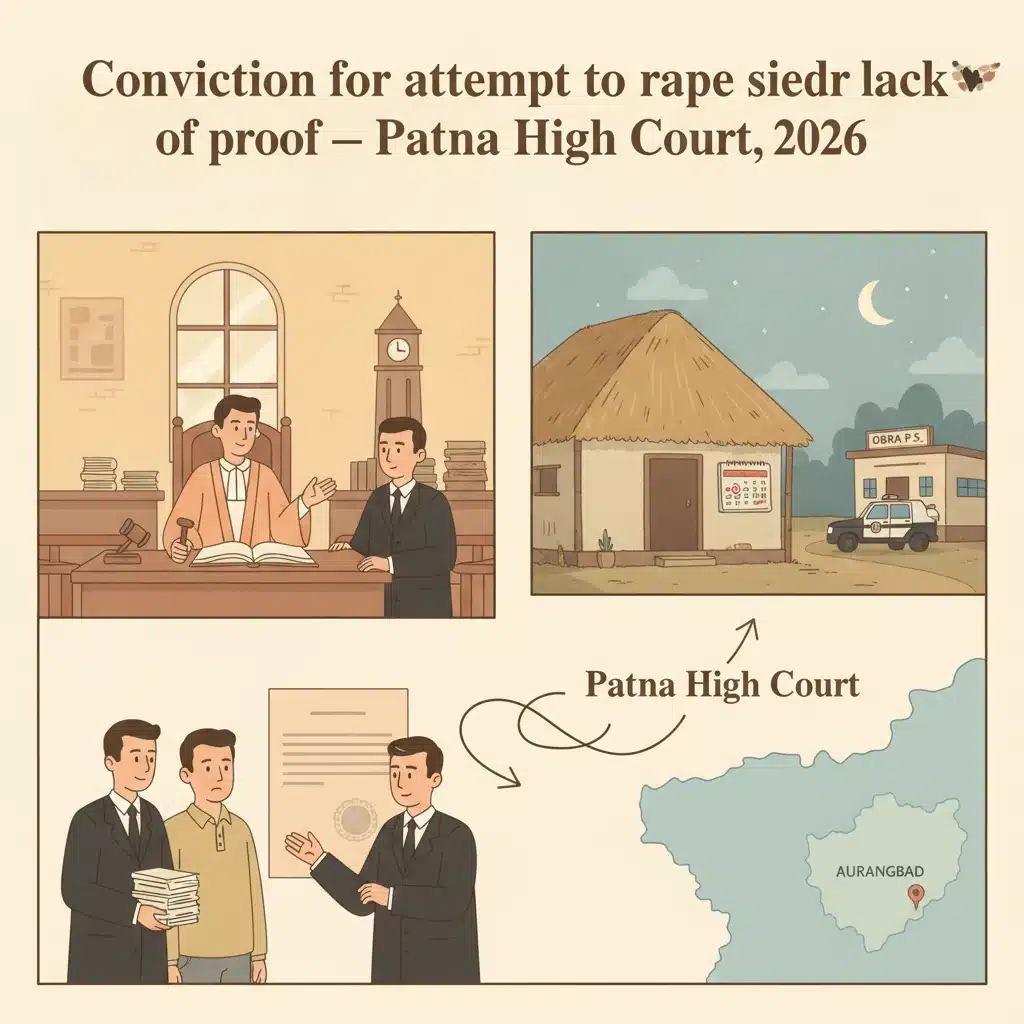
Case Background
This case arose from an incident said to have occurred in village Tejpura, P.S. Obra, District Aurangabad, on the intervening night of 20/21.09.2012.
According to the written report, the informant stated that around midnight, while she was sleeping in her house, the accused allegedly entered, pressed her mouth, pulled her down and attempted to commit rape upon her. During the scuffle, her clothes were allegedly torn. On her raising alarm, the accused was said to have fled, leaving behind a torch and a vest/T-shirt.
It was further alleged that the accused was intoxicated and habitually abused people after consuming liquor.
On the basis of this written report, Obra P.S. Case No. 138 of 2012 dated 21.09.2012 was registered under Section 376/511 of the Indian Penal Code (IPC). After investigation, the police submitted charge-sheet against the accused for attempt to commit rape.
The case was committed to the Court of Sessions. The learned Adhoc Additional Sessions Judge IV, Aurangabad, in Sessions Case No. 80 of 2013/19 of 2013, tried the appellant. By judgment dated 31.08.2013, followed by order of sentence dated 02.09.2013, the trial court convicted him under Sections 376 and 511 IPC and sentenced him to rigorous imprisonment for four years and a fine of Rs. 3,000/-, with three months’ simple imprisonment in default.
Aggrieved by this conviction and sentence, the accused filed Criminal Appeal (SJ) No. 744 of 2013 before the Patna High Court under Sections 374(2) and 389(1) of the Code of Criminal Procedure.
What the Court Examined and Decided
The Patna High Court heard Mr. Aman Vishal and Ms. Leelawati Kumari for the appellant, and Mr. Abhay Kumar, learned APP, for the State. The Court examined the trial court record, witness testimonies, and the legal principles governing sexual offences and attempts under the IPC.
Defence arguments in appeal
The appellant’s counsel argued that the trial court had wrongly appreciated the evidence. According to them, the conviction rested on conjectures, not solid proof.
They stressed that prosecution witnesses P.W.1, P.W.2, P.W.3 and P.W.4 were only hearsay witnesses. None of them had actually seen the incident. They only heard about it from others the next morning or after the alarm.
A major point raised was that the husband of the informant, who was admittedly sleeping beside her at the time of the incident, was never examined. As a natural and material witness, his absence, without explanation, weakened the case.
The defence also relied on the testimony of the informant herself (P.W.5). In cross-examination, she clearly admitted that the accused had not outraged her modesty. There was no medical evidence, no independent witness to any overt sexual act, and no consistent support for the claim of attempt to rape. On this basis, the defence sought setting aside of the conviction and complete acquittal.
State’s stand
The learned APP supported the trial court’s judgment. He submitted that the Sessions Court had rightly convicted the appellant after considering all the evidence and documents, since the allegations were serious and involved a cognizable offence.
Evidence of the witnesses
The prosecution examined seven witnesses, including the informant and the Investigating Officer.
P.W.1, Jitendra Ram, stated that he was sleeping at home on the night of the incident. The next morning he heard that an unknown person had entered the house of the informant and that a torch and T-shirt were recovered there. He also heard that the accused had attempted to commit rape. He proved his signature on the seizure list. But in cross-examination he admitted he had not seen the incident and only heard about it. He could not even clearly identify the seized torch or its details.
P.W.2, Kameshwar Prajapati, said that after hearing noise at midnight he went to the house of the informant and heard that the accused had caught her hand and pressed her mouth. He saw a torch and T-shirt at the spot and later saw the accused trying to snatch the T-shirt the next morning. Yet in cross-examination he admitted that he had not seen the occurrence himself, had not seen the accused at the place of occurrence, and that similar T-shirts were worn by many people. He also stated that the seizure list was not prepared in his presence.
P.W.3, Jai Prakash Paswan, went to the informant’s house after hearing alarm at midnight and saw a torch and T-shirt lying there. He said that the accused had attempted to outrage her modesty and ran away when she raised alarm. But he accepted in cross-examination that he reached about half an hour after the incident and did not see it himself.
P.W.4, Kamendra Yadav, said that upon hearing noise he went to the house of one Dharmdeo Prajapati, where another person told him that someone had pressed the informant’s mouth and fled when she raised alarm. He stayed at the door and did not go inside. In cross-examination he admitted he had neither seen the occurrence nor the allegedly left articles.
P.W.5, the informant and victim, Bhagawaniya Devi, stated in her examination-in-chief that the accused entered her house at night, pressed her mouth, pushed her down and ran away when she raised alarm, leaving behind his vest and torch. She identified the accused in court.
However, in cross-examination, she made crucial admissions. She said the night was dark, there was a bamboo screen at the entrance that was not locked, and that her husband was sleeping beside her at the time. Very significantly, she stated that the accused had not outraged her modesty. She also mentioned that the accused had a torch in his hand and a vest on his shoulder.
P.W.6, the Investigating Officer, described the steps of investigation: recording statements, inspecting the place, arresting the accused, preparing the seizure list and submitting charge-sheet under Section 376/511 IPC. He proved the seizure list and formal FIR.
P.W.7 was a formal witness who proved the forwarding endorsement of the Sarpanch on the written report.
Legal principles on reliance on prosecutrix’s testimony
The Court then discussed the settled law on when conviction can rest on the sole testimony of the prosecutrix in sexual offences.
Referring to Krishan Kumar Malik v. State of Haryana, (2011) 7 SCC 130, the Court noted that while the solitary evidence of the victim can be enough, this is only when her testimony is trustworthy, unblemished and of “sterling quality”. If there are serious lacunae, inconsistencies or gaps, the court must look for corroboration.
In Rai Sandeep v. State (NCT of Delhi), (2012) 8 SCC 21, the Supreme Court explained that a “sterling witness” is one whose version is consistent from beginning to end, withstands cross-examination, and matches the surrounding evidence. If material contradictions arise between the FIR, statements under Sections 161 and 164 CrPC, and court deposition, the witness may not qualify as a sterling witness.
The Court also cited Ganesan v. State, (2020) 10 SCC 573, to reaffirm that a reliable and trustworthy sole testimony of the prosecutrix needs no corroboration. But where that quality is missing, the court must be cautious.
Assessment of the evidence in this case
Applying these principles, the Patna High Court held that the prosecution case mainly rested on P.W.5, because P.W.1 to P.W.4 were admittedly hearsay witnesses who did not see the incident. Their statements only established that some disturbance occurred and that a torch and vest/T-shirt were said to be recovered.
The Court found that in her chief, the informant did not clearly state any specific act amounting to an attempt to commit rape. She only mentioned that her mouth was pressed and she was pushed down. Importantly, in cross-examination she categorically admitted that the accused had not outraged her modesty.
This admission, the Court said, directly hit the prosecution allegation that there was an attempt to rape. Without clear evidence that the accused took a proximate step towards sexual intercourse as described under Section 375 IPC, the ingredients of Section 376 read with Section 511 IPC could not be said to be proved.
The Court also highlighted the non-examination of the informant’s husband, who was sleeping beside her. As a natural and crucial witness, his absence remained unexplained and attracted an adverse inference against the prosecution.
Further, no medical evidence was produced. The Medical Officer was not examined. While the Court accepted that non-examination of a doctor does not automatically demolish every prosecution, it pointed out that here, in the backdrop of already weak and inconsistent evidence, the absence of medical corroboration added to the doubt.
The Court referred to Rajesh Patel v. State of Jharkhand, (2013) 3 SCC 791, to explain how omission to examine the doctor is to be evaluated, and to Sadashiv Ramrao Hadbe v. State of Maharashtra, (2006) 10 SCC 92, where the Supreme Court held that when the victim’s version is doubtful and inconsistent with surrounding circumstances, the accused must get benefit of doubt.
Failure to conduct Test Identification Parade of seized articles
The High Court then turned to the recovery of the torch and vest/T-shirt. It noted that their evidentiary value was very limited.
Relying on Thammaraya v. State of Karnataka, 2025 INSC 108, the Court observed that not conducting a Test Identification Parade (TIP) of recovered articles can be a serious lapse. When articles are identified for the first time in court, their identification becomes doubtful and may reflect negligence by the Investigating Agency and the Public Prosecutor.
In this case, the seizure witnesses admitted they had not seen the incident and that similar T-shirts were common. There was no scientific or other reliable link between the seized items and the accused. Therefore, mere recovery of a torch and vest/T-shirt, without a proper TIP and corroborating evidence, could not prove an attempt to commit rape.
Final conclusion of the Patna High Court
After reviewing all evidence and legal principles, the Court concluded that although it might be possible that the accused had entered the informant’s house and some scuffle occurred, the prosecution had failed to show beyond reasonable doubt that he had taken any definite or near step towards committing rape.
The inconsistencies in the victim’s testimony, her own statement that her modesty was not outraged, the absence of direct eyewitnesses, the non-examination of her husband, lack of medical evidence, and the weak link around the seized articles together created substantial doubt.
In criminal law, when such reasonable doubt exists, the accused is entitled to benefit of doubt. Accordingly, the High Court held that the conviction under Sections 376/511 IPC could not be sustained.
The judgment of conviction dated 31.08.2013 and sentence dated 02.09.2013 passed by the Adhoc Additional Sessions Judge IV, Aurangabad, in Sessions Case No. 80 of 2013/19 of 2013 was quashed and set aside. The appellant was acquitted of all charges. As he was already on bail, he was discharged from his bail bond, and any fine deposited was ordered to be refunded. The appeal was allowed, and the lower court records were directed to be sent back.
Why This Judgment Matters
This Patna High Court decision is important for both accused persons and victims in sexual offence cases.
First, it shows that courts will not uphold a conviction for a serious charge like attempt to rape unless the prosecution proves each element clearly and beyond reasonable doubt. Mere suspicion, hearsay, or recovery of common articles is not enough.
Second, it highlights the importance of careful investigation. Non-examination of key witnesses, failure to conduct Test Identification Parade of seized articles, and skipping medical evidence can seriously weaken the prosecution, even in grave offences.
Third, the judgment underlines that while the testimony of a victim is given great weight, it must still be consistent and reliable. Where the victim herself clarifies that her modesty was not outraged and does not describe any clear sexual act, courts may hesitate to confirm a conviction for attempt to rape.
For ordinary people, especially in Bihar, this judgment explains that every criminal case depends heavily on the quality of evidence. If you are a victim, it is important to give a clear and consistent statement and cooperate with medical and other procedures. If you are accused, the law allows you to question gaps and contradictions in the prosecution story.
Legal Issues and Answers
- Issue: Did the prosecution prove beyond reasonable doubt that the appellant attempted to commit rape under Sections 376/511 IPC?
Answer: No. The Patna High Court held that the evidence, particularly the victim’s inconsistent testimony, lack of medical and independent corroboration, non-examination of her husband, and weak proof regarding seized articles, failed to establish any definite or proximate step towards rape. The appellant was given benefit of doubt and acquitted. - Issue: What is the effect of not conducting a Test Identification Parade of recovered articles in such cases?
Answer: The Court, relying on Supreme Court precedent, held that failure to conduct TIP of recovered articles made their identification in court doubtful and amounted to a serious lapse by the investigating agency. In this case, it further weakened the prosecution case based on the torch and vest/T-shirt.
Cases Cited by the Court
- Krishan Kumar Malik v. State of Haryana, (2011) 7 SCC 130
- Rai Sandeep v. State (NCT of Delhi), (2012) 8 SCC 21
- Ganesan v. State, (2020) 10 SCC 573
- Rajesh Patel v. State of Jharkhand, (2013) 3 SCC 791
- Sadashiv Ramrao Hadbe v. State of Maharashtra, (2006) 10 SCC 92
- Thammaraya v. State of Karnataka, 2025 INSC 108
- Ramkishan Mithanlal Sharma v. State of Bombay, cited in Thammaraya
- Munna Kumar Upadhyaya v. State of Andhra Pradesh, cited in Thammaraya
Case Details
Case Number: Criminal Appeal (SJ) No. 744 of 2013; arising out of Obra P.S. Case No. 138 of 2012; G.R. Case No. 744 of 2012; Sessions Case No. 80 of 2013/19 of 2013.
Case Title: Pawan Paswan v. The State of Bihar
Coram: Hon’ble Mr. Justice Purnendu Singh
Advocates: Mr. Aman Vishal, Advocate for the appellant; Ms. Leelawati Kumari, Advocate for the appellant; Mr. Abhay Kumar, APP for the State.
Nature of the Case: Criminal appeal against conviction and sentence under Sections 376 and 511 IPC.
Date of High Court Judgment: 09.07.2026 (CAV judgment, CAV date 23.06.2026)
Trial Court Judgment and Sentence: Judgment of conviction dated 31.08.2013 and order of sentence dated 02.09.2013 by Adhoc Additional Sessions Judge IV, Aurangabad.
Final Outcome: Appeal allowed; conviction and sentence set aside; appellant acquitted; bail bond discharged; fine, if deposited, to be refunded.
If you found this explanation helpful and wish to stay informed about how legal developments may affect your rights in Bihar, you may consider following Samvida Law Associates for more updates.




