

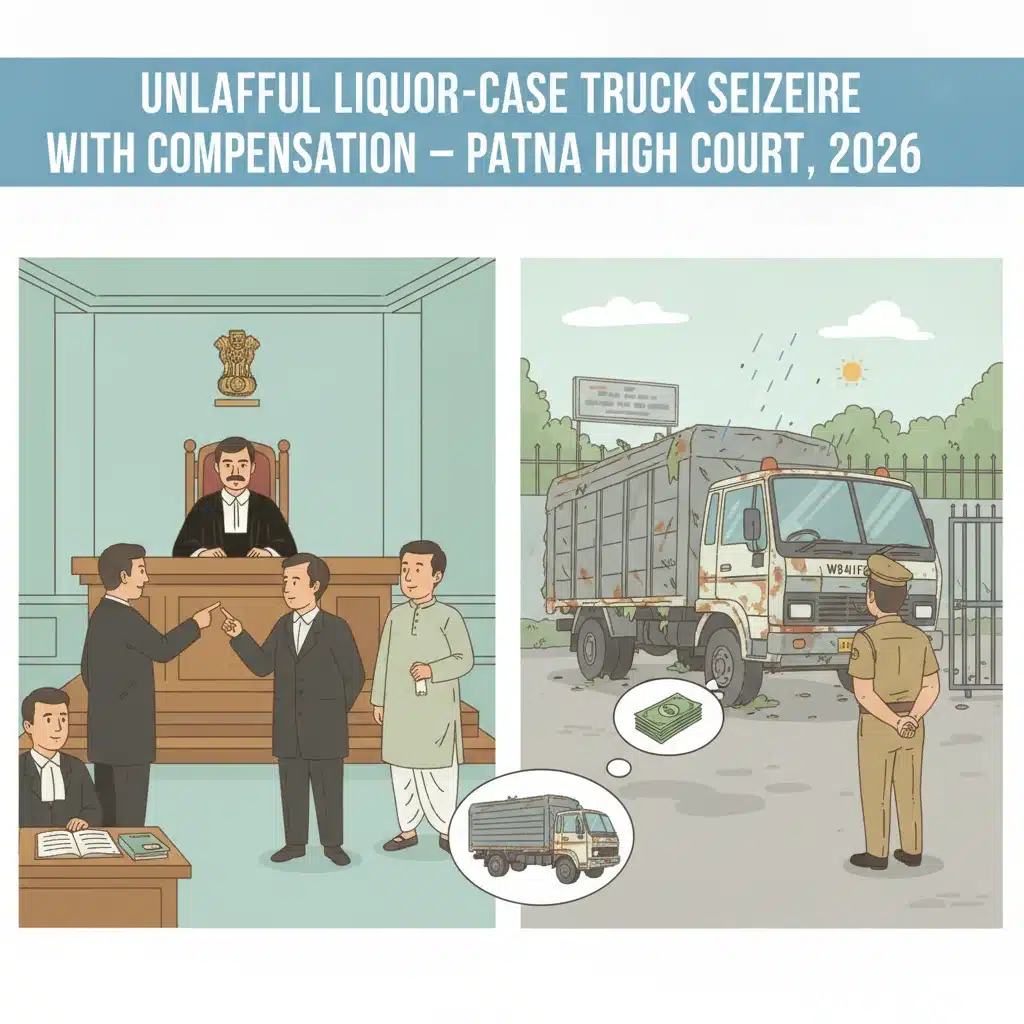
Case Background
This case arose from a writ petition filed by a truck owner before the Patna High Court in Civil Writ Jurisdiction Case No. 2958 of 2026. The petitioner is a resident of Muzaffarpur district and the truck in question is a commercial vehicle bearing Registration No. WB41F0282 and Chassis No. MAT448030BIC08240.
On 14.08.2024, Assistant Sub-Inspector (ASI) Surendra Rai of Kochaikote Police Station, Gopalganj, submitted a written report to the Officer Incharge. He claimed that acting on secret information the police team reached NH-27, near Balathri Check Post, around 9:45 PM for checking vehicles.
According to his report, a truck bearing the above registration number arrived. On being signalled to stop, the driver halted the truck. Another person allegedly tried to run away. Both were apprehended and disclosed their names as Randhir Kumar (driver) and the present petitioner.
The police requested bystanders to act as independent witnesses, but no one agreed. Two members of the raiding team were then treated as independent witnesses. During search of the truck, the officer claimed a “foul smell like liquor” was coming from a box made in the cabin of the truck. He noted that the engine number was not clear.
The ASI recorded that both accused persons confessed that they had earlier transported liquor, had sold it, and were now going to bring more liquor. Their mobile phones were seized. The petitioner allegedly disclosed that the seized truck was registered in his name, and both accused said the liquor had been ordered by one Sonu Kumar.
Based on this self-statement, Kochaikote P.S. Case No. 344 of 2024 dated 14.08.2024 was registered under Sections 47 and 52 of the Bihar Prohibition and Excise Act, 2016 (as amended). The truck was seized and kept in the premises of the police station.
The petitioner approached the Patna High Court claiming that the seizure was illegal. He produced the registration certificate as proof of ownership and pointed out that the truck, being a commercial vehicle, was lying unused in the open at the police station, exposed to sun and rain, with risk of theft of parts and loss of road-worthiness.
The Court called for a counter affidavit. Respondent No. 4 (Superintendent of Police, Gopalganj) filed an affidavit through the Dy.S.P. Traffic, Gopalganj. The State did not dispute that the petitioner was the owner of the vehicle. However, it argued that the petitioner had an alternative remedy before the Special Judge, Excise, Gopalganj, for release of the vehicle.
Crucially, in paragraph 6 of the counter affidavit, it was specifically stated that this was “not a case of seizure of vehicle upon recovery of prohibited liquor” and therefore no proposal for confiscation of the vehicle was to be initiated under the Act.
What the Court Examined and Decided
The Division Bench of Hon’ble Mr. Justice Rajeev Ranjan Prasad and Hon’ble Mr. Justice Kumar Manish heard the matter. Oral judgment was delivered on 17.06.2026, after detailed interaction with both the Superintendent of Police, Gopalganj, and Sub-Inspector (formerly ASI) Surendra Rai.
On 16.06.2026, after reading the FIR and the counter affidavit, the Court recorded a prima facie view that the seizure itself appeared illegal and a sign of “high-handedness” by the police under the Bihar Prohibition and Excise Act, 2016. It noted that:
- The truck had been under seizure for about one year and ten months.
- No liquor was found being transported in the vehicle at the time of interception.
- The only basis was the officer’s claim of smelling “something like liquor” from a secret cabin and alleged oral confession.
- The State itself admitted in the counter affidavit that this was not a case of seizure upon recovery of prohibited liquor and that no confiscation was proposed.
Because of this, the Court indicated that it intended to order release of the vehicle and impose costs on the State, with directions to take administrative action against the erring officer. Before passing final orders, the Court summoned the Superintendent of Police, Gopalganj, and S.I. Surendra Rai to appear online.
On 17.06.2026, in the pre-lunch session, the Superintendent of Police appeared online but S.I. Surendra Rai did not. An Additional S.H.O. from Dinara Police Station, where the officer was then posted, claimed his mobile phone was switched off and he was “traceless”. The Court took a serious view of this, and only then did S.I. Surendra Rai appear online at 2:15 PM after the lunch break.
The Bench questioned the Superintendent of Police as to whether he had read the Court’s order dated 16.06.2026 and what his opinion was about the seizure. He stated that he had gone through the order and was taking administrative action against the officer who seized the truck.
The Court then directly questioned S.I. Surendra Rai whether he had gone through the provisions of the Bihar Prohibition and Excise Act, 2016. Initially, he admitted that he had not read the provisions. Later, during continued interaction, he changed his statement and claimed to have read the law. The Court also noted that he had investigated around 40 Excise cases at Kochaikote Police Station and was handling six more at Dinara Police Station.
The Bench then turned to the legal basis of the case. It noted that the case was registered under Sections 47 and 52 of the Act of 2016 and reproduced these provisions in the judgment. Section 47 deals with “Penalty for allowing premises, etc., to be used for commission of an offence” and essentially punishes a person who knowingly allows his premises, space, animal or conveyance to be used by another for an offence under the Act. Section 52 provides for penalty for offences not otherwise specifically provided for.
After a “bare reading” of these sections, the Court held that by no stretch of imagination do they authorize a police officer to seize a vehicle when no liquor is found being transported in it. A self-serving statement by the officer that one accused confessed to having earlier sold liquor and was going to bring more liquor, coupled only with a claimed smell “like liquor”, could not justify seizure.
The Bench described such a basis as “fanciful” and held that the seizure of the vehicle solely on this self-statement was unlawful. It emphasized that the Act of 2016 contains detailed provisions on confiscation and release of seized items (Sections 56 and 57B, which were quoted), and the machinery of the Act operates only when a cognizable offence under the Act is actually committed.
Referring back to paragraph 6 of the counter affidavit, the Court highlighted that even the State’s own stand was that this was not a case of seizure upon recovery of liquor. Despite this, the officer had used his “imagination and power to smell” as the only ground to seize the truck.
The Court concluded that the officer had used his police powers “unreasonably, capriciously and arbitrarily” without satisfying the requirements of law. As a result, the commercial truck remained seized for nearly one year and ten months, causing serious harassment and hardship to the petitioner.
The Bench then addressed an important question: who should bear the cost and compensation when a citizen suffers due to misuse of power by a State officer? The Court referred to its earlier judgment in K.K. Pathak @ Keshav Kumar Pathak versus Ravi Shankar Prasad and Others, reported in 2019 (1) PLJR 1051. In that case, after discussing Supreme Court decisions such as Lucknow Development Authority v. M.K. Gupta and Delhi Airtech Services Pvt. Ltd. v. State of Uttar Pradesh, the Court had held that:
- Public officers are personally answerable for mala fide or whimsical exercise of power.
- Where public money is paid as cost or compensation due to such conduct, the State is entitled to recover that amount from the erring officer after following principles of natural justice.
The present Bench reiterated these principles, noting that its earlier judgment had been challenged before the Supreme Court in SLP (Crl) No. 003566 of 2019 but was not interfered with.
Applying those principles, the Court held that the petitioner was entitled to compensation and costs for the unlawful seizure. It assessed litigation cost at Rs. 15,000 and, considering that the truck was a commercial vehicle, directed the State of Bihar (Respondent No. 1) to pay Rs. 2,00,000 as compensation within six weeks. Importantly, it directed that the State “would realise the cost and compensation amount from the erring official in accordance with law”.
The Court further directed the Superintendent of Police, Gopalganj, to verify the present condition of the truck lying at Kochaikote Police Station and to ascertain whether any parts had been pilfered or if the vehicle had suffered damage during the long period of seizure. If damage or theft was found, he must fix liability on the officers responsible for custody of the vehicle. The petitioner was given liberty to recover the cost of such missing parts or damage in accordance with law.
Finally, the Bench ordered that the vehicle be released forthwith in favour of the petitioner. The writ petition was allowed to the extent indicated in the judgment.
Why This Judgment Matters
This Patna High Court judgment is important for vehicle owners, transporters and ordinary citizens in Bihar who may face seizure of their vehicles in cases under the Bihar Prohibition and Excise Act.
The Court has clearly said that:
- A truck cannot be seized under the Act merely because a police officer claims to smell liquor or alleges a confession about past or future transport of liquor, when no liquor is actually found.
- Police powers must be exercised strictly according to law, not on imagination or suspicion.
- When a vehicle is kept seized for a long time without lawful basis, the owner is entitled to compensation and litigation costs.
- The burden of such compensation will ultimately fall on the officer who misused his power, not just on the public exchequer.
The ruling also protects citizens’ property by directing that if parts are stolen or the vehicle is damaged while in police custody, responsibility must be fixed and the owner can claim the cost.
For people affected by similar seizures, this judgment shows that they can directly approach the Patna High Court through a writ petition in clear cases of abuse of power, and the Court may grant both relief and compensation.
Legal Issues and Answers
- Issue: Can a commercial truck be seized under Sections 47 and 52 of the Bihar Prohibition and Excise Act, 2016, when no prohibited liquor is found in it and the only basis is a claimed smell “like liquor” and alleged confession?
Answer: No. The Patna High Court held that Sections 47 and 52 do not authorize seizure of a vehicle in such circumstances. The seizure was declared an unreasonable, arbitrary and capricious exercise of police power. - Issue: Is the State liable to pay compensation and can it recover the amount from the erring officer?
Answer: Yes. The Court directed the State to pay litigation costs and compensation to the petitioner and permitted recovery of these amounts from the concerned police officer, in line with earlier precedent on public accountability. - Issue: What obligations do police authorities have regarding safe custody of seized vehicles?
Answer: The Court directed the Superintendent of Police to assess the condition of the seized truck, identify any damage or pilferage, and fix liability on responsible officers, while allowing the owner to recover the cost of such damage according to law.
Cases Cited by the Court
- K.K. Pathak @ Keshav Kumar Pathak versus Ravi Shankar Prasad and Others, 2019 (1) PLJR 1051 (Patna High Court), which in turn referred to:
- Lucknow Development Authority v. M.K. Gupta, 1994 (1) SCC 243.
- Delhi Airtech Services Private Limited and Another v. State of Uttar Pradesh and Another, 2011 (9) SCC 354.
Case Details
Case Number: Civil Writ Jurisdiction Case No. 2958 of 2026
Case Title: Rajesh Kumar Yadav v. The State of Bihar & Ors.
Citation: 2026 (4) PLJR 381
Court: High Court of Judicature at Patna
Coram: Hon’ble Mr. Justice Rajeev Ranjan Prasad and Hon’ble Mr. Justice Kumar Manish
Date of Judgment: 17.06.2026
Advocates:
- For the Petitioner: Mr. Hemant Ray, Advocate
- For the State: Mr. Sudhir Kumar Singh, A.C. to S.C.-23
Nature of the Case: Writ petition (Civil) seeking mandamus for release of seized vehicle and related reliefs under the Bihar Prohibition and Excise Act, 2016.
Link to Judgment: https://patnahighcourt.gov.in/viewjudgment/MTUjMjk1OCMyMDI2IzEjTg==-jKsw2XJoiUI=
If you found this explanation helpful and wish to stay informed about
how legal developments may affect your rights in Bihar,
you may consider following Samvida Law Associates for more updates.




