

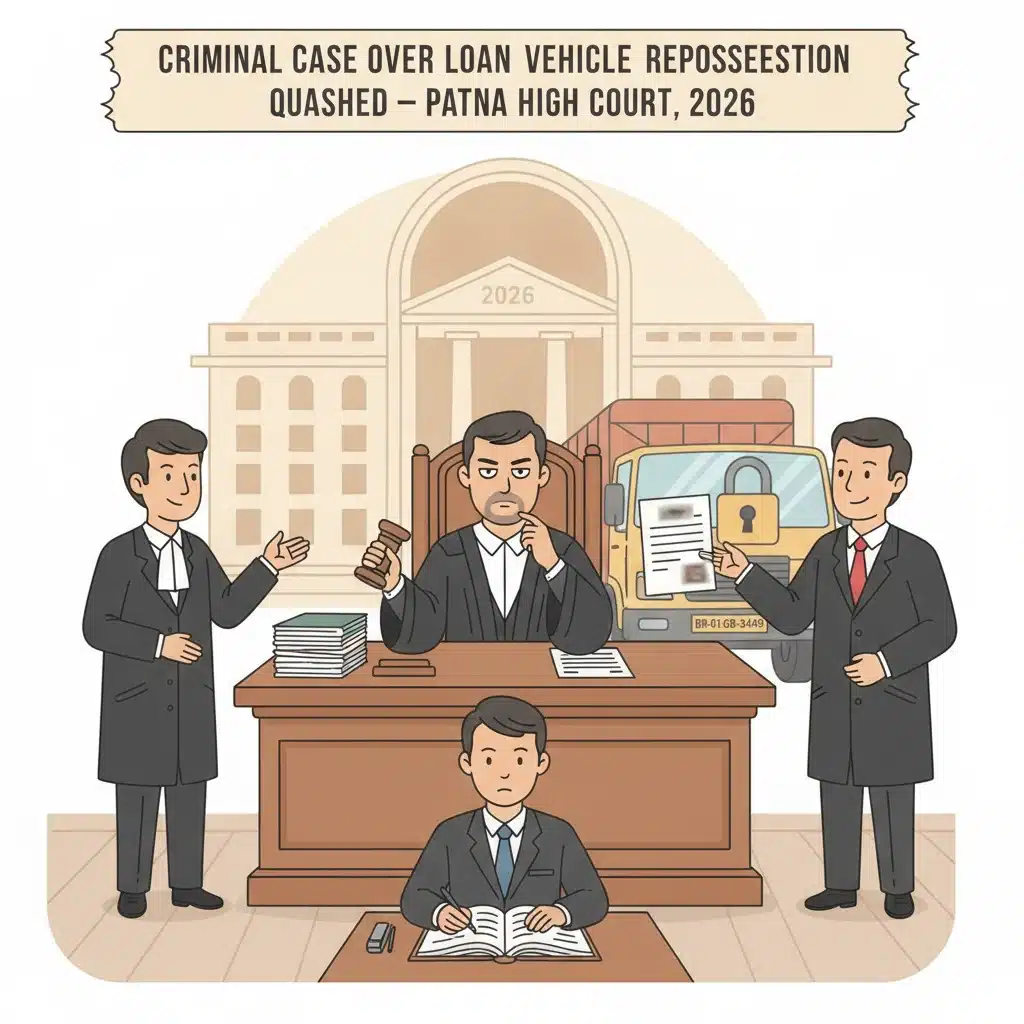
Case Background
This case arose from a police station case registered as Teghra P.S. Case No. 142 of 2018 in Begusarai district.
The informant had purchased a truck bearing registration number BR-01-GB-3449 from one Sunil Kumar. The vehicle was transferred in the informant’s name.
Later, on 30.01.2018, officials of Shriram Transport Finance Company Limited came and took back the vehicle. According to the FIR, the Senior Branch Manager, the Regional Collection Head and another Branch Manager of Shriram Transport Finance repossessed the truck claiming to act on behalf of the company’s Aurangabad branch.
The informant alleged that these officials forcibly and fraudulently took away the vehicle. On this basis, offences under Sections 406, 420 and 120B of the Indian Penal Code were alleged.
After investigation, the learned Chief Judicial Magistrate, Begusarai, took cognizance on 11.01.2021 against the three company officials in Teghra P.S. Case No. 142 of 2018.
Aggrieved by this order of cognizance, the officials approached the Patna High Court by filing Criminal Miscellaneous No. 71238 of 2022. They requested the Court to quash the cognizance order and the criminal proceedings.
What the Court Examined and Decided
The matter came before Hon’ble Mr. Justice Ansul of the Patna High Court. The Court heard learned counsel for the petitioners and the learned APP for the State of Bihar. Postal notice sent to the informant (opposite party no. 2) was received by him personally on 15.06.2026, but he did not appear before the Court.
The petitioners’ main case was that the truck was purchased by Sunil Kumar through a loan from Shriram Transport Finance Company Limited. A loan-cum-hypothecation agreement was executed on 15.02.2017 for Rs. 7,50,000/-. Under this agreement, the vehicle remained hypothecated to the finance company till full repayment.
According to the petitioners, Sunil Kumar defaulted in repayment of the loan. Notices were issued to him, but the dues remained unpaid.
Despite this outstanding loan, Sunil Kumar sold the vehicle to the informant. The petitioners argued that Sunil Kumar did so without discharging the loan and without informing the finance company. They pointed out that the informant purchased the vehicle “without conducting the necessary due diligence”.
In other words, the petitioners claimed that the informant did not check whether there was any outstanding loan or hypothecation on the vehicle. He simply bought the truck from Sunil Kumar.
The petitioners further argued that when no payment was made even after service of notice, the finance company legally repossessed the vehicle.
The petitioners emphasised that Shriram Transport Finance Company Limited repossessed the truck only because the loan had not been repaid. They submitted that under the loan-cum-hypothecation agreement, ownership of the vehicle remained with the finance company till full repayment.
Therefore, their act of repossession was according to the contract and not an act of cheating, criminal breach of trust or criminal conspiracy.
To support this stand, counsel for the petitioners relied on the judgment of the Hon’ble Supreme Court in Anup Sarmah v. Bhola Nath Sharma, reported in (2013) 1 SCC 400. In that decision, the Supreme Court upheld the right of a finance company to repossess the vehicle in case of default in payment of the loan.
The petitioners also pointed out their designations in the finance company. They were Branch Manager, Balia; Regional Business Head, Begusarai region; and Branch Manager, Begusarai, respectively. They were not acting in personal capacity but on behalf of the company under the loan agreement.
After hearing the parties and examining the case records, the Patna High Court analysed the factual situation. The Court recorded that the facts were “crystal clear” on key points.
First, the vehicle originally belonged to Sunil Kumar. Second, Sunil Kumar sold the truck to the informant. Third, the vehicle was already under hypothecation with Shriram Transport Finance Company Limited when the sale took place.
Fourth, the loan amount had not been fully repaid. On default of payment, the finance company, through its officials, repossessed the vehicle.
On these undisputed facts, the Court examined whether any criminal offence could be made out against the petitioners under Sections 406 (criminal breach of trust), 420 (cheating), or 120B (criminal conspiracy) of the IPC.
The Court clearly held that “no criminality at all could be attached to the act in such circumstances”. When a finance company repossesses a loan-financed vehicle after default, in line with the hypothecation agreement, that act is not criminal.
In reaching this conclusion, the Patna High Court referred to the well-known Supreme Court judgment in State of Haryana and Others v. Bhajan Lal and Others, reported in AIR 1992 SC 604.
This landmark decision sets out situations where criminal proceedings can be quashed at the initial stage, especially when the allegations do not disclose any offence or when continuation of proceedings would be an abuse of the process of the court.
The High Court held that the present case was fully covered by the principles laid down in Bhajan Lal. Since the basic facts showed a straightforward case of loan default and contractual repossession, there was no ground to drag company officials into a criminal case.
The Court found that no prima facie case was made out against the petitioners. The ingredients of cheating, criminal breach of trust or conspiracy were not present in the conduct of the finance company officials.
Therefore, continuing the criminal proceedings based on the FIR and cognizance order would be unjustified.
On this reasoning, in paragraph 10 of the judgment, the Patna High Court quashed the order of cognizance dated 11.01.2021 passed by the Chief Judicial Magistrate, Begusarai, in Teghra P.S. Case No. 142 of 2018.
In paragraph 11, the Court concluded by allowing the application filed by the petitioners. As a result, the criminal case against them before the Magistrate cannot proceed further.
Why This Judgment Matters
This judgment is important for both borrowers and finance company officials involved in vehicle loans.
For borrowers, it highlights that when a vehicle is purchased from someone who has taken a loan and has not repaid it, the finance company may still have rights over the vehicle. Simply having the registration transferred in their own name does not automatically wipe out the earlier loan or hypothecation.
For finance companies and their staff, the judgment offers protection from criminal cases when they repossess vehicles strictly in accordance with loan and hypothecation agreements after default. The Patna High Court has reaffirmed that such repossession, by itself, does not amount to cheating or criminal breach of trust.
The judgment also sends a message that criminal law should not be used to settle what are essentially civil or contractual disputes. When the facts clearly show a loan default and a contractual right of repossession, criminal proceedings against company officials can be quashed at an early stage.
Legal Issues and Answers
- Issue: Whether taking cognizance of offences under Sections 406, 420 and 120B IPC against finance company officials, for repossessing a hypothecated vehicle after loan default, was legally justified.
Answer: No. The Patna High Court held that repossession of the vehicle pursuant to a loan-cum-hypothecation agreement, after default in payment, did not disclose any criminal offence and therefore the cognizance order was liable to be quashed.
Cases Cited by the Court
- Anup Sarmah v. Bhola Nath Sharma, (2013) 1 SCC 400 – cited by petitioners to show that a finance company has the right to repossess a vehicle in case of loan default.
- State of Haryana and Others v. Bhajan Lal and Others, AIR 1992 SC 604 – relied upon by the Court to hold that when no prima facie offence is made out, criminal proceedings can be quashed.
Case Details
Case Number: Criminal Miscellaneous No. 71238 of 2022; arising out of Teghra P.S. Case No. 142 of 2018, District Begusarai.
Case Title: Sushil Kumar and others v. The State of Bihar and another.
Coram: Hon’ble Mr. Justice Ansul.
Citation: 2026 (4) PLJR 321
Advocates: For the petitioners – Mr. Patanjali Rishi, Advocate. For the State/opposite party – Mr. Ram Naresh Ray, APP. Presence of counsel for informant is not recorded.
Nature of the case: Criminal miscellaneous application seeking quashing of order of cognizance passed by the Chief Judicial Magistrate in a police station case alleging offences under Sections 406, 420 and 120B IPC.
Link: https://patnahighcourt.gov.in/viewjudgment/NiM3MTIzOCMyMDIyIzEjTg==-T58fUgSlgDg=
If you found this explanation helpful and wish to stay informed about
how legal developments may affect your rights in Bihar,
you may consider following Samvida Law Associates for more updates.