

Case Background
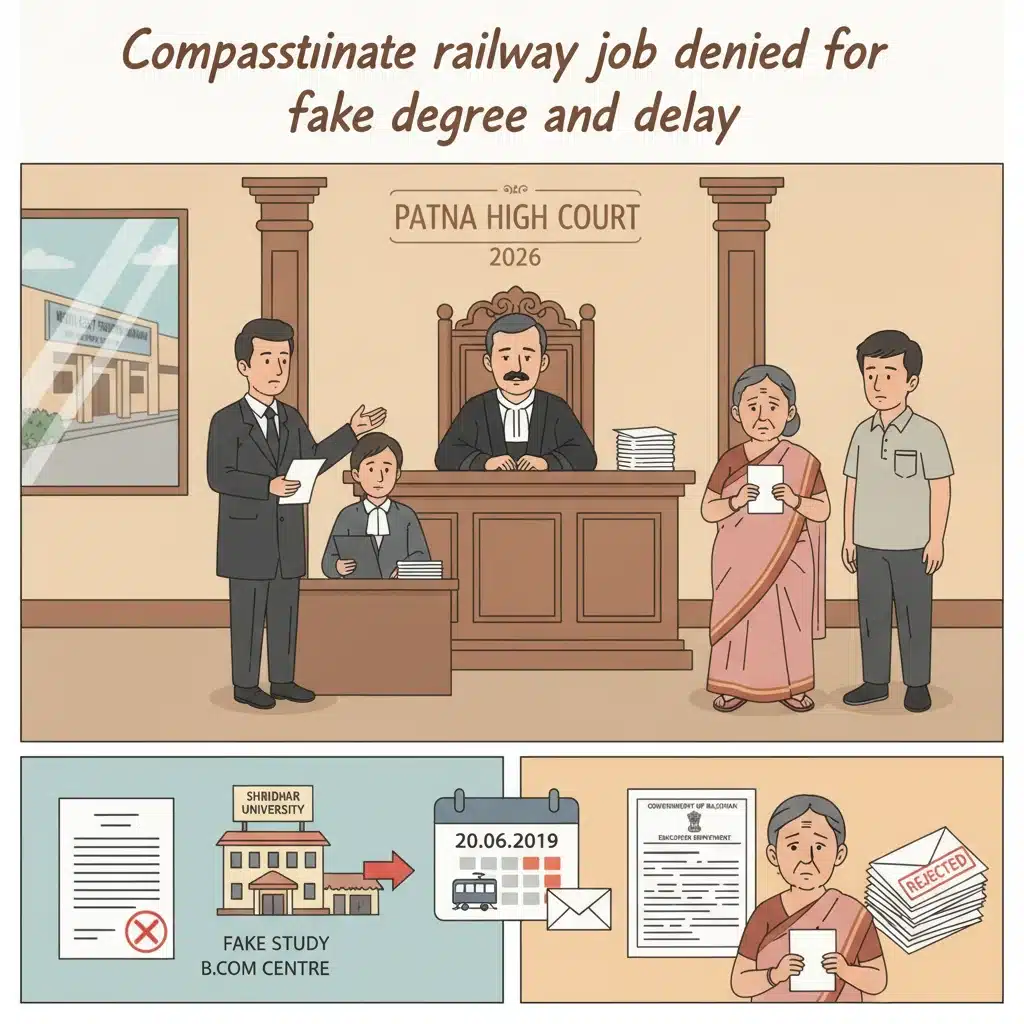
The case arose from the death in service of a railway employee, Late Sri Surja Kant Tiwari, who was working as Chief Reservation Supervisor at Raiganj. He died in harness on 20.06.2019.
Soon after his death, on 12.07.2019, the employee’s widow applied for compassionate appointment for her son, the petitioner in this case. The application was signed by both mother and son.
Along with the application, the family submitted three educational documents of the petitioner: a matriculation certificate of 2007, a senior secondary examination certificate of 2010 from CBSE, and a B.Com (Accountancy) Statement of Grades of 2013 said to be from Shridhar University, Pilani, Rajasthan.
The railway authorities sent the B.Com (Accountancy) qualification for verification to Shridhar University. The Registrar of Shridhar University, Pilani, Rajasthan, by letter dated 20.08.2019, informed the Divisional Railway Manager that the petitioner was not a student of the University and that the documents sent for verification were not genuine.
On receiving this information, the Railways rejected the petitioner’s claim for compassionate appointment by letter dated 16.09.2019. They recorded that the petitioner had enclosed a fake B.A. pass certificate and stated that, as per the rules, no further correspondence would be entertained.
Later, on 30.06.2022, the petitioner’s mother wrote to clarify that the petitioner had pursued his B.Com (Accountancy) course from a fake study centre and had been duped after spending substantial money. She pleaded that the forged degree was not the petitioner’s fault.
The petitioner then requested that his case be considered on the basis of his matriculation and senior secondary certificates alone, ignoring the disputed B.Com degree. However, the Railways, by letter dated 13.12.2022, again rejected the request, reiterating that the case had already been rejected due to submission of a fake certificate and noting that he had tried to cheat the Railway Administration.
In 2023, almost four years after the initial rejection, the petitioner approached the Central Administrative Tribunal, Patna Bench, by filing O.A. No. 050/00677 of 2023. On 25.02.2026, the Tribunal dismissed the original application as devoid of merit, holding that submission of a forged certificate for obtaining a government job disentitled the applicant from appointment on compassionate grounds.
Aggrieved, the petitioner filed Civil Writ Jurisdiction Case No. 6680 of 2026 before the Patna High Court, challenging the CAT order dated 25.02.2026.
What the Court Examined and Decided
The Division Bench of the Patna High Court, consisting of Hon’ble Mr. Justice Mohit Kumar Shah and Hon’ble Mr. Justice Raj Kumar, heard the writ petition and delivered an oral judgment on 07.07.2026.
The petitioner’s counsel argued that the petitioner was a victim, not an offender. According to this argument, he had enrolled in a B.Com (Accountancy) course at a fake study centre linked to Shridhar University, spent considerable money, and was later given a forged degree. The petitioner claimed that he did not intentionally submit a forged document.
To support this narrative, the petitioner relied on a public notice dated 20.10.2020 issued by the Joint Secretary, Education Department, Government of Rajasthan. That notice cautioned the public that private universities running study centres, off-campus centres or offshore centres outside their approved campus, without permission of the State Government or UGC, were not recognized. It advised students to thoroughly verify such institutions before enrolling.
The petitioner’s side argued that, in light of this, his B.Com degree should be treated as a product of fraud by others, and his request for compassionate appointment should be considered on the basis of his genuine matriculation and senior secondary certificates. They stressed that he should not be permanently barred from government service only because he took admission in a fake centre unknowingly.
On the other side, counsel for the Union of India and the Railways pointed to the clear verification report from Shridhar University. The Registrar’s letter dated 20.08.2019 confirmed that the petitioner had never been a student and that the documents relating to his graduation were not genuine.
The Railways relied on their own internal circular dated 25.09.2017 issued by Northeast Frontier Railway regarding compassionate appointment cases where dependents submit fake certificates. The circular noted that:
Divisions and workshops were receiving compassionate appointment cases with fake educational qualification and caste certificates. Such cases were being rejected. Often family members later re-applied seeking compassionate appointment for another dependent. The circular made it clear that where a case had been rejected for submission of fake certificates, no further application from any family member should be considered. Submission of fake or false certificates was treated as concealment of facts and misleading the Railway Administration, and defaulting applicants could be dealt with accordingly.
Relying on this policy, the respondents argued that once the petitioner had submitted a fake B.A./B.Com certificate, his entire claim for compassionate appointment stood disqualified, and no fresh claim could be entertained even on the basis of lower genuine qualifications.
The respondents also raised the issue of delay. The petitioner’s father died on 20.06.2019. The claim was rejected on 16.09.2019. Yet, the petitioner approached the CAT only in 2023, almost four years later. They submitted that compassionate appointment is meant to meet an immediate crisis, not to provide employment after a long gap.
After hearing both sides, the Patna High Court examined the factual record and the legal position. The Court first confirmed the timeline: death in harness on 20.06.2019, application on 12.07.2019, verification by Shridhar University and its letter dated 20.08.2019 pointing to non-genuineness of the degree, and the rejection of the compassionate appointment claim by letter dated 16.09.2019.
The Court then considered the effect of the 25.09.2017 Railway circular. It noted that the circular clearly treats submission of fake or false certificates as concealment of facts and misleading the administration. Under this circular, applications for compassionate appointment by such applicants are not to be considered, especially if filed repeatedly.
The High Court also looked at the Central Administrative Tribunal’s conclusion that submission of a forged certificate for obtaining a government job disentitles the applicant from government service on compassionate ground. The Bench stated that it could not differ from this finding. It called this principle “most fundamental”: no appointment can be obtained on the basis of a false or fake certificate.
The Court acknowledged a limited possibility that, even without the graduation degree, the petitioner might have been educationally eligible for some post on the strength of his matriculation and senior secondary certificates. However, the judges held that this did not cure the basic problem – the deliberate submission of a forged certificate.
According to the Court, the crucial question was the credibility of an applicant who, at the very first stage of seeking public employment, suppressed the material fact that his graduation certificate was forged. Such concealment, the Court observed, “strikes at the core of the trust” reposed in candidates for public service, where honesty and transparency are indispensable attributes. This justified a strict approach by the authorities.
On delay, the Court held that the time gap also went against the petitioner. It reiterated that the object of providing compassionate employment is to help the family tide over the immediate financial crisis arising from sudden death of the breadwinner. For this, the Court relied on two Supreme Court decisions.
First, it cited Umesh Kumar Nagpal v. State of Haryana and Others, reported in (1994) 4 SCC 138. In paragraphs 6 and 7 of that judgment, the Supreme Court held that compassionate employment cannot be granted after a lapse of a reasonable period. The consideration for such employment is not a vested right that can be exercised at any time in future. Since it is meant to meet the crisis at the time of death of the sole breadwinner, it cannot be claimed long after the crisis is over. The Supreme Court also emphasized that compassionate appointment must be governed by rules or executive instructions and cannot be offered on an ad hoc basis.
Second, the High Court referred to Central Coalfields Limited and Others v. Parden Oraon, reported in 2021 SCC Online SC 299. In paragraphs 8 and 9 of that decision, the Supreme Court restated that the whole object of compassionate appointment is to enable the family to overcome the sudden crisis caused by the death of the sole breadwinner. The authority must examine the financial condition of the family and can offer a job only if needed to meet the crisis. The Supreme Court clarified that compassionate employment is not a vested right and cannot be claimed after a significant lapse of time when the original crisis has passed.
Applying these principles, the Patna High Court noted that about seven years had passed since the petitioner’s father died in 2019 by the time of the High Court’s decision in 2026. It found it “very late” to seek compassionate appointment at such a stage.
The Court summed up that compassionate employment is neither a vested right nor an alternate mode of regular employment. It is a narrow exception to normal recruitment rules, meant only to give immediate help to a bereaved family.
Before concluding, the Bench invoked the legal maxim “juda lex sed lex”, meaning “the law may be harsh, but it is the law”. With this, the Court held that there was no error in the CAT’s order dated 25.02.2026 and dismissed the writ petition as being devoid of merit.
Why This Judgment Matters
This judgment sends two clear signals to families seeking compassionate jobs in Railways or other government departments.
First, any forged or non-genuine educational certificate, even if attached “by mistake” or through reliance on a fake institution, can completely destroy the claim. The authorities are entitled to treat such submission as concealment and an attempt to mislead, and they need not entertain any further requests from the family.
Second, the Patna High Court reinforces that compassionate appointment is only for dealing with immediate financial crisis after a government employee’s death. Waiting several years before approaching court weakens the claim, as the very purpose of the scheme is short-term relief, not long-term job security.
For dependents of deceased employees, especially in Bihar and neighbouring states, this decision underscores the need for complete honesty in documents and for acting promptly after the death of the breadwinner.
Legal Issues and Answers
- Issue: Can a dependent who submitted a forged graduation certificate still claim compassionate appointment on the basis of genuine lower qualifications?
Answer: No. The Court held that submission of a fake or forged certificate amounts to concealment and misleading the administration and disqualifies the applicant from compassionate appointment, even if he is otherwise educationally eligible. - Issue: Can compassionate appointment be sought several years after the employee’s death and initial rejection of the claim?
Answer: No. Relying on Supreme Court precedents, the Court held that compassionate employment is only to meet the immediate financial crisis and cannot be granted after a long lapse of time.
Cases Cited by the Court
- Umesh Kumar Nagpal v. State of Haryana and Others, (1994) 4 SCC 138
- Central Coalfields Limited and Others v. Parden Oraon, 2021 SCC Online SC 299
Case Details
Case Number: Civil Writ Jurisdiction Case No. 6680 of 2026
Case Title: Abhishek Ranjan Tiwari v. The Union of India & Ors.
Citation: 2026 (5) PLJR 1
Court: High Court of Judicature at Patna
Bench: Hon’ble Mr. Justice Mohit Kumar Shah and Hon’ble Mr. Justice Raj Kumar
Date of Judgment: 07.07.2026
Nature of Case: Writ petition under Civil Writ Jurisdiction challenging order dated 25.02.2026 of the Central Administrative Tribunal, Patna Bench, in O.A. No. 050/00677 of 2023
Impugned Order: Order dated 25.02.2026 of the Central Administrative Tribunal, Patna Bench, dismissing the petitioner’s original application for compassionate appointment
Advocates:
For the petitioner: Mr. Prashant Sinha, Advocate; Mr. Amar Kumar Singh, Advocate
For the Union of India / Respondents: Dr. Maurya Vijay Chandra, Advocate; Ms. Preety Ranjan, Advocate
Link to Judgment: https://patnahighcourt.gov.in/viewjudgment/MTUjNjY4MCMyMDI2IzEjTg==-yo0yYCsHDyE=
If you found this explanation helpful and wish to stay informed about
how legal developments may affect your rights in Bihar,
you may consider following Samvida Law Associates for more updates.




