

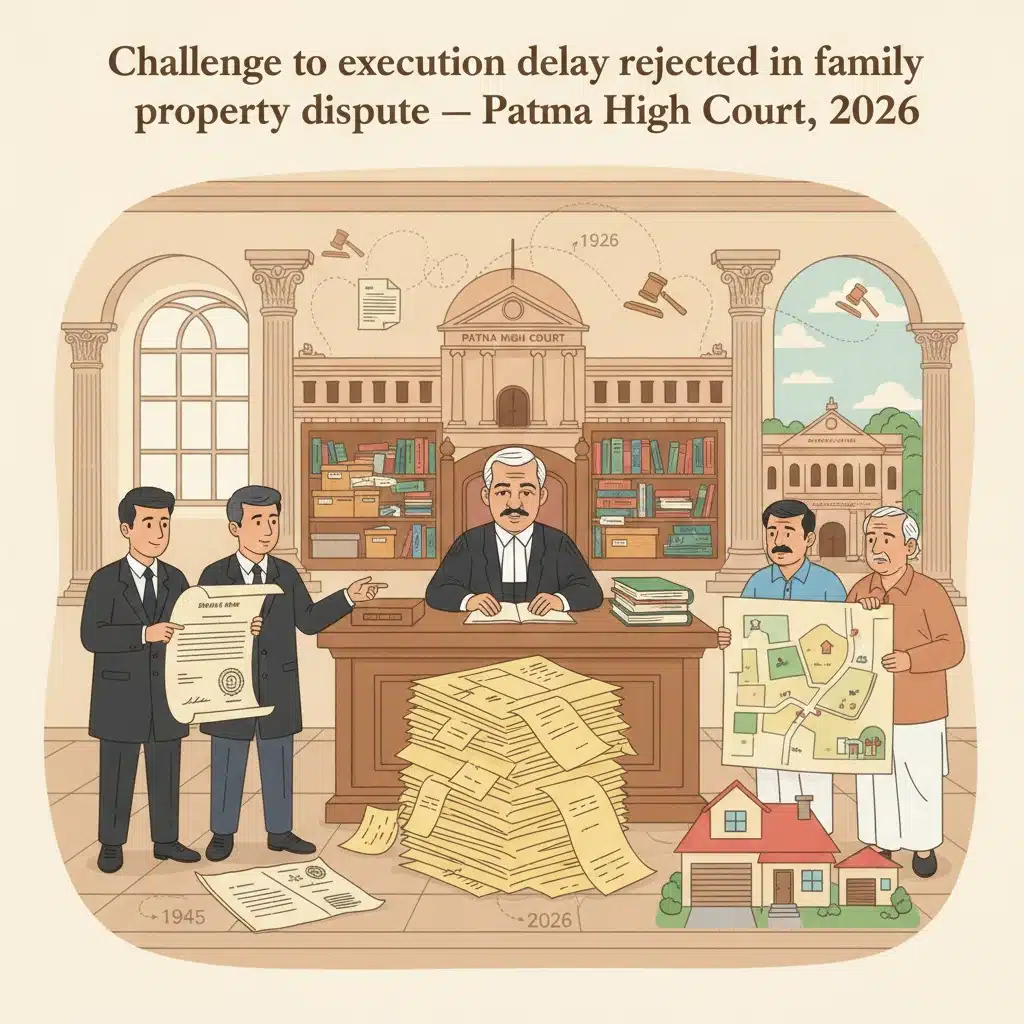
Case Background
The dispute relates to land in Patna bearing Holding No. 169/A, Municipal Plot No. 222, measuring 18 kathas, 3 dhurs and 18 dhurkis.
This land was jointly purchased by three persons: Harilal Sahu, Bansi Lal and Raghunandan Prasad. Harilal Sahu held half share, while the remaining half was jointly owned by Bansi Lal and Raghunandan Prasad.
After Harilal Sahu’s death, his son Raj Kumar Prasad filed Title Partition Suit No. 07 of 1945 before the Sub-Judge-IV, Patna, against Bansi Lal. The suit was decided on 26.04.1947 and a preliminary decree for partition was passed.
Over time, the decree led to multiple rounds of litigation from the side of Bansi Lal’s branch of the family. The father of the present petitioner challenged the decree in Title Appeal No. 144 of 1991, which was dismissed on 23.03.1998. He then filed Second Appeal No. 113 of 1998 before the Patna High Court, which was dismissed on 14.06.2000.
Thereafter, the father approached the Supreme Court through Special Leave Petition (Civil) No. 14937 of 2000, which was dismissed on 05.02.2001. Later, the petitioner’s uncle again tried to challenge the decree by filing SLP (D) No. 29372 of 2006 before the Supreme Court. That petition was also dismissed on 23.10.2009.
Meanwhile, on the basis of the decree in the partition suit, a final decree was prepared on 08.12.1988. After the dismissal of the SLPs, the decree-holder started Execution Case No. 01 of 2002 to get actual possession as per the decree.
The present petitioner is a descendant of Bansi Lal. He was not born when the original partition suit was filed, but he later became one of the judgment-debtors in the execution case. He entered appearance in the execution case on 15.02.2010 as Judgment Debtor No. 13.
What the Court Examined and Decided
The petitioner filed Miscellaneous Case No. 66 of 2017 before the Civil Judge (Senior Division) 3rd, Patna, under Order XXI Rule 97 read with Section 151 of the Code of Civil Procedure (CPC). Through this miscellaneous case, he wanted to resist the execution of the decree in Execution Case No. 01 of 2002.
He also approached the Patna High Court in Civil Miscellaneous Jurisdiction No. 670 of 2018, asking for two reliefs. First, he requested that the High Court set aside the order dated 12.03.2018 passed in Miscellaneous Case No. 66 of 2017, by which the trial court had dismissed his miscellaneous case as not maintainable. Second, he wanted a direction to the trial court to decide his miscellaneous case on merits.
Before the High Court, the petitioner narrated his version of the property history. He claimed that after long disputes, the parties had reached an amicable settlement in 1982 regarding the same holding. According to him, under this settlement, holding numbers were re-allotted among the families of Bansi Lal and Raghunandan Prasad and the branch of Raj Kumar Prasad.
He stated that Holding No. 85 went to the sons of Bansi Lal and Holding No. 85/A went to the sons of Raghunandan Prasad. Each side allegedly took exclusive possession of their allotted portions, their names were mutated in revenue records, and they paid municipal tax separately.
The petitioner further stated that he later separated from his father, Binay Krishna, and his brother. He said he was allotted Holding No. 106/85B in Circle No. 20A, now Ward No. 38, consisting of land with a garage and an out-house. He claimed to have invested a large amount to renovate and construct a double-storeyed house on this portion, in full knowledge of the decree-holders and others.
His main grievance was that, despite this alleged 1982 settlement, the decree-holder (from Raj Kumar Prasad’s side) obtained appointment of a survey knowing advocate commissioner in the execution proceedings. The petitioner alleged that this commissioner prepared an illegal and incorrect allotment chart behind his back, to grab his land and house. He also complained that the commissioner’s report was confirmed without giving him a hearing.
The petitioner argued that since he was not a party to Title Partition Suit No. 07 of 1945, the decree was not binding on him. On this basis, he claimed an independent right, title and interest in the portion in his possession and tried to resist execution under Order XXI Rule 97 CPC.
In Miscellaneous Case No. 66 of 2017, respondents 1 to 10 (from the decree-holder side) appeared and the trial court initially admitted the case on 08.09.2017. Later, without filing a detailed written statement on merits, they moved a petition dated 10.10.2017 questioning the maintainability of the miscellaneous case itself. The trial court accepted their objection and, by order dated 12.03.2018, held that the miscellaneous case was not maintainable and dismissed it.
In the Patna High Court, the petitioner repeated his arguments about non-impleadment in the original suit and the alleged family settlement of 1982. He relied on a co-ordinate Bench decision in Zulfikar Haidar and Others v. Sajila Khatoon (Civil Miscellaneous Jurisdiction No. 400 of 2018) to support his plea for adjudication of his objections.
The High Court, however, noted that no registered deed or any documentary evidence had been produced to prove the alleged 1982 amicable settlement. There was nothing on record either before the trial court or before the High Court to legally substantiate such a family arrangement. For this reason, the Court held that the alleged settlement had no legal force.
The Court also found that the decision in Zulfikar Haidar’s case did not apply. In the present matter, the decree had already been fully adjudicated, tested in appeal, second appeal and special leave petitions, and there was no need for taking fresh evidence in the miscellaneous case.
The respondents highlighted that, as per the petitioner’s own affidavit dated 28.08.2017, he was 52 years old. This showed he was not born when Title Suit No. 07 of 1945 was filed, so he could not have been a party then. More importantly, they pointed out that his father and uncle had already challenged the decree up to the Supreme Court, and all such challenges had failed.
They also drew attention to Title Partition Suit No. 476 of 2002 filed by the petitioner, his father and his brother against Arvind Krishna and others. In that suit, they themselves had admitted the judgment and final decree passed in T.S. No. 07 of 1945. In their own plaint, they stated that after separation from Raj Kumar Prasad (decree holders), the land and house allotted to the defendants of T.S. No. 07 of 1945 remained joint between them and needed partition. This, according to the respondents and the Court, clearly showed that the petitioner knew about the decree and accepted its effect.
The High Court closely examined the reasoning of the trial court. The trial court had stressed several facts. First, the petitioner had been shown as Judgment Debtor No. 13 in Execution Case No. 01 of 2002 from the very beginning. Second, he had appeared in the execution case as early as 15.02.2010. Third, in the 2002 suit filed by him with his father and brother, he had admitted the judgment and final decree in T.S. No. 07 of 1945.
Despite these facts, he filed the miscellaneous case only in 2017, after a delay of about seven years from his appearance in the execution case and many years after part execution had already been carried out on 07.09.2004. The trial court found his explanation—that he waited because a cousin had filed another miscellaneous case and his lawyer advised him to “wait and watch”—to be a naive excuse that did not justify such delay.
The trial court also recorded that respondents 1 to 10 had filed several orders and judgments of the Patna High Court and the Supreme Court, showing that earlier similar challenges by the petitioner’s father had all been dismissed. It found that the present miscellaneous case was only a tactic to delay the execution further, and therefore dismissed it as devoid of merit and lacking maintainability.
The Patna High Court agreed with this assessment. It further examined Section 11 of the CPC on res judicata, especially Explanation VI. It noted that where persons litigate bona fide in respect of a private right claimed in common for themselves and others, all persons interested in such right are deemed to claim under those litigating.
Applying this, the Court held that once the partition of the suit property had been finally settled and the decree affirmed up to the Supreme Court, it could not be re-opened by descendants or successors-in-interest of Bansi Lal. The petitioner was claiming through Bansi Lal, who had already contested the matter. Therefore, he was bound by the earlier decisions. Allowing him to challenge the decree again would go against the purpose of res judicata and would lead to endless litigation.
The Court also took serious note of the delay in execution. The decree under execution dated back to 26.04.1947—before India’s independence. Execution Case No. 01 of 2002 had been pending for many years. The petitioner had entered appearance in 2010 but, by filing his petition in 2017, had effectively halted execution for about 16 years.
The High Court held that this conduct amounted to flagrant misuse of the legal provisions under Order XXI Rule 97 read with Section 151 CPC. It found no illegality or impropriety in the trial court’s order dated 12.03.2018 dismissing the miscellaneous case.
Accordingly, the Patna High Court dismissed Civil Miscellaneous No. 670 of 2018. It upheld the impugned order, imposed an exemplary cost of Rs. 20,000/- on the petitioner, payable to the respondents within one month from receipt or production of the order, and vacated the earlier stay order dated 16.05.2018.
The Court directed the executing court to conclude Execution Case No. 01 of 2002 at the earliest, preferably within two months from the date of the High Court’s judgment, on a day-to-day basis.
Why This Judgment Matters
This judgment is important for families involved in long-running property disputes.
First, it shows that once a partition decree has been confirmed by higher courts, including the Supreme Court, descendants cannot keep opening new rounds of litigation on the same issue. The law of res judicata binds all those who claim through a person who has already fought the case.
Second, it warns against using objections in execution proceedings just to delay enforcement of a decree. The Patna High Court treated such delay as misuse of the law and even imposed costs on the objector.
Third, it underlines that alleged family settlements about property must be supported by proper documents. Without a registered deed or reliable proof, such claims will not defeat a court decree.
For people facing similar situations, the message is clear: if your elders have already contested and lost a property case up to the Supreme Court, it will be very hard to re-open the same dispute. Trying to block execution at a late stage may only waste time and money, and can result in costs being imposed.
Legal Issues and Answers
- Issue: Can a descendant, who was not a party to the original partition suit, resist execution of an old partition decree on the ground of independent rights and an alleged later family settlement?
Answer: No. The Patna High Court held that the petitioner, claiming through Bansi Lal, was bound by the earlier litigation and final decree, especially after repeated challenges up to the Supreme Court had failed. The alleged 1982 settlement was unsupported by any valid document and had no legal force. - Issue: Was Miscellaneous Case No. 66 of 2017 under Order XXI Rule 97 CPC maintainable to re-agitate issues already decided in earlier rounds of litigation?
Answer: No. The Court agreed with the trial court that the miscellaneous case was not maintainable, was filed after inordinate and unjustified delay, and was a dilatory tactic to obstruct execution, barred by res judicata. - Issue: What directions should be given regarding the long-pending execution of the 1947 decree?
Answer: The Court vacated the stay, directed the executing court to conclude Execution Case No. 01 of 2002 at the earliest, preferably within two months, on a day-to-day basis, and imposed exemplary costs of Rs. 20,000/- on the petitioner.
Cases Cited by the Court
- The petitioner relied on: Zulfikar Haidar and Others v. Sajila Khatoon, Civil Miscellaneous Jurisdiction No. 400 of 2018 (Patna High Court). The Court held that this decision was not applicable to the present case.
- The judgment also refers generally to orders and reported judgments of the Hon’ble Supreme Court and Hon’ble Patna High Court in earlier challenges to Title Suit No. 07 of 1945 (including SLP (Civil) No. 14937 of 2000 and SLP (D) No. 29372 of 2006), but does not detail their citations.
Case Details
Case Number: Civil Miscellaneous Jurisdiction No. 670 of 2018
Case Title: Saket Krishna v. Sanjeev Ranjan Gupta and Others
Coram: Hon’ble Mr. Justice S. B. Pd. Singh
Date of Judgment: 19.06.2026
Citation: 2026 (4) PLJR 420
Advocates:
For the petitioner: Mr. J. S. Arora, Mr. Manoj Kumar, Mr. Ravi Bhatia
For the respondents: Mr. Jitendra Kishore Verma, Mr. Ravi Ranjan, Mr. Shreyash Goyal, Mr. Abhishek Kumar Srivastava, Ms. Kumari Shreya, Mr. Achyut, Mr. Ayush, Mr. Prateek Ranjan
Nature of the case: Civil miscellaneous application challenging an order of the Civil Judge (Senior Division) dismissing a miscellaneous case under Order XXI Rule 97 CPC in an execution proceeding arising from an old partition decree.
Link to judgment: https://patnahighcourt.gov.in/viewjudgment/NDQjNjcwIzIwMTgjMSNO-QjQlvcbyf7k=
If you found this explanation helpful and wish to stay informed about
how legal developments may affect your rights in Bihar,
you may consider following Samvida Law Associates for more updates.




