

Case Background
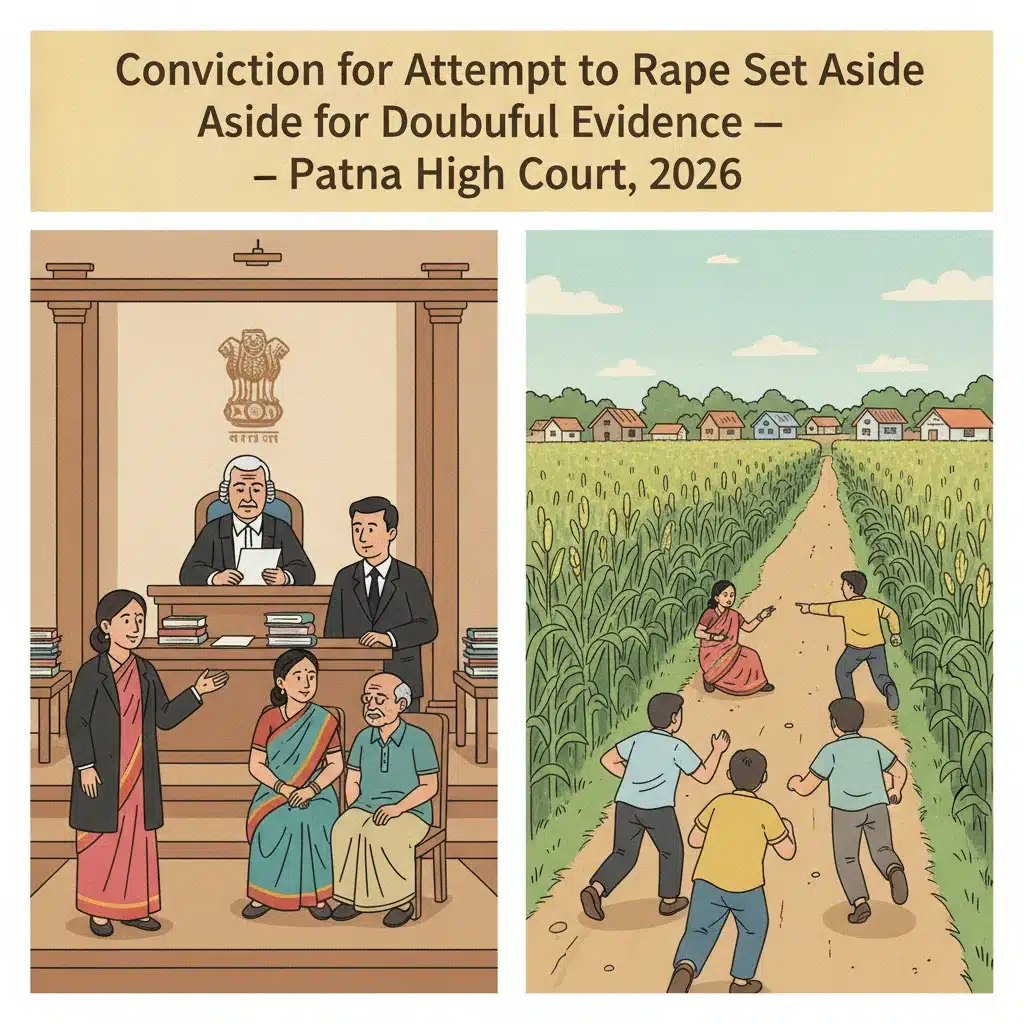
This case arose from an incident reported on 14.08.2007 at Barauni (Refinery) Police Station, District Begusarai. The complainant, a woman, gave a written report alleging that when she went to a maize field outside the village to attend the call of nature, the appellant followed her, caught hold of her, pushed her on the ground and tried to commit rape. She claimed that when she raised alarm, the appellant fled.
It was further alleged in the written complaint that the appellant had earlier also tried to outrage her modesty on several occasions. On the basis of this written complaint, Barauni (Refinery) P.S. Case No. 274 of 2007 was registered under Sections 376/511 of the Indian Penal Code.
After investigation, charge-sheet no.196 of 2008 was submitted on 11.06.2008. The Chief Judicial Magistrate, Begusarai took cognizance under Sections 376/511 IPC and transferred the case to the court of the Judicial Magistrate 1st Class, Begusarai. Thereafter, on 19.01.2009, the case was committed to the Court of Sessions.
The case was tried as Sessions Trial No. 62/2009 before the 3rd Additional Sessions Judge, Begusarai. By judgment dated 24.04.2013, followed by order of sentence dated 26.04.2013, the trial court convicted the appellant under Sections 376/511 IPC and sentenced him to five years rigorous imprisonment and fine of Rs. 1,000/-, with one month further imprisonment in default.
Aggrieved, the appellant filed Criminal Appeal (SJ) No. 358 of 2013 before the Patna High Court. Ms. Akanksha Malviya was appointed Amicus Curiae for the appellant, and Mr. Satya Narayan Prasad, APP, appeared for the State. The appeal was heard by Hon’ble Mr. Justice Purnendu Singh, who reserved judgment (CAV) on 18.06.2026 and delivered it on 01.07.2026.
What the Court Examined and Decided
The Patna High Court closely examined the evidence led during the Sessions Trial. The prosecution examined nine witnesses and produced three documents: the forwarding note of the SHO, the endorsement of the Barauni P.S. SHO, and the formal FIR.
The key prosecution witnesses included the alleged eye-witnesses, the husband of the victim, the victim herself, and the investigating officers.
P.W.1, P.W.2 and P.W.3 were projected as persons who had reached the field on hearing the cry of the victim. In their examination-in-chief, they initially deposed that they had seen the accused lying on the victim and trying to commit rape, and that the accused fled when they rushed towards him. However, on the record it emerged that these witnesses ultimately turned hostile and categorically stated that they did not know about the occurrence.
P.W.4 was a formal witness who proved the forwarding note and endorsement but admitted in cross-examination that the written report and endorsement were not prepared in his presence and he had no knowledge of their contents.
P.W.5, the husband of the victim, stated that he had gone to see his land when he heard his wife’s cry. He claimed that he went to the field of Ram Subhag Singh and saw the accused “ridden on the chest” of his wife, trying to rape her, and that on his threat the accused fled. P.W.7 similarly stated that he saw the accused lying on the victim in the field and that the accused fled on seeing him. However, the Court noted that P.W.5 and P.W.7 failed to clearly establish the time of the occurrence.
P.W.6, the victim, was the central witness. The Patna High Court emphasized that in sexual offence cases, conviction can be based solely on the testimony of the prosecutrix if it is trustworthy, reliable and of “sterling” quality.
In her deposition, the victim went beyond what she had alleged in her initial written complaint. In the FIR-based report, the allegation was that the appellant followed her, caught hold of her, lifted and pushed her on the ground, and tried to commit rape. However, as P.W.6 in court, she added that the appellant shut her mouth, opened her saree, mounted upon her body and attempted to commit rape, and that he ran away only when she raised alarm and her husband came.
The High Court treated these additional details as “material improvements” over the earliest version. The Judge held that the allegation of attempt to rape took on greater prominence in the court testimony than in the first written report, and therefore required cautious scrutiny.
The Court then considered the legal position on relying solely on the testimony of the victim. It referred to several Supreme Court decisions:
In Krishan Kumar Malik v. State of Haryana (2011) 7 SCC 130, the Supreme Court held that while the solitary evidence of the prosecutrix can be enough to convict, this is only where her testimony is absolutely trustworthy and of “sterling” quality. Where there are major gaps and inconsistencies between her earlier statements and her evidence in court, independent corroboration becomes important.
In Ganesan v. State (2020) 10 SCC 573, the Supreme Court clarified that the sole testimony of the victim can sustain a conviction if it is reliable and trustworthy and does not raise any reasonable doubt.
In Rai Sandeep v. State (NCT of Delhi) (2012) 8 SCC 21, the Supreme Court elaborated the idea of a “sterling witness”. Such a witness must give a version that is consistent from the beginning, withstands cross-examination, and matches with surrounding evidence. Only then can the court rely on such testimony without corroboration.
The Patna High Court applied these principles to the present case. It found that the victim’s version was not consistent from the FIR stage to her deposition in court. The changes were not small or minor; they significantly changed the nature and intensity of the alleged act.
The Court also noted that no medical officer or doctor was examined at trial. There was, therefore, no medical evidence to support the allegation of attempt to rape. The Court discussed that, in law, non-examination of a doctor does not automatically destroy the prosecution case. The impact of such omission has to be assessed case by case, especially where there may be prejudice to the accused. The Court referred to Rajesh Patel v. State of Jharkhand (2013) 3 SCC 791, where the effect of non-examination of the doctor was discussed.
In this particular matter, the High Court held that, in the absence of medical evidence, the improving version of the victim had to be examined with extra caution. There was also no strong independent ocular evidence, especially since some alleged eye-witnesses turned hostile and others failed to give key details like the time of occurrence.
Another relevant factor was an admitted land dispute between the parties. According to the Amicus Curiae, there was a dispute regarding the boundary wall, and both sides were agnates living in the same courtyard (“Angan”). The Court accepted that enmity is a double-edged weapon: it can be a motive either for crime or for false implication. However, when combined with improving statements and lack of corroboration, it made a careful and cautious approach necessary.
The High Court then referred to Sadashiv Ramrao Hadbe v. State of Maharashtra (2006) 10 SCC 92, where the Supreme Court held that when the version of the prosecutrix is not of sterling quality and is inconsistent with other evidence and surrounding circumstances, the accused is entitled to the benefit of doubt and conviction cannot be sustained.
Applying this law, the Patna High Court concluded that:
- The prosecution case mainly rested on the testimony of the victim, but her versions at different stages were materially inconsistent.
- Important witnesses (including some projected as eye-witnesses) either turned hostile or failed to provide complete and reliable details.
- No medical officer was examined, leaving the allegation of attempt to rape without medical support.
- An underlying land dispute provided a possible motive for false implication, further demanding circumspection.
In these circumstances, the Court held that the prosecution failed to prove the charge under Sections 376/511 IPC beyond reasonable doubt. The evidence did not meet the standard required for sustaining a criminal conviction.
Accordingly, the High Court set aside the judgment of conviction dated 24.04.2013 and the order of sentence dated 26.04.2013 passed by the 3rd Additional Sessions Judge, Begusarai. The appellant was acquitted of all charges. Since he was already on bail, he was discharged from his bail bonds, and any fine deposited was ordered to be refunded.
The appeal was allowed. The Court also directed the Patna High Court Legal Services Committee to pay Rs. 10,000/- to Ms. Akanksha Malviya, Amicus Curiae, as consolidated fee for her assistance. Lastly, the Court ordered that the lower court records be sent back to the District Court along with a copy of the judgment.
Why This Judgment Matters
This decision of the Patna High Court is important for both survivors of sexual offences and persons facing such accusations. The Court did not say that medical evidence is mandatory in every case. Nor did it say that a woman’s testimony is weak. Instead, it stressed that when a conviction is to rest only on the victim’s word, her version must remain broadly consistent from the first complaint to her evidence in court.
For complainants, it shows the importance of giving a complete and truthful first statement and remaining consistent. For accused persons, it shows that courts will not uphold convictions where there are major contradictions, hostile witnesses and lack of supporting evidence, especially when there is admitted enmity between the parties.
More broadly, the judgment reinforces the basic criminal law rule that guilt must be proved beyond reasonable doubt. Where doubt exists due to unreliable or improved testimony, the benefit goes to the accused, even in sensitive cases like sexual offences.
Legal Issues and Answers
- Issue: Whether the appellant’s conviction under Sections 376/511 IPC for attempt to commit rape could be sustained on the basis of the evidence on record, mainly the testimony of the victim.
Answer: No. The Patna High Court held that due to material improvements in the victim’s testimony over her original written report, absence of medical evidence, hostile and weak supporting witnesses, and an admitted land dispute, the prosecution failed to prove the charge beyond reasonable doubt. The appellant was given the benefit of doubt and acquitted. - Issue: Whether non-examination of the medical officer by itself vitiated the trial.
Answer: No. The Court held that non-examination of the doctor does not automatically nullify the prosecution case, but in this case, combined with other weaknesses and inconsistencies, it contributed to reasonable doubt.
Cases Cited by the Court
- Rajesh Patel v. State of Jharkhand, (2013) 3 SCC 791
- Krishan Kumar Malik v. State of Haryana, (2011) 7 SCC 130
- Ganesan v. State, (2020) 10 SCC 573
- Rai Sandeep v. State (NCT of Delhi), (2012) 8 SCC 21
- Sadashiv Ramrao Hadbe v. State of Maharashtra, (2006) 10 SCC 92
Case Details
Case Number: Criminal Appeal (SJ) No. 358 of 2013; arising out of Barauni P.S. Case No. 274 of 2007; G.R. No. 2310/2007; Trial No. 2427 of 2009; Sessions Trial No. 62/2009.
Case Title: Pappu Mahton v. State of Bihar.
Coram: Hon’ble Mr. Justice Purnendu Singh.
Advocates: Ms. Akanksha Malviya, Amicus Curiae for the appellant; Mr. Satya Narayan Prasad, APP for the State.
Nature of the Case: Criminal appeal against judgment of conviction and sentence in a sessions trial for offence under Sections 376/511 IPC (attempt to commit rape).
Link to Judgment: https://patnahighcourt.gov.in/viewjudgment/MjQjMzU4IzIwMTMjMSNO-7RyKRbMJA6A=
If you found this explanation helpful and wish to stay informed about
how legal developments may affect your rights in Bihar,
you may consider following Samvida Law Associates for more updates.




