

Case Background
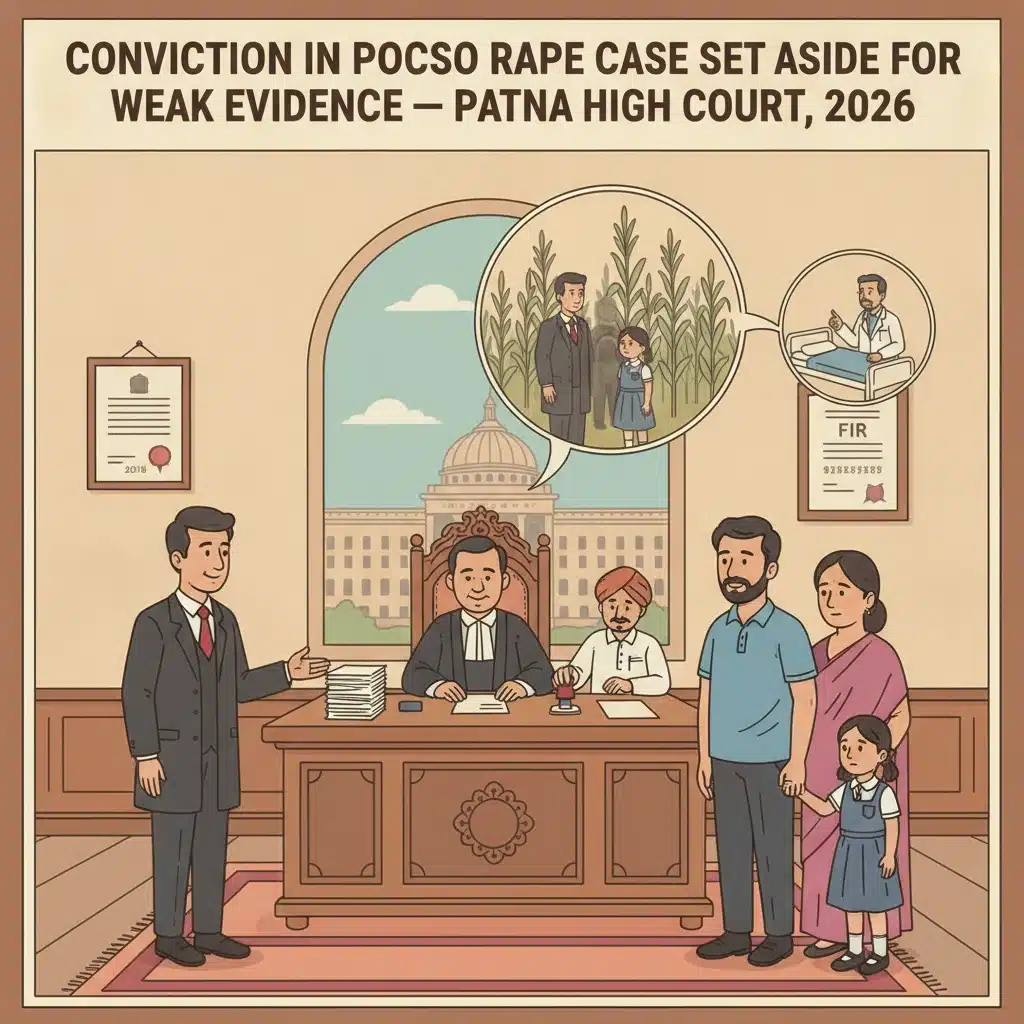
The case began with a written complaint by the father of a minor girl in Begusarai district. On 25.05.2018 around 8:00 a.m., his daughter complained of stomach pain. He took her to a nearby private hospital, where, according to him, the doctor informed that she was pregnant.
On questioning, the girl allegedly said that about 5–6 months earlier, when she was returning from school, two persons – the present appellant and one Gaurav Kumar – had taken her into a maize field and raped her one after the other. She also said they threatened to kill her and her father if she spoke about it.
On this written complaint, Muffasil (Lakho O.P.) P.S. Case No. 284 of 2018 was registered on 25.05.2018 under Section 376 IPC and Sections 8 and 12 of the POCSO Act against both named accused. The FIR reached the Special POCSO Court on 27.05.2018.
Police first filed Chargesheet No. 435 of 2018 on 20.07.2018 only against Gaurav Kumar, keeping investigation pending against the appellant. The Special Court took cognizance on 06.08.2018 and, after finding Gaurav Kumar to be a juvenile in conflict with law, sent his case to the Juvenile Justice Board. Supplementary Chargesheet No. 497 of 2018 dated 31.08.2018 was later filed against the appellant under Sections 376(D), 313, 506/34 IPC and Section 5(8) of the POCSO Act.
After supply of police papers, the Special POCSO Court framed charges on 08.04.2019 under Section 376 IPC and Sections 8 and 12 POCSO, which the appellant denied. During trial, the prosecution examined ten witnesses including the victim, her parents, her uncle, four doctors from a Medical Board, and the Investigating Officer. The defence examined three witnesses and produced some documents.
On 02.02.2023, the Exclusive Special Court (POCSO Act)-cum-6th Additional Sessions Judge, Begusarai convicted the appellant under Section 376(3) IPC and Section 5(j)(ii) read with Section 6 POCSO, and on 06.02.2023 sentenced him to twenty years’ rigorous imprisonment with a fine of Rs. 50,000 under POCSO. No separate sentence was passed under Section 376(3) IPC in view of Section 42 POCSO.
The appellant approached the Patna High Court in Criminal Appeal (DB) No. 324 of 2023 challenging both the conviction and sentence. Notice to the victim’s father was served but he did not appear. The appeal was heard with assistance of counsel for the appellant and the Additional Public Prosecutor for the State.
What the Court Examined and Decided
The Division Bench (Hon’ble Mr. Justice Rajeev Ranjan Prasad and Hon’ble Mr. Justice Ritesh Kumar) re-examined the entire evidence to see whether the conviction could safely stand.
The appellant argued that there was unexplained delay of several months in lodging the FIR, that the first doctor who allegedly detected the pregnancy was never named or examined, that there were major contradictions regarding abortion and delivery of the child, and that the prosecution failed to properly prove the victim’s age. He also said there was a land dispute with the village Mukhiya and he had been falsely implicated to grab his land, and that the trial court wrongly shifted the burden on the defence under Sections 29 and 30 POCSO without first laying a proper factual foundation.
The State contended that the testimonies of the victim and other witnesses were consistent and supported by medical evidence, and that the conviction was justified.
FIR and 164 CrPC statement: changing stories
The High Court first noted that the FIR was based on the father’s written complaint dated 25.05.2018, registered the same day at 22:30 hrs and received in the Special Court on 27.05.2018. The complaint mentioned that the victim developed abdominal pain, was taken to a private doctor (not named), and was found pregnant. On being pressed, she allegedly disclosed that about 5–6 months earlier both accused had raped her in a maize field while returning from an unnamed middle school, and had threatened her into silence.
However, when the victim’s statement under Section 164 CrPC was recorded on 28.05.2018, she added new facts not mentioned in the FIR. She stated that 1–2 months earlier, when going to defecate, co-accused Gaurav Kumar gagged her mouth and made her take a tablet, after which she had stomach pain. Her mother then took her to a village compounder who gave no medicine, and later to the police station where, according to that statement, she delivered a dead child. She further stated that after this, she was taken home and given medicines.
The Bench observed that these were serious, material additions within three days of the FIR, and the FIR itself did not mention any delivery of a child in the police station. Both the father and the victim consistently omitted the names of the school and the first doctor, and the mother too did not name any doctor.
Medical evidence and age determination
Several doctors deposed. Dr. Kamini Rai (PW-1) examined the victim and signed the medical report but admitted in cross-examination that she had not mentioned the reasons for abortion in her report.
Dr. Asha Kumari (PW-6), a Medical Board member, noted in the report “history of 4 months amenorrhea and aborted female fetus on 25th May, 2018,” blood mixed watery discharge, torn hymen, spermatozoa in vaginal swab, and a bulky postpartum uterus on ultrasound suggesting recent termination of pregnancy. However, in cross-examination she said she was told about the abortion by the victim and the accompanying person, found no external injuries on the body, did not mention the exact date of abortion, and only said abortion could occur within 1–4 days.
For age, Dr. Rampravesh Prasad (PW-8) and Dr. Arun Kumar (PW-9) relied on dental and radiological findings and assessed the victim’s age between 14–15 years. The victim herself said she was a Class V student but could not produce any document of age. The Investigating Officer admitted that he had not collected any school or municipal record to prove age and had not verified if she actually attended school.
The Bench stressed that under Section 34 POCSO and Section 94 of the Juvenile Justice (Care and Protection of Children) Act, 2015, the proper procedure requires first calling for school or birth certificates, and only in their absence resorting to ossification or medical tests on the orders of the competent Board or Committee. In this case, no school record or birth certificate was produced, and the medical age report itself was not ordered by any Board or Committee under the JJ Act. The trial court did not make a proper determination of age or record reasons, yet assumed she was a “child” under the POCSO Act.
The High Court held that without legally determining age, the foundation for applying POCSO and invoking Section 29’s presumption against the accused was missing.
Contradictions on pregnancy, abortion and place of delivery
The Court closely compared the statements of the victim, her parents, and the Investigating Officer regarding where and how the alleged abortion or delivery took place.
The father (PW-2) said the doctor had told him she was seven months pregnant, and only then she narrated the rape. In cross-examination, he said his daughter delivered the child at the police station and the child died there. He also claimed cordial visiting terms with the appellant as they were neighbours, but admitted the appellant had several litigations, without producing any record.
The mother (PW-3), however, said in chief that after noticing physical changes she took her daughter to a doctor and then to a government hospital, where doctors said she was 7–8 months pregnant. She did not name the hospital. In cross-examination, she changed and said she had gone to the doctor for abortion, that the abortion occurred in the police station itself, the police saw the dead child but prepared no papers, and they told her to throw the child away. She too did not name any doctor.
The victim (PW-5) in chief stated that after 6–7 months of the rape she was given a tablet in a “gaachhi” (orchard), felt pain, her mother took her to Sadar Hospital where the government doctor said the child had already died, and only then they went to the police station and returned home. She did not say that she delivered a child at the police station.
The Investigating Officer (PW-10) stated that the victim told him she had delivered a dead child at the police station, but he did not seize any fetus or conduct any seizure memo, and he did not support a clear version that such an event actually occurred in his presence. He also admitted hearing no rumours of rape in the village and confirmed that the appellant had no criminal antecedent.
Additionally, the victim plainly admitted in cross-examination that she could not produce any document for her age and, significantly, stated in paragraph 10 that she had “no complaint” against the appellant.
The High Court found these contradictions deep and irreconcilable. There was no record from any government or private hospital; no doctor who treated the girl during pregnancy or at the time of alleged abortion/delivery was examined; and the dead fetus, if any, was never preserved for DNA testing.
Failure to link pregnancy to the appellant
While the medical report suggested that the victim had undergone abortion and spermatozoa were present in the vaginal swab, the Court observed that there was no scientific attempt to link the biological material to the appellant. His medical examination was not conducted, ignoring the requirement of Section 53A CrPC in serious sexual offence cases. No DNA profiling was done, and the dead fetus was allegedly made to “disappear.”
In these circumstances, the Court held that it was not well proved that the pregnancy, if any, was caused by rape committed by the appellant. It also noted that co-accused Gaurav Kumar had already been acquitted by the trial court.
Wrong application of amended punishment provisions
The occurrence was alleged to have taken place 6–7 months before 25.05.2018. At that time, Section 376(3) IPC did not exist. It was inserted by the Criminal Law (Amendment) Act, 2018 with retrospective effect from 21.04.2018, and punishment under Section 5(j)(ii)/6 POCSO was also enhanced later.
The Bench pointed out that on the date of the alleged offence, the minimum punishment under the then existing provisions was 7 years, but the trial court had sentenced the appellant as per the newly inserted/modified provisions, fixing minimum 20 years’ imprisonment. This was another serious legal error.
Conclusion of the High Court
After considering the entire material, the Patna High Court held that:
- The prosecution had not laid the basic foundation required under POCSO – particularly proper proof of the victim’s age.
- The victim was not a wholly reliable witness, especially in light of her statement that she had no complaint against the appellant.
- The parents’ versions and the victim’s version on where and how the child was delivered and who treated her were inconsistent and unsupported by any hospital record or medical witness.
- The investigation was defective: no age documents, no seizure of fetus, no DNA test, and no medical examination of the accused.
- It was unsafe to sustain conviction solely on the uncorroborated, shifting version of the victim.
The Court therefore set aside the judgment of conviction dated 02.02.2023 and the order of sentence dated 06.02.2023. The appeal was allowed, and the Court directed that the appellant be released forthwith, if not wanted in any other case. The trial court records were ordered to be sent back.
Why This Judgment Matters
This judgment is important for both victims and accused persons in sexual offence cases, especially under the POCSO Act.
First, it shows that courts will not automatically uphold a conviction only because the case involves a minor and serious allegations. The evidence must still be reliable, consistent, and supported by proper investigation.
Second, it underlines that age proof is crucial in POCSO matters. Without school or birth records or a properly ordered medical age test, the case cannot safely be treated as one involving a “child” for POCSO purposes. This ensures that POCSO, which carries very heavy sentences, is applied only where the legal requirements are clearly met.
Third, the decision highlights the need for scientific investigation. In cases where pregnancy and abortion are central facts, police should preserve the fetus, conduct DNA tests, and medically examine the accused. If these steps are skipped, linking the accused to the alleged act becomes very difficult.
Finally, the judgment warns trial courts against using amended, harsher punishment provisions if those were not applicable at the time of the alleged offence. Sentencing must match the law as it stood then.
For families and complainants, this case is a reminder that accurate, consistent statements and prompt medical and legal steps are essential. For accused persons, it shows that the Patna High Court will interfere where conviction rests on shaky evidence and procedural lapses.
Legal Issues and Answers
- Issue: Could the conviction under Section 376(3) IPC and Section 5(j)(ii)/6 POCSO be sustained when age of the victim was not duly proved and evidence on pregnancy and abortion was contradictory and incomplete?
Answer: No. The Patna High Court held that age was not legally determined, key medical and documentary evidence was missing, testimonies were inconsistent, and the victim was not a wholly reliable witness. It was unsafe to base conviction solely on her statement. - Issue: Was the trial court right in applying the amended, enhanced punishment provisions of Section 376(3) IPC and Section 5(j)(ii)/6 POCSO to an offence allegedly committed 6–7 months before 25.05.2018?
Answer: No. The Court held that on the date of occurrence Section 376(3) IPC did not exist and the minimum punishment under then existing provisions was 7 years, yet the trial court sentenced the appellant to 20 years under the newly inserted/amended provisions. - Issue: Did the prosecution establish a sufficient foundational fact situation to invoke the presumptions under Sections 29 and 30 of the POCSO Act against the appellant?
Answer: No. In the absence of lawful age determination and reliable, corroborated evidence linking the appellant to the pregnancy, the foundational requirements for applying POCSO presumptions were not satisfied.
Cases Cited by the Court
- The judgment text does not refer to or rely on any other decided cases. No precedents are cited.
Case Details
Case Number: Criminal Appeal (DB) No. 324 of 2023; arising out of Muffasil (Lakho O.P.) P.S. Case No. 284 of 2018, Begusarai
Case Title: Ranjay Singh v. The State of Bihar & Anr.
Citation: 2026 (4) PLJR 461
Court: High Court of Judicature at Patna
Coram: Hon’ble Mr. Justice Rajeev Ranjan Prasad; Hon’ble Mr. Justice Ritesh Kumar
Date of Judgment: 01.07.2026
Advocates:
- For the Appellant: Mr. Mayank Mani, Advocate; Mr. Jai Prakash Singh, Advocate
- For the State: Mr. Abhimanyu Sharma, Additional Public Prosecutor
- For Respondent No. 2 (father of victim): None appeared
Nature of the Case: Criminal appeal (Division Bench) against conviction and sentence in a POCSO and rape case decided by the Exclusive Special Court (POCSO Act)-cum-6th Additional Sessions Judge, Begusarai in POCSO Case No. 73 of 2018.
Link to Judgment: https://patnahighcourt.gov.in/viewjudgment/NSMzMjQjMjAyMyMxI04=-eyqQJD4Nu6M=
If you found this explanation helpful and wish to stay informed about how legal developments may affect your rights in Bihar, you may consider following Samvida Law Associates for more updates.




