

Case Background
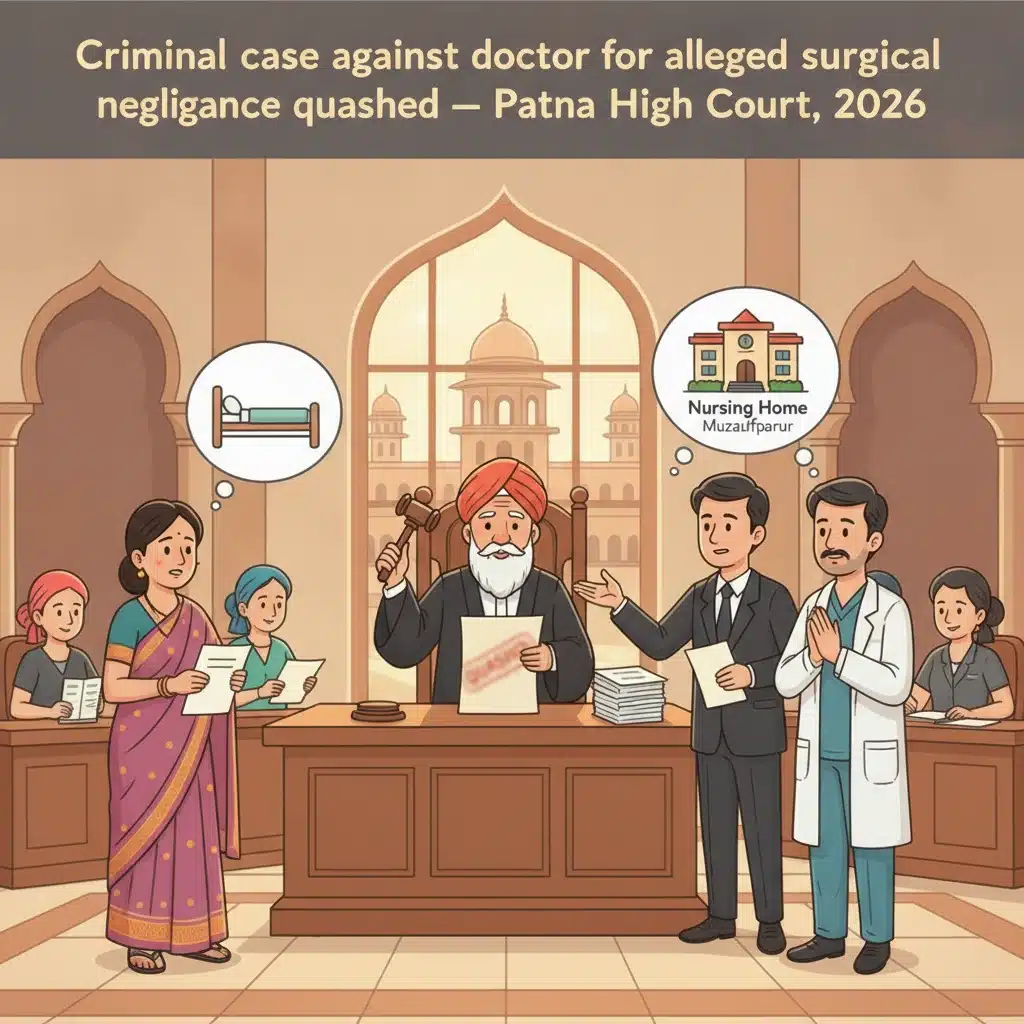
The matter started with a police case from Brahampura Police Station, Muzaffarpur, registered as P.S. Case No.314 of 2015 on the basis of a fardbeyan given by the informant (Opposite Party No.2), Rima Devi.
According to the fardbeyan, in July 2014 the informant was admitted to the Nursing Home of the present petitioner, a surgeon, for delivery of a child. She underwent a surgical procedure for delivery.
She alleged that after the operation she developed serious complications. She claimed that during further treatment by different doctors an ultrasound revealed that a surgical towel had been left inside her abdomen in the first operation, and that this towel was later removed by another doctor, after which her condition improved. She also alleged that she suffered long illness, heavy expenses on treatment, and that her child died due to consequences of the negligent treatment.
Police investigated the case and submitted chargesheet dated 29.01.2016, C.S. No.7 of 2016, against the petitioner for offences under Sections 337, 338 and 506 of the Indian Penal Code.
On 29.02.2016, the Chief Judicial Magistrate, Muzaffarpur, on perusal of the chargesheet and case diary, found a prima facie case and took cognizance of the offences under Sections 337, 338 and 506 IPC in Brahampura P.S. Case No.314 of 2015 (Trial No.1807 of 2016).
Feeling aggrieved, the doctor approached the Patna High Court under Section 482 of the Code of Criminal Procedure, 1973, seeking quashing of the cognizance order and the entire criminal proceeding.
What the Court Examined and Decided
The petitioner’s counsel argued that the complaint basically alleged medical negligence in a surgery. Therefore, before starting any criminal case against a medical professional, an independent opinion of a competent doctor or a Medical Board was necessary, as per settled Supreme Court law.
He pointed out that the Investigating Officer had in fact requested an opinion from the Civil Surgeon, Muzaffarpur. Despite this, the chargesheet was filed and cognizance was taken before the expert opinion was received, which, according to the petitioner, vitiated the entire proceeding.
The petitioner’s counsel gave a detailed medical history based on records. The informant was admitted to Indraprastha Nursing Home on 07.07.2014 and an LSCS (Lower Segment Cesarean Section) was performed the same day. She remained under observation and was discharged on 15.07.2014 in good condition.
On 24.07.2014, when she complained at home of excessive gas and inability to pass flatus and stool, she underwent ultrasound and X-ray on the advice of Dr. (Prof.) Rajiv Bhushan Sinha (Ex-H.O.D. Surgery, S.K.M.C.H.) and radiologist Dr. Vinayak Gautam. She was diagnosed with intestinal obstruction and primary peritonitis, and there was no sign of any foreign body in the abdomen.
On the same date, her attendant consulted the petitioner along with these reports and requested another operation. On 26.07.2014, the petitioner operated again, doing adhenolysis and drainage of collection. According to him, no foreign object was found inside the abdomen during this surgery.
Due to unavailability of blood and financial problems, on 02.08.2014 the petitioner referred the informant to S.K.M.C.H., where she remained admitted from 02.08.2014 to 26.09.2014. An ultrasound on 04.08.2014 at S.K.M.C.H. reportedly found everything normal with no foreign body.
On 08.08.2014 she suffered “burst abdomen” and underwent repair surgery. The government surgical unit, during surgery and observation up to 18.08.2014, noted that nothing abnormal was seen inside the abdomen.
On 04.11.2014, another ultrasound at Anupam Ultrasound Centre by Dr. Bhartendu Kumar showed only a 12 ml abscess collection and again confirmed no foreign body.
The petitioner argued that the story that a surgical towel was finally removed on 24.02.2015 at Motihari by another doctor was an afterthought with mala fide motive. He stressed that three open surgeries and at least three specific ultrasound scans between July and November 2014 did not detect any towel, making the later claim impossible.
He also argued that complications like peritonitis, obstruction, burst abdomen and abscess are known post-operative complications and do not by themselves prove criminal negligence. Further, he maintained that there was no factual basis for any allegation of criminal intimidation under Section 506 IPC.
The informant’s counsel opposed the petition. He submitted that the FIR, the investigation materials and the chargesheet together showed a prima facie case. He emphasised that the informant had suffered long treatment and that, according to the prosecution, a towel was finally found and removed, after which she improved. Whether the doctor was actually negligent, he argued, should be decided at trial after evidence, not at the stage of cognizance.
The State’s counsel supported the Magistrate’s order, saying that the Trial Court had considered the police report and materials before taking cognizance and that detailed evaluation of evidence is not needed at that early stage.
The Patna High Court first restated the settled principles on use of its inherent powers under Section 482 Cr.P.C. These powers are to be used sparingly to prevent abuse of the process of the court or to secure the ends of justice. The High Court should not conduct a detailed trial-level examination of evidence, but can interfere where, even if all allegations are taken at face value, no offence is made out or continuation of proceedings would be an abuse of law.
The Court then turned specifically to the criminal prosecution of doctors. Relying on the jurisprudence of the Supreme Court, it noted that medical practice involves professional judgment and that complications or unsuccessful treatment do not automatically mean criminal negligence. Only when the doctor’s conduct is so grossly negligent or reckless that it crosses the line from civil wrong to crime can criminal liability arise. Independent medical opinion is therefore crucial before proceeding against a doctor.
Looking at the record, the Court recognised that the main allegation against the petitioner was that he left a surgical towel inside the informant’s abdomen in July 2014, leading to prolonged suffering. However, after leaving the petitioner’s Nursing Home, the informant received treatment at different institutions including S.K.M.C.H. and underwent several investigations.
Critically, ultrasound examinations on 04.08.2014 at S.K.M.C.H., on 04.11.2014 at Anupam Ultrasound and Colour Doppler Centre, and on 02.02.2015 as advised by later treating doctors did not show any foreign body in the abdomen. The reports instead spoke of fluid collection, abscess and other post-operative issues.
The records also showed that though the FIR alleged that another doctor later removed a towel, there was no operative note, recovery memo, pathology report or any medical document collected during investigation to support this claim.
Importantly, during investigation the police themselves had sought expert opinion from the Civil Surgeon-cum-Chief Medical Officer, Muzaffarpur. A Medical Board was formed. Its report clearly stated that there was no proof of recovery of any surgical towel from the informant’s abdomen.
Despite requesting this expert opinion, the Investigating Officer filed chargesheet on 29.01.2016 and the Magistrate took cognizance on 29.02.2016 before the Medical Board’s report was received and considered. In a case centred on alleged professional negligence, the High Court held that such expert opinion carries great weight in deciding whether there is even a prima facie case.
The Patna High Court then closely followed the tests laid down by the Supreme Court in Jacob Mathew v. State of Punjab, Kusum Sharma v. Batra Hospital, A.S.V. Narayanan Rao v. Ratnamala, Vinod Jain v. Santokba Durlabhji Memorial Hospital and M.A. Biviji v. Sunita. These cases emphasise that:
- Negligence must be gross or of a very high degree to attract criminal liability.
- A doctor is not criminally liable for simple errors of judgment or mere lack of best possible skill.
- Courts and police must obtain independent and competent medical opinion before prosecuting a doctor.
- Doctors should not be harassed through frivolous criminal complaints, and complainants must show clear breach of duty and injury linked to that breach.
Applying these principles, the High Court found that neither the chargesheet nor the accompanying materials showed any independent medical opinion that the petitioner’s conduct was grossly negligent. The expert Medical Board, in fact, found no proof of any towel being recovered.
The Court also noted that the FIR itself did not contain specific facts amounting to criminal intimidation under Section 506 IPC. There was no clear allegation of threat that could meet the legal ingredients of that offence.
Given the lack of medical evidence of a foreign body, the repeated negative ultrasound results, the Medical Board’s report, and the high standard for criminal liability of doctors, the Court concluded that continuing the prosecution would not serve justice. Instead, it would allow criminal process to be used in a case where necessary medical support for the allegations was missing.
The Court referred to the categories laid down by the Supreme Court in State of Haryana v. Bhajan Lal, where High Courts may use Section 482 Cr.P.C. to quash proceedings that amount to abuse of process. It held that this case clearly fell within those categories.
Finally, the Patna High Court quashed the cognizance order dated 29.02.2016 passed by the Chief Judicial Magistrate, Muzaffarpur in Brahampura P.S. Case No.314 of 2015 (Trial No.1807 of 2016), and the entire criminal proceeding against the petitioner. The Criminal Miscellaneous application was allowed, and a copy of the judgment was directed to be sent to the concerned court for compliance.
Why This Judgment Matters
This judgment is important for both patients and doctors, especially in Bihar. It shows that if someone alleges criminal medical negligence, courts will insist on strong medical evidence, not just suspicion or delay-based complaints.
For patients, the decision clarifies that criminal law is not an easy route for every grievance arising from treatment. They must collect and present medical documents and expert opinions, particularly when alleging something as serious as a foreign object left in the body.
For doctors, especially surgeons and gynaecologists in private nursing homes, the ruling reinforces that if they follow accepted medical practices and records show no foreign body or gross error, they should not be dragged into criminal trials on bare allegations. The Court highlighted that investigations must properly consider expert medical reports before filing charges.
At a wider level, the judgment strengthens the Supreme Court’s guidelines on protecting medical professionals from misuse of criminal machinery, while still keeping space open for genuine cases of gross negligence to be prosecuted.
Legal Issues and Answers
- Issue: Whether the materials collected during investigation disclosed a prima facie case of gross medical negligence under Sections 337 and 338 IPC against the petitioner-doctor for allegedly leaving a surgical towel inside the patient’s abdomen.
Answer: No. Multiple ultrasound reports and treatment records from different institutions showed no foreign body, and the Medical Board reported no proof of any towel recovery. In absence of cogent expert evidence of gross negligence, no prima facie criminal case was made out. - Issue: Whether there were sufficient allegations and materials to constitute the offence of criminal intimidation under Section 506 IPC.
Answer: No. The FIR did not contain specific facts fulfilling the ingredients of criminal intimidation, and there was no supporting material in the chargesheet. - Issue: Whether continuation of the criminal proceeding, despite lack of supporting expert opinion, would amount to abuse of process justifying use of Section 482 Cr.P.C. by the Patna High Court.
Answer: Yes. Since cognizance was taken without awaiting and considering the Medical Board’s opinion, and the record lacked evidence of gross negligence or intimidation, the case fell within the categories laid down in Bhajan Lal. The High Court therefore quashed the cognizance order and the entire proceeding.
Cases Cited by the Court
- Jacob Mathew v. State of Punjab, (2005) 6 SCC 1
- Kusum Sharma and Ors. v. Batra Hospital and Medical Research Centre and Ors., (2010) 3 SCC 480
- A.S.V. Narayanan Rao v. Ratnamala and Anr., (2013) 10 SCC 741
- Vinod Jain v. Santokba Durlabhji Memorial Hospital and Anr., (2019) 12 SCC 229
- M.A. Biviji v. Sunita and Ors., (2024) 2 SCC 242
- State of Haryana and Ors. v. Bhajan Lal and Ors., 1992 Supp (1) SCC 335
Case Details
Case Number: Criminal Miscellaneous No.19013 of 2016 (arising out of Brahampura P.S. Case No.314 of 2015, Trial No.1807 of 2016)
Case Title: Dr. Rajesh Kumar @ Rajesh Kumar v. The State of Bihar & Anr.
Citation: 2026 (4) PLJR 522
Court: High Court of Judicature at Patna
Coram: Hon’ble Mr. Justice Sunil Dutta Mishra
Date of Judgment: 29.06.2026
Advocates: Mr. Deepak Kumar, Advocate for the petitioner; Mr. R.B. Roy Raman, APP for the State; Mr. Yashraj Bardhan, Advocate for Opposite Party No.2
Nature of the Case: Petition under Section 482 of the Code of Criminal Procedure, 1973 for quashing the order of cognizance and the related criminal proceeding for offences under Sections 337, 338 and 506 of the Indian Penal Code.
If you found this explanation helpful and wish to stay informed about how legal developments may affect your rights in Bihar, you may consider following Samvida Law Associates for more updates.




