

Case Background
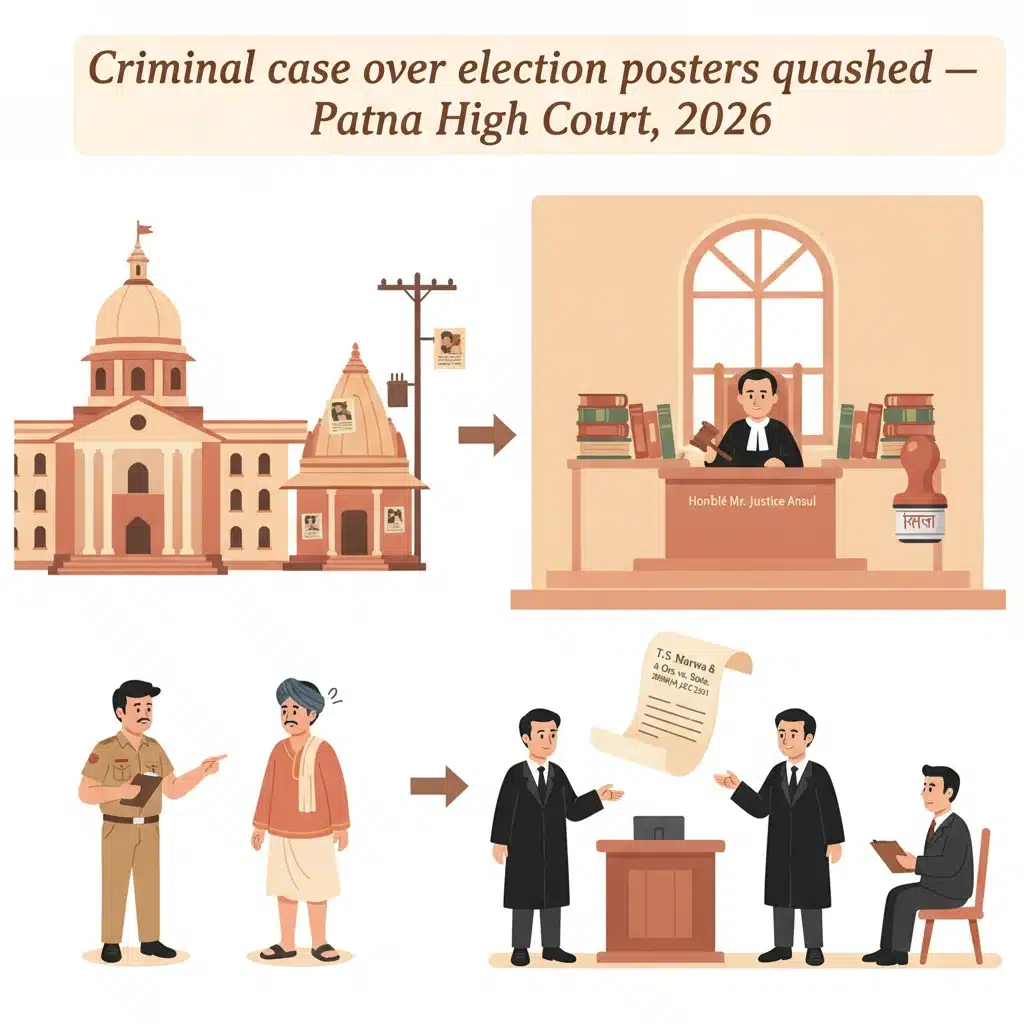
The case arose out of Thakurganj P.S. Case No. 163 of 2022 from District Kishanganj. During the Municipal General Election, 2022, a Revenue Officer was working as the in-charge Model Code of Conduct Officer in the absence of the Circle Officer.
According to the allegation in the First Information Report (FIR), the officer noticed election campaign material of the petitioner affixed on a temple wall and on an electricity pole. On this basis, a criminal case was registered for offences under Sections 426 and 427 of the Indian Penal Code (IPC) and Section 3 of the Defacement of Property Act, 1987.
After investigation, the police submitted Charge-Sheet No. 231 of 2022 dated 19.12.2022 for the same offences. Faced with criminal prosecution, the petitioner approached the Patna High Court by filing Criminal Miscellaneous No. 68262 of 2023. The petition sought quashing of both the FIR and the charge-sheet.
The matter came up before Hon’ble Mr. Justice Ansul, who heard the parties and delivered an oral judgment on 17.06.2026.
What the Court Examined and Decided
The Patna High Court first noted the nature of the allegations. The only accusation was that the petitioner’s election campaign material was affixed on a temple wall and an electricity pole. There was no allegation of any permanent damage, writing, or marking on the surface of the properties.
The charge-sheet had been filed for offences under Sections 426 and 427 of the IPC and Section 3 of the Defacement of Property Act, 1987. Section 426 deals with the general offence of “mischief,” which requires causing wrongful loss or damage to a person by destroying or changing property. Section 427 provides a higher punishment where such mischief causes damage of a particular value.
Section 3 of the Defacement of Property Act, 1987 was reproduced in the judgment. It penalises any person who “defaces any property in public view by writing or marking with ink, chalk, paint or any other material,” except for indicating the name and address of the owner or occupier. It also contains provisions relating to offences done for the benefit of companies or associations, and for use of private property for election campaigns with written consent of the owner or occupier.
The Court had to decide whether the act complained of — affixing election campaign material on a temple wall and an electricity pole — came within the meaning of “defacement” under Section 3, or mischief under Sections 426 and 427 IPC.
On behalf of the petitioner, learned counsel relied on the judgment of the Delhi High Court in T.S. Marwa & Ors. vs. State, reported in 2008(4) JCC 2561. In that case, the Delhi High Court had interpreted an analogous provision under the West Bengal Prevention of Defacement of Property Act, 1976. The language and scheme of that Act were found to be materially similar to Section 3 of the Defacement of Property Act, 1987.
In T.S. Marwa, the Delhi High Court had held that merely putting up a banner is not covered by the provision dealing with “defacement.” Relying on this reasoning, it was argued that simple affixing of campaign material, without any permanent writing or marking, could not amount to defacement under Section 3.
The State’s counsel, appearing for the opposite parties, opposed the quashing of the FIR and charge-sheet. He urged the Court not to interfere with the criminal proceedings. However, the judgment does not record any detailed separate submissions from the State beyond this opposition.
The Patna High Court carefully considered the rival submissions and examined the FIR and charge-sheet. The Court emphasised the exact nature of the allegation: election campaign material “affixed” to a temple wall and an electricity pole. There was no statement that the petitioner had written or marked anything with ink, chalk, paint, or any other material on these properties.
On a plain reading of Section 3, the Court focused on the requirement of “defacement” by “writing or marking” with certain materials. The Court held that the affixing of removable campaign material, such as posters or banners, does not fall within the type of defacement contemplated by this provision.
The Court found support for this interpretation in the Delhi High Court decision in T.S. Marwa & Ors. vs. State. Since the wording of the relevant provision in the West Bengal Act was materially similar, the reasoning in that case was considered persuasive. According to that judgment, merely putting up a banner does not amount to defacement within the meaning of the statute.
Turning to Sections 426 and 427 of the IPC, the Court examined whether the FIR or charge-sheet disclosed any factual basis for alleging mischief. For mischief, there must be wrongful loss or damage caused to someone by an act of the accused. For the aggravated form under Section 427, the damage must reach a certain monetary value.
The Court noted that neither the FIR nor the charge-sheet mentioned any actual damage to the temple wall or electricity pole. There was no description of property being broken, spoiled, or permanently damaged. There was also no indication of the value of any damage, as required to attract Section 427.
In the absence of such specific allegations, the Court held that there was no factual foundation to support a claim that the petitioner had committed mischief or caused damage to the extent required under Sections 426 and 427.
The Court observed that when the allegations in the FIR and the materials in the charge-sheet are taken at their face value, they still do not constitute the offences alleged. In simple terms, even if everything stated by the informant is treated as true, the law does not treat the act as a crime under these provisions.
On this basis, the Court concluded that the “entire substratum” of the criminal proceeding did not make out any offence against the petitioner. Continuing such a prosecution would therefore be an “abuse of the process of the Court.”
Accordingly, the Patna High Court allowed the quashing application. It specifically quashed Thakurganj P.S. Case No. 163 of 2022 and Charge-Sheet No. 231 of 2022, but only “so far as the petitioner is concerned.” This means that, as per the judgment, the petitioner stands discharged from the criminal case based on the alleged defacement and mischief.
Why This Judgment Matters
This judgment is significant for candidates and political workers involved in local elections in Bihar and similar contexts. It shows that every act of putting up election material in public view will not automatically become a criminal offence under the Defacement of Property Act or the IPC.
The Court has drawn a clear line between permanent markings on property, such as painting or writing on walls, and temporary, removable materials like banners or posters. Only the former, as described in Section 3, can be treated as “defacement” for the purpose of this Act.
For ordinary citizens and small candidates, the ruling underlines that criminal prosecution cannot be based on vague or incomplete allegations. Police and complainants must show specific facts that fit the exact words of the law, including details of actual damage where mischief is alleged.
For legal practitioners and law enforcement, the decision from the Patna High Court reinforces the need to carefully apply penal provisions in election-related matters. It also highlights the persuasive value of similar High Court decisions, such as the Delhi High Court’s ruling in T.S. Marwa.
Legal Issues and Answers
- Issue: Does affixing removable election campaign material on a temple wall and an electricity pole amount to “defacement” under Section 3 of the Defacement of Property Act, 1987?
Answer: No. The Court held that such affixing, without any permanent writing or marking with ink, paint, or similar material, does not constitute defacement as contemplated by Section 3. - Issue: Do the FIR and charge-sheet disclose offences of mischief under Sections 426 and 427 of the IPC on the facts alleged?
Answer: No. There is no factual foundation showing wrongful loss or damage, or damage of the extent required under Section 427; therefore, no offence is made out. - Issue: Should the High Court exercise its power to quash the criminal proceedings in these circumstances?
Answer: Yes. Since the allegations, even if accepted as true, do not constitute the alleged offences, allowing the proceedings to continue would amount to an abuse of the process of the Court. The FIR and charge-sheet were quashed as against the petitioner.
Cases Cited by the Court
- T.S. Marwa & Ors. vs. State, 2008(4) JCC 2561 (Delhi High Court) – relied upon for interpreting “defacement” under an analogous statute.
Case Details
Case Number: Criminal Miscellaneous No. 68262 of 2023
Case Title: Puja Anand vs. State of Bihar & Anr.
Originating Police Case: Thakurganj P.S. Case No. 163 of 2022, District Kishanganj
Charge-Sheet: Charge-Sheet No. 231 of 2022 dated 19.12.2022
Citation: 2026 (4) PLJR 366
Coram: Hon’ble Mr. Justice Ansul
Date of Judgment: 17.06.2026
Advocates: Mr. Sanjeev Ranjan, Advocate for the petitioner; Mr. Md. Matloob Rab, APP for the State/opposite parties
Statutory Provisions Involved: Sections 426 and 427 of the Indian Penal Code; Section 3 of the Defacement of Property Act, 1987
Nature of the Case: Criminal miscellaneous petition seeking quashing of FIR and charge-sheet
Outcome: FIR and charge-sheet quashed as against the petitioner
Link to Judgment: https://patnahighcourt.gov.in/viewjudgment/NiM2ODI2MiMyMDIzIzEjTg==-QZMtkc7hvuM=
If you found this explanation helpful and wish to stay informed about
how legal developments may affect your rights in Bihar,
you may consider following Samvida Law Associates for more updates.




