

Case Background
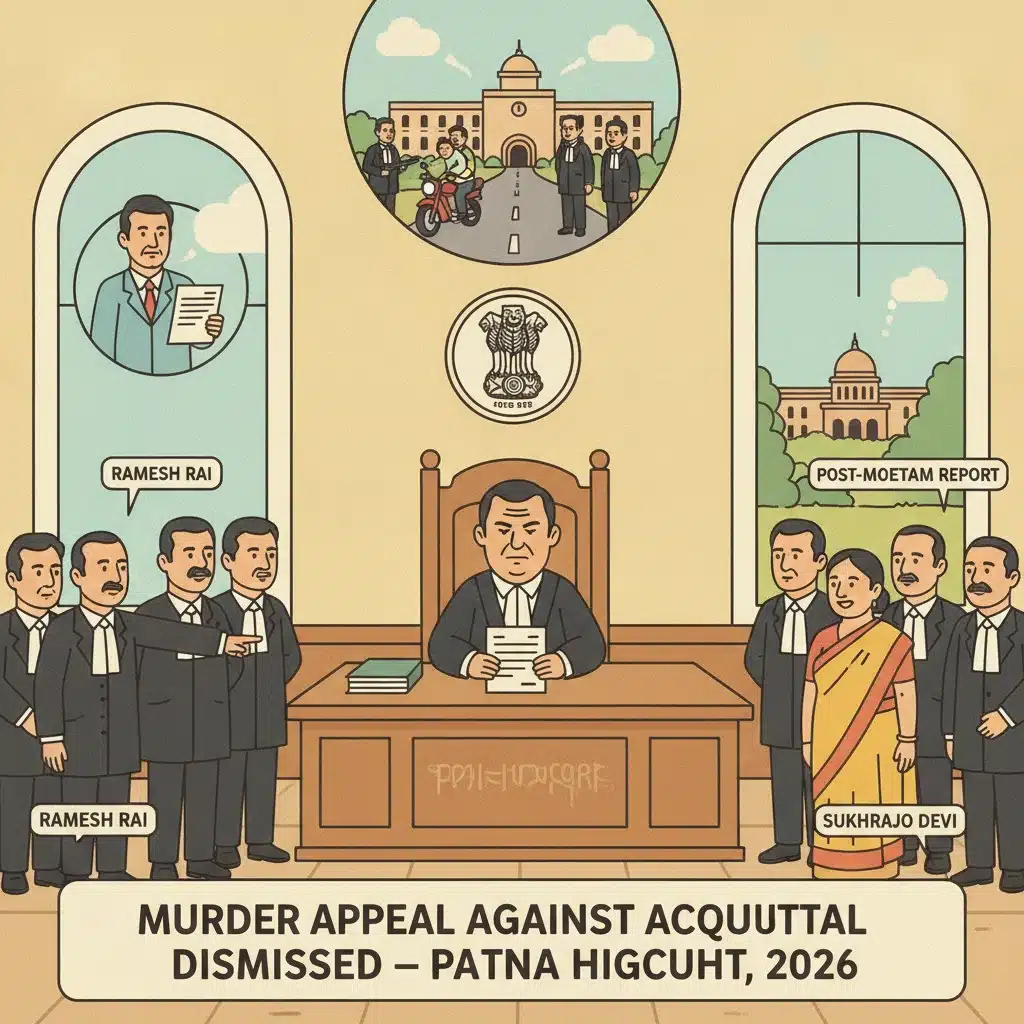
The case started with an incident on 01.11.2011 at about 4:45 PM near Sarenja main road under Rajpur Police Station, District Buxar. According to the fardbeyan of Ramesh Rai (later examined as PW-3), he was returning from his rice mill with his father, Ranjeet Rai, on a motorcycle.
Near Sarenja main road, he claims to have seen several persons armed with rifles. He alleged that Ram Suresh Yadav @ Langa Yadav, Ashok Yadav and Jitendra Yadav fired at his father, causing his death at the spot. He also named others as being present with rifles, surrounding his father and shouting to kill him.
The informant further alleged that Baliram Yadav ordered the firing. He stated that the background of the incident was political and personal: the wife of his elder brother, Shail Kumari Devi, had lost the Panchayat Mukhiya election to Sukhrajo Devi, and there were also court litigations between the families. He alleged that Mukhiya Sukhrajo Devi was openly shouting that his father should be killed, otherwise she would again contest the election.
On the basis of this fardbeyan, Rajpur P.S. Case No.121 of 2011 was registered on 01.11.2011. After investigation, the police submitted charge-sheet against respondent nos.2 to 9 for offences under Sections 302/34 and 120B/34 of the Indian Penal Code and Section 27 of the Arms Act. The case was committed to the Court of Session and registered as Sessions Trial No.97 of 2012 before the Additional District and Sessions Judge-VI, Buxar.
After a full trial, the Sessions Court, by judgment dated 29.08.2018, acquitted all eight accused (respondent nos.2 to 9) of all charges. Aggrieved by this acquittal, the original informant Ramesh Rai filed Criminal Appeal (DB) No.1291 of 2018 under Section 372 CrPC before the Patna High Court.
What the Court Examined and Decided
The Patna High Court heard counsel for the appellant-informant as well as the Additional Public Prosecutor for the State. The central question was whether the trial court had wrongly acquitted the accused, or whether its view was a possible and lawful view of the evidence.
The appellant argued that the trial court had taken a faulty, over-technical approach. According to him, the ocular (eye-witness) and medical evidence clearly established that the accused intercepted the motorcycle and shot dead Ranjeet Rai. He submitted that three accused were the shooters, while the others surrounded the deceased with rifles and encouraged the killing. He also highlighted the political rivalry from the Mukhiya election as strong motive.
The appellant contended that supposed contradictions pointed out by the trial court were only minor discrepancies, and that the core story remained consistent in the evidence of PW-1, PW-2, PW-3 and PW-6. He argued that the post-mortem and FSL (forensic science laboratory) report showing firearm injuries and bullet recovery perfectly supported the prosecution story. He further said that the trial court was wrong in suspecting the witnesses merely because no completely independent shopkeepers or Chhath-vratis were examined.
On the other hand, counsel for the respondents supported the acquittal. They pointed out that the prosecution witnesses had made major improvements at the trial compared to what was stated in the fardbeyan and in their police statements. They stressed that the case was rooted in political rivalry and long-standing enmity, making over-implication of several family members quite possible.
The High Court then closely examined each important witness.
PW-1, Shashibhushan Rai, was projected as an independent eye-witness. He said that he was going to his shop on Sarenja main road and, from near a Pakad tree and tea shop about 45 feet from the spot, he saw around ten persons with rifles, identified by name. He claimed that Ramashish Yadav first fired in the air, then Ashok Yadav and Jitendra Yadav dragged the deceased from the motorcycle, and that Ram Suresh Yadav @ Langa Yadav shot him in the head from behind. He also said Ashok and Jitendra later fired at the chest and that Sukhrajo Devi was exhorting the assailants.
The High Court noted that such minute detailing of dragging, specific shots to head and chest and exact roles of each accused did not appear in the original fardbeyan. These details surfaced for the first time at trial. The Court found these to be material improvements, not simple minor omissions. It also found it unnatural that PW-1, standing only about 45 feet away during “indiscriminate firing”, remained totally unharmed and that no tea-shop owner or other customer was examined to confirm his presence.
PW-2, Umesh Rai, another son of the deceased, spoke about the Mukhiya election rivalry and alleged that all accused, armed with rifles, participated in the killing. The Court observed that while related witnesses cannot be rejected just for being related, in a background of admitted political rivalry there is a real risk of exaggeration. PW-2 made general allegations against several accused without clearly explaining each person’s individual act. His testimony also showed improvements over the original version, especially about the manner of assault.
PW-3, Ramesh Rai, the informant and son of the deceased, was treated as the principal witness. He stated that the accused had already assembled at Sarenja Mor with rifles, intercepted the motorcycle and fired at his father, leading to his death at the spot. He too spoke of political enmity and alleged instigation by Sukhrajo Devi.
The High Court again noted serious improvements in his testimony. The fardbeyan contained general accusations that three named accused fired at the deceased. But in court, PW-3 gave elaborate details about the sequence of events and the specific acts of each accused. The Court held that these were not minor additions but important alterations affecting the very structure of the case. Moreover, his claim that many persons surrounded the deceased with rifles was not supported by clear proof of individual active roles. There was also no neutral witness to back his presence at the spot despite the incident happening on a busy road during Chhath.
PW-4, Dr. Ram Kumar Gupta, proved the post-mortem report (Exhibit-2). He found firearm injuries and said death was due to those injuries. The High Court accepted that the death was homicidal and by firearm. However, it emphasised that medical evidence only confirms cause of death. It does not by itself show who fired the shots or in what sequence, nor does it cure defects in unreliable eye-witness accounts.
PW-5, the Investigating Officer, proved the seizure list, statements and charge-sheet. His evidence showed that no truly independent local witness like shopkeepers, passers-by or Chhath-vratis was examined, even though the incident allegedly happened in a market area at a festival time. He could not give a satisfactory explanation for this. Through his cross-examination, contradictions between 161 CrPC statements and trial depositions of key witnesses also came on record.
PW-6, a formal witness on the death review report, and PW-8, a formal ASI who proved police papers, did not add to the core story. PW-7, the younger brother of the deceased, repeated the prosecution version but again as a closely related and interested witness, with general statements rather than precise, consistent details of each accused’s acts.
After reviewing this evidence, the Patna High Court turned to the legal principles on appeals against acquittal. It relied on several Supreme Court decisions, including Chandrappa v. State of Karnataka (2007) 4 SCC 415, Muralidhar v. State of Karnataka (2014) 5 SCC 730 and Babu Sahebagouda v. State of Karnataka (2024) 8 SCC 149.
From these cases, the Court repeated that an appellate court can fully re-appreciate evidence. But where a trial court has acquitted the accused, there is a “double presumption” of innocence: the basic presumption of innocence plus the reinforcement from the acquittal itself. If two reasonable views are possible on the evidence, the appellate court must not disturb the acquittal and must choose the view favourable to the accused.
The High Court said it could interfere with an acquittal only if the trial court’s findings were perverse, based on ignoring important evidence, or if no reasonable person could have reached such a conclusion. Suspicion, however strong, cannot replace proof beyond reasonable doubt.
Applying these principles, the Court agreed with the trial court that:
- There were substantial improvements between the fardbeyan and trial evidence on who did what and how the firing happened.
- Allegations against many accused were largely omnibus, about surrounding and exhortation, without consistent proof of specific overt acts.
- In a politically charged background, the possibility of over-implication of rival group members could not be ruled out.
- No neutral, independent witness was examined despite the alleged busy public place and festival context.
The Court stressed that in offences based on common intention or conspiracy, mere presence with others at the spot is not enough for conviction. There must be reliable evidence that each accused actively participated or shared the common intention, which was missing here for respondent nos.2 to 9.
Ultimately, the High Court concluded that the trial court had taken a plausible and legally sustainable view in giving the benefit of doubt to the accused. Its appreciation of evidence was neither arbitrary nor perverse. Therefore, there was no justification to overturn the acquittal.
Accordingly, the Criminal Appeal (DB) No.1291 of 2018 filed by the informant was dismissed. The acquittal dated 29.08.2018 in Sessions Trial No.97 of 2012 in respect of Rajpur P.S. Case No.121 of 2011 stood confirmed.
Why This Judgment Matters
This judgment is important for families of crime victims and for accused persons alike. It explains that even in serious cases like murder, courts cannot convict unless the evidence is consistent, reliable and free from major doubts.
Where there is old political rivalry, as here from a Mukhiya election, courts will be careful before accepting versions that bring in many opponents with general allegations. If witnesses change or expand their story significantly in court compared to the first report, courts will treat such improvements with caution.
For victims’ families, the decision shows that simply filing an appeal against acquittal is not enough. They must show that the trial court’s view was unreasonable or that it ignored clear evidence. For accused persons, it confirms that once they are acquitted after trial, the law gives them a strong protection: higher courts will interfere only in rare situations.
Legal Issues and Answers
- Issue: Whether the Patna High Court should overturn the trial court’s acquittal of respondent nos.2 to 9 in a murder case under Sections 302/34, 120B/34 IPC and Section 27 Arms Act.
Answer: No. The High Court held that the trial court’s view was a possible and reasonable view on the evidence, so the acquittal could not be disturbed. - Issue: Whether the prosecution evidence, mainly from related witnesses, was reliable enough to prove guilt beyond reasonable doubt.
Answer: No. The Court found material improvements, inconsistencies, omnibus allegations and absence of independent witnesses, creating reasonable doubt about the participation of the accused. - Issue: What is the scope of appellate interference in an appeal against acquittal under Section 372 CrPC.
Answer: The appellate court can re-appreciate evidence but should interfere only if the acquittal is perverse, based on misreading or ignoring material evidence, and if no other reasonable view is possible except guilt. Where two views are reasonably possible, the view favouring the accused must prevail.
Cases Cited by the Court
- Chandrappa v. State of Karnataka, (2007) 4 SCC 415
- Muralidhar v. State of Karnataka, (2014) 5 SCC 730
- Babu Sahebagouda v. State of Karnataka, (2024) 8 SCC 149
- Rajesh Prasad v. State of Bihar, (2022) 3 SCC 471 (cited within Babu Sahebagouda excerpt)
- H.D. Sundara v. State of Karnataka, (2023) 9 SCC 581
Case Details
Case Number: Criminal Appeal (DB) No.1291 of 2018, arising out of Rajpur P.S. Case No.121 of 2011; Sessions Trial No.97 of 2012
Case Title: Ramesh Rai v. The State of Bihar & Ors.
Citation: 2024 (4) PLJR 605
Coram: Hon’ble Mr. Justice Bibek Chaudhuri; Hon’ble Mr. Justice Chandra Shekhar Jha
Date of Patna High Court Judgment: 08.07.2026
Trial Court Judgment Under Challenge: Judgment of acquittal dated 29.08.2018 by Additional District and Sessions Judge-VI, Buxar in Sessions Trial No.97 of 2012
Advocates: Mr. Ajay Kumar Thakur, Advocate; Mr. Nilesh Kumar, Advocate; Mr. Rajeev Ranjan, Advocate for the appellant; Mr. Sri Ashwani Kumar Sinha, Additional Public Prosecutor for the State/respondents
Nature of Case: Criminal appeal (victim-informant appeal) against judgment of acquittal in a murder case under Section 302/34 and 120B/34 IPC and Section 27 of the Arms Act
Link to Judgment: https://patnahighcourt.gov.in/viewjudgment/NSMxMjkxIzIwMTgjMSNO-NNRhia3l7Jg=
If you found this explanation helpful and wish to stay informed about
how legal developments may affect your rights in Bihar,
you may consider following Samvida Law Associates for more updates.




