

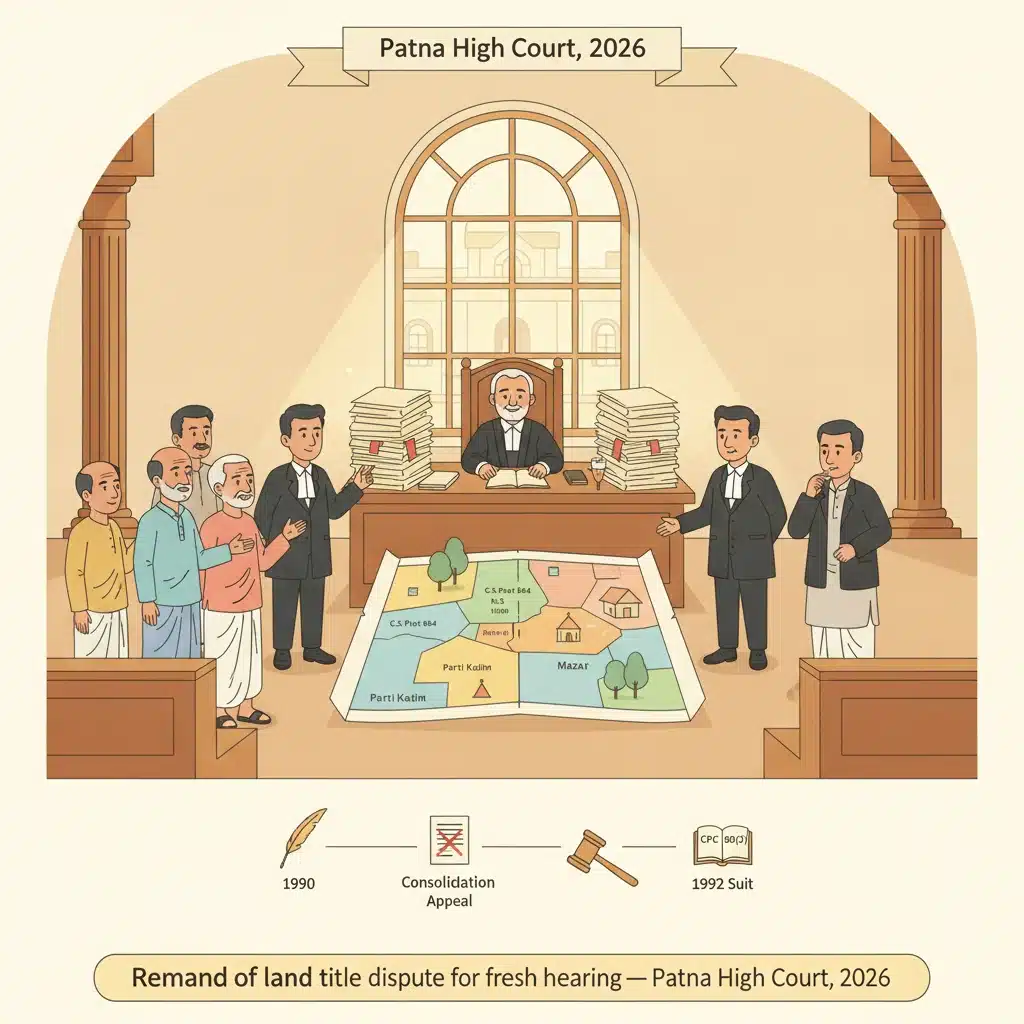
Case Background
This case arises from a long-running land dispute in Village Chainpur, District Kaimur at Bhabua, Bihar.
The plaintiffs, who are descendants of one Jhuri Hazam, filed Title Suit No. 133 of 1992 before the Sub-Judge-II, Bhabua. They sought a declaration of their title over certain plots of land described in the schedule of the plaint. These plots fall under old C.S. Khata No. 118 and various C.S. plot numbers, which later became R.S. plots in revisional survey.
According to the plaintiffs, the land originally belonged to Maharaj Banaras. They claimed that their ancestors, Kiju and Niju, had a house on C.S. Plot No. 867 and also planted trees and improved other adjoining plots. They said they were in peaceful possession for generations.
Problems started when, during revisional survey and consolidation proceedings, parts of the land were recorded either in the name of the State of Bihar as “Anabad Bihar Sarkar Parti Kadim” or in the name of original defendant no. 1, Badiuzzama Khan. The plaintiffs alleged that these entries were wrong and were made behind their back.
They therefore filed the title suit for declaration of their title, without serving a prior notice under Section 80(1) of the Code of Civil Procedure (CPC), claiming urgency and invoking Section 80(2) CPC.
The Sub-Judge-II, Bhabua, dismissed the suit on 28.05.2003, holding that the plaintiffs failed to prove their title or legal possession. The trial court also held that defendant 1st set, including Badiuzzama Khan and his heirs, also had no title and that the land belonged to the State of Bihar.
The plaintiffs filed Title Appeal No. 29 of 2003 / 41 of 2009 before the Additional District Judge, F.T.C.-I, Kaimur at Bhabua. On 06.12.2010, the first appellate court affirmed the trial court judgment but went further and declared that defendant no. 1 was the khatiyani raiyat for certain plots. The plaintiffs then approached the Patna High Court in Second Appeal No. 49 of 2011.
What the Court Examined and Decided
The Second Appeal came before Hon’ble Mr. Justice Khatim Reza of the Patna High Court. The appeal was admitted on 11.02.2016 on a single substantial question of law.
The question was whether the first appellate court had failed in its duty as an appellate court by not properly considering and scrutinising the evidence led by the plaintiffs, and whether its judgment was therefore vulnerable.
The High Court began by briefly restating the plaintiffs’ case as presented in the plaint.
The plaintiffs asserted that C.S. Plot Nos. 864, 865, 867 and 868 under C.S. Khata No. 118 belonged to Maharaj Banaras. They said C.S. Plot No. 867 (31 decimals) was recorded as “Gairmajarua Malik” with a house of Kiju and Niju mentioned in the remarks column. After the death of Kiju and Niju, the house allegedly came into possession of the plaintiffs as their descendants.
In the revisional survey, this land was renumbered, and for R.S. Plot No. 1136 under R.S. Khata No. 817, the State of Bihar’s name was recorded as raiyat, though the plaintiffs’ names also appeared in the remarks column. The nature of the land was recorded as “Parti Kadim”, which the plaintiffs contested.
The plaintiffs further claimed that C.S. Plot No. 864 (53 decimals) was recorded as “Parti Kadim” but they had planted trees on it, as mentioned in the remarks column of the C.S. khatiyan, and they remained in possession. C.S. Plot No. 865 was a ditch (“Gadha”) which, according to them, their ancestors filled up and merged with C.S. Plot No. 864. In revisional survey, these became R.S. Plot No. 1134, area 60 decimals.
They also said there was a Mazar of their ancestor on Plot No. 1137/1901 and they had provided a pathway over Plot No. 1134 to access the Mazar. Their residential house stood on C.S. Plot No. 867, out of which R.S. Plots 1132 and 1133/1902 were recorded in their names, but 10 decimals of Plot No. 1133/1902 were wrongly recorded in the name of the State of Bihar.
The plaintiffs stated that in December 1990 they heard that defendant no. 1, Badiuzzama Khan, had managed to get his name recorded over R.S. Plot No. 1901 (60 decimals) in collusion with the consolidation authorities. They applied for certified copies on 05.12.1990 and received them on 17.12.1990.
They then filed Consolidation Appeal No. 869 of 1990-91 before the Deputy Director, Consolidation, Sasaram, Bhabua. They pleaded that consolidation proceedings were stayed, no further proceedings took place, and they received no notice, so they had no knowledge of any final order. They also argued that since the land was “chak out” and related to title, the Consolidation Officer had no jurisdiction, and his order was null and void.
The plaintiffs also alleged that without their knowledge, defendant no. 1 got his name fraudulently entered in the revisional survey khatiyan over R.S. Plot No. 1134, which they claimed as “Kaymi” land. This, they said, compelled them to file the civil suit.
On the defence side, defendant no. 1, Badiuzzama Khan, filed a written statement. He denied the plaintiffs’ claim and stated that the suit was not maintainable, barred by limitation, and barred by Sections 4(b) and 4(c) of the Bihar Consolidation of Holdings and Prevention of Fragmentation Act, 1956, on the ground of res judicata.
He said that Maharaj Banaras was not the landlord; instead, Kishori Raman Prasad and Radha Raman Prasad were the ex-landlords of Mauza Chainpur till vesting. He denied that Kiju and Nizu were mentioned in the remarks column of the C.S. khatiyan or that plaintiffs’ ancestors had planted any tree. According to him, his own ancestors had filled up the ditch and made the land cultivable, and there was a Mazar of his ancestor on Plot No. 1137/1901, for which they used a pathway.
Defendant no. 1 also asserted that he had filed a consolidation appeal before the Deputy Director, Consolidation, against the order of the Consolidation Officer, and this appeal was dismissed on 23.08.1993. He said the plaintiffs did not file any revision against that dismissal. He claimed that R.S. khatiyan was correctly prepared in his name for Plot No. 1134 and that an earlier case filed by the plaintiffs’ father (Case No. 490/1990-91) had been dismissed. He further contended that Plots 864 and 865 had been settled with him, that he had paid rent, and that his name was entered in Register-II after enquiry, and he was receiving rent receipts from the State of Bihar.
He and his heirs claimed to be in possession for more than 12 years and relied on khatiyan, consolidation orders and land registers as evidence.
The State of Bihar (defendant no. 2) also filed a written statement. It asserted that the suit land was recorded as “Anabad Bihar Sarkar Parti Kadim” and that the State was in possession. It argued that the plaintiffs had no right to sue and that the survey authorities had correctly prepared the survey khatiyan. It even alleged that the plaintiffs and defendant 1st set had brought the suit in collusion.
The trial court framed issues on maintainability, limitation, title, possession, and the effect of consolidation proceedings. The plaintiffs examined six witnesses and produced several documents, including survey khatiyan and maps (Ext. 5, 5/a, 6, 6/a) and a compromise petition (Ext. 3). Defendant no. 1 filed certified copies of survey khatiyan (Ext. A), order of the Consolidation Officer (Ext. B) and register of land under Section 9 of the Consolidation Act (Ext. C), but neither he nor his heirs led any oral evidence or cross-examined the plaintiffs’ witnesses. The State also did not lead evidence.
The trial court held that the compromise petition (Ext. 3), filed without the consent of the State, showed collusion between the plaintiffs and defendant 1st set. It further held that the documents produced by the plaintiffs were not documents of title and that they had not proved any settlement or gift from Maharaj Banaras. Since Zamindari had vested, the State was held to be the full owner and neither side was able to show lawful title. The suit was dismissed, declaring that the land belonged to the State of Bihar.
In appeal, the first appellate court re-analysed the record but in a limited manner. It accepted that the plaintiffs had claimed title based on settlement or gift by Maharaj Banaras but noted that no such document had been exhibited. Referring to Ext. A, it held that R.S. Plot No. 1134 stood in the name of defendant no. 1 and that he was the khatiyani raiyat for Plots 1134 and 1137, while the rest of the land belonged to the State.
The appellate court relied on Ext. B (order of the Deputy Director, Consolidation) to record that a consolidation appeal (Appeal No. 859 of 1990-91) filed by the plaintiffs’ father was dismissed, contrary to the plaintiffs’ pleading that the appeal had never been decided. It concluded that the plaintiffs had suppressed the true facts and did not come with clean hands, and it affirmed the dismissal of the suit.
Before the High Court, counsel for the appellants attacked the first appellate court’s judgment. They argued that since the defendants had led no evidence and had not challenged the trial court’s finding that they had no title, the appellate court could not have declared title in favour of defendant 1st set. They also argued that the appellate court had not complied with Order XLI Rule 31 CPC, which requires formulation of points for determination and reasoned findings. They relied on Supreme Court decisions such as Chaudhary Sahu v. State of Bihar and Banarasi v. Ramphal to argue that the appellate court could not grant relief to a non-appealing defendant by using Order XLI Rule 33 CPC in these circumstances.
Respondents 8 and 9, who purchased land from the heirs of original defendant no. 1, argued that the plaintiffs’ suit itself was not maintainable because they had asked only for a declaration of title and not for confirmation or recovery of possession. They referred to Order II Rule 2 and 3 CPC and the proviso to Section 34 of the Specific Relief Act, and cited the Supreme Court decision in Venkataraja v. Vidyane Doureradjaperumal to support this point. They also pointed to a compromise petition dated 13.05.1997, in which, according to them, the plaintiffs had admitted that certain plots including R.S. Plot No. 1134 belonged to defendant 1st set, while certain other plots were accepted as belonging to the plaintiffs. On this basis they argued that the plaintiffs could not seek declaration over Plot No. 1134.
The Patna High Court, however, focused strictly on the substantial question of law—whether the first appellate court had discharged its duty under Order XLI Rule 31 CPC.
After examining the appellate judgment, the High Court found that the first appellate court had not framed any points for determination, had not discussed the evidence of the plaintiffs, and had merely listed the names of witnesses and exhibits. There was no analysis of oral or documentary evidence, despite the fact that the defendants had not led any evidence.
The High Court observed that, as a court of first appeal under Section 96 CPC, the appellate court must reappreciate the entire evidence on record and give its own findings on both facts and law, with reasons. It relied on the Supreme Court judgment in B.V. Nagesh & Anr. v. H.V. Sreenivasa Murthy, reported in (2010) 13 SCC 530, which emphasises that non-compliance with Order XLI Rule 31 CPC leads to infirmity in the appellate judgment.
The High Court noted that the first appellate court had based its conclusions mainly on Ext. A and Ext. B (filed on behalf of defendant no. 1) even though these documents were not formally proved, and without discussing the plaintiffs’ evidence. This approach, it held, caused serious prejudice to the plaintiffs and deprived them of their valuable right to a proper first appeal.
In these circumstances, the High Court answered the substantial question of law in favour of the appellants. It held that the first appellate court had indeed abdicated its jurisdiction by not complying with Order XLI Rule 31 CPC and that its judgment could not be sustained.
Consequently, the Patna High Court set aside the judgment and decree dated 06.12.2010 passed in Title Appeal No. 29 of 2003 / 41 of 2009. It remanded the title appeal back to the first appellate court for fresh decision in accordance with law.
The High Court directed the first appellate court to dispose of the appeal preferably within six months from the date of receipt or production of a copy of this judgment, after issuing due notice to all parties and giving them full opportunity of hearing. The Second Appeal was allowed, all other contentions were kept open, and no order as to costs was made.
Why This Judgment Matters
This judgment is important for villagers and landholders who fight for their land rights in civil courts.
The Patna High Court did not decide who is the real owner of the disputed land. Instead, it protected the basic right of every litigant to get a full and fair hearing in the first appeal.
The Court made it clear that a first appellate court cannot simply copy or briefly refer to the trial court record. It must clearly state what issues it is deciding, discuss the evidence, and give reasons. If it fails to do this, its judgment can be set aside.
For people involved in land disputes, especially where survey and consolidation records are in question, this judgment shows that the appellate process itself is a safeguard. If an appellate court ignores your evidence, you can challenge that failure as a legal error.
The decision also sends a message to courts that they must be careful before declaring title in favour of a party who has not even appealed, particularly when that party did not lead evidence or challenge findings against them.
Legal Issues and Answers
- Issue: Did the first appellate court fail in its duty by not framing points for determination and not properly examining the evidence of the plaintiffs as required by Order XLI Rule 31 CPC?
Answer: Yes. The Patna High Court held that the appellate court did not comply with Order XLI Rule 31 CPC. It did not frame points for decision, did not analyse the plaintiffs’ oral and documentary evidence, and relied on unproved defence documents, causing prejudice to the plaintiffs. - Issue: Is the judgment and decree of the first appellate court sustainable in law in such circumstances?
Answer: No. The High Court held that non-compliance with Order XLI Rule 31 CPC made the appellate judgment infirm. It therefore set aside that judgment and remanded the title appeal for fresh decision.
Cases Cited by the Court
- B.V. Nagesh & Anr. v. H.V. Sreenivasa Murthy, (2010) 13 SCC 530 (relied upon by the Patna High Court on the duty of first appellate courts under Order 41 Rule 31 CPC).
- The parties also cited Chaudhary Sahu (dead) by Lrs. v. State of Bihar, (1982) 1 SCC 232; Banarasi v. Ramphal, (2003) 9 SCC 606; and Venkataraja v. Vidyane Doureradjaperumal, (2014) 14 SCC 502, but these were referred to in arguments and not as the foundation of the High Court’s final reasoning.
Case Details
Case Number: Second Appeal No. 49 of 2011
Case Title: Salim Hazam & Ors. v. Raphiu Jama Kha & Ors.
Court: High Court of Judicature at Patna
Coram: Hon’ble Mr. Justice Khatim Reza
Date of Patna High Court Judgment: 18.06.2026
Impugned Judgment: Judgment and decree dated 06.12.2010 in Title Appeal No. 29 of 2003 / 41 of 2009 passed by the Additional District Judge, F.T.C.-I, Kaimur at Bhabua affirming judgment dated 28.05.2003 in Title Suit No. 133 of 1992 passed by Sub-Judge-II, Bhabua.
Citation: 2026 (4) PLJR 393
Advocates:
For the Appellants (plaintiffs): Mr. Waliur Rahman, Advocate; Mr. Shailendra Kumar Tiwary, Advocate.
For the Respondents: Mr. Binod Kumar Singh, Advocate; Ms. Vagisha Pragya Vacaknavi, Advocate.
Nature of the Case: Second appeal in a title suit concerning declaration of title over agricultural/residential land and challenge to survey and consolidation entries; focus on the correctness of the first appellate court’s judgment under Order XLI Rule 31 CPC.
Link to Judgment: https://patnahighcourt.gov.in/viewjudgment/OSM0OSMyMDExIzEjTg==-ksL–am1–TW1YHms=
If you found this explanation helpful and wish to stay informed about
how legal developments may affect your rights in Bihar,
you may consider following Samvida Law Associates for more updates.




