

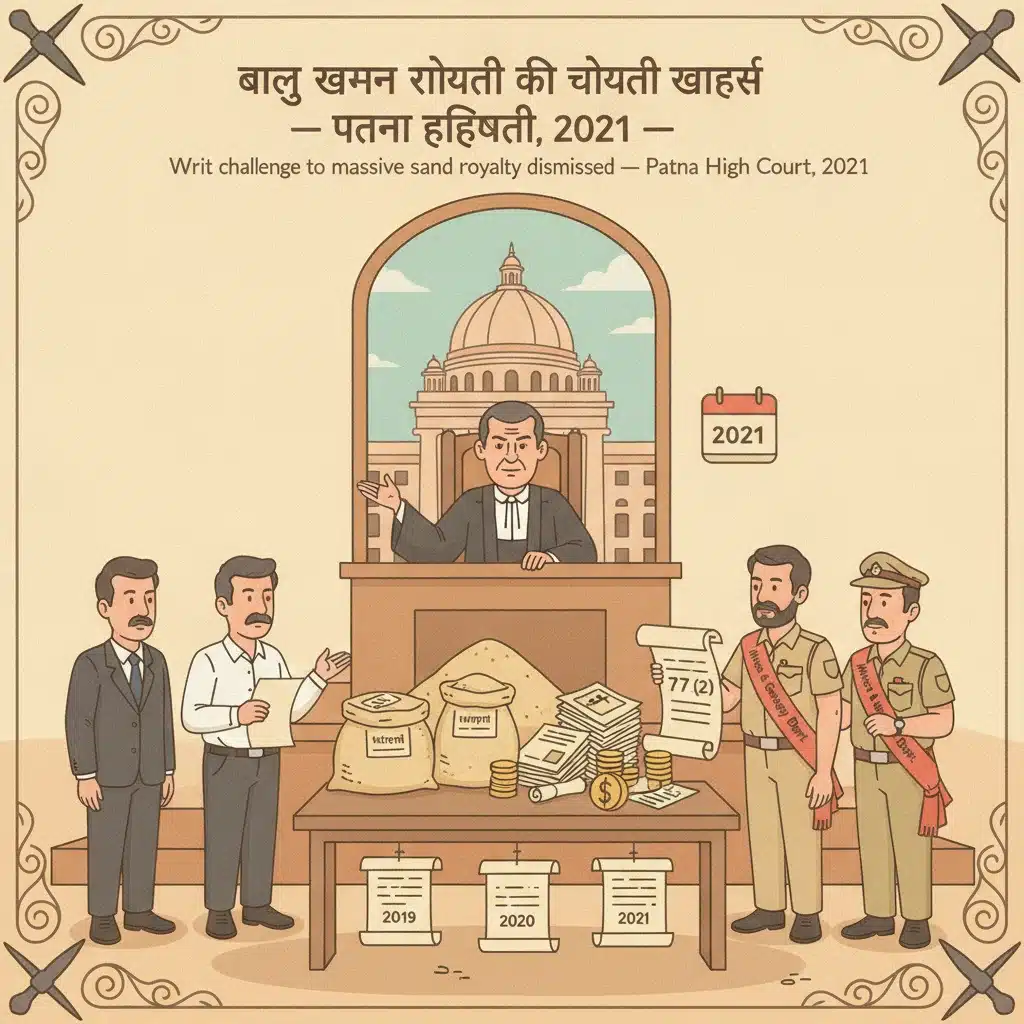
Case Background
The case arises out of settlement of sand ghats in Bhojpur district in favour of the petitioner company under the earlier sand policy. The initial settlement was for five years, from 2015 to 2019, after an auction in which the petitioner emerged as the highest bidder. Separate work orders were issued for the years 2015, 2016, 2017 and 2018, and the agreement period ended on 31.12.2019.
In the meantime, the State of Bihar framed the Bihar Sand Mining Policy, 2019 and also notified the Bihar Minerals (Concession, Prevention of Illegal Mining, Transportation & Storage) Rules, 2019. These 2019 Rules came into force on 17.09.2019 and repealed earlier minor mineral rules.
Using its power under Rule 77(2) of the 2019 Rules, the Department of Mines and Geology issued a notification dated 27.12.2019. This notification allowed extension of the existing sand ghat settlements, which were ending on 31.12.2019, up to 31.10.2020 or till new settlees obtained environmental clearance, whichever was earlier. The settlement amount was increased by 50 per cent.
Later, by a resolution dated 14.09.2020, the extension was continued till 31.12.2020, and by another resolution dated 30.12.2020, it was extended till 31.03.2021. The petitioner accepted and availed all these extensions of settlement.
On 31.03.2021, a further extension for the period 01.04.2021 to 30.09.2021 was granted under another notification. A work order for this extended period was issued to the petitioner by the Assistant Director, District Mining Office, Bhojpur, on the same date. The petitioner accepted this work order and deposited the first installment of royalty of Rs. 27,35,37,240/-.
Soon thereafter, on 26.04.2021, the petitioner wrote to the Assistant Director, District Mining Office, Bhojpur. It stated that due to rampant illegal mining of sand and lack of cooperation from the State machinery, it was not possible to pay the next installment. It declared that it had decided to surrender its settlement of sand mining in Bhojpur, Patna and Saran districts with effect from 01.05.2021.
The Collector, Bhojpur, by letter dated 28.04.2021, rejected the petitioner’s application for surrender. He referred to Rule 50(1) of the 2019 Rules and said the petitioner had not complied with its requirements. The petitioner was also directed to deposit the second installment of royalty, which was due before 30.04.2021, failing which action under Rule 47 of the 2019 Rules would follow.
Subsequently, by Memo No. 2985 dated 07.07.2021, the District Magistrate-cum-Collector, Bhojpur, raised a demand of Rs. 1,39,50,39,924/- against the petitioner. This amount related to the second, third and fourth installments of royalty for the extended settlement period from 01.04.2021 to 30.09.2021, along with interest at 24 per cent per annum and a warning of certificate proceedings on failure to pay.
The petitioner filed the present writ petition (CWJC No. 13251 of 2021) in the Patna High Court, challenging this demand and the rejection of its surrender application. The petition was heard and decided by Hon’ble Mr. Justice Chakradhari Sharan Singh on 08.12.2021.
What the Court Examined and Decided
The petitioner’s main prayer was to quash Memo No. 2985 dated 07.07.2021, by which the demand of Rs. 1,39,50,39,924/- was raised. It also sought a declaration that it was not liable to pay the second, third and fourth installments of royalty because it had surrendered the settlement. It argued that this surrender could not be treated as a violation of Rule 50(1) of the 2019 Rules and that Rule 50(1) did not apply to extensions granted under Rule 77(2).
The Court first noted that several important facts were not in dispute. The petitioner had accepted each extension of settlement issued after 31.12.2019. It had also accepted the extension for 01.04.2021 to 30.09.2021 and deposited the first installment of royalty. Its surrender letter was dated 26.04.2021, that is, after enjoying the benefit of the new work order for some time.
The State, through counter affidavits filed by the Mines Department and the State of Bihar, opposed the writ. They alleged that the petitioner was a habitual defaulter and itself involved in illegal mining. It was stated that the petitioner had mined in areas not allotted to it and had fraudulently removed or stocked sand without e-challans worth Rs. 15.84 crores. It was also said that the petitioner had violated environmental norms several times and was punished on several occasions.
The State further pointed out that FIRs had been lodged against the petitioner in Chandi P.S. Case No. 30 of 2021 and Sahar P.S. Case No. 37 of 2021, dated 04.02.2021 and 08.02.2021 respectively. It was asserted that the State Government had taken strict measures against illegal mining and transport of sand.
A very significant point, noted by the Court, was that no rejoinder was filed by the petitioner to deny the allegations made in the counter affidavits. As a result, all those statements remained uncontroverted on record.
On the legal side, the petitioner raised two main arguments.
First, it argued that due to uncontrolled illegal mining and lack of cooperation from State authorities, along with a later policy decision dated 16.12.2020 prohibiting use of trucks with 14 or more wheels for transporting sand and stone chips, performance of the settlement had become impossible. According to the petitioner, these circumstances made it impracticable and useless to continue with the sand mining business. Relying on Section 56 of the Contract Act, 1872 and the Supreme Court judgment in Delhi Development Authority v. Kenneth Builders and Developers Private Limited (2016) 13 SCC 561, it argued that the settlement contract had become void by “frustration” and that it was entitled to surrender immediately.
Second, the petitioner argued that its surrender was wrongly rejected by invoking Rule 50(1) of the 2019 Rules. Rule 50(1) gives an exit option to a mineral concession holder, on six months’ notice, but says the option is not available to those who have not paid the bidding amount or settlement amount or who have violated any condition of settlement. The petitioner contended that Rule 50(1) does not apply to settlements or extensions granted under Rule 77(2) because Rule 77(2) contains a non obstante clause (“notwithstanding anything contained in these rules”). It argued that Rule 77(2) was an independent provision with overriding effect and that settlements granted under it were not controlled by other rules, including Rule 50(1). It also relied on Union of India v. G.M. Kokil, 1984 Supp SCC 196, to explain the effect of a non obstante clause. It submitted that since the extended settlement period itself was less than six months, the requirement of six months’ prior notice could not logically apply.
The Mines Department responded that the petitioner could not play hot and cold. On one hand, it did not deny its own involvement in irregularities and alleged illegal mining, but on the other hand, it blamed “rampant illegal mining” by others for making business impossible. They argued that Rule 77(2) only allowed the State Government to grant mining lease or settlement, or quarrying or movement permits, on terms and conditions other than those in the Rules, where required in public interest. It did not wipe out the rest of the Rules for such settlees. They submitted that Rule 50(1) continued to apply, and that the exit option was not available to the petitioner because it had not paid the full settlement amount and had violated conditions.
The State’s counsel also argued that once the petitioner voluntarily accepted the extended settlement terms, with knowledge of existing circumstances including alleged illegal mining and the 16.12.2020 resolution on truck restrictions, it could not later turn around and say that performance had become impossible. The petitioner was estopped from approbating and reprobating at the same time.
The Court then carefully considered the Collector’s order dated 28.04.2021 rejecting the surrender. It observed that the Collector had quoted Rule 50(1) in full and then stated that the petitioner had not complied with the requirements of that rule. The Court held that, on a plain reading of the communication, the absence of six months’ notice could not be treated as the sole reason for rejection. The rule itself states that the exit option is not available to concession holders who have not paid their bidding or settlement amount or have violated settlement conditions. Therefore, the Collector’s reference to non-compliance with Rule 50(1) covered both lack of prior notice and these disqualifications.
Accordingly, the Court rejected the petitioner’s argument that the only ground of rejection was timing of the notice and that this ground was bad.
Next, the Court examined the reach of the non obstante clause in Rule 77(2). It referred to the Supreme Court’s explanation in G.M. Kokil on how such clauses give overriding effect only over contrary provisions. The Court noted that Chapter XIII of the 2019 Rules deals with exemptions and relaxations. Rule 77(1) gives a general power to relax operation of one or more provisions where necessary in public interest. Rule 77(2) specifically authorises the State Government to grant a mining lease or mining settlement, and to authorise quarrying or movement permits, to any person on terms and conditions other than those prescribed in the Rules, with reasons recorded.
The Court held that the expression “notwithstanding anything contained in these Rules” in Rule 77(2) is limited to matters relating to grant of mining lease, mining settlement, quarrying permit or movement permit, and to prescribing terms and conditions different from those in the Rules at the time of grant. It does not mean that all other provisions of the 2019 Rules cease to apply to such a settlement once granted.
The Court accepted the Mines Department’s view that the non obstante clause in Rule 77(2) overrides only procedural provisions about how leases, settlements or permits are granted. It does not override later provisions dealing with management, cancellation, suspension or exit from a settlement, such as Chapter XII and Rule 50.
By way of illustration, the Court observed that if the petitioner’s interpretation were accepted, then none of the provisions in Chapter XII on cancellation of mineral concession, suspension, management takeover by the Collector, or requisition of minor minerals would apply to a settlement granted under Rule 77(2). That would create an anomalous and unacceptable situation. Further, if Rule 50(1) were held inapplicable, a settlee under Rule 77(2) would actually have no exit option at all, which would be self-defeating.
On this reasoning, the Court held that Rule 50(1) does apply to the petitioner’s extended settlement granted under Rule 77(2). Since the petitioner had not paid all settlement dues and there were allegations of violation of settlement conditions (left uncontroverted in the pleadings), the petitioner did not qualify for the exit option under Rule 50(1). Its surrender application was therefore not covered by the rule.
The Court did not express any final opinion on the allegations of irregularities and illegal mining, noting that these could be the subject of separate proceedings before the appropriate forum. But it underlined that the petitioner had not challenged those facts in a rejoinder.
In conclusion, the Court held that the writ petition had no merit. The communication dated 28.04.2021 rejecting surrender, and the subsequent demand memo dated 07.07.2021 requiring payment of the second, third and fourth installments of royalty for the period 01.04.2021 to 30.09.2021, could not be interfered with in writ jurisdiction. The application was dismissed, with no order as to costs.
Why This Judgment Matters
This judgment is important for all sand ghat settlees and mining lease holders in Bihar. It clarifies that once a company accepts an extension of settlement under Rule 77(2) of the 2019 Rules and starts operating under it, it remains bound by other rules governing exit and compliance.
The Patna High Court has clearly held that Rule 77(2) does not create a “free zone” settlement outside the rest of the 2019 Rules. Provisions like Rule 50(1), which regulate when and how a concession holder can exit, continue to apply. A company that has not fully paid settlement dues or has violated settlement conditions cannot use the exit option to avoid further liability.
The judgment also sends a signal that if a settlee alleges circumstances like illegal mining by others or administrative non-cooperation, but simultaneously faces uncontroverted allegations of its own irregularities, the Court will look at the entire conduct carefully. Accepting an extension knowing all existing conditions and then backing out after the first installment may not be allowed.
For ordinary readers, especially those involved in sand mining or planning to bid for such contracts, the lesson is simple: before accepting an extension or new settlement, consider all risks and policies already in force. Once you accept and start work, walking away midway without following the exit rules will not automatically relieve you from paying remaining installments.
Legal Issues and Answers
-
Issue: Can a sand ghat settlee, whose settlement was extended under Rule 77(2) of the 2019 Rules, avoid payment of later royalty installments by surrendering the settlement without complying with Rule 50(1)?
Answer: No. The Patna High Court held that Rule 50(1) applies even to settlements granted or extended under Rule 77(2), and the exit option is not available to a concession holder who has not paid the settlement amount or has violated settlement conditions. -
Issue: Does the non obstante clause in Rule 77(2) exclude the operation of other provisions of the 2019 Rules, such as those governing cancellation and exit?
Answer: No. The Court held that the clause “notwithstanding anything contained in these rules” is confined to grant of lease/settlement or permits and prescribing different terms at the time of grant. It does not render other parts of the Rules, including Chapter XII and Rule 50, inapplicable. -
Issue: Was the Collector’s rejection of the surrender application invalid because it relied only on the absence of six months’ prior notice?
Answer: No. The Court found that the Collector’s order referred to non-compliance with Rule 50(1) as a whole. Since the rule itself bars exit for those who have not paid settlement amounts or have violated conditions, the rejection could not be seen as based solely on the six months’ notice requirement.
Cases Cited by the Court
- Delhi Development Authority v. Kenneth Builders and Developers Private Limited and Others, (2016) 13 SCC 561 (cited by the petitioner).
- Union of India and Another v. G.M. Kokil and Others, 1984 Supp SCC 196 (considered by the Court while interpreting the non obstante clause).
- Mohinder Singh Gill and Another v. Chief Election Commissioner, New Delhi and Others, AIR 1978 SC 851 (cited by the petitioner to argue that an order must be judged by its own reasons).
- M/s Aditya Multicom Private Limited v. The State of Bihar and others and analogous matters, 2019(4) PLJR 246 (earlier writ involving related issues, mentioned in the counter affidavit).
Case Details
Case Number: Civil Writ Jurisdiction Case No. 13251 of 2021
Case Title: Broad Son Commodities Private Limited v. The State of Bihar & Ors.
Citation: 2022(4) PLJR 259
Court: High Court of Judicature at Patna
Coram: Hon’ble Mr. Justice Chakradhari Sharan Singh
Date of Judgment: 08.12.2021
Nature of the Case: Writ petition under civil writ jurisdiction challenging royalty demand and rejection of surrender of sand ghat settlement.
Petitioner’s Advocates: Mr. S.B. Upadhyay, Senior Advocate; Mr. Suraj Samdarshi, Advocate; Mr. Nishant Kumar, Advocate; Mr. Piyush Ranjan, Advocate (for the petitioner company).
Advocates for State of Bihar: Mr. Gyan Prakash Ojha, G.A.-7; Mr. Abhishek Singh, AC to G.A.-7 (for the respondent State).
Advocate for Mines Department: Mr. Naresh Dixit, Advocate (for the respondent Mines Department).
Link to Full Judgment: Click here to read the official Patna High Court judgment
If you found this explanation helpful and wish to stay informed about how legal developments may affect your rights in Bihar, you may consider following Samvida Law Associates for more updates.




