

Case Background
The case arose from an internal recruitment process in Bihar State Power Holding Company Limited and its four subsidiary companies. The petitioner was initially appointed as a Junior Accounts Clerk and, at the time of the writ petition, was working as an Account Assistant in the company since 10.05.2013.
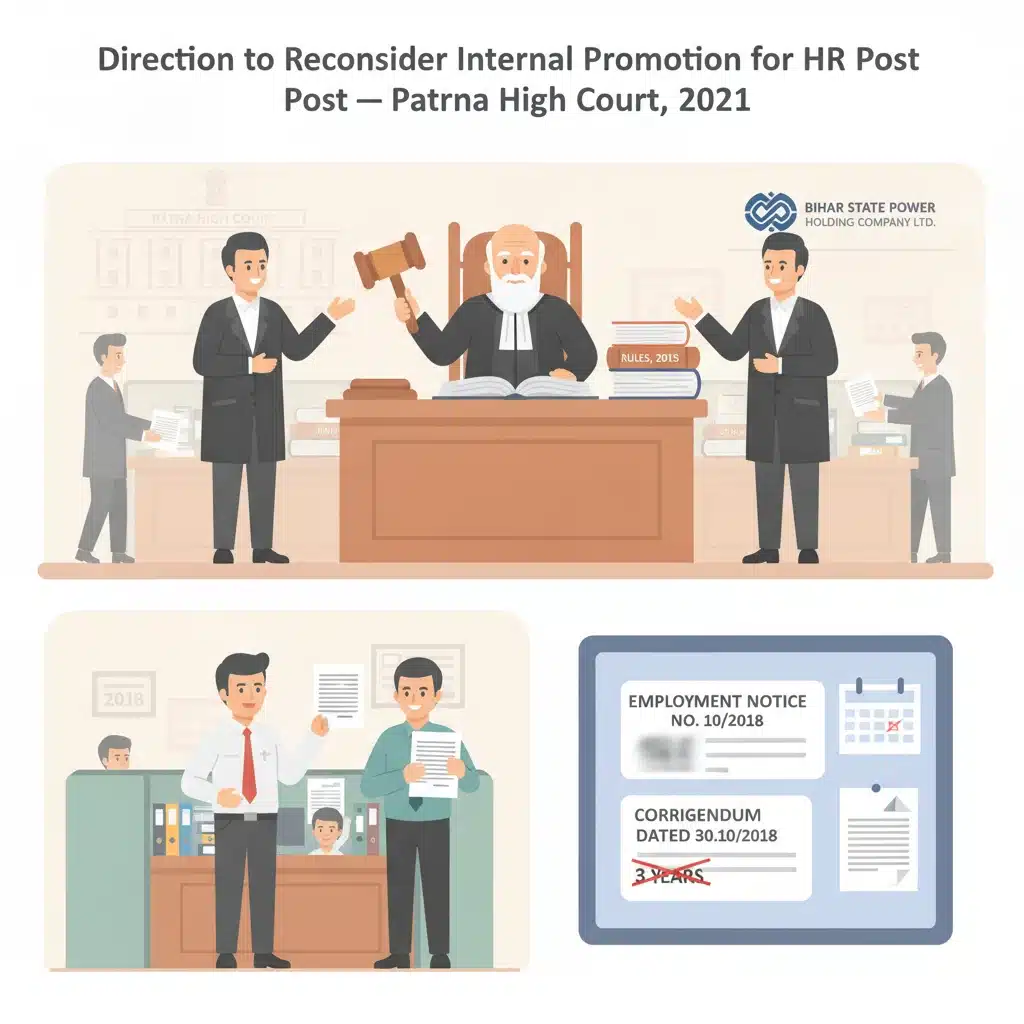
An internal advertisement, Employment Notice No. 10/2018, was issued inviting online applications from existing staff for various posts, including Assistant Personnel Officer. Only employees working in the regular establishment of the company and its subsidiaries for a minimum period of five years were eligible to apply.
The petitioner applied for the post of Assistant Personnel Officer in the unreserved category. The advertisement showed 13 vacant posts of Assistant Personnel Officer, out of which five were for the unreserved category. Clause 11 of the employment notice provided that candidates would be shortlisted based on marks obtained in an OMR-based written examination, with 40% prescribed as minimum qualifying marks for unreserved candidates.
Later, the company issued a corrigendum dated 30.10.2018, by which the minimum service length required for eligibility was reduced from five years to three years. This relaxation enabled some employees, including private respondent no. 7, to participate despite not having completed five years of service.
After the written examination, the petitioner was surprised to see that his name did not appear in the shortlist for the post of Assistant Personnel Officer, even though, according to him, he had secured the cut-off marks for the unreserved category and had obtained the same marks as the last selected candidate, one Rajeev Kumar.
Only three of the shortlisted candidates ultimately joined on the post of Assistant Personnel Officer. This meant that some advertised vacancies remained unfilled. The petitioner made representations before the Director and the General Manager (Human Resources) of the company, but his request for appointment was rejected. The rejection was communicated by the Under Secretary of the company (respondent no. 6) by order dated 30.07.2019.
The rejection order stated that the cut-off for the unreserved category was 51 marks. Both the petitioner and another candidate, Rajeev Kumar, obtained 51 marks. The company decided in favour of Rajeev Kumar solely on the basis that he was older than the petitioner. Rajeev Kumar’s date of birth is 11.10.1984, whereas the petitioner’s date of birth is 20.10.1984. On this basis, the petitioner’s claim was rejected.
Aggrieved, the petitioner approached the Patna High Court through Civil Writ Jurisdiction Case No. 21075 of 2019, challenging the rejection order and seeking a direction for his appointment against the vacant post of Assistant Personnel Officer advertised in Employment Notice No. 10/2018.
What the Court Examined and Decided
The Court first recorded the main prayers in the writ petition: quashing the order dated 30.07.2019 rejecting the petitioner’s claim for appointment and directing the respondents to appoint him as Assistant Personnel Officer against a vacant post under Employment Notice No. 10/2018.
The petitioner’s counsel argued that the recruitment violated the governing Cadre Rules, namely the Karmik Seva Samvarg Nimayawali, 2015 (Rules, 2015). Rule 7, as cited, treated Assistant Personnel Officer as the entry-level post in the personnel cadre and provided that 5% of the total sanctioned posts would be filled through internal appointment based on a limited written competitive examination.
Under this rule, only employees or staff who had completed five years of service with the company or the erstwhile Board were eligible to appear. On this basis, counsel contended that respondent no. 7, Ms. Chinmayee, had not completed five years of service on the date of the application and was therefore ineligible, yet her name appeared at serial no. 6 in the list of shortlisted candidates.
The petitioner further submitted that the reduction of the required service from five years to three years by corrigendum dated 30.10.2018 was done to favour respondent no. 7. He also argued that no proper merit list, as envisaged under Rule 7, had been published and that only a list of shortlisted candidates existed. For these reasons, he claimed the entire selection and subsequent appointments to the post of Assistant Personnel Officer were vitiated in law.
On the specific issue of non-selection despite equal marks, the petitioner’s argument was that the decision to choose the older candidate lacked legal basis. Neither the advertisement nor the Rules, 2015 mentioned that, where two candidates secured the same marks, age would be used as the tie-breaking factor. The petitioner relied on the Supreme Court judgment in Bibhudatta Mohanty v. Union of India, (2002) 4 SCC 16, particularly paragraph 14, where the Court held that a selection made solely on the basis of being senior in age, without merit as the dominant factor, is vitiated by extraneous consideration.
In response, counsel for the respondent company did not dispute that the petitioner had obtained the same marks as Rajeev Kumar. She explained that the cut-off for the post was 51 marks and, when two candidates secured equal marks, the candidate older in age was preferred. She argued that it is a settled principle that when two candidates obtain equal marks, age can be used as a criterion and that the older candidate is given priority in employment.
The company’s counsel further submitted that once a merit list is prepared, the selection process ends, and any unfilled post is carried forward to the next year. She asserted that clause 7 of the Cadre Rules, 2015 had been diluted or modified by the competent authority of the company, reducing required service from five years to three years, and the company had the power to bring in such changes.
According to her, after the written examination, a shortlist or select list was prepared in the ratio of 1:1. The shortlisted candidates were then called for document verification, and on the basis of the verification committee’s remarks, a selection committee constituted by office order dated 12.02.2019 recommended names of eligible candidates against Employment Notice No. 10/2018 (internal). She stated that no recruitment panel existed except this select list. To justify the use of age, she relied on the Supreme Court case reported in (2011) 8 SCC 115, DP Das v. Union of India & Ors., to show that age is a fair basis for determining seniority among similarly placed candidates.
After hearing both sides and examining the materials, the Patna High Court first noted that the “rules of the game” had indeed been changed midway. The initial advertisement required five years of service, but the corrigendum dated 30.10.2018 relaxed this to three years. The Court observed that the respondent company had erred in changing the conditions after the advertisement.
However, the Court then focused on the petitioner’s conduct. Despite the corrigendum, the petitioner did not challenge this change at that stage. Instead, he voluntarily participated in the selection process “without any demur and protest.” Only after failing in the selection did he raise objections. In such circumstances, relying on the Supreme Court decision in Madan Lal and others v. State of J & K and others, (1995) 3 SCC 486, the Court held that a candidate who takes part in the process cannot later challenge it merely because the result is unfavourable.
Additionally, the petitioner had not specifically challenged the corrigendum dated 30.10.2018 in his writ petition. For this reason, the Court held that the plea that the whole process was vitiated due to the mid-way change in rules “holds no water” and was fit to be rejected.
The Court then turned to the second major issue: the decision to prefer another candidate over the petitioner solely on the basis of age when both had equal marks. Here, the Court found that the advertisement and the Rules, 2015 did not mention any mechanism that allowed preference to a candidate only because of being older in age where marks were equal. The respondent company could not point to any provision authorising such a method.
The Court analysed the two Supreme Court judgments cited by the parties. It observed that in Bibhudatta Mohanty, the Supreme Court accepted age being considered only in a scenario where selection was primarily on merit and age was an additional factor. At the same time, that judgment clearly said a selection solely on the basis of age is vitiated by extraneous consideration.
On the other hand, DP Das, relied on by the company, dealt with determination of seniority, not with initial selection in a recruitment process. The Supreme Court in that case spoke of age being a fair basis for deciding seniority of officers who were recommended on the same day, but it did not prescribe age as a tie-breaker for selection in competitive recruitment.
Considering these aspects, the Court observed that the company’s action in this recruitment was not free from “procedural infirmities/inconsistencies.” It also highlighted a “glaring infirmity” in that, though a select list had been prepared, no merit list, as envisaged under the Rules, 2015, was produced before the Court.
Faced with these irregularities, the Court chose not to strike down the entire selection or issue a direct mandamus appointing the petitioner. Instead, it adopted an equitable approach. The Court wanted to “iron out the equities and put a quietus to the dispute” taking into account both the petitioner’s position and the interest of the company, especially since vacancies on the post of Assistant Personnel Officer still existed.
The Patna High Court therefore directed the Chairman-cum-Managing Director, Bihar State Power Holding Company Limited, to consider the petitioner’s case for appointment to the post of Assistant Personnel Officer in view of the existing vacancies. It further ordered that an appropriate decision be taken within six weeks from the receipt or production of a copy of the judgment.
With these directions, the writ petition was disposed of. The Court did not grant any other relief and did not expressly quash the appointment of any existing candidate.
Why This Judgment Matters
This judgment is significant for employees in public sector undertakings and government-controlled companies who participate in internal recruitment processes. It shows that while courts disapprove of authorities changing eligibility norms mid-way, a candidate who participates without objection may lose the right to challenge such changes later.
At the same time, the Patna High Court made it clear that authorities cannot arbitrarily pick one candidate over another based on criteria like age unless such criteria are clearly mentioned in the advertisement or in the governing rules. Selection must be grounded in the notified rules, and tie-breakers cannot be invented later without legal backing.
The Court’s direction to reconsider the petitioner for appointment, rather than cancelling the whole recruitment, offers a practical remedy. It balances the interests of existing appointees and the recruiting authority with the rights of a candidate who appears to have been unfairly sidelined despite obtaining equal marks and with vacancies still available.
For internal candidates in similar situations, this judgment underscores the importance of promptly challenging any perceived unfair changes in recruitment rules and carefully examining whether selection decisions follow the published criteria.
Legal Issues and Answers
Issue: Can a candidate who has participated in an internal recruitment process later challenge a corrigendum that relaxed eligibility conditions mid-way, without having challenged it earlier?
Answer: No. Since the petitioner voluntarily participated in the selection process after the corrigendum and did not challenge it at the relevant time, he could not later attack the entire selection process on that ground.
Issue: Is it permissible for the employer to prefer one candidate over another solely on the basis of age when both have secured the same marks, in the absence of any such provision in the advertisement or rules?
Answer: The Court found no support in the Rules, 2015 or the advertisement for using age alone as a tie-breaker and held that the selection process suffered from procedural infirmities. It therefore directed reconsideration of the petitioner’s case for appointment against existing vacancies.
Cases Cited by the Court
- Bibhudatta Mohanty v. Union of India, (2002) 4 SCC 16.
- DP Das v. Union of India & Ors., (2011) 8 SCC 115.
- Madan Lal and others v. State of J & K and others, (1995) 3 SCC 486.
Case Details
Case Number: Civil Writ Jurisdiction Case No. 21075 of 2019
Case Title: Raghwendra Kumar v. The State of Bihar & Ors.
Citation: 2022 (4) PLJR 124
Court: High Court of Judicature at Patna
Coram: Hon’ble Mr. Justice Mohit Kumar Shah
Date of Judgment: 04.09.2021
Advocates:
- For the petitioner: Mr. Amarnath Singh, Advocate; Mr. Anish Kumar, Advocate
- For the State-respondents: Mr. Abbas Haider (SC-6)
- For the respondent-company: Ms. Soni Shrivastava, Advocate
Nature of the Case: Writ petition (service and recruitment – internal promotion/selection to post of Assistant Personnel Officer)
Impugned Order: Order dated 30.07.2019 issued by the Under Secretary, Bihar State Power Holding Company Limited, rejecting the petitioner’s claim for appointment as Assistant Personnel Officer.
Relief Granted: Direction to the Chairman-cum-Managing Director, Bihar State Power Holding Company Limited, to consider the petitioner for appointment to the post of Assistant Personnel Officer against existing vacancies and to take an appropriate decision within six weeks of receipt/production of the order.
Link to Judgment (Patna High Court website): https://patnahighcourt.gov.in/viewjudgment/MTUjMjEwNzUjMjAxOSMxI04=-ec0rR5Jojgg=
If you found this explanation helpful and wish to stay informed about
how legal developments may affect your rights in Bihar,
you may consider following Samvida Law Associates for more updates.




