

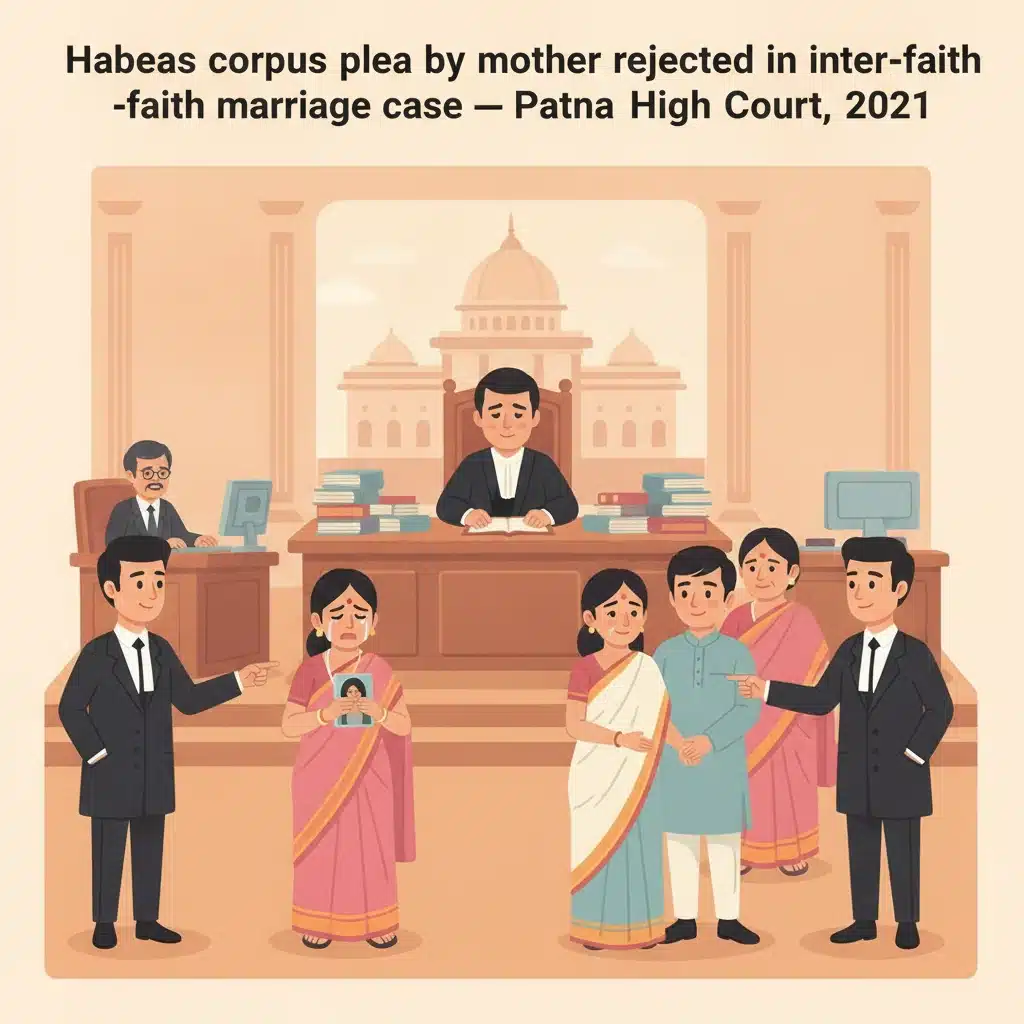
Case Background
This case arose out of a mother’s attempt to recover her adult daughter through a criminal writ petition in the Patna High Court, styled as a habeas corpus matter.
The daughter, respondent no.7, was a B.A. Part-II student at B.N. College, Patna. She was staying in Shahin Girls Hostel, Ramna Road, Patna. On 07.12.2019, she left the hostel at about 7:15 a.m. and did not return.
Despite efforts by the family, she could not be traced. On 11.12.2019, her maternal uncle, who was her local guardian in Patna, lodged Pirbahore P.S. Case No. 631 of 2019 under Sections 363 and 364 of the Indian Penal Code. He alleged that she had gone missing from the hostel and suspected that she had been abducted and wrongfully confined for illegal purposes.
In his written report, the uncle mentioned that a co-villager, respondent no.6, had allegedly threatened the brother of respondent no.7 that he would forcibly take her away from her place of stay. He also stated that the mobile phones of both respondent nos.6 and 7 were switched off.
Later, according to the mother, on 19.01.2020 she received a call from her daughter’s mobile number. She claimed that her daughter said she had been forcibly taken and married to respondent no.6 with the help of his parents (respondent nos.4 and 5) and was being kept captive, frequently shifted from one place to another. The mother further asserted that the daughter again called on 21.01.2020 and 22.01.2020 on various family members’ numbers, expressing a desire to be rescued from respondents 4 to 6.
The mother and other family members then approached the local police, including the Officer-in-charge of Pirbahore Police Station and the investigating officer, requesting recovery of the girl. Dissatisfied with what she perceived as lack of sincere effort, the mother moved the Patna High Court in Criminal Writ Jurisdiction Case No. 241 of 2020, seeking a writ of habeas corpus.
What the Court Examined and Decided
The writ petition was heard by a Division Bench of Hon’ble Mr. Justice Ashwani Kumar Singh and Hon’ble Mr. Justice Rajeev Ranjan Prasad. The petitioner-mother alleged illegal confinement and sought production and custody of her daughter. The State authorities and the private respondents opposed the petition.
On behalf of the mother, it was argued that respondent no.7 was being detained illegally by respondent nos.4 to 6. Counsel submitted that she had repeatedly expressed her wish to come back home, but because she was allegedly kept as a captive, she could not move freely. According to the petitioner, police had failed to take effective steps despite clear information and calls received from the daughter.
The State and the private respondents (particularly respondent nos.4 to 7) took a completely different stand. Their counsels stated that the writ petition had been filed only because the marriage was an inter-religion marriage. They asserted that respondent no.7 had chosen her life partner of her own free will and was being harassed by her parents for that reason.
Two counter affidavits were filed before the Court. One was by the Senior Superintendent of Police, Patna (respondent no.2), and the other was a joint counter by respondent nos.6 and 7.
In the counter affidavit of respondent no.2, the Court was informed about the progress of investigation in Pirbahore P.S. Case No.631 of 2019. The investigating officer recorded the statements of the informant and witnesses, namely Farida Khatoon, Firoz Hashmi and Danish Parwez. Call detail records of respondent nos.6 and 7 were collected for the period from 01.11.2019 to 11.12.2019. The matter was also supervised by senior police officers.
Significantly, the police stated that respondent no.7 herself appeared physically at Pirbahore Police Station on 20.01.2020. Her statement under Section 164 of the Code of Criminal Procedure was recorded before a Judicial Magistrate 1st Class, Patna.
In that judicial statement, respondent no.7 clearly stated that she had married respondent no.6, Nitish Kumar, of her own wish and volition. She said that she married him on 13.12.2019 in the court at Jamtara and on 14.12.2019 in a temple at Chitranjan. She categorically denied being kidnapped by anyone.
She produced her Aadhaar card and matriculation marksheet before the authorities. On examining these documents, her date of birth was found to be 31.03.2001, confirming that she was above 18 years of age at the relevant time.
After considering her statement, the call detail records and the overall investigation, the police concluded that the allegations in the FIR were a “mistake of fact”. A final report (Final Form No.25 of 2020) dated 07.03.2020 was submitted before the criminal court to that effect.
In the joint counter affidavit of respondent nos.6 and 7, the daughter reiterated that the FIR lodged by her maternal uncle was false. She explained that after learning about the FIR, she came to Patna with respondent no.6 and his parents to give a statement before the court.
She again described, in detail, how she left the hostel. She said she walked out of Shahin Girls Hostel, Ramna Road, Patna, without informing anyone, reached near NIT More, called respondent no.6 from there, and then went to his room, where she stayed for four to five days. Thereafter, they travelled together by train to Jamtara. She affirmed that she married respondent no.6 in court on 13.12.2019 and again in a temple at Chitranjan on 14.12.2019, and since then they had lived as husband and wife.
Even after these counter affidavits, the petitioner’s counsel expressed apprehension about the daughter’s safety, alleging that it was not clear whether her earlier statement under Section 164 CrPC was voluntary or given under threat or duress. To address this concern, the Court, by order dated 25.11.2021, directed respondent nos.6 and 7 to appear “in Chambers” on 30.11.2021.
In compliance, respondent nos.6 and 7 appeared personally before the Bench in Chambers on 30.11.2021. The Bench directly interacted with respondent no.7.
During this interaction, respondent no.7 categorically denied the FIR allegations. She explained that she and respondent no.6 were co-villagers, had been studying together since Class 8, and had fallen in love. They knew each other’s religions and still chose to marry. She said their marriage had been notarised and later solemnised in a temple.
Respondent no.7 firmly stated that no one had abducted her and that she married respondent no.6 entirely of her own free will. When asked specifically whether she wished to meet or talk to her parents, she gave an unambiguous answer. She said she did not wish to meet her father or mother or talk to them, should not be forced to meet them, and did not want to return to their home. She stated that she was accompanied by respondent no.6, would return with him to the place from where they had voluntarily travelled to court, wanted to remain married to him, and was being kept well by her husband and in-laws in her matrimonial home.
Having heard the parties and after interacting with the daughter, the Court examined the constitutional position. The Bench noted that Article 21 of the Constitution guarantees every individual the right to life and liberty. The Supreme Court has recognised that the right to marry a person of one’s choice and the right to choose a religion are integral parts of this liberty, and that expression of choice is a fundamental right under Articles 19 and 21.
The Court relied on the Supreme Court’s judgment in Shafin Jahan v. Asokan K.M., (2018) 16 SCC 368. That decision traced the history and purpose of the writ of habeas corpus and emphasised that its primary objective is to ensure that no one is deprived of liberty without sanction of law. The Supreme Court held that the Court’s role in a habeas corpus matter is to ensure that the alleged detenue is produced, ascertain his or her independent choice, and if found to be under illegal restraint, to secure release.
In Shafin Jahan, the Supreme Court also held that the High Court, while exercising habeas corpus jurisdiction, cannot decide what it considers a “just” way of life or the “correct” course of living for an adult. An adult has absolute autonomy over his or her own person.
The Patna High Court applied these principles. It noted that in habeas corpus cases, once the allegedly missing person appears and states, as a major, that he or she is not under illegal confinement and the Court finds that statement to be a free expression of will, the Court’s jurisdiction is at an end.
In the present case, the daughter was admittedly a major and had consistently stated—before the Magistrate, in the counter affidavit, and directly before the Bench—that she left home and married respondent no.6 by choice, was living with him in her matrimonial home, and did not want to go back to her parents.
The police investigation had already concluded that the FIR allegations of abduction were a mistake of fact. There was no material to show any coercion or illegal confinement by respondent no.6 or his family.
On these findings, the Court held that no case for issuing a writ of habeas corpus and handing over the custody of respondent no.7 to the petitioner-mother was made out. The Bench observed that the petitioner must respect her daughter’s decision and allow her to live a peaceful life in her matrimonial home.
Accordingly, the criminal writ application was dismissed for want of merit.
Why This Judgment Matters
This Patna High Court decision is important for families and young adults in Bihar and beyond who face conflicts over choice marriage, especially inter-religion marriages.
First, it clarifies that habeas corpus is not a tool for parents to reverse an adult child’s marriage or to force her back home. The Court’s focus is only on whether there is illegal detention, not on whether the family approves of the relationship.
Second, the ruling reinforces that an adult woman has full legal capacity to decide whom to marry and where to live. Once she clearly says she is living with her partner by choice, the Court will not interfere, even if the parents strongly object.
Third, the judgment shows that police are expected to investigate missing-person complaints properly. Here, they verified the daughter’s age, recorded her Section 164 CrPC statement, checked call records, and only then treated the FIR as a mistake of fact.
For ordinary readers, the case underlines a simple but strong message: when an adult woman chooses her partner and confirms before a court that she is safe and staying by her own will, the law will protect her decision, not family pressure.
Legal Issues and Answers
Issue: Can a mother use a habeas corpus petition to get back the custody of her adult daughter who has voluntarily married a man of another religion and is living with him?
Answer: No. The Patna High Court held that since the daughter was a major, had freely chosen to marry respondent no.6, and was not under illegal confinement, no writ of habeas corpus could be issued and her custody could not be handed over to the mother.
Issue: What is the Court’s role once the allegedly missing person appears and declares that she is staying with someone of her own free will?
Answer: The Court’s role is limited to verifying that the statement is a free and voluntary expression of will. Once satisfied, the Court cannot interfere with the adult’s personal choices about marriage and residence.
Issue: How does police investigation affect a habeas corpus claim based on alleged abduction?
Answer: Where police investigation, supported by the adult’s own statement and documentary proof of age, shows that the allegation of abduction is a “mistake of fact,” and there is no illegal restraint, a habeas corpus petition based on that FIR will not succeed.
Cases Cited by the Court
- Shafin Jahan v. Asokan K.M., (2018) 16 SCC 368
- The judgment also refers to earlier Indian, English and American cases discussed in Shafin Jahan, including Cox v. Hakes, (1890) LR 15 AC 506 (HL); Secy. of State for Home Affairs v. O’Brien, 1923 AC 603; Kanu Sanyal v. DM, Darjeeling, (1973) 2 SCC 674; Ware v. Sanders, 124 NW 1081 (1910); and Ummu Sabeena v. State of Kerala, (2011) 10 SCC 781, as part of the Supreme Court’s analysis of habeas corpus jurisdiction.
Case Details
Case Number: Criminal Writ Jurisdiction Case No. 241 of 2020
Case Title: Bibi Darakhshan Firoz v. The State of Bihar & Ors.
Citation: 2022 (4) PLJR 74
Court: High Court of Judicature at Patna
Bench (Coram): Hon’ble Mr. Justice Ashwani Kumar Singh and Hon’ble Mr. Justice Rajeev Ranjan Prasad
Date of Judgment: 30.11.2021
Advocates: Mr. Syed Masleh Uddin Ashraf, Advocate for the petitioner; Mr. Prabhu Narayan Sharma, APP for the State; Mr. Shailendra Kumar Singh, Advocate for respondent nos.4 to 7.
Nature of the Case: Criminal writ petition in the nature of habeas corpus, arising out of Pirbahore P.S. Case No.631 of 2019 under Sections 363 and 364 IPC.
Outcome: Writ petition dismissed; no illegal confinement found; adult daughter allowed to continue living with her husband.
Link to Judgment: View full judgment on the Patna High Court website
If you found this explanation helpful and wish to stay informed about
how legal developments may affect your rights in Bihar,
you may consider following Samvida Law Associates for more updates.




