

Case Background
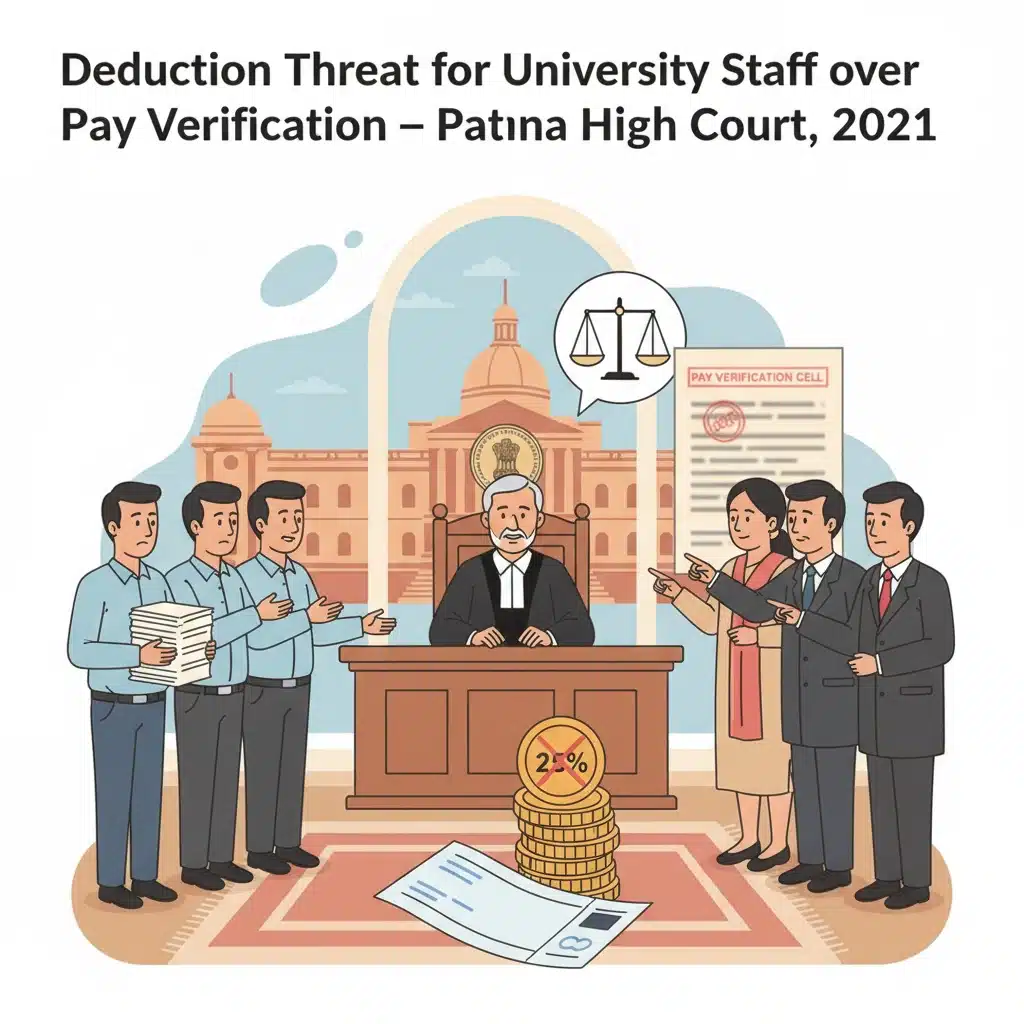
The case arose from a decision taken in a meeting held at Raj Bhawan, Patna. In that meeting, it was decided that all Class-III and Class-IV employees of universities would have to submit applications for pay verification through their concerned university by a fixed date.
The decision further stated that if an employee failed to do so, there would be a serious financial consequence. Their basic salary could be reduced by 25%. This condition was later reflected in Clause-xii of Para-4 of a notification issued under Memo No. 15/G1-01/2020-2021 dated 23.06.2020.
The petitioner, a clerk working in Nalanda Mahila College, Bihar Sharif, under Patliputra University, felt aggrieved. He approached the Patna High Court in Civil Writ Jurisdiction Case No. 7783 of 2020. He sought quashing of a communication dated 22.04.2020 and also requested that Clause-xii of Para-4 of the notification dated 23.06.2020 should not be given effect.
The target of his challenge was the possibility that his salary, and that of other Class-III staff, could be cut by 25% even when they had done what was required from their side, but the authorities had not completed pay verification.
What the Court Examined and Decided
The Patna High Court, through Hon’ble Mr. Justice Ashutosh Kumar, heard the writ on 03.12.2021. The petitioner was represented by a senior advocate, while the State and university authorities were represented by their respective counsel.
The first point before the Court was the nature of the decision taken at Raj Bhawan. As recorded, the decision clearly made it an obligation of all Class-III and Class-IV university employees to deposit their applications for pay verification through their university by a particular date. Failure to meet this deadline would lead to deduction of 25% of their basic salary.
The petitioner’s stand was that he had complied with this condition. According to submissions made on his behalf, the necessary application for pay verification had been submitted, not only for him but also for other similarly placed Class-III employees. However, even after submitting the application, no communication had been received regarding verification or pay fixation.
The petitioner’s core fear was simple and practical. If there was any delay from the side of the State or the university in processing and completing pay verification, then, under Clause-xii, he could still suffer a 25% cut in his basic salary. This would be despite the fact that he had done everything required from his side.
On the other hand, counsel for the respondent university presented the university’s position. He submitted that all Class-III and Class-IV employees had already submitted their pay verification applications within the fixed date. Hence, there was no default by the employees at all on the requirement of submitting applications.
The problem, according to the university, lay elsewhere. The Pay Verification Cell (PVC) of the Government of Bihar had not yet issued any pay verification certificate, even after the applications were received. So the pending verification was due to inaction on the part of this government cell, not the employees.
The Court noted that, in this situation, the State Government and the university appeared to be trying to shift responsibility on each other. Each side seemed to say that the fault lay with the other authority. The Court clearly observed that “this ought not to be done.”
Next, the Court examined what the Government’s own circular required. Reference was made to a government circular dated 28.01.2013. From this circular, it became apparent that the Pay Verification Cell was under a clear obligation to issue the pay verification certificate within 15 days of the deposit of the application.
In other words, once an employee submitted an application for pay verification, the Pay Verification Cell had a specific time-bound duty to complete the process within 15 days. This requirement placed responsibility on the authorities and not on the employees once they had applied.
Against this background, the Court focused on ensuring that innocent employees did not suffer loss of salary due to delay by the authorities. The threat of a 25% cut in basic salary, if applied mechanically without considering whose fault caused the delay, could seriously harm Class-III and Class-IV workers, who are generally lower-paid staff.
Taking note of the facts and the government circular, the Court issued a clear direction. Respondent No. 4, identified as the Director, Department of Education, Government of Bihar, Patna, was directed to look into the matter. The Director was asked to provide the verification report at the earliest.
The purpose of this direction was expressly stated: none of the Class-III or Class-IV employees should suffer deduction of 25% of their basic salary because of delay in pay verification. The responsibility was placed on the Director to ensure that the system functioned properly and that employees were protected.
During the hearing, the Court also noted an important assurance given on behalf of the university. Counsel for the university informed the Court that, based on an undertaking given by the petitioner that he would furnish proper verification, no deduction was being made in the disbursement of his salary.
This meant that, at least for the petitioner, salary was being paid without any 25% deduction, subject to his assurance that he would submit proper verification as required. Thus, the immediate fear of pay cut was addressed for him.
However, the Court did not stop at individual relief. By directing the Director, Department of Education, to act quickly and ensure verification, the Court extended protection to all similarly placed Class-III and Class-IV university employees who had filed their applications on time but were waiting for the authorities to complete the verification process.
Finally, with this direction to respondent No. 4, the Court disposed of the writ petition. There was no further detailed discussion of Clause-xii itself or formal quashing of the memo, but the operative effect of the order was to prevent unjust salary deduction where employees were not at fault and to fix responsibility on the concerned government authority to act within a reasonable time.
Why This Judgment Matters
This judgment is important for Class-III and Class-IV employees working in universities in Bihar, especially those facing pay verification processes. It clarifies that when employees have submitted their applications on time, they should not be penalised through salary cuts due to delay by government departments.
The Patna High Court has reminded the State that its own circular requires the Pay Verification Cell to act within 15 days. This ensures that the system cannot legally sit on applications for months and yet threaten employees with heavy financial penalties.
For lower-level staff whose livelihood depends on each month’s salary, a 25% cut is a serious blow. The Court’s direction that no such deduction should happen when the delay is not their fault gives them a shield against arbitrary or careless action by authorities.
The judgment also sends a message to government departments and universities not to “pass on the buck” between themselves. When a policy decision affects workers’ salaries, it is the duty of the authorities to coordinate and ensure timely implementation, rather than blaming each other.
Legal Issues and Answers
Issue: Can Class-III and Class-IV university employees suffer a 25% deduction in basic salary when they have timely applied for pay verification but the authorities delay issuing verification certificates?
Answer: The Court held that employees should not suffer such deduction. It directed the Director, Department of Education, to ensure early verification so that no Class-III or Class-IV employee faces a 25% reduction in salary due to administrative delay.
Issue: What is the responsibility of the Pay Verification Cell once an application is submitted?
Answer: Based on the government circular dated 28.01.2013, the Pay Verification Cell is obliged to issue the pay verification certificate within 15 days of deposit of the application.
Cases Cited by the Court
- No previous judgments or case law have been cited in the text of this judgment.
Case Details
Case Number: Civil Writ Jurisdiction Case No. 7783 of 2020
Case Title: Ranjit Kumar v. The State of Bihar & Ors.
Coram: Hon’ble Mr. Justice Ashutosh Kumar
Citation: 2022 (4) PLJR 138
Advocates:
- For the petitioner: Mr. D.K. Sinha, Senior Advocate; Mr. Anil Kumar No. 1, Advocate
- For respondents (State and university authorities): Mr. Dr. Anand Kumar, Advocate; Ms. Abhanjali, AC to GA-12
Nature of the case: Writ petition under civil writ jurisdiction challenging communication dated 22.04.2020 and seeking non-implementation of Clause-xii of Para-4 of notification dated 23.06.2020 relating to pay verification and salary deduction.
Link to judgment: Click here to read the full judgment of the Patna High Court
If you found this explanation helpful and wish to stay informed about how legal developments may affect your rights in Bihar, you may consider following Samvida Law Associates for more updates.




