

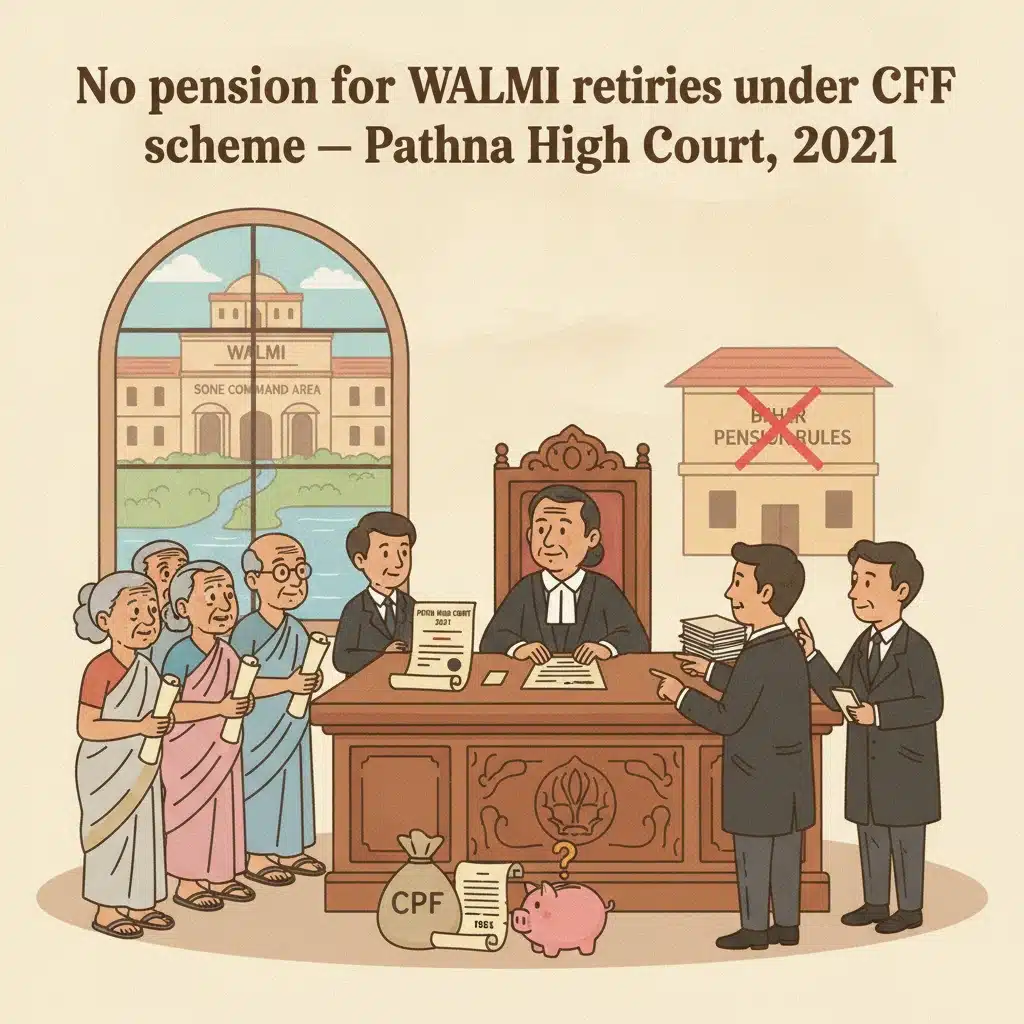
Case Background
The petitions were filed as Civil Writ Jurisdiction Case No. 17738 of 2019 and Civil Writ Jurisdiction Case No. 17772 of 2019 before the Patna High Court. Both sets of petitioners were employees working in the Sone Command Area Development Agency, which later merged into the Water and Land Management Institute (WALMI), Patna in September 2018.
The petitioners were appointed on different posts from 1975 onwards. All of them later retired on attaining the age of 60 years. On retirement, they received contributory provident fund (CPF) amounts with interest, gratuity, group insurance, and leave encashment. However, they were not granted any monthly pension.
Feeling aggrieved, they approached the Patna High Court seeking application of the Bihar Pension Rules to them and payment of pension and other pensionary benefits. In CWJC No. 17738 of 2019, they also challenged Memo No. 2621 dated 17.09.1983 issued by the Regional Development Commissioner-cum-Chairman, Sone Command Area Development Agency, Patna, directing that CPF accounts be maintained for employees of the Agency.
Since both writ petitions raised the same issue, they were heard together and decided by a common judgment dated 14.12.2021 by Hon’ble Mr. Justice Mohit Kumar Shah.
What the Court Examined and Decided
The core dispute was whether these retired employees were entitled to pension under the Bihar Pension Rules, 1950, or whether they were rightly placed under the CPF scheme only.
The petitioners’ counsel argued that in the second meeting of the Sone Command Area Development Authority held on 07.02.1974 at the office of the Commissioner, Patna Division, it was decided under Agenda No. 4 that several rules, including the Bihar Pension Rules, would apply to employees of the Sone Command Area Development Authority. The same rules were again mentioned in an order of the Chairman of that Authority dated 22.06.1974.
According to the petitioners, this showed a clear and conscious decision to cover them under the pension scheme. They further argued that under the Bihar Agricultural and Rural Area Development Agency Act, 1978 (BARADA Act, 1978), especially Sections 38 and 39, the State Government and the Board had power to frame rules and regulations about service conditions. Since no service regulations were ever framed or published in the Official Gazette for Sone Command Area Development Agency, they claimed that the earlier 22.06.1974 order of the Sone Command Area Development Authority should continue to govern their service and entitle them to pension.
They also referred to Section 43 of the BARADA Act, 1978 (repeal and saving) to argue that actions taken under the earlier Ordinance stood protected. To support their stand on statutory procedure and illegality of actions contrary to statute, they relied on several Supreme Court decisions such as H.C. Puttaswamy, Dipak Babaria, and I.T.C. Bhadrachalam Paperboards.
On the other hand, WALMI’s counsel took a different stand based on the statutory history. He pointed out that:
- The State Government first created three Command Area Development Authorities (Koshi, Gandak, and Sone) by Resolution No. 2240 dated 20.10.1973, effective from 01.11.1973.
- Later, the Bihar Agricultural and Rural Area Development Agency Ordinance, 1974 converted these authorities into independent agencies, including Sone Command Area Development Agency.
- The Ordinance was replaced by the BARADA Act, 1978, under which the three agencies again got statutory recognition and became independent bodies corporate under Section 3 and Section 31C.
According to WALMI, once the Sone Command Area Development Agency became a separate statutory body, any decision taken earlier by the Sone Command Area Development Authority in 1974 did not automatically bind the new Agency. The Board of the Agency was empowered to take decisions for the Agency and its employees.
WALMI further relied on Memo No. 2621 dated 17.09.1983 issued by the Regional Development Commissioner-cum-Chairman, Sone Command Area Development Agency. This memo directed that CPF accounts be maintained for employees directly appointed in the Agency. On this basis, CPF accounts were opened and maintained for all such employees. WALMI emphasised that the petitioners were directly appointed in the Agency after it came into existence under the Ordinance of 1974, and were never employees of the earlier Sone Command Area Development Authority.
Importantly, it was not disputed that, on retirement, all petitioners accepted payment of their full CPF balance with interest, along with gratuity, group insurance, and leave encashment, without any protest.
The State Government adopted WALMI’s arguments and additionally relied on Rule 60 of the Bihar Pension Rules, 1950. Rule 60 states that the service of a government servant qualifies for pension only when he is appointed and his pay and duties are regulated by the Government or under conditions determined by the Government. It then gives examples of employees excluded from pension, including employees of grant-in-aid schools and institutions.
The State contended that Sone Command Area Development Agency never generated its own income and depended entirely on government grant-in-aid till its dissolution on 01.09.2018. Therefore, its employees fell in the category of employees of grant-in-aid institutions and were excluded from pension under Rule 60.
The State and WALMI also relied on Patna High Court and Supreme Court judgments dealing with similar agencies and with CPF versus pension options. They pointed out that a coordinate Bench in Jagdish Narain Sinha and others, later reported in (2011) 1 PLJR 652, had already held that no service regulations had yet been framed for such agencies and that employees were not thereby entitled to pension. Another decision in Ramesh Prasad Singh and others, upheld in LPA No. 11 of 2015, was also cited to show that employees of these agencies could not claim pension directly without proper regulations.
From the Supreme Court, reliance was placed on R.N. Gosain v. Yashpal Dhir regarding the principle that a person cannot “approbate and reprobate” at the same time; and more importantly on Union of India v. M.K. Sarkar, where an employee who had long ago chosen CPF and withdrawn the full amount was not allowed to switch belatedly to a pension scheme many years later.
The State argued that the petitioners, having agreed to CPF deductions throughout their service, and having withdrawn the full CPF with interest, could not now resile from that conscious choice and demand pension in addition.
After considering all submissions, the Patna High Court first clarified the basic statutory position. It noted that the petitioners joined service only after the Sone Command Area Development Agency came into existence by virtue of the BARADA Ordinance, 1974. Thus they were employees of the Agency, not of the earlier Authority. On this basis alone, the Court held that the order dated 22.06.1974 of the Sone Command Area Development Authority was not applicable to them.
Regarding Section 43 of the BARADA Act, 1978 (repeal and saving), the Court explained that it merely saved actions done under the repealed Ordinance and did not extend or revive decisions of the pre-Ordinance Authority in favour of Agency employees who were never part of that Authority.
The Court then turned to Rule 60 of the Bihar Pension Rules. It observed that employees of grant-in-aid schools and institutions are specifically excluded from pension. Since the Sone Command Area Development Agency had no independent income and depended wholly on government grants, it was treated as a grant-in-aid institution. Consequently, its employees, including the petitioners, were not entitled to pension under the Bihar Pension Rules.
The Court also looked at the Bihar Contributory Provident Fund Rules, 1948, which apply to every non-pensionable service of a servant of the Government. This, in the Court’s view, supported the decision to keep petitioners under the CPF scheme, as their service was non-pensionable.
The Court noted that no service rules or regulations under Sections 38 and 39 of the BARADA Act, 1978, relating to service conditions of Sone Command Area Development Agency employees, had ever been framed or published in the Official Gazette. In absence of such regulations granting a pension scheme, and in view of the specific exclusion under Rule 60, employees could not claim pension as a matter of right.
Equally important for the Court was the conduct of the petitioners. They had contributed to CPF during their entire tenure, accepted matching contributions from the Agency, and on superannuation drawn the complete CPF balance with interest without objection. Following the principle laid down in M.K. Sarkar’s case, the Court held that they could not, at this late stage, seek to change over to a pension scheme and effectively obtain the double benefit of CPF plus pension.
The Court further clarified that the Supreme Court judgments cited by the petitioners on violations of statutory procedure and on estoppel (H.C. Puttaswamy, Dipak Babaria, and I.T.C. Bhadrachalam Paperboards) were not applicable to the facts of this case. Here, there was a clear statutory framework, a specific exclusion in the Pension Rules, and actual acceptance of CPF benefits by the petitioners.
In the final analysis, the Patna High Court held that the petitioners were not entitled to pension. The writ petitions were found devoid of merit and were dismissed.
Why This Judgment Matters
This judgment is important for employees of Sone Command Area Development Agency and its successor WALMI, as well as similar agencies in Bihar created under the BARADA Act, 1978.
First, it clarifies that decisions of earlier “Authorities” (like Sone Command Area Development Authority) do not automatically extend to employees of later “Agencies” created under a statute, especially when the employees joined only after the new body came into existence.
Second, it reinforces that employees of grant-in-aid institutions, even if fully funded by government, are not automatically entitled to a government pension unless the law or duly notified regulations clearly grant that benefit.
Third, for workers who have long been under the CPF scheme and have already withdrawn their CPF amounts, this judgment underscores that courts will be very reluctant to allow a switch to pension at a late stage. Accepting CPF benefits without protest can legally bar later claims for pension.
For similarly placed retired employees, this decision signals that pushing for pension through writ petitions may not succeed if their service was always treated as non-pensionable, and if they accepted CPF and other terminal benefits in full.
Legal Issues and Answers
Issue: Are retired employees of Sone Command Area Development Agency/WALMI entitled to pension under the Bihar Pension Rules, 1950, on the basis of a 1974 decision of the earlier Sone Command Area Development Authority?
Answer: No. The Court held that the petitioners were never employees of the Sone Command Area Development Authority, that Rule 60 of the Bihar Pension Rules excludes employees of grant-in-aid institutions like the Agency, and no valid regulations granting pension were framed. Hence, they are not entitled to pension.
Issue: Can employees who have served under the CPF scheme and fully withdrawn their CPF amounts later switch over to a pension scheme and claim monthly pension?
Answer: No. Relying on the Supreme Court decision in M.K. Sarkar, the Court held that after consciously remaining under the CPF scheme, contributing to it, and taking full withdrawal with interest at retirement, employees cannot later resile and claim pension in addition.
Issue: Does Section 43 (repeal and saving) of the BARADA Act, 1978, save and extend earlier authority decisions of 1974 so as to create pension rights for Agency employees appointed later?
Answer: No. Section 43 only saves actions taken under the repealed Ordinance of 1974. It does not make decisions of the pre-Ordinance Authority binding on the later Agency for employees who were never part of the Authority.
Cases Cited by the Court
- Jagdish Narain Sinha and Anr. v. The State of Bihar & Anr., (2011) 1 PLJR 652
- Ramesh Prasad Singh & Ors. v. The State of Bihar & Ors., CWJC No. 21105 of 2013, judgment dated 24.03.2014, affirmed in L.P.A. No. 11 of 2015 by judgment dated 16.05.2016
- Jagdish Narain Sinha & Ors. v. The State of Bihar & Ors., CWJC No. 9446 of 2009 & analogous case, judgment dated 20.05.2010
- R.N. Gosain v. Yashpal Dhir, AIR 1993 SC 352
- Union of India & Ors. v. M.K. Sarkar & Ors., (2010) 2 SCC 59
- H.C. Puttaswamy & Ors. v. Chief Justice of Karnataka High Court, AIR 1991 SC 295
- Dipak Babaria v. State of Gujarat & Ors., (2014) 3 SCC 502
- I.T.C. Bhadrachalam Paperboards & Anr. v. Mandal Revenue Officer, A.P. & Ors., (1996) 6 SCC 634
Case Details
Case Number: Civil Writ Jurisdiction Case No. 17738 of 2019 with Civil Writ Jurisdiction Case No. 17772 of 2019
Case Title: Lakshaman Kishor & Ors. v. The State of Bihar & Ors.; Narendra Prasad Singh & Ors. v. The State of Bihar & Ors.
Citation: 2022 (4) PLJR 146
Court: High Court of Judicature at Patna
Coram: Hon’ble Mr. Justice Mohit Kumar Shah
Date of Judgment: 14.12.2021
Advocates:
- For the petitioners (both cases): Mr. Vindhyachal Singh, Advocate; Mr. Manoj Kumar Singh, Advocate; Mr. Uday Pratap Singh, Advocate; Mr. Anil Kumar Dwivedi, Advocate
- For WALMI: Mr. Harshvardhan Shivsundram, Advocate
- For the State/Respondents: Mr. Harish Kumar, Government Pleader 8 (GP-8)
Nature of the Case: Writ petitions under civil writ jurisdiction seeking mandamus for application of Bihar Pension Rules, 1950, and payment of pension and pensionary benefits, along with challenge to CPF memo in one petition.
Link to Judgment: Patna High Court Judgment in CWJC No. 17738 of 2019 and CWJC No. 17772 of 2019
If you found this explanation helpful and wish to stay informed about
how legal developments may affect your rights in Bihar,
you may consider following Samvida Law Associates for more updates.




