

Case Background
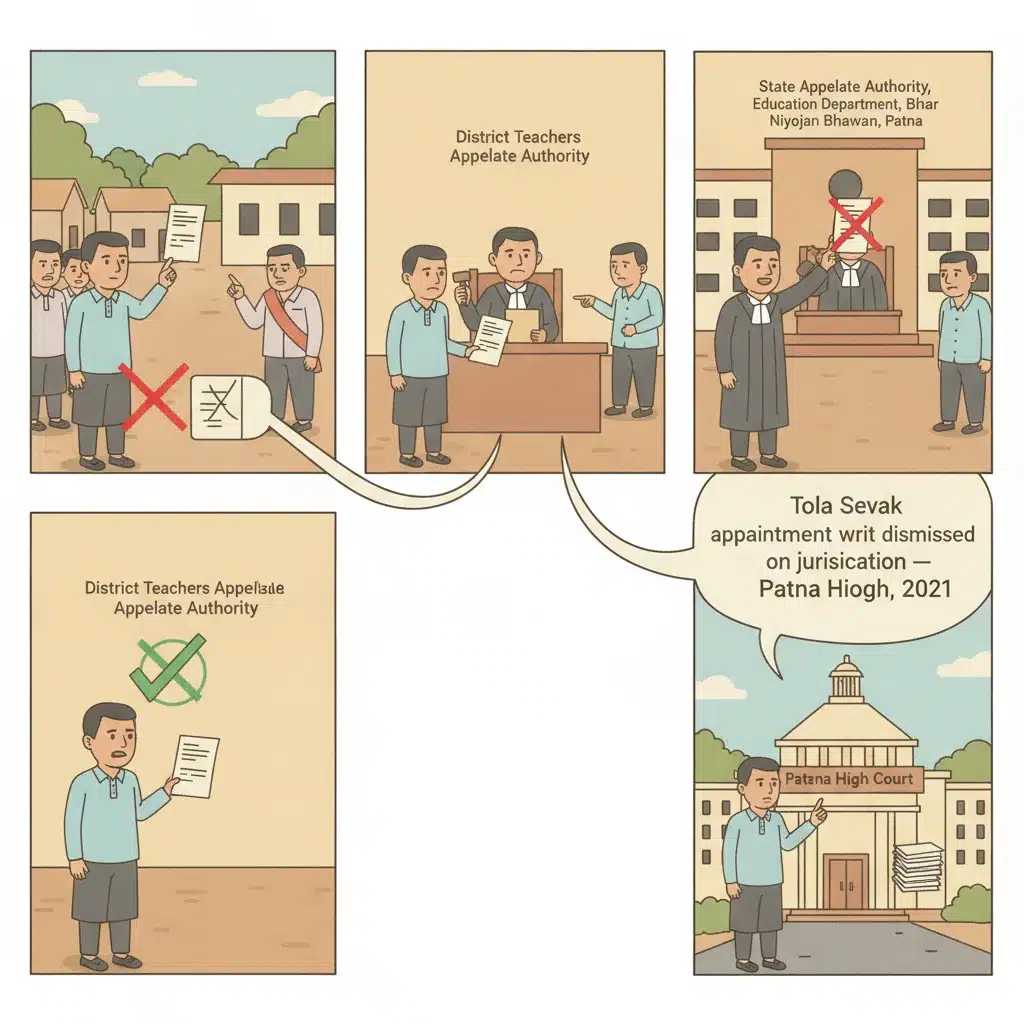
The petitioner in this case was appointed as a Tola Sevak in Saharsa district. Tola Sevaks are local education functionaries appointed under specific rules relating to appointment of Tola Sevaks and Swayam Sevaks. After his appointment, another local resident, arrayed as respondent no. 12, challenged this appointment.
On the basis of respondent no. 12’s complaint, the District Programme Officer annulled, that is, cancelled, the petitioner’s appointment as Tola Sevak. Feeling aggrieved, the petitioner challenged this annulment order before the District Teachers Appellate Authority by filing Appeal No. 38 of 2016.
The District Teachers Appellate Authority allowed the appeal. It set aside the annulment order of the District Programme Officer and restored and affirmed the petitioner’s appointment as Tola Sevak. In simple terms, the District Authority gave relief to the petitioner and put him back in his post.
Respondent no. 12 was not satisfied with this outcome. He then preferred an appeal before the State Appellate Authority, Education Department, challenging the order of the District Teachers Appellate Authority that had favoured the petitioner.
The State Appellate Authority, by order dated 12.07.2017, set aside the order of the District Teachers Appellate Authority. It held that the District Teachers Appellate Authority did not have jurisdiction to decide disputes about appointment of Tola Sevaks. In effect, this meant that the order restoring the petitioner’s appointment was cancelled and the earlier annulment by the District Programme Officer stood revived.
The petitioner then approached the Patna High Court in Civil Writ Jurisdiction Case No. 14334 of 2017, challenging the order dated 12.07.2017 of the State Appellate Authority.
What the Court Examined and Decided
The writ petition came up before Hon’ble Mr. Justice Ashutosh Kumar. The Court heard learned counsel for the petitioner and counsel for the State. The central issue before the Court was whether the District Teachers Appellate Authority had jurisdiction to entertain a dispute relating to appointment of a Tola Sevak.
Learned counsel for the petitioner submitted that the question of jurisdiction had already been raised before the District Teachers Appellate Authority. According to him, the District Authority had rejected that objection and proceeded to decide the appeal in favour of the petitioner. On this basis, the petitioner wanted the High Court to interfere with the State Appellate Authority’s order and to restore the order of the District Teachers Appellate Authority.
To resolve this question, the Patna High Court examined the relevant legal framework. The Court first looked at the Bihar State School Teachers and Employees (Disputes Redressal) Rules, 2015. The preamble to these Rules shows under what powers they were framed and what types of disputes they are intended to cover.
As recorded in the judgment, the preamble indicates that the 2015 Rules have been framed in exercise of powers conferred under Articles 162 and 243 of the Constitution of India, Section 47 read with Section 146 of the Bihar Rajya Panchayat Raj Act, 2006, Sections 46 and 47 read with Section 419 of the Bihar Municipal Act, 2007, and Section 38 of the Right of Children to Free and Compulsory Education Act, 2009.
The Government of Bihar framed these Rules for redressal of complaints and appeals related to employment of teachers and non-teaching employees on fixed pay in elementary schools and higher secondary schools. This includes government-aided and minority schools of the State, set up by Panchayat Raj and urban institutions under the notified Employment Rules, 2006.
The Court then noted an important clarification: Tola Sevaks do not come within the aforesaid category. In other words, the 2015 Disputes Redressal Rules are meant for “teachers and non-teaching employees” of certain schools, not for Tola Sevaks.
The judgment further refers to the definition of “Niyojit Karmi” contained in Section 2 of the 2015 Rules. That term covers librarians, clerks, peons and other employees of elementary, high and higher secondary schools who are employed according to the relevant engagement Rules. The Court observed that this category, too, does not include Tola Sevaks.
Instead, Tola Sevaks are appointed under a separate set of Rules of 2018 relating specifically to appointment of Tola Sevaks and Swayam Sevaks. Under these 2018 Rules, the appointment of Tola Sevaks is made by a committee headed by the member of the concerned ward.
Most importantly, the 2018 Rules themselves provide a special mechanism for resolving disputes about Tola Sevak appointments. The Court recorded that, under these Rules, if any person has a dispute regarding appointment of a Tola Sevak:
First, a person can file an appeal within 15 days of the appointment before the District Education Officer. Second, if still aggrieved, a further appeal can be filed within 15 days thereafter before the District Magistrate.
This two-step appeal process, specifically laid down in the 2018 Rules, creates a special procedure and clearly identifies the authorities competent to decide such disputes. The District Teachers Appellate Authority does not find mention in this special scheme for Tola Sevaks.
From this, the Patna High Court drew a clear conclusion. When a special provision has been created in Rules dealing with appointment of Tola Sevaks, including how those appointments can be challenged, other bodies like the District Teachers Appellate Authority cannot assume jurisdiction over such disputes.
The Court held that, in view of these special provisions, the District Teachers Appellate Authority had no jurisdiction to enter into the dispute about the petitioner’s appointment as Tola Sevak or the challenge to it by respondent no. 12. Because the District Authority acted without jurisdiction, its order restoring the petitioner’s appointment could not stand in the eyes of law.
Once this was found, the State Appellate Authority’s action in setting aside the District Teachers Appellate Authority’s order became legally justified. The High Court expressly stated that, for the aforesaid reason, the order passed by the State Appellate Authority is justified in law.
The Court also noted that the learned counsel for the petitioner had not been able to assign any good reason for interfering with the order of the State Appellate Authority. There was thus no basis for the High Court, in its writ jurisdiction, to disturb that order.
Accordingly, the Court held that there was no merit in the writ petition. The petition was dismissed. However, the Court did not close all doors for the petitioner. It expressly observed that it would be open for the petitioner to approach the appropriate authority, if so desired.
Reading this along with the earlier discussion in the judgment, “appropriate authority” clearly points to the authorities mentioned in the Tola Sevak appointment Rules—namely, the District Education Officer and thereafter the District Magistrate, within the time and manner prescribed there.
In summary, the Patna High Court confirmed that:
- Disputes about appointment of Tola Sevaks have to go through the specific appeal route provided in the Tola Sevak and Swayam Sevak Rules of 2018.
- The District Teachers Appellate Authority, created under the 2015 Disputes Redressal Rules for school teachers and non-teaching staff, has no role in Tola Sevak disputes.
- The order of the State Appellate Authority, which had restored the cancellation of the petitioner’s appointment by holding that the District Teachers Appellate Authority lacked jurisdiction, was lawful and required no interference.
Why This Judgment Matters
This judgment is important for Tola Sevaks and for people who wish to challenge Tola Sevak appointments in Bihar. It makes clear that they cannot simply go to any education-related appellate authority. They must follow the special route laid down in the Tola Sevak appointment rules.
For villagers, ward members, and local complainants, this decision shows where to file an appeal and in what order: first before the District Education Officer, then before the District Magistrate. Trying to use the District Teachers Appellate Authority, or other wrong forums, can result in dismissal on the ground of lack of jurisdiction.
For government officers and education authorities, the judgment reinforces that bodies set up under the 2015 Disputes Redressal Rules can only deal with teachers and school staff who fall under those Rules. They cannot extend their reach to categories like Tola Sevaks, who are governed by a different set of rules.
The Patna High Court, by upholding the State Appellate Authority’s view, also underscores a general legal principle: when the government frames special rules for a particular kind of appointment, along with a special dispute redressal mechanism, that special mechanism must be used. Other forums cannot overstep into that area.
Legal Issues and Answers
Issue: Could the District Teachers Appellate Authority decide a dispute about appointment of a Tola Sevak under the Bihar State School Teachers and Employees (Disputes Redressal) Rules, 2015?
Answer: No. The Patna High Court held that Tola Sevaks are governed by separate Rules of 2018, which provide their own appeal mechanism before the District Education Officer and the District Magistrate. Therefore, the District Teachers Appellate Authority had no jurisdiction in such matters.
Cases Cited by the Court
- No earlier cases or precedents are cited or relied upon in the text of this judgment.
Case Details
Case Number: Civil Writ Jurisdiction Case No. 14334 of 2017
Case Title: Kamal Kumar Rajak v. The State of Bihar and Ors.
Coram: Hon’ble Mr. Justice Ashutosh Kumar
Citation: 2022 (4) PLJR 132
Advocates: Mr. Amarnath Jha, Advocate for the petitioner; Mr. S.C. Mishra, Standing Counsel 16 for the respondents.
Nature of the Case: Writ petition under civil writ jurisdiction challenging the State Appellate Authority’s order relating to cancellation of a Tola Sevak appointment.
Date of Judgment: 29-11-2021
Link to Judgment: Click here to read the full judgment of the Patna High Court
If you found this explanation helpful and wish to stay informed about
how legal developments may affect your rights in Bihar,
you may consider following Samvida Law Associates for more updates.




